

The UAE’s property market is moving in one direction right now, and that’s up. Strong demand, solid economic growth, and a wave of foreign capital are all pushing the same way.
According to JLL MENA’s Q1 2024 UAE Real Estate Market Overview, both Dubai and Abu Dhabi’s residential sectors posted impressive growth. In Dubai, sale prices and rentals rose around 21% on an annual basis. Abu Dhabi saw a 7% lift in sales prices and a 4% rise in rental rates.
Reidin.com reported that Dubai’s all-residential property price index jumped 20.71% year on year, or 16.81% when adjusted for inflation, in Q1 2024. That’s a continuation of a trend that’s been building for years. On a quarterly basis, Dubai residential prices rose 6.12%, or 5.57% in inflation-adjusted terms.
The UAE’s Booming Housing Market
Property Types Breakdown
- Apartments in Dubai: Prices surged by 20.43% (16.54% inflation-adjusted) annually, and 6.2% (5.66% inflation-adjusted) quarterly.
- Villas in Dubai: Prices increased by 22.08% (18.14% inflation-adjusted) y-o-y, and 5.35% (4.8% inflation-adjusted) quarterly.
By the end of 2023, the average purchase price of a Dubai apartment sat at AED 1,500,000 (roughly US$408,386), while villas were averaging AED 3,200,000 (around US$871,222).
Abu Dhabi’s Market
- The all-residential property price index rose by 7.53% (4.05% inflation-adjusted) y-o-y in Q1 2024, and 2.45% (1.92% inflation-adjusted) quarterly.
- Apartments: Prices increased by 6.42% (2.98% inflation-adjusted) annually, and 2.37% (1.84% inflation-adjusted) quarterly.
- Villas: Prices rose by 12.97% (9.32% inflation-adjusted) y-o-y, and 2.81% (2.28% inflation-adjusted) quarterly.

Demand Surge
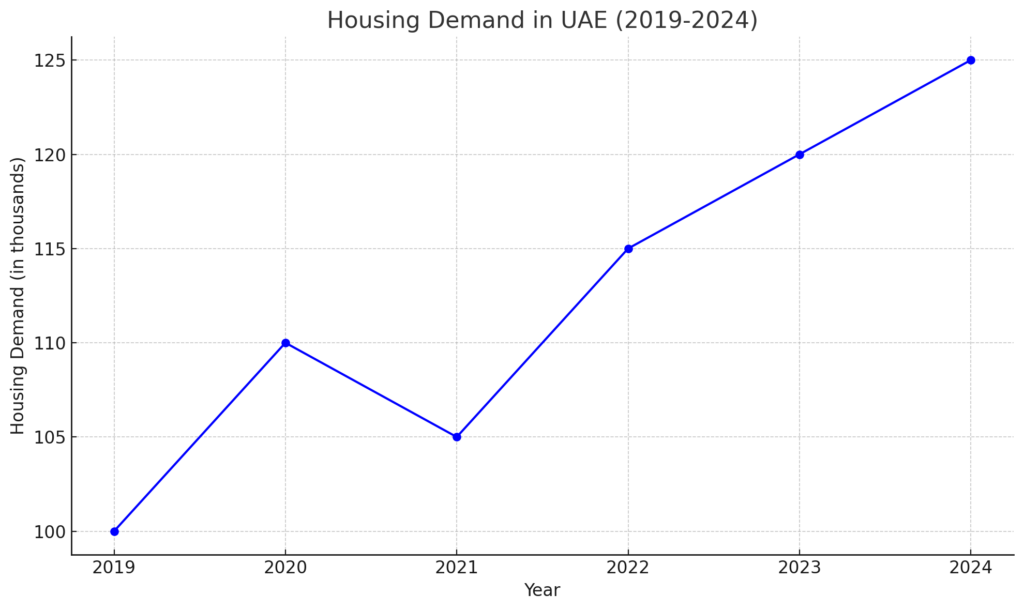
Dubai’s registered sales transactions hit a record 133,134 in 2023, up 38% from the year before. Abu Dhabi wasn’t far behind, with a 75% jump in transactions to 13,298 units that same year. That momentum carried into Q1 2024, with Dubai posting a 16% growth in transaction value and a 20% increase in volume year on year. Abu Dhabi saw a slight 1% dip in value but a strong 17% rise in volume.
Economic and Investment Appeal
Dubai’s economy has developed a reputation for stability and strong financial fundamentals, drawing global investors who appreciate its infrastructure and business-friendly regulations. The UAE economy grew 3.1% in 2023, driven largely by domestic consumption. Looking ahead, both the IMF and the UAE central bank projected further growth of 4% and 4.2% respectively for 2024.
The UAE ranks among the wealthiest nations on earth. With a GDP per capita on a purchasing power parity basis of US$92,073 in 2023, according to IMF figures, your investment is landing in genuinely affluent territory.

Historical Context
Between 2002 and 2008, Dubai’s property prices nearly quadrupled, making it one of the fastest-growing markets on the planet. The passage of the long-awaited foreign property ownership law in March 2006 unleashed a surge of international capital and supercharged Dubai’s ambitions.
That capital poured into mega-projects on a scale that’s still hard to grasp. Jumeirah Garden City was estimated at US$95 billion. Dubailand at US$64 billion. The Lagoons at US$25 billion. Palm Jumeirah and The World each at US$14 billion.
Then the global credit crunch hit at the end of 2008 and the market dropped fast. Transaction volumes collapsed, and nearly half of all construction projects in the UAE, worth around AED 1.1 trillion (US$300 billion), were put on hold or scrapped entirely.
As the economy found its footing again, many of those halted projects came back to life. From January 2012 to the end of 2014, Dubai went through another housing boom, with prices rising an average of 21.5% annually. By end-2014, that growth had started to fade, and the market spent years in a subdued state.
Dubai’s all-residential property price index fell 11% in 2015, or 14.1% in inflation-adjusted terms, according to DubaiLand.com. The slide continued from there. Prices dropped 0.4% in 2016, 3.9% in 2017, 8.6% in 2018, 6% in 2019, and another 7.1% in 2020, all in nominal terms.
Several forces drove that prolonged slump. An oversupply of apartments was one factor. Regulatory moves added more pressure, including the Federal Mortgage Cap introduced in 2013, a 5% VAT applied from January 2018 to home sales after three years of project completion, and the Dubai Land Department doubling property registration fees from 2% to 4%. Then the pandemic hit, knocking both demand and supply at the same time.
The recovery started in 2021. Dubai house prices climbed 9.25% that year, and Abu Dhabi followed with a 1.56% gain. In 2022, Dubai added another 9.53% and Abu Dhabi chipped in 1.46%. The turnaround was clearly underway.

Dubai’s Strong Demand
Demand in Dubai is hard to ignore right now. In 2023, registered sales transactions hit a record 133,134 deals, a 38% jump from the 96,459 deals recorded the prior year, according to Property Finder.
The total value of transactions in Dubai last year reached AED 571.3 billion (US$155.54 billion), covering apartments, villas, commercial properties, and plots across both cash and mortgage deals. That’s a 45.8% year-on-year surge from AED 391.8 billion (US$106.67 billion) in 2022. If you needed a sign that serious money is moving into this market, that’s it.
In 2023:
- Apartment sales transactions amounted to AED 218 billion (US$59.35 billion), a significant 48.2% increase from the previous year.
- Villa sales transactions reached AED 65.7 billion (US$17.89 billion), up by 8.2% from the previous year.
According to Afimmo Properties LLC, Dubai Marina posted the highest transaction volume, with total purchases hitting AED 36.7 billion (US$10 billion). Palm Jumeirah came in second at AED 28.51 billion (US$7.76 billion), followed by Jebel Ali Industrial First at AED 27.93 billion (US$7.61 billion) and Wadi Al Safa 3 at AED 25.33 billion (US$6.89 billion).
That growth didn’t slow down heading into 2024. In Q1 alone, Dubai’s residential sales transactions posted a 16% increase in value and a 20% rise in volume compared to the same period the year before, per JLL MENA.

Abu Dhabi’s Robust Demand
Abu Dhabi had a record-breaking 2023. The number of transactions hit 13,298 units, up a striking 75% from the 7,957 units recorded in 2022, according to the Department of Municipalities and Transport. Total transaction value surged 120% year on year to AED 44 billion (US$11.98 billion), compared to AED 19.9 billion (US$5.42 billion) the year before.
That demand held firm into 2024. In Q1, total real estate transactions in Abu Dhabi reached AED 15.9 billion (US$4.32 billion), made up of 5,127 combined sales and mortgage transactions. Of those, 2,919 were sales and purchase transactions totaling over AED 9.6 billion (US$2.61 billion), while 2,208 mortgage deals accounted for a combined AED 6.3 billion (US$1.72 billion).

Asteco noted that demand for off-plan developments, especially high-quality ones, stayed strong, with foreign investors from Russia and China showing particularly active interest.
Asteco also pointed to Gardenia Bay, launched in September 2023, which recorded a roughly 15% increase in asking prices between its initial and most recent phases. That kind of pricing movement tells you something important about appetite for premium off-plan units and what reputable master developers can command right now. If you’re thinking about structuring a real estate investment proposal in this region, Abu Dhabi’s off-plan segment deserves a close look.
Expat Policies
Back in 2019, the UAE introduced the Golden Visa, a long-term residence program designed to attract investors and skilled professionals. The visa lets expatriates live, work, and study in the country without needing a national sponsor, and gives them 100% ownership of their business. These visas run for either five or ten years and renew automatically.
Eligibility for a 10-year visa includes
- Investors: Individuals with public investments of at least AED 10 million (US$2.72 million).
- Specialized talents: Professionals such as doctors, scientists, specialists, inventors, and creative individuals in culture and art.
- Outstanding students: Exceptional students who meet the set criteria.
Eligibility for a 5-year visa includes
- Property investors: Individuals who invest in property in the UAE with a minimum gross value of AED 5 million (US$1.36 million). The investment must not be financed through a loan, and the property must be retained for at least three years.
- Entrepreneurs: Individuals with an existing project with a minimum capital of AED 500,000 (US$136,000).
In June 2021, the UAE launched a round-the-clock residency visa service so applicants could track their transactions and connect with a service team at any hour. By 2022, the government had updated the Golden Visa conditions, cutting the required investment amount and dropping restrictions on how long holders could spend outside the country. New rules that came into force in October 2023 also opened the door to off-plan property purchases.

Updated Golden Visa Requirements
- 10-year Golden Visa: Purchase real estate in the UAE for AED 2 million (US$545,000) or buy property for AED 750,000 (US$204,000) for a two-year residence visa.
- 5-year residence visa: Purchase real estate for AED 2 million (US$545,000) or AED 750,000 (US$204,000) for a three-year residence permit.
Foreign Homeownership Rules
The UAE has steadily opened up foreign ownership laws, with Dubai and Abu Dhabi leading the way.
- Dubai: Foreign nationals can buy freehold properties in designated areas.
- GCC nationals: Allowed freehold ownership anywhere in the Emirates.
- Abu Dhabi: Foreigners can own property in designated investment zones on a freehold basis. This follows measures to boost the market, including a mandate in 2012 for public sector employees to reside within Abu Dhabi and the removal of a 5% cap on annual rent increases in November 2013.
UAE nationals drive the bulk of real estate activity, followed closely by investors from India, Saudi Arabia, the UK, and Pakistan. In 2023, Dubai logged 133,134 sales transactions, up 38% year on year, with a total value of AED 571.3 billion (US$155.54 billion), a 45.8% jump from AED 391.8 billion in 2022. Abu Dhabi saw 13,298 transactions, a 75% rise from 2022, and total transaction values climbed 120% to AED 44 billion (US$11.98 billion).
Housing Supply
In 2023, Dubai saw roughly 39,000 new residential units completed, following 41,000 in 2022, 44,000 in 2021, and 40,000 in 2020, according to JLL MENA’s 2023 UAE Real Estate Market Report. That brought Dubai’s total housing stock to 719,000 units by end-2023. A large share of those completions traces back to the Expo 2020 development push.
Abu Dhabi added around 5,000 new units in 2023, pushing its total housing stock to 284,000 units.
JLL MENA projected around 35,000 units entering the Dubai market in 2024, with approximately 8,000 units expected to be completed in Abu Dhabi over the same period.
JLL’s Q1 2024 report showed Dubai’s residential market off to a strong start, with around 10,000 units completed in the first quarter alone, lifting total stock to 729,000 units.

Looking ahead through the rest of 2024, another 25,000 units are scheduled for delivery, with apartments in MBR City, Business Bay, Jumeirah Village, and Dubai Land making up the bulk of the pipeline.
Abu Dhabi delivered 1,600 units in Q1 2024, bringing total stock to 286,000 units. A further 6,000 units are expected to be added before year end, according to JLL MENA.
Rental Market and Yields
Rental Trends in Dubai
Dubai’s rental market has been on a strong run. By April 2024, rental rates across all residential units had risen 20.75% from the same point the year before. Apartment rents climbed 21.79% year on year, and villa rents posted a 13.12% gain. The driver behind all of this is straightforward, as expatriates keep arriving, drawn by the lifestyle and the business opportunities.
Gross rental yields in Dubai are sitting at a healthy average of 7.24% as of April 2024, virtually unchanged from a year earlier, according to Reidin.com. The breakdown by property type tells an interesting story for yield-focused investors.
- Apartments: rental yields were 7.66% in April 2024, slightly up from 7.58% a year earlier.
- Villas: rental yields stood at 5.59%, slightly down from 6.01% in the previous year.
Reidin.com also reported a 1% rise in overall rental transactions in Q4 2023 compared to the prior quarter, with renewed contracts posting a more notable 9% jump. That points to tenants preferring to stay put rather than move, which translated into a 7% year-on-year increase in total rental contracts and a 19% surge in renewals.

Specific Developments
- DIFC: One-bedroom apartments rented for AED110,000 (US$29,948) annually, and three-bedroom apartments for AED220,000 (US$59,897).
- Downtown Dubai: Rents for one-bedroom apartments averaged AED115,000 (US$31,310) per annum, while three-bedroom apartments were AED250,000 (US$68,065).
- Palm Jumeirah: Rents ranged from AED155,000 (US$42,200) per annum for one-bedroom apartments to AED260,000 (US$70,787) for three-bedroom apartments.
- Sheikh Zayed Road: Annual rents ranged from AED100,000 (US$27,226) to AED157,500 (US$42,881).
Rental Trends in Abu Dhabi
Abu Dhabi’s rental market grew too, though at a steadier pace than Dubai. The average rental rate across all residential units rose 8.49% year on year by April 2024.
Gross rental yields in Abu Dhabi averaged 6.46% in April 2024, up slightly from 6.37% a year earlier and not far behind Dubai’s numbers. Still, worth factoring into your comparison.
- Villas: rental yields were 5.31% in April 2024, down from 5.7% a year ago.
- Apartments: gross rental yields stood at an average of 6.82% in April 2024, up from 6.61% in the same period in the prior year.
Apartment rents in Abu Dhabi rose 9.24% year on year, while villa rents moved up 4.84% over the same period.
High-end properties in Abu Dhabi posted solid rent increases, contributing to overall market growth of around 3% annually.
Specific Developments
- Central Abu Dhabi: One-bedroom apartments averaged AED60,000 (US$16,336) annually, two-bedroom apartments AED98,000 (US$26,681), and three-bedroom apartments AED128,000 (US$34,849).
- Corniche: Rents ranged from AED65,000 (US$17,697) for one-bedroom apartments to AED138,000 (US$37,572) for three-bedroom apartments.
- Al Khalidiya/Al Bateen: Annual rents ranged from AED73,000 (US$19,875) for one-bedroom apartments to AED160,000 (US$43,561) for three-bedroom apartments.
- Al Raha Beach: Rents ranged from AED75,000 (US$20,420) for one-bedroom apartments to AED175,000 (US$47,645) for three-bedroom apartments.
- Marina Square: One-bedroom apartments rented for AED63,000 (US$17,152) annually, and three-bedroom apartments for AED135,000 (US$36,755).
A recent study by the Global Property Guide found that gross rental yields across the UAE averaged 5.16% in Q1 2024, up from 4.93% in Q3 2023. Dubai and Abu Dhabi both sit above that national average, at 6.3% and 5.68% respectively. If you’re building out a real estate investment portfolio, those yield figures are worth benchmarking against other markets.
Dubai yields are solid, but let’s be honest, the era of stratospheric returns is behind you. This is also a market that can move sharply in both directions, so volatility is part of the deal.
Other emirates come in lower. Ras Al Khaimah averaged 4.69% in Q1 2024, Ajman came in at 5.23%, and Sharjah posted 3.92%.

Regulatory Environment
Dubai
The Real Estate Regulatory Agency, known as RERA, oversees tenancy laws and landlord-tenant relationships across Dubai. The key regulations shape what you can expect as a property owner or tenant in the emirate.
- Law No. 26 of 2007: Governs landlord-tenant relationships.
- Law No. 33 of 2008: Amends certain provisions of Law No. 26.
- Decree No. 26 of 2013: Establishes the Rent Disputes Settlement Centre.
- Decree No. 43 of 2013: Governs rent increases, with caps on allowable rent hikes based on the market rate.
In 2024, rent increases in Dubai follow a tiered structure tied to how far a property’s current rent sits below market rate.
| Rental rates | Allowable rent increase |
|---|---|
| If the existing rent is: | |
| Equal to or 10% below the average market rental rate | Nil |
| 11% to 20% below the average market rental rate | 5% |
| 21% to 30% below the average market rental rate | 10% |
| 31% to 40% below the average market rental rate | 15% |
| More than 40% below the average market rental rate | 20% |
Landlords can only raise rents at the point of lease renewal, and they must give tenants 90 days’ notice before doing so.
Abu Dhabi:
Abu Dhabi runs with a 5% annual rent cap that was reinstated in 2016. Rules introduced in 2018 made it easier for landlords to move against tenants who don’t pay rent. The city has also tightened protections for off-plan buyers, requiring developers to hold escrow accounts and issue full disclosure statements before sales.
Mortgage Market Insights
Despite the rate environment, Dubai’s mortgage market has held up well, largely because a high share of buyers pay cash. Mortgage transactions in Dubai reached AED 121 billion (US$32.94 billion) through 33,280 real estate deals in 2023. Abu Dhabi, by contrast, leans more heavily on mortgage financing than cash purchases. You can explore more about how leverage works in property deals with this guide to home equity loans.
Mortgage Rules
- First Home (Owner-occupier): Nationals can borrow up to 80% for properties under AED5 million (US$1.36 million), and 70% for properties above this value. Expatriates can borrow up to 75% and 65% respectively.
- Second Home or Investment Property: Nationals can borrow up to 65%, and expatriates up to 60%.
- Off-plan Purchase: Both nationals and expatriates can borrow up to 50%.
Loan-to-value ratios were raised by 5% for first-time homebuyers in March 2020 as part of measures to ease pandemic-related economic pressure.
The key interest rate kept at 5.40%
In May 2024, the Central Bank of the UAE kept its key overnight deposit facility rate at 5.40%, mirroring the US Fed’s decision to hold interest on reserve balances steady. That came after six consecutive rate hikes over the prior nineteen months.
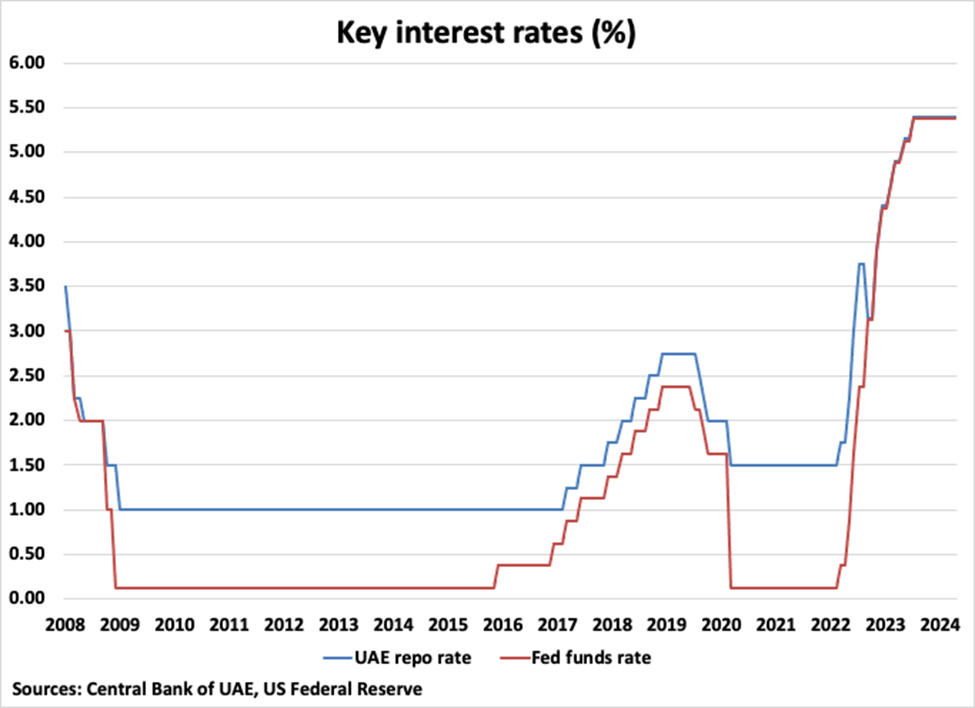
The UAE’s base rate for overnight deposits moves in line with the US Fed’s interest on excess reserves, which is why what happens in Washington directly shapes the cost of borrowing in Dubai.
Mortgage rates in Dubai have historically tracked US Fed rates closely, because the dirham is pegged to the US dollar at AED 3.67 to US$1. Both nationals and expatriates can access mortgage lending from a number of local banks.
That rate linkage has had real consequences. As the Fed tightened aggressively to fight inflation, variable-rate mortgage holders in the UAE saw their rates jump from the 2% to 3% range all the way up to 6% to 9%. Some homeowners ended up paying above 10%.
Crude Oil Prices and Economic Growth
Brent crude saw sharp swings during this period, peaking at US$120.08 per barrel in June 2022 after Russia’s invasion of Ukraine, then pulling back to US$90.05 per barrel by April 2024. The UAE’s push to lift oil production within OPEC+ created friction within the group, though gradual agreements to increase supply have helped settle the situation somewhat. For context on how regional economic shifts like this ripple into broader investment decisions, the Saudi Arabia $30 billion yachting plan is a useful example of how Gulf wealth is being redeployed across asset classes.