

Territorial acquisition has historically transformed American economic power in ways that compound across generations, creating value that early skeptics could never have imagined.
Take the Louisiana Purchase of 1803. For just $15 million, the nation doubled its geographic footprint, opening the agricultural heartland that would feed both America and the world while generating incalculable wealth through farming, resource extraction, and westward expansion.
Alaska was purchased from Russia in 1867 for $7.2 million, a deal that contemporaries mocked as “Seward’s Folly.” Since then, it has delivered over $140 billion in cumulative economic value through oil production, fisheries, minerals, and strategic military positioning.
Yet for over 150 years, such transformative territorial expansion seemed relegated to history books, a relic of 19th century imperial ambition with no place in modern geopolitics.
Greenland sits at the intersection of three converging global crises that have revived serious interest in territorial expansion for the first time in generations. The accelerating race for rare earth minerals that power everything from smartphones to fighter jets has nations scrambling for resource security as supply chains expose dangerous vulnerabilities.
Climate change is opening Arctic trade routes that remained frozen throughout human history, creating new commercial passages that could reshape global shipping patterns and generate enormous economic value for nations controlling Arctic territory. And increasing geopolitical tension between the United States, China, and Russia over strategic Arctic positioning transforms what was once a remote, largely ignored region into contested space where great powers maneuver for 21st century advantage.
Any major territorial acquisition involving Greenland would be the largest expansion of American sovereignty since Alaska’s purchase, fundamentally altering US economic geography, resource independence, and strategic positioning in ways that would compound over decades rather than years.
Key Takeaways & The 5Ws
- Greenland holds an estimated $1.5 trillion in untapped mineral resources, including strategic rare earths critical for U.S. defense, EVs, and clean energy technologies.
- Control of Greenland would strengthen U.S. leverage in the Arctic trade race as melting ice opens faster shipping routes between Asia, Europe, and North America.
- Any acquisition price would likely land in the hundreds of billions, far above historic deals like Alaska or the Louisiana Purchase, reflecting modern data and strategic value.
- Full development would require roughly $300–$500 billion in infrastructure over 20, 30 years before Greenland becomes a net economic contributor.
- The U.S. would likely inherit permanent subsidy obligations similar to or higher than Denmark’s current transfers, making Greenland a long-term fiscal and strategic commitment.
- The core question is whether rare-earth independence, Arctic control, and long-duration resource upside justify the largest geopolitical “purchase” of the modern era.
- Who is evaluating this?
- U.S. policymakers, defense strategists, energy and mining investors, and geopolitical analysts assessing whether buying Greenland could deliver long-term strategic and economic returns for the United States.
- What is the idea?
- A 21st-century territorial acquisition thesis: using Greenland to secure strategic minerals (including rare earths), expand Arctic influence, and strengthen U.S. supply-chain and security positioning, while weighing acquisition cost, buildout capex, and ongoing fiscal obligations.
- When does it matter most?
- Across the 2020s, 2030s, as climate change makes Arctic routes more usable, rare-earth competition intensifies, and U.S.–China, Russia rivalry accelerates in the polar region, while development timelines stretch 20, 30 years.
- Where are the stakes concentrated?
- In Greenland and the wider Arctic, with knock-on effects for U.S. resource supply chains, NATO security architecture, and global shipping patterns linking Asia, Europe, and North America.
- Why is it controversial?
- Because the strategic upside, rare-earth independence and Arctic leverage, comes with enormous modern-era costs, long lead times, and persistent subsidy commitments, forcing a trade-off between geopolitical advantage and a multi-decade fiscal burden.

What $1.5 Trillion in Resources Could Mean for America
Greenland’s subsurface wealth provides the primary economic justification for acquisition discussions. Geological surveys estimate approximately $1.5 trillion worth of untapped mineral resources distributed across the island’s accessible regions.
The strategic minerals story is well sourced. Reuters and the Financial Times have both tracked Greenland’s emerging role in the rare earths supply chain, especially the high-grade deposits that matter most for defense procurement and EV production. The economics here are not abstract.
The geopolitical framing aligns with IMF work on supply-chain resilience and dollar-bloc commodity flows. Even setting aside the politics, any rebalancing of critical mineral access toward US-aligned jurisdictions has measurable second-order effects on capex cycles and currency positioning.
Those deposits include rare earth elements such as neodymium, praseodymium, and dysprosium that prove critical for manufacturing electric vehicles, wind turbines, advanced electronics, and military systems from precision guided munitions to stealth aircraft.
Beyond rare earths, significant uranium deposits could supply nuclear power generation, while zinc, lead, gold, and iron ore reserves offer conventional mining opportunities. Offshore Arctic reserves compound this mineral wealth with potentially 17.5 billion barrels of oil and 148 trillion cubic feet of natural gas, though extracting those hydrocarbon resources in one of Earth’s harshest environments presents technical and environmental challenges that may defer development for decades.
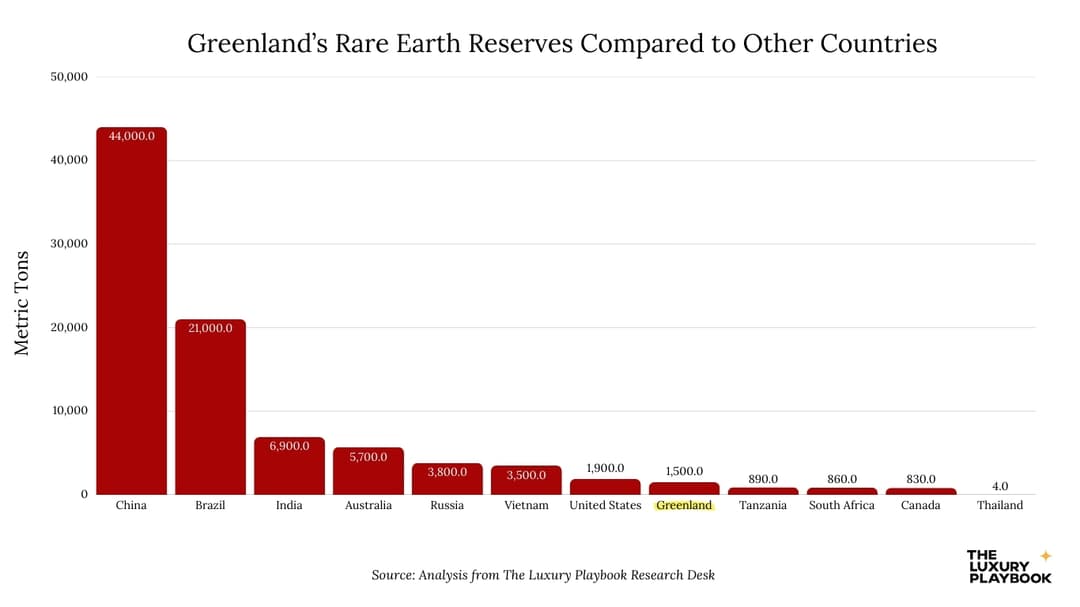
However, the strategic value of breaking China’s rare earth monopoly likely exceeds the raw commodity value that standard resource estimates capture.
China currently controls approximately 70% of global rare earth mining capacity and a staggering 90% of the processing infrastructure that refines raw ores into usable materials. This dominance creates profound American dependence on Chinese rare earths for virtually all advanced technology, from F-35 fighter components to the tiny magnets inside iPhones and the motors powering electric vehicles that climate policy increasingly mandates.
During trade disputes or military conflicts, that dependency becomes a strategic vulnerability. China could potentially restrict exports and cripple American manufacturing of both consumer electronics and defense systems.
Greenland’s rare earth deposits, if developed to commercial scale with American controlled processing facilities, could provide genuine resource independence in materials so critical that Pentagon planning documents classify rare earth security as a national defense priority.
Beyond mineral extraction, the opening of year round Arctic shipping routes presents economic opportunities that standard resource valuations completely ignore. The Northern Sea Route connecting Asia and Europe through Arctic waters above Russia could cut shipping time by 40% compared to traditional Suez Canal passages, while climate change progressively extends the ice-free season that makes such voyages commercially viable.
If Greenland’s geographic position allows the United States to control or heavily influence Arctic shipping lanes through port infrastructure, search and rescue capabilities, and Coast Guard presence, the nation could capture enormous economic value through transit fees, trade advantages, and the strategic leverage that comes from sitting astride critical 21st century commercial passages. For those tracking where smart capital is positioning itself for long-term geopolitical shifts, this dimension of the Greenland debate deserves serious attention.
Acquisition Price, Development Investment, and Long-Term Obligations
Translating Greenland’s resource potential and strategic value into actual American ownership confronts a fundamental challenge. What would Denmark accept, and what should America reasonably pay for territory that currently generates minimal economic activity?
Acquisition cost estimates range dramatically depending on which historical precedents and valuation methodologies analysts employ. If valued proportionally to Alaska’s inflation adjusted purchase price, with that territory’s $7.2 million in 1867 translating to roughly $140 million in contemporary dollars and adjusted for Greenland’s greater size, the figure might reach $2.8 billion.
But that approach ignores modern reality. Denmark has invested heavily in Greenland’s infrastructure and governance over 300 years of sovereignty. Resource wealth is far better understood through today’s geological surveys than 19th century explorers could ever achieve.
And strategic value in an era of great power competition commands premiums that 1867 valuations never contemplated.
More realistic modern valuations, ones that factor in resource wealth, strategic positioning, and the precedent that sovereign nations don’t sell valuable territory cheaply, could push estimates anywhere from $200 billion to over $1 trillion depending on the negotiation framework.
Whether compensation includes resource sharing agreements where Denmark retains royalties on mineral extraction, whether Greenlandic residents receive permanent fund style payments from resource revenues similar to Alaska’s oil dividend, and whether the transaction involves American assumption of Danish debt all dramatically affect the headline price.
Denmark shows no interest in selling regardless of price, but hypothetical negotiation would likely demand compensation reflecting not just current economic activity but the enormous future value that rare earth independence and Arctic positioning represent.
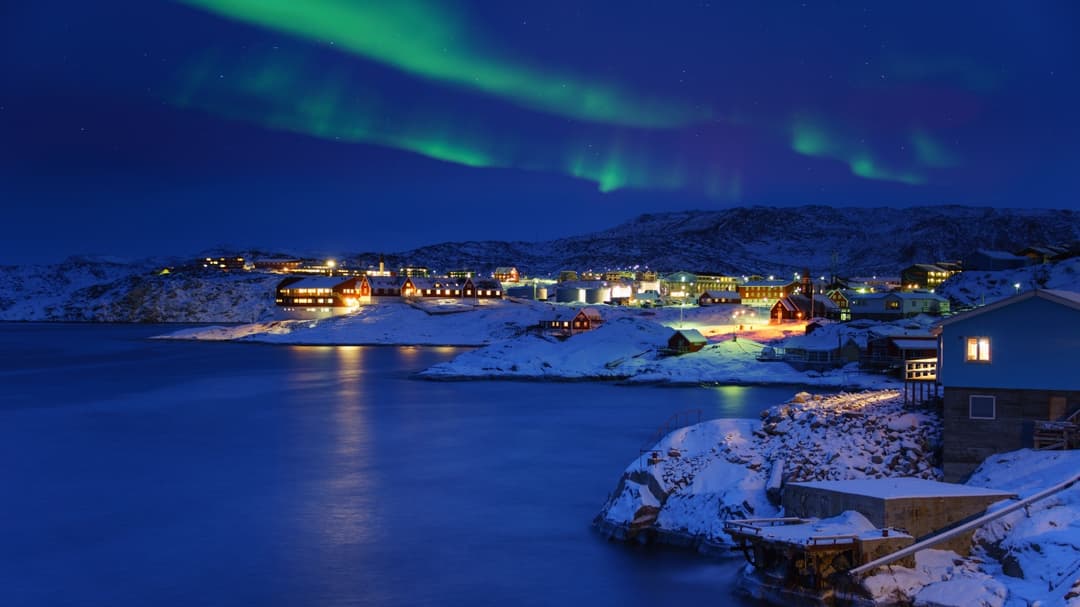
Beyond acquisition costs, infrastructure development requirements present staggering financial obligations before Greenland generates any positive economic returns. The territory currently supports just 57,000 residents scattered across coastal settlements with no road system connecting major towns, forcing reliance on expensive air and sea transport for all movement between communities.
Mining infrastructure is essentially nonexistent at the scales required for commercial rare earth extraction. Oil and gas development in Arctic offshore environments requires specialized drilling platforms, pipelines, and support facilities that would cost tens of billions to construct and operate safely.
Developing commercial scale rare earth mining operations, offshore oil extraction capabilities, modern ports able to accommodate container ships and naval vessels, military grade airfields, and the civilian support systems including housing, healthcare, education, and utilities that American standards would demand could require $300 billion to $500 billion invested over 20 to 30 years before resources begin generating positive returns.
That figure excludes the ongoing operational costs of maintaining infrastructure in one of Earth’s harshest climates, where winter temperatures reach minus 50 degrees Fahrenheit, sea ice damages port facilities, and permafrost creates foundation challenges that warm climate construction never confronts.
Ongoing subsidy obligations would transfer entirely from Denmark to the United States, creating permanent fiscal drains that resource revenues must eventually offset. Denmark currently provides Greenland approximately $591 million annually, working out to roughly $10,400 per resident to cover government operations, healthcare, education, and basic infrastructure maintenance. American acquisition would inherit this financial responsibility while likely facing pressure to increase spending to meet American standards for territorial governance, healthcare access, educational quality, and infrastructure reliability. For context on how wealthy nations structure long-term territorial investments, the HNWI relocation and residency playbook offers useful frameworks around cost-of-living baselines and governance premiums.
That said, modern technology and urgent rare earth demand could accelerate Greenland’s timeline to economic viability compared to Alaska’s century long development arc. Advanced mining techniques, climate adapted construction methods, and the premium prices that rare earth independence commands might compress development timelines that 19th and 20th century technology could never have achieved.
Whether that acceleration proves sufficient to justify the enormous upfront costs, perpetual subsidy obligations, and multi generational commitment that Greenland would demand is the central economic question any serious acquisition proposal must answer convincingly. Without a compelling answer, the political and financial support required for such a historically territorial expansion will never fully materialize.
We last reviewed this analysis in May 2026.

Stefanos Moschopoulos
Stefanos Moschopoulos founded The Luxury Playbook in Athens and has spent the better part of a decade following the auction calendar, the en primeur releases, and the watchmakers, gallerists, and shipyards the magazine covers. He writes the field guides and listicles that anchor the Connoisseur section — pieces built on Phillips and Christie's results, Liv-ex movements, and conversations with collectors he has met across Geneva, Bordeaux, Basel, and Monaco. His own collecting habits sit closer to watches and wine than art, and it shows in the level of detail in the magazine's coverage of those categories. Under his direction, The Luxury Playbook now publishes long-form field guides, market-defining year-end listicles, and the Voices interview series with the founders behind the houses and the brands.