

The Sharjah real estate market in 2026 is gaining unprecedented momentum. Once seen as a secondary market to Dubai and Abu Dhabi, Sharjah has transformed into a dynamic investment hub fueled by progressive property ownership reforms, growing infrastructure, and robust transaction activity across residential zones.
As the third-largest emirate in the UAE, Sharjah attracts long-term investors, end-users, and value-seeking buyers drawn by affordability, yield strength, and cultural appeal. If you’re looking for a market that combines accessibility with real upside, this is one worth your attention.
Through the second quarter of 2026, property values in Sharjah have held firm, with solid growth reported in both freehold and leasehold zones. That resilience comes down to strong end-user demand, limited inventory in new master-planned communities, and a growing number of expatriates acquiring long-term residency through real estate ownership.
For investors, the market is shifting toward high-yield communities on the outskirts of Sharjah city, along key transit corridors and near the Dubai border. That’s where price accessibility and tenant demand intersect in ways that are hard to ignore.
The emirate’s rental market is also posting stable growth, as more professionals, families, and commuters seek affordable alternatives to Dubai’s rising rents. Key districts such as Aljada, Muwaileh, and Al Khan have seen rental increases of 4% to 6% year-over-year, supported by low vacancy and a tightening job market alignment. You can get a fuller picture of how this fits into the broader regional story by reading this UAE real estate market overview.
Table of Contents
Overview of The Sharjah Real Estate Market
As of Q2 2026, the Sharjah real estate market is showing strong performance and healthy price appreciation across most residential segments. Following record-breaking transaction activity in 2024, demand has stayed elevated, supported by new freehold ownership regulations, increased investor participation, and a meaningful wave of migration from neighboring emirates chasing affordability.
The median listing price for residential units in Sharjah currently sits at AED 891,000, with median sale prices averaging around AED 850,000.
That narrow gap between asking and closing prices tells you something important about this market. It’s competitive and balanced. You see this most clearly in integrated communities such as Aljada and Muwaileh, where modern infrastructure and strong rental potential have drawn both buyers and end-users in equal measure.
Sales volume keeps climbing, with Sharjah recording over AED 8.4 billion in real estate transactions in Q2 2026, a double-digit increase over the same period the year before. That upward momentum is largely driven by off-plan purchases and steady resale activity in established freehold areas. Reuters reporting on Gulf real estate trends has highlighted how UAE secondary markets are absorbing investor capital that once flowed exclusively to Dubai.
Inventory stays moderate but is tightening. Developers are actively launching new phases in master communities to meet demand, while completed units in high-demand locations are moving faster, averaging 39 days on the market compared to 47 days in early 2024.
About 36% of residential properties are selling at or above asking price, with the mid-market villa and townhouse segments leading the charge. Buyers are increasingly competing for homes in communities that offer family-friendly amenities, walkability, and access to main road networks.
The current average price per square meter across Sharjah sits at approximately AED 10,420 (around USD 2,855), though that figure shifts considerably across submarkets. Prime locations such as Al Majaz and Al Khan reach up to AED 12,500 per sqm, while outer areas like Al Suyoh and Tilal City stay under AED 6,000 per sqm, appealing to investors seeking entry-level positions with real capital upside.

- Median home prices at AED 895K, with steady YoY appreciation.
- Over AED 8.4B in Q2 2025 transactions, driven by both off-plan and resale activity.
- Homes selling in 39 days on average, with increased velocity in master communities.
- 36% of listings close at or above asking, signaling localized competition.
- Price per sqm ranges from AED 6,000 to AED 10,500, based on community and asset type.
The Sharjah housing market in 2026 gives you a stable and accessible environment whether you’re buying to live or buying to invest. With ongoing infrastructure improvements, population growth, and investor-focused incentives, the market offers compelling value across a diverse range of neighborhoods.

Neighborhood Analysis
Sharjah is made up of a diverse mix of residential communities, each with its own advantages, price points, and investment profile. Those distinctions matter a great deal if you’re trying to optimize for long-term yield, capital growth, or strategic proximity to Dubai and major infrastructure corridors.
Aljada
Aljada stands out as one of Sharjah’s most prominent and fastest-growing freehold developments. Master-planned and lifestyle-oriented, the community offers modern apartments, townhouses, and retail spaces that appeal to young professionals and investors targeting mid-market returns.
The median home price in Aljada sits at approximately AED 980,000, with a 5.1% year-over-year increase. Strong off-plan sales and consistent construction progress keep investor confidence high, while demand for rental units stays elevated thanks to walkability and education-focused amenities.
Aljada benefits from sustained interest rooted in its central location and an active pipeline of mixed-use developments that keep the community feeling alive and evolving.
Muwaileh
Muwaileh has grown into a high-demand residential area, especially popular with families and commuting professionals. Its position near University City and direct access to Emirates Road give it a structural advantage that shows up in the numbers.
The median home price in Muwaileh is AED 860,000, with appreciation of 4.3% from Q2 2025. Townhouses and small villas are moving fast in this district, and demand is outpacing available stock.
The area is known for stable rental yields and the kind of long-term tenant retention that makes buy-to-let ownership genuinely straightforward.
Al Khan
Al Khan is one of Sharjah’s oldest waterfront neighborhoods, known for sea views and proximity to the Dubai border. It attracts residents who want coastal living at price points far more accessible than comparable Dubai communities.
The median home price here is AED 1.15 million, with 3.6% year-over-year price growth. Demand is strongest for renovated high-rise apartments, particularly among end-users and lifestyle-focused buyers who want the water without the Dubai premium.
Neighborhood Median Prices and Price per Square Meter
| Neighborhood | Median Listing Home Price |
|---|---|
| Aljada | AED 980K |
| Muwaileh | AED 860K |
| Al Khan | AED 1.15M |
| Tilal City | AED 765K |
| Al Majaz | AED 1.3M |
Sharjah Rental Market Overview
The Sharjah rental market in 2026 is a stable, income-generating segment of the emirate’s property story. As affordability continues pushing residents out of neighboring emirates, particularly Dubai, Sharjah is seeing rising rental demand across both apartment and villa categories. The effect is especially visible in new freehold zones and communities along major transit corridors.
Rents have increased by an average of 3.7% year-over-year, with the strongest gains in mid-market apartments and suburban villas. A growing population, an expanding education sector, and a rise in dual-city commuters have all kept leasing activity running hot. The Financial Times has noted similar affordability-driven rental migration patterns across Gulf cities.
Average Rent Prices by Unit Type
- Studio Apartments: AED 22,500/year (USD ~6,100)
- 1-Bedroom Apartments: AED 34,000/year (USD ~9,250)
- 2-Bedroom Apartments: AED 47,000/year (USD ~12,780)
- 3-Bedroom Apartments: AED 62,000/year (USD ~16,850)
- 3-Bedroom Villas: AED 85,000/year (USD ~23,000)
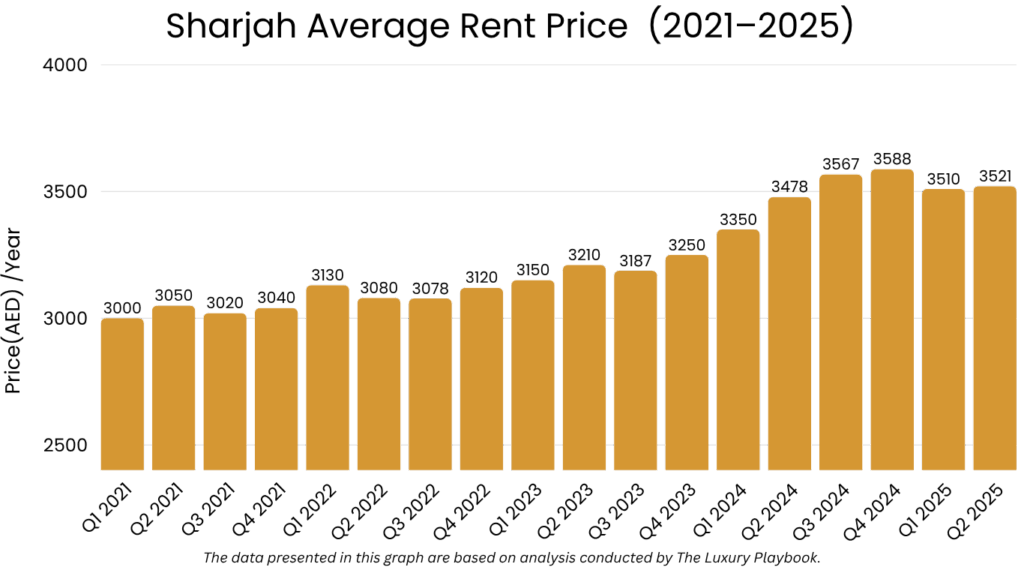
These figures reflect citywide averages. Rent levels vary considerably by neighborhood, proximity to Dubai, and project age, so your actual return will depend heavily on where exactly you buy.
Rent by Neighborhood
- Aljada: One-bedroom units lease for AED 38,000/year, with larger apartments commanding AED 55,000 or more in newly completed buildings.
- Muwaileh: Studios lease around AED 24,000/year, while two-bedrooms range from AED 42,000 to AED 48,000 depending on building amenities.
- Al Khan: One-bedroom waterfront apartments average AED 45,000/year, supported by location demand and consistent leasing interest.
- Tilal City: Studios and one-bedrooms lease between AED 18,000 and AED 28,000/year, making the area attractive to cost-conscious renters and investors seeking cash flow.
Vacancy Rates and Leasing Dynamics
Sharjah’s average residential vacancy rate sits at an estimated 6.1%, slightly above Dubai or Abu Dhabi but still within a healthy range. Vacancy is considerably lower in newer communities such as Aljada and Muwaileh, where occupancy exceeds 95% thanks to quality supply and genuine lifestyle appeal.
Tenants are increasingly signing longer leases, typically 12 to 24 months, to lock in rate stability, particularly in well-located developments. Developers and landlords are responding by pulling back on incentives while pushing rents higher in line with demand.
The most sought-after rental properties are those near universities, public transportation, and mixed-use developments that bundle retail, education, and health services in one place.
Investor Outlook
Sharjah delivers above-average rental yields compared to other UAE emirates. Annual gross yields typically run between 6% and 9%, with outer districts like Tilal City and Muwaileh outperforming due to lower acquisition costs and solid leasing performance. If you’re thinking about how long to hold a real estate investment, Sharjah’s fundamentals reward patience.
The Sharjah rental market in 2026 offers consistent yield, strong tenant demand, and growing occupancy across newly delivered inventory. For investors focused on income stability, mid-market apartments and villas in emerging communities are among the most compelling opportunities available in the region right now.

Factors Influencing The Sharjah Housing Market
The Sharjah housing market in 2026 is being shaped by a combination of regulatory changes, infrastructure development, affordability advantages, and demographic growth. These forces are defining investment momentum and overall market direction across the emirate’s key residential zones.
- Freehold Ownership Expansion: The introduction of full freehold ownership for non-GCC nationals has significantly boosted demand across master-planned communities. This legal reform opened the door to a broader investor base and positioned Sharjah as a more inclusive and competitive alternative to neighboring emirates. As a result, communities like Aljada, Tilal City, and Muwaileh are seeing consistent investor activity and faster unit turnover.
- Affordability Advantage: Sharjah remains one of the most affordable housing markets in the UAE. With average prices still 30% to 40% lower than Dubai, the emirate is attracting price-conscious buyers and end-users seeking larger homes and community living at accessible price points. This affordability edge is also drawing young families and first-time investors who prioritize value retention and yield.
- Strategic Location and Connectivity: Sharjah’s proximity to Dubai and its well-developed road networks continue to attract residents who work in the neighboring emirate. Developments with quick access to Sheikh Mohammed Bin Zayed Road and Emirates Road are particularly appealing. Improved infrastructure has also enhanced connectivity between suburban areas and commercial districts within Sharjah itself.
- Strong Off-Plan Activity: Developers in Sharjah have ramped up off-plan supply, particularly in Aljada and Tilal City. Attractive payment plans, low initial deposits, and construction-linked schedules are fueling off-plan demand. These offerings are appealing to both end-users and investors looking to lock in prices before completion and capitalize on value appreciation.
- Demographic and Job Growth: The emirate’s population continues to expand, driven by steady job creation in education, healthcare, manufacturing, and logistics. Sharjah’s growing university and school network also supports strong demand for rental housing near academic zones. As more long-term residents settle in the emirate, demand for larger, family-oriented housing continues to increase.
- Investor Confidence and Yield Performance: Sharjah is increasingly viewed as a stable, income-producing market. With yields ranging from 6% to 9%, the emirate attracts regional and international investors seeking long-term cash flow without the volatility seen in more speculative markets. Its regulatory simplicity and relatively low transaction fees further enhance its appeal.
Sharjah Housing Market Forecast for 2026
Looking ahead through 2026, the Sharjah housing market is expected to maintain its upward trajectory, though growth is likely to stabilize after the accelerated gains of 2023 and 2024. Steady demand, investor-friendly policies, and limited mid-market supply will keep supporting property values across key residential areas.
Rapid expansion may cool slightly. But the fundamentals point to consistent, sustainable appreciation in both pricing and rental performance.
Residential property prices in Sharjah are forecast to increase by 3.5% to 5% by the end of 2026. With the current median price around AED 891,000, average values are projected to reach AED 925,000 to AED 940,000, depending on the district and asset type. Communities like Aljada and Muwaileh are expected to lead on price appreciation due to infrastructure maturity and active off-plan handovers.
Inventory is expected to tighten further. While several new project launches are scheduled for completion in late 2026, many sit in the premium or off-plan categories. Affordable ready units will stay in short supply, especially in well-connected neighborhoods where demand is most concentrated.
Submarkets with immediate occupancy, finished amenities, and school proximity will likely attract the majority of new demand as buyers prioritize convenience over future promises.
The rental market is also forecast to strengthen. Rents are expected to grow by 3% to 4.5%, driven by limited leasing supply, steady job market growth, and affordability constraints in nearby emirates. One-bedroom apartments may average AED 35,000 to AED 37,000 per year, while two-bedroom units could reach AED 49,000 to AED 52,000 per year in high-demand communities. Bloomberg’s real estate coverage has pointed to similar supply-demand dynamics playing out across Gulf residential markets.
Vacancy rates are projected to stay low, particularly in completed developments with mixed-use access and family-centric facilities. Landlords are expected to hold pricing power, especially in newer buildings and gated communities where the product quality justifies the premium.
Economically, Sharjah’s position is solid. Public investment in industrial zones, cultural districts, and academic institutions is expected to keep flowing, further reinforcing residential demand. With growing population density and strong housing absorption, most analysts predict continued upward movement in both values and yields.
Demographic trends favor the market. Younger professionals and middle-income families make up the majority of new residents, and these groups will drive leasing and purchase activity in mid-tier housing segments across Muwaileh, Al Rahmaniya, and Tilal City throughout 2026 and beyond.

Is It Worth Buying a Property in Sharjah?
Sharjah makes a compelling case for property buyers in 2026, especially if you’re looking for affordable entry points, steady rental income, and long-term capital preservation. That said, whether it’s the right move depends on your risk profile, time horizon, and target return.
On the upside, property values in Sharjah are forecast to grow by 3.5% to 5% through 2026, supported by limited supply in key districts and a strong pipeline of infrastructure development. That level of growth will appeal most to conservative investors who value stability over speculation. Areas like Muwaileh, Tilal City, and Aljada offer reasonable price points with room for gradual appreciation.
Rental yields stay attractive compared to neighboring emirates. Gross annual yields typically run between 6% and 9%, especially in mid-market apartment blocks and townhouses. For buy-to-let investors focused on cash flow, Sharjah’s relatively low entry costs and consistent tenant demand make the market genuinely appealing. Understanding the optimal investment period for real estate can help you decide how to time your entry and exit here.
Still, there are limitations worth knowing. Liquidity can be lower than in Dubai or Abu Dhabi, particularly in the resale segment. Capital gains may be slower in underdeveloped areas, and rental demand is heavily concentrated around a few core neighborhoods. Price appreciation is also unlikely to be as aggressive as in higher-growth UAE markets, especially at the luxury end.
Sharjah also lacks the international visibility and foreign investor depth you see in larger regional hubs. For globally minded investors, that could limit exposure to international capital cycles and resale opportunities. The Financial Times has explored how secondary Gulf markets often trade on local fundamentals rather than global sentiment, which cuts both ways.
Buying property in Sharjah can be a strategic move if you’re prioritizing steady yields, long-term affordability, and family-focused housing. But if you’re chasing rapid appreciation or high liquidity, the market will reward a more selective and value-driven approach rather than a broad bet.
Other Market Forecasts & Overviews
Dubai Real Estate Market Overview & Forecast
Abu Dhabi Real Estate Market Overview & Forecast
Al Ain Real Estate Market Overview & Forecast
FAQ
Are Sharjah property prices expected to rise in 2026?
Yes. Property prices in Sharjah are projected to increase by 3.5% to 5% by the end of 2026.
What are the best areas to invest in Sharjah?
Top investment areas include Aljada, Muwaileh, Al Rahmaniya, Al Khan, and Tilal City.
Are rental yields in Sharjah high?
Yes. Rental yields in Sharjah range between 6% and 9%, depending on location and unit type.
Is now a good time to buy property in Sharjah?
Yes, if you seek long-term income or value growth. However, returns are more gradual compared to other UAE markets.