

Investing in a Rolex watch has become more than just owning a luxury timepiece; it’s now widely regarded as a tangible asset with strong investment potential. Rolex, a name synonymous with precision, durability, and timeless elegance, continues to dominate the luxury watch market.
While some Rolex models are priced at sky-high figures, entry-level Rolex watches offer a more accessible gateway into this prestigious world without compromising on quality or long-term value.
As of 2025, the market for entry-level Rolex watches is gaining momentum, driven by increasing demand, limited production, and a growing appreciation for classic models. These watches not only serve as excellent entry points for collectors and investors but also hold their value remarkably well over time, often appreciating in price if properly maintained.
Table of Contents
Entry-Level Rolex Investment Snapshot
| Model / Reference | Typical Retail | Typical Secondary Range | Value Retention vs Retail | Liquidity | Investment Score / 10 |
|---|---|---|---|---|---|
| Oyster Perpetual 36 (ref. 126000) | ≈ $6,100 | ≈ $7,000 – $9,000 | ≈ 115% – 145% of retail | High | 7.5 / 10 |
| Oyster Perpetual 41 “Pistachio” (ref. 134300) | ≈ $6,650 | ≈ $18,000 – $22,500 | ≈ 270% – 340% of retail | High (but hype-sensitive) | 8.5 / 10 (speculative) |
| Air-King (ref. 126900) | ≈ $7,750 | ≈ $7,700 – $8,500 | ≈ 100% – 110% of retail | Medium | 6.5 / 10 |
| Explorer 36 (ref. 124270) | ≈ $7,700* | ≈ $8,500 – $9,700 | ≈ 110% – 125% of retail | High | 8 / 10 |
| Datejust 36 Smooth (ref. 126200) | ≈ $8,750 | ≈ $9,500 – $11,000 | ≈ 110% – 125% of retail | High | 8.5 / 10 |
| Oysterdate Precision (ref. 6694) | Vintage only | ≈ $3,500 – $6,500 | n/a (no current MSRP) | Medium | 7 / 10 |
What Does Entry-Level Rolex Watches Mean?
Within Rolex’s hierarchy, “entry-level” identifies models starting around $5,000 retail, featuring stainless steel construction and simpler complications. This classification represents accessibility relative to Rolex pricing, not diminished quality. These watches employ identical manufacturing standards, movement precision, and material quality as six-figure references.
Entry-level models focus on core functionality—time and date display—rather than complex features like moon phases or annual calendars. Oystersteel construction provides exceptional corrosion resistance while keeping prices below precious metal alternatives. Despite lower MSRPs, strict production controls and sustained global demand create secondary market dynamics where certain references trade at substantial premiums.
These watches serve dual purposes: genuine luxury timepieces suitable for daily wear and tangible assets with documented appreciation potential. Market data shows specific entry-level references outperforming traditional investments during certain periods, driven by Rolex’s brand equity, controlled supply, and universal recognition.
Rolex Oyster Perpetual (Price Range: $5,500 – $7,500)
Rolex Oyster Perpetual (OP)
The Oyster Perpetual is Rolex’s purest expression of the brand: time-only, stainless steel, and built around the waterproof Oyster case and Perpetual rotor. In 2025, retail prices for current references typically sit in the $5,000–$7,000 range depending on size, while standard dial colours on the secondary market trade around $4,500–$9,000. Special dial configurations such as the 41 mm “pistachio” reference 134300 can command more than 3× retail, trading above $20,000 when supply is tight. Investment-wise, the OP offers strong brand exposure and good liquidity with relatively low risk at the entry level; standard colours behave like steady, long-term value holders, while hyped dial variants behave more like speculative trades that can be volatile in both directions.
The Oyster Perpetual represents Rolex’s purest design philosophy. As the foundation of the brand’s modern collection, it embodies the essential innovations that established Rolex’s reputation: the waterproof Oyster case developed in the 1920s and the self-winding Perpetual rotor introduced in 1931.
Current models feature clean aesthetics across five case sizes (28mm, 31mm, 34mm, 36mm, 41mm), offering versatility for different wrist sizes and preferences. The 2024 refresh introduced updated references with new dial colorways including pistachio green, lavender, and beige alongside traditional options. Powered by Caliber 3230, these watches deliver chronometer-certified precision within -2/+2 seconds daily and maintain a 70-hour power reserve.
The secondary market reveals compelling dynamics. While standard dial colors trade close to retail, vibrant colorways command significant premiums. The 41mm pistachio green dial (reference 134300) currently trades around $22,500—more than three times its $6,650 retail price. This premium reflects limited availability and collector demand for distinctive pieces.
The Oyster Perpetual’s investment appeal stems from three factors: universal recognition, pure design that resists obsolescence, and Rolex’s production discipline creating persistent supply constraints.
| Reference | Case Size | Retail Price | Secondary Market Range |
|---|---|---|---|
| 276200 | 28mm | $5,000 | $4,500–$5,500 |
| 277200 | 31mm | $5,650 | $5,000–$6,000 |
| 124200 | 34mm | $5,800 | $5,500–$6,500 |
| 126000 | 36mm | $6,100 | $7,000–$9,000 |
| 134300 | 41mm | $6,650 | $8,000–$22,500* |
*Pistachio and special colorways command premium pricing
Source: WatchCharts, Rolex Official (December 2025)

Rolex Air-King (Price Range: $7,000 – $8,500)
Rolex Air-King
The Air-King brings aviation-inspired design into Rolex’s entry-level professional line, with its 40 mm case, bold 3-6-9 numerals, and green seconds hand. The current reference 126900 lists around $7,750 at retail, with secondary prices typically in the $7,700–$8,500 range, hovering close to MSRP. From an investment perspective, the Air-King offers stable value retention, modest premiums, and a distinctive look that avoids the most crowded hype segments. It is best viewed as a long-term “wear and hold” piece: solid value preservation, decent upside if discontinued, and relatively low downside risk compared with more speculative references.
The Air-King carries distinct aviation heritage dating to the 1940s when Rolex honored RAF pilots. The current reference 126900, introduced in 2022, features design elements that set it apart from other Oyster Professional models: large Arabic numerals at 3, 6, and 9 o’clock, a prominent minute scale for navigation timing, and the distinctive green seconds hand.
At 40mm with Caliber 3230, the Air-King delivers identical technical specifications to the Oyster Perpetual—70-hour reserve, chronometer certification, and antimagnetic Parachrom hairspring—while adding aviation-specific design language. The black dial with high-contrast numerals ensures exceptional legibility, true to its tool watch origins.
The Air-King occupies an interesting position in Rolex’s pricing structure. At $7,750 retail, it sits between the Oyster Perpetual and Explorer, offering a distinctive aesthetic for buyers seeking something beyond conventional sport watch design.
Secondary market pricing remains close to retail, typically $7,700–$8,500, suggesting stable demand without the speculative premiums affecting some references.
This stability presents opportunity for long-term holders. The Air-King’s aviation heritage and unique dial layout appeal to collectors who value historical significance alongside wearability.
As Rolex maintains strict production controls, the Air-King remains in limited supply, driving up demand on the secondary market. Prices have shown steady appreciation over the years, and this trend is expected to continue into 2026, particularly for models with unique serial numbers or limited production runs.
| Reference | Retail Price | Secondary Market | Movement |
|---|---|---|---|
| 126900 | $7,750 | $7,700–$8,500 | Caliber 3230 |
| 116900 | Discontinued | $7,000–$7,800 | Caliber 3131 |
Rolex Explorer (Price Range: $8,000 – $9,500)
Rolex Explorer
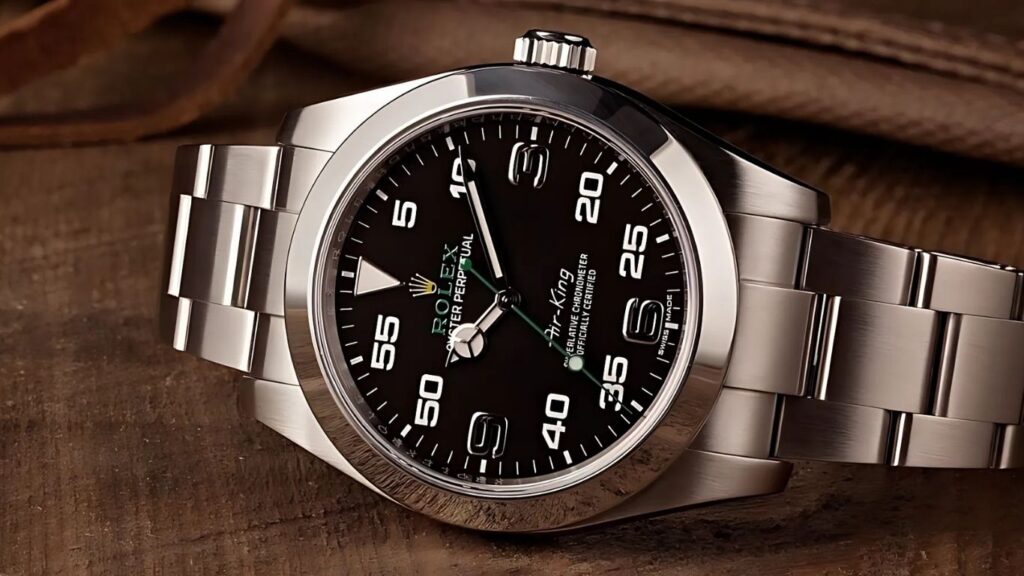
The Explorer is Rolex’s pure tool-watch icon, born from mountaineering history and designed around a simple 3-6-9 black dial, Mercedes hands, and rugged Oyster construction. In 2025, the modern 36 mm reference 124270 and 40 mm reference 224270 are typically acquired via waitlists, with secondary prices roughly $8,500–$9,700 for the 36 mm and $9,200–$10,500 for the 40 mm. The Explorer has strong collector credibility and limited production, which supports healthy premiums and high liquidity. Investment-wise, it offers one of the strongest risk-reward profiles in the “entry-level” tier: robust demand, good long-term appreciation potential, and a design that ages very slowly, provided you buy at sensible premiums and plan to hold through full market cycles.
The Rolex Explorer is a timepiece built for adventure, engineered to endure the harshest conditions while maintaining the precision and elegance that define Rolex. Originally introduced in 1953 to commemorate Sir Edmund Hillary and Tenzing Norgay’s historic ascent of Mount Everest, the Explorer has since become a symbol of resilience, functionality, and understated sophistication. In 2025, it remains one of the best entry-level Rolex watches for investment, blending rich history with strong market performance.
Design simplicity defines the Explorer: black dial, Mercedes hands, Arabic numerals at 3-6-9, and Chromalight luminescence for low-light readability. This minimalism serves function—the watch provides essential information in extreme conditions without unnecessary complexity. Caliber 3230 ensures reliability with shock resistance and 70-hour autonomy.
The Explorer demonstrates consistent secondary market strength. Reference 124270 trades between $8,500–$9,700, reflecting demand for the restored 36mm sizing. Vintage references, particularly the legendary 1016 produced from 1963–1989, command significant premiums in collector markets.
The Explorer’s investment case rests on three pillars: storied heritage connecting it to mountaineering achievement, timeless design that works equally well in boardrooms and backcountry, and relative scarcity as Rolex maintains limited production across its sports watch lineup.
| Reference | Case Size | Retail Price | Secondary Market |
|---|---|---|---|
| 124270 | 36mm | N/A (Waitlist) | $8,500–$9,700 |
| 224270 | 40mm | N/A (Waitlist) | $9,200–$10,500 |
| 214270 | 39mm | Discontinued | $7,500–$9,000 |
| 114270 | 36mm | Discontinued | $6,500–$8,000 |
Source: WatchCharts, Chrono24
Rolex Datejust (Price Range: $7,000 – $11,000)
Rolex Datejust
The Datejust is Rolex’s most versatile all-rounder, combining the Cyclops date, fluted or smooth bezels, and Oyster or Jubilee bracelets in sizes from 28 mm to 41 mm. Modern steel and steel-and-gold Datejust references in “entry-level” configurations typically retail around $7,000–$11,000, with popular 36 mm and 41 mm models like the 126200 and 126300 trading on the secondary market in the $9,500–$12,500+ band. Fluted-bezel, Jubilee-bracelet and special dials (blue, Wimbledon, green) command higher premiums and have shown strong appreciation since 2020. As an investment, the Datejust offers excellent liquidity, broad global demand, and relatively low volatility, making it a core “blue-chip” candidate for an entry-level Rolex allocation.
The Rolex Datejust is one of the most recognizable and iconic Rolex models, seamlessly blending timeless design, innovative functionality, and lasting prestige. Introduced in 1945, it was the first wristwatch to feature an automatically changing date display, a revolutionary advancement that cemented its place in watchmaking history. In 2025, the Datejust remains a cornerstone of Rolex’s collection and an exceptional choice for investors seeking an entry-level Rolex model with enduring value and strong market performance.
Renowned for its versatility and refined aesthetics, the Datejust appeals across generations and lifestyles. Its signature elements include the Cyclops lens over the date display, fluted or smooth bezel options, and a choice between the Oyster or Jubilee bracelet, all of which contribute to its timeless and instantly recognizable design. Whether worn at formal events, business meetings, or casual outings, the Datejust maintains an air of elegance and adaptability.
Modern Datejust models are powered by Rolex’s Caliber 3235 movement, one of the brand’s most advanced in-house automatic calibers. With a 70-hour power reserve, high resistance to shocks and magnetic fields, and Superlative Chronometer certification, the movement ensures accuracy within -2/+2 seconds per day, solidifying the Datejust’s reputation for precision and reliability.
With multiple case sizes—28mm, 31mm, 36mm, and 41mm—the Datejust caters to a wide range of preferences. Buyers can also select from a diverse range of dial colors and configurations, including classic silver, bold blue, and elegant champagne finishes, allowing for a personalized touch while maintaining Rolex’s signature sophistication.
The Rolex Datejust consistently retains strong value and has demonstrated steady appreciation over the years. As one of Rolex’s most versatile and universally appealing models, it enjoys broad demand in both primary and secondary markets.
Certain dial configurations and precious metal accents have shown particularly strong investment returns. For example, the Datejust 36 with a Wimbledon dial has become highly sought after, commanding premium prices in the resale market.
| Reference | Size | Bezel | Retail Price | Secondary Market |
|---|---|---|---|---|
| 126200 | 36mm | Smooth | $8,750 | $9,500–$11,000 |
| 126300 | 41mm | Smooth | $8,500 | $10,500–$12,500 |
| 126234 | 36mm | Fluted | $10,000+ | $11,500–$14,000 |
| 126334 | 41mm | Fluted | $10,900+ | $13,500–$16,000 |

Rolex Oysterdate (Price Range: $5,000 – $7,000)
Rolex Oysterdate
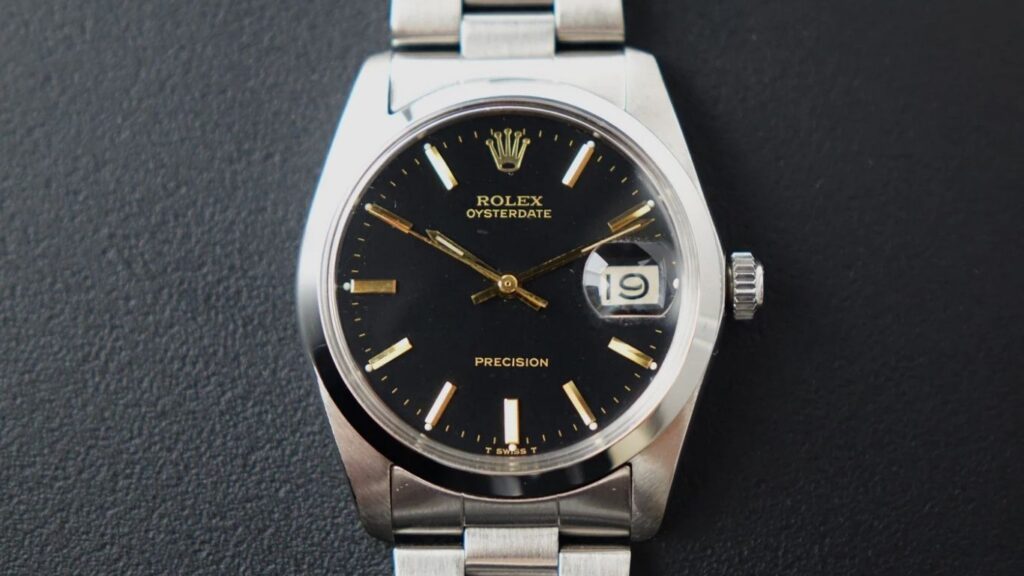
The vintage Oysterdate Precision (especially reference 6694) is one of the most accessible ways into the Rolex universe. Produced mainly from the 1960s–1980s with a 34 mm case and manual-wind movement, it offers classic Rolex aesthetics at lower price points. In 2025, good examples typically trade around $3,500–$6,500, depending on condition, dial variant, originality, and presence of box/papers. From an investment angle, the Oysterdate is a vintage play: upside depends heavily on finding clean, honest pieces and avoiding over-polished cases or replacement parts. Liquidity is moderate rather than instant, but for disciplined buyers it delivers true vintage Rolex exposure and long-term appreciation potential at a comparatively low entry cost.
The Oysterdate Precision represents Rolex’s vintage entry point. Produced from the early 1960s through 1989, reference 6694 holds distinction as Rolex’s final manual-wind model. This discontinued status, combined with relatively modest production volumes, creates interesting vintage market dynamics.
At 34mm with manual-wind Caliber 1225, the Oysterdate appeals to collectors appreciating traditional watchmaking and compact sizing. The wide variety of dial variations—black, silver, blue, champagne, and specialty configurations—provides options for individual taste. Original examples with matching boxes and papers command premiums over watch-only pieces.
The Oysterdate occupies the most accessible price bracket for authentic vintage Rolex, currently trading between $3,500–$6,500 depending on condition, dial variant, and completeness. Well-preserved examples with original components and service documentation trade toward the upper range, while project pieces requiring service or restoration sell for less.
This market segment attracts both new collectors seeking affordable Rolex entry and experienced buyers pursuing specific dial variations. As vintage Rolex prices have generally appreciated, the Oysterdate provides exposure to this market at manageable investment levels.
| Reference | Era | Approximate Price | Notes |
|---|---|---|---|
| 6694 | 1960s–1980s | $3,500–$6,500 | Most common variant |
| 6466 | 1950s–1960s | $2,400–$3,900 | Earlier, smaller case |
Best Entry-Level Rolex Watches Below $7,000
- Rolex Oyster Perpetual 31–36 mm (standard dials)
- Rolex Oysterdate Precision (vintage ref. 6694 and similar)
This bracket is ideal if you want a true Rolex with timeless design and strong brand equity, without stretching into five-figure territory. Modern Oyster Perpetuals in smaller sizes and standard dials give you current specs, long power reserves, and clean aesthetics, while vintage Oysterdate pieces offer that classic “old Rolex” charm at accessible prices. Both work well as first serious watches and as low-risk, long-horizon holds if bought in good condition.
Best Entry-Level Rolex Watches From $7,000 to $9,000
- Rolex Oyster Perpetual 36–41 mm (desirable colors, non-hype dials)
- Rolex Air-King 126900
- Rolex Explorer 124270 / 214270
This range suits buyers who want a daily-wear Rolex with stronger long-term appeal and better upside. Larger Oyster Perpetuals in versatile colors, the updated Air-King with its aviation DNA, and the Explorer with its Everest story all combine real tool-watch credibility with wear-everywhere versatility. They’re especially good fits for professionals who want one watch that can handle office, travel, and weekends while still behaving sensibly as an asset on the secondary market.
Best Entry-Level Rolex Watches From $9,000 to $12,000
- Rolex Datejust 36 (smooth bezel, Oyster bracelet)
- Rolex Datejust 41 (smooth bezel)
This bracket is for buyers who want a more “complete” Rolex experience: date function, stronger presence on the wrist, and that classic “Rolex look” without jumping to precious metals. Modern Datejusts in this band give you the latest movements, excellent accuracy, and extremely broad resale demand. They fit investors and professionals who want a single watch that works with a suit, a polo, or a t-shirt, and who care about both stability and moderate appreciation over time.
Best Entry-Level Rolex Watches From $12,000 to $15,000+
- Rolex Datejust 36 with fluted bezel + Jubilee bracelet (e.g., Wimbledon / blue dials)
- Rolex Datejust 41 with fluted bezel + Jubilee bracelet (popular dial variants)
This top bracket is ideal if you’re comfortable spending more upfront to target configurations with the strongest long-term desirability. Fluted bezels, Jubilee bracelets, and sought-after dials (like Wimbledon or blue) push these Datejusts closer to “investment-grade” territory while still being wearable every day. They’re best suited to buyers who see the watch as both a personal signature piece and a long-term store of value with solid liquidity across global markets.
FAQ
What is an entry-level Rolex watch?
An entry-level Rolex is a more affordable model with simpler designs, fewer complications, and stainless steel construction, offering an accessible entry point into Rolex ownership.
Are entry-level Rolex watches a good investment?
Yes, they offer strong value retention, consistent demand, and often appreciate over time, especially models with unique dials or discontinued references.
Which entry-level Rolex offers the best ROI?
The Oyster Perpetual and Explorer are top choices for their timeless design, broad appeal, and historically strong appreciation rates.
Is it better to buy a new or pre-owned Rolex?
Both are valid options. New Rolexes offer warranty and authenticity, while pre-owned models may provide better availability and unique references.
How long should I plan to hold an entry-level Rolex if I care about ROI?
If you care about investment outcomes, think in terms of at least 5–10 years, not months. Rolex price action can be cyclical, and buying at the peak of a hype cycle may lead to several years of flat or negative performance. A longer holding period lets you smooth out market noise, benefit from gradual brand-wide price increases, and capture the compounding effect of sustained demand.