IBM made headlines in May 2023 when CEO Arvind Krishna announced the company would pause hiring for 7,800 positions that artificial intelligence could soon handle. Within weeks, Amazon revealed plans to automate 1 million warehouse jobs by 2026.
These weren’t isolated incidents. They were early tremors of an economic earthquake reshaping how wealth gets created globally.
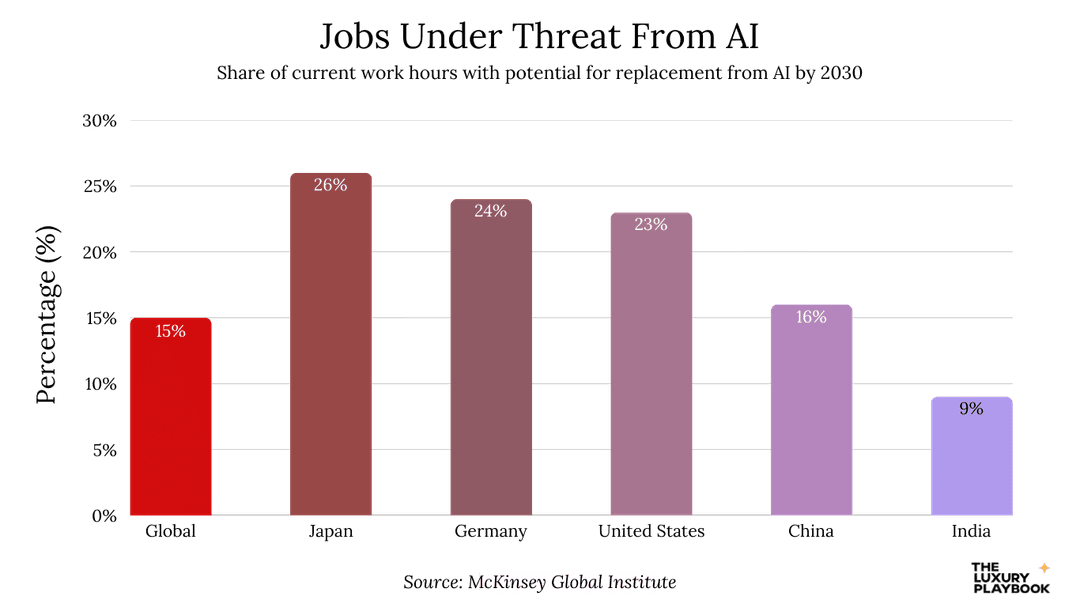
Goldman Sachs economists now project AI could replace 300 million jobs worldwide, while McKinsey estimates 12 million Americans will need entirely new careers by 2030. But here’s what most people miss, this isn’t just about unemployment.
Think of it as the biggest wealth transfer in modern history. Trillions in labor costs shifting away from worker paychecks and straight into corporate profits.
Companies embracing AI early are seeing cost advantages of 40% to 60% over their competitors, while those hesitating face the very real threat of obsolescence. For you as an investor, that creates both the largest opportunity and the greatest risk of our generation.
Key Takeaways
Navigate between overview and detailed analysisKey Takeaways
- AI will pressure routine cognitive and entry-level white-collar roles first, with firms accelerating automation during downturns to lock in lower labor intensity.
- Displacement can cap wage growth and demand while boosting adopters’ margins, expect uneven sector outcomes and higher dispersion in earnings quality.
- Positioning: overweight AI infrastructure (semis/compute, networking, power), workflow platforms with measurable ROI, and operators with automation leverage.
- Key risks: governance and reliability gaps, regulatory shocks, data/security liabilities, and social backlash that can compress valuation multiples.
The Five Ws Analysis
- Who:
- Employers, knowledge-workers, policymakers, and public equity investors.
- What:
- A surge in AI-driven automation that reduces demand for routine cognitive roles and reshapes corporate cost structures.
- When:
- Building now and likely to accelerate in the next recessionary phase and recovery cycle.
- Where:
- Developed markets and services sectors: technology, finance, legal, operations, media, and customer support.
- Why:
- To cut costs, raise productivity, and secure competitive advantage, creating risks to labor income but opportunities for capital returns.
How AI Is Reshaping the Workforce
Manufacturing is leading this transformation. The International Federation of Robotics reported a 31% year-over-year increase in global robot installations, reaching 517,385 units in October 2023.
The World Economic Forum’s projection of 1.4 million manufacturing job losses by 2027 translates directly into cost savings that could boost industrial profit margins by 8% to 12% annually for automation leaders. For companies that resist this transition, the competitive disadvantage may be impossible to recover from.
Customer service automation tells an even sharper story. Salesforce’s August 2023 data showed 83% of companies deploying AI for customer interactions. But the real story sits underneath that number.
AI systems handle customer queries at roughly $0.50 per interaction versus $15 to $25 for human agents.
Klarna’s AI assistant handling 2.3 million conversations monthly is a perfect case study. The savings work out to an estimated $50 to $75 million annually in labor costs alone. That’s not a rounding error.
That’s a structural shift in how profits get built.
The penetration into white-collar professions creates the most significant investment implications because these roles represent higher-value activities with greater economic multiplier effects.
When OpenAI’s GPT-4 passes the bar exam at the 90th percentile, it signals that AI can handle legal research, contract analysis, and document review that typically costs $200 to $500 per hour. Goldman Sachs estimates AI could automate 46% of administrative tasks and 44% of legal work, translating into potential cost savings of $300 to $400 billion annually across professional services. Those savings flow directly to corporate bottom lines and, ultimately, to your investment returns.

The Scale of the AI Job Collapse
Goldman Sachs’ projection of 300 million displaced jobs is the largest shift of money from workers to business owners in modern history. When two-thirds of U.S. jobs face potential automation, you’re looking at roughly $4 to $6 trillion in annual labor costs that could migrate from worker paychecks to corporate profits and investor returns.
McKinsey’s timeline showing 12 million job transitions by 2030 reveals something crucial for your portfolio strategy. This change is moving fast. Unlike past technological shifts that took generations to play out, this transformation compresses decades of disruption into roughly five years.
The result is a winner-take-all situation. Companies and investors who move first capture most of the benefits. Those who wait are not just late to the party, they may miss it entirely.
The International Labour Organization warns unemployment could hit 8.5% globally by 2028, creating a genuine economic puzzle. As companies become more efficient and profitable through AI, they’re simultaneously reducing the number of people who can afford to buy their products.
That tension forces governments into massive spending programs, which opens new investment opportunities in some areas while putting real pressure on sectors that depend on consumer spending. You need to be watching both sides of that equation.
Sectors Most at Risk From AI Disruption
Retail is being completely rewired. Amazon’s “Just Walk Out” technology rolling out across 3,000 stores eliminates cashier positions while cutting operating costs by an estimated 15% to 20%. Traditional retailers face a brutal choice right now, spend billions on AI technology or accept a permanent disadvantage against automated competitors.
The National Retail Federation projects 1.2 million retail job losses ahead. That money doesn’t disappear. It flows to shareholders instead of being distributed through wages, which changes the investment math considerably.
Financial services firms are cutting costs while actually improving service quality through AI. JPMorgan Chase’s AI now processes 90% of trade settlements and 70% of mortgage applications, eliminating labor costs and reducing expensive errors at the same time.
Bank of America’s AI assistant Erica saves an estimated $200 to $300 million annually in customer service costs while improving customer satisfaction scores. That combination of lower costs and happier customers is exactly what drives premium stock valuations over time.
Media companies face a more existential challenge. AI can produce content at near-zero cost, and when the Associated Press uses AI for 25% of their earnings reports and Buzzfeed pivots to AI-generated content, the message is clear. Even established media brands must adapt or become irrelevant.
For you, that means real opportunity in AI content platforms and real risk in traditional media holdings.

Where the Money Is Moving
The $67 billion in AI infrastructure investment during 2023 was just the opening move. A capital reallocation that could exceed $2 trillion over the next decade is now well underway.
NVIDIA’s data center revenue growth of 1,000% to $47.5 billion shows exactly how AI infrastructure providers capture outsized returns during technological transitions. The company’s $2 trillion market cap reflects investors recognizing that AI infrastructure is the picks-and-shovels play of this technological era.
Essential tools that generate returns regardless of which specific AI applications succeed.
Microsoft’s $13 billion OpenAI investment is a blueprint for how established tech giants are securing AI leadership through massive capital deployment rather than building from scratch internally. This approach creates winner-take-all dynamics where a handful of large players control AI infrastructure and potentially generate monopoly-like returns for decades.
For your portfolio, that concentration means picking AI infrastructure leaders matters far more than spreading capital across dozens of AI applications that may never reach meaningful scale.
The BlackRock Global Robotics ETF growing from $1.2 billion to $3.8 billion in assets tells you something important. Institutional money is treating automation as a structural economic shift, not a cyclical technology bet. And when institutional money moves with that kind of conviction, you pay attention.
Hedge funds allocating $23 billion to AI-focused strategies in 2023 confirms that sophisticated capital is treating AI displacement as both an opportunity and a risk requiring real expertise to navigate. This is not retail speculation. This is serious portfolio positioning by people who do this for a living.
AI investments are transitioning from speculative tech bets to core portfolio allocations for anyone serious about long-term economic participation. If you haven’t started working with a financial advisor who understands this shift, now is the time.
The Social Consequences Investors Can’t Overlook
The Congressional Budget Office warns that income inequality could reach levels not seen since the 1920s. That’s not just a social concern. For you as an investor, it’s a direct risk factor.
When AI benefits flow mainly to business owners while workers lose jobs, the political pressure that builds can lead to wealth taxes, AI automation fees, or tech company regulations that hit your returns hard. History is clear on this point. Extreme inequality tends to trigger political responses that dramatically reshape investment environments.
Thirty-four states are already considering taxes on companies that use AI to eliminate jobs. That’s not background noise. Those are early signals of how governments may start capturing AI benefits for public use rather than letting them flow entirely to private investors like you.
California’s proposed AI safety bill requiring worker retraining shows how regulation could transform AI from pure cost reduction into mandatory social investment, potentially compressing the profit margins that make AI stocks so attractive right now.
The International Monetary Fund’s warnings about social instability echo historical patterns where rapid technological change triggers political movements that reshape entire economic systems. Your AI investment thesis needs to account for not just profit potential, but whether these investments are socially sustainable and politically viable over the long run.

Future Outlook for AI and the Global Economy
McKinsey’s projection of $13 trillion in AI economic benefits by 2030 would be the largest productivity increase in human history. But how those gains get distributed will determine your investment returns across every market you touch. Companies that successfully adopt AI could see profit margins 20% higher than today, while those that don’t may simply become obsolete.
That split creates a two-tier investment market where technology adoption becomes the single most important factor in determining long-term business survival. You want to be on the right side of that divide well before it becomes obvious to everyone else.
The World Economic Forum predicts 69 million new AI-related jobs will partially offset 83 million displaced positions, which points to real investment opportunity in human-AI collaboration rather than pure automation plays. Companies that combine AI efficiency with human creativity and problem-solving are likely to command premium valuations because they deliver both productivity gains and social sustainability.
Goldman Sachs notes that AI-capable companies already trade at 25% higher prices while AI-vulnerable companies trade at 15% discounts.
That 40% gap suggests markets are only beginning to price in the full scale of AI transformation risk. If you want to understand which industries stand to benefit most from this repricing, this breakdown of U.S. investment trends by sector is worth your time.
As AI capabilities expand and costs decrease, this gap will likely widen further, creating ongoing opportunities for investors who can accurately assess which companies are prepared for an automated economy.
The next decade will determine whether AI creates shared prosperity or concentrates wealth in ways that trigger real political disruption. Your success as an investor will depend not just on identifying AI winners, but on understanding how societies adapt to technological change and positioning your capital for the political and economic responses that will inevitably follow this transformation.
We last reviewed this analysis in May 2026.


Stefanos Moschopoulos
Stefanos Moschopoulos founded The Luxury Playbook in Athens and has spent the better part of a decade following the auction calendar, the en primeur releases, and the watchmakers, gallerists, and shipyards the magazine covers. He writes the field guides and listicles that anchor the Connoisseur section — pieces built on Phillips and Christie's results, Liv-ex movements, and conversations with collectors he has met across Geneva, Bordeaux, Basel, and Monaco. His own collecting habits sit closer to watches and wine than art, and it shows in the level of detail in the magazine's coverage of those categories. Under his direction, The Luxury Playbook now publishes long-form field guides, market-defining year-end listicles, and the Voices interview series with the founders behind the houses and the brands.