

The year 2025 did not just challenge investors. It pushed a large part of the market to rethink what “wealth preservation” actually means when equity volatility, political uncertainty, and inflation pressure all arrive at the same time.
Traditional portfolios built around stocks and bonds looked less predictable than they had in previous decades. As confidence in conventional allocation models weakened, sophisticated investors moved toward assets they could see, touch, and hold, turning alternative investments from a supporting role into a primary strategy.
Throughout the year, contested elections, policy surprises, and central bank interventions failed to create lasting calm. Even seasoned institutional investors started questioning whether the classic mix of equities and fixed income could still deliver attractive risk adjusted returns.
That shift in sentiment is what made 2025 feel like a turning point. Alternative assets were no longer about adding variety. They became a way to defend purchasing power and reduce exposure to rapid, sentiment driven drawdowns.
Table of Contents
Key Takeaways & The 5Ws
- Illiquidity became a feature, not a bug: slow-moving markets in art, watches, wine, and real estate helped investors avoid panic selling and forced exits during volatility spikes.
- Scarcity and culture drove real outperformance: truly scarce, culturally important assets—such as Paul Newman Daytonas, blue-chip art, and top-tier wines—held or grew value while many liquid assets whipsawed.
- Alternative assets shifted from “satellite” to “core”: for sophisticated investors, tangibles moved from cosmetic diversification to central tools for wealth preservation and purchasing-power defense.
- Process replaced reaction as a risk-control mechanism: auction pipelines, authentication, appraisals, and long transaction cycles created built-in cooling-off periods that reduced behavioral mistakes.
- Domain expertise became the main edge: the best results went to investors who understood references, artists, estates, and market microstructure—not just prices on a screen.
- Who is driving this?
- High-net-worth investors, family offices, and sophisticated retail investors reallocating away from traditional 60/40 portfolios and into alternative assets.
- What is the shift?
- A structural move toward tangible alternative investments—fine art, luxury watches, wine, and real estate—being treated as core wealth-preservation tools rather than small “satellite” holdings.
- When did it accelerate?
- Throughout 2025, as equity volatility, political risk, and inflation concerns exposed the fragility of conventional stock-and-bond strategies and increased demand for scarcity-backed assets.
- Where is it happening?
- Across global capital hubs and luxury markets: major auction houses, prime real estate cities, key watch and wine trading centers, and private-bank and specialist-dealer platforms.
- Why does it matter?
- Because investors want lower correlation, inflation protection, and scarcity-driven value support—while using illiquidity and slow transaction cycles as built-in protection against panic-driven drawdowns.

Why Alternative Assets Mattered More Than Ever in 2025
Alternative assets gained influence because their value drivers are not the same as those that power public markets. In a year when narratives changed weekly and pricing moved in violent bursts, investors looked for holdings, whose fundamentals felt less dependent on earnings calls, rate decisions, and daily positioning.
Three characteristics stood out as the main reason alternative investments moved into the spotlight.
Low correlation to equities mattered because some tangible assets moved independently when stock markets swung.
Inflation hedging mattered because tangible value can persist even when currency purchasing power erodes.
Non financial value drivers mattered because returns often come from scarcity, provenance, cultural significance, and physical utility rather than quarterly earnings growth.
Fast Money vs Slow Money
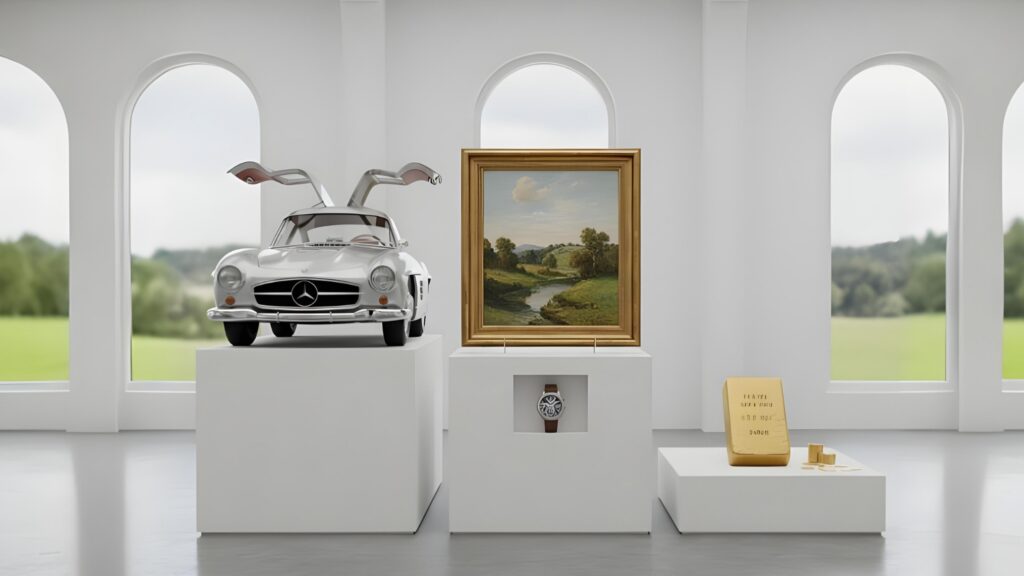
A useful way to understand 2025 is through a simple contrast: fast money versus slow money.
Fast money is what you can trade in seconds: listed stocks, ETFs, liquid derivatives, crypto. It offers optionality and speed, but it also plugs you directly into the most brutal feature of modern markets, panic can become execution instantly.
Slow money is what takes time to sell: fine art, collectible watches, investment-grade wine, prime real estate, and other illiquid tangibles. It can feel inconvenient, especially if you are used to daily liquidity and instant fills.
Yet in 2025, that inconvenience often behaved like a protective layer.
When volatility spiked, slow-money holders were not hammering a “sell” button. They were calling specialists, waiting for appraisals, assembling provenance files, prepping auctions, or simply deciding not to sell at all.
That’s the liquidity paradox that became impossible to ignore:
- The ability to exit instantly is comforting in theory, but it also invites the worst timing decisions when fear takes over.
- Assets that force patience reduce the odds of locking in permanent losses during temporary periods of panic.
Fast money is perfect for tactics. Slow money proved its value as a strategic ballast.
Alternative Assets With the Best Investment Returns
Fine Art
Fine art remained the purest expression of slow money working as designed.
A major painting does not hit the market overnight. It goes through authentication, condition reviews, professional photography, catalog preparation, and targeted marketing to qualified buyers. That pipeline takes time, and it costs money.
Total transaction costs are often in the 15 percent to 20 percent range, which is not trivial. But in a year like 2025, that friction mattered. It filtered out impulse selling and reduced the kind of forced supply that can collapse liquid markets during panic.
The top of the art market also runs on real scarcity. Works priced above $1 million represent about 58 percent of total market value, while making up only 1 percent of transactions. That is the kind of concentration that creates a genuine supply ceiling.
A deceased artist cannot increase output. Museums remove important works from circulation permanently. When demand rises, supply cannot respond.
Even liquidity needs were handled differently. Instead of selling into weakness, collectors increasingly used art secured lending, borrowing roughly 40 percent to 60 percent of appraised value to access capital while keeping the asset.
This is why art can feel “quiet” during market stress. It is not that prices never move. It is that the market structure slows down emotional decision making.

Rolex Daytona
Watches, particularly Rolex, showed a similar pattern: knowledge created separation.
Vintage Rolex Daytona exotic dials continued to demonstrate how a niche market can generate outsized results when scarcity and cultural significance overlap. Paul Newman dial variants kept commanding premiums that are difficult to understand until you see the specific numbers attached to specific references.
A white dial reference 6239 could command $350,000 or more depending on condition and provenance. A reference 6262 with an acrylic bezel could exceed $500,000. A reference 6264 in 18K yellow gold reached around $950,000 at auction.
Those prices did not appear out of nowhere. They were built over time by collectors who understood two things early.
First, the supply was fixed and thin, often in the hundreds or low thousands for the most desirable configurations. Second, the story mattered. When an object becomes culturally iconic, the market stops pricing it like a product and starts pricing it like a symbol.
Modern Daytonas also illustrated that watch investing is not limited to six figure trophies. The ceramic bezel Daytona reference 116500LN appreciated about 22 percent over five years from its 2016 launch, with secondary market pricing in the $28,000 to $35,000 range. That matters because it shows the ladder.
You can participate at different levels of capital, and the same forces still apply: supply discipline, global demand, and status permanence.
In simple terms, the Daytona market rewarded investors who were not buying “a Rolex.” They were buying a reference, a dial, a condition profile, and a narrative with staying power.

Wine Investment
Unlike many collectibles where the object survives indefinitely, fine wine is designed to be consumed. Every year, a portion of the world’s top inventory disappears permanently through drinking, celebrations, restaurant lists, and private events. This creates a natural supply reduction curve that other alternative assets rarely have.
When you combine that with limited production from top estates, the scarcity effect becomes compounding. A top Bordeaux château or a blue chip Burgundy domaine cannot simply double output without changing quality and reputation.
Vineyard land is fixed, yield is controlled, and classification reputations are built over generations. In practical terms, supply is naturally capped.
Fine wine is supported by a wide demand base, which is a big reason it remains investable when you focus on the most traded names.
- Private collectors buy for long term cellaring and status.
- Restaurants and hospitality groups buy for premium wine programs and client experiences.
- Merchants, brokers, and traders buy because certain labels have repeatable turnover.
- Auction buyers buy for provenance backed bottles and rare formats.
This matters because you do not depend on one buyer type to create liquidity. The best investment grade wines tend to have repeat demand across regions, especially in markets where luxury consumption remains resilient.

What 2025 Taught Investors
By the end of 2025, many investors stopped treating illiquidity as a flaw and started treating it as a protective moat.
Fine art cannot be dumped at the bottom because selling is a process. High transaction costs discourage impulse exits.
Vintage watches do not crash like tech stocks because there is no universal sell button, and auction timelines create natural cooling off periods. Real estate moves slowly, and that slowness prevents the kind of rapid capitulation you see in liquid markets.
Meanwhile, scarcity emerged as the true dividing line between durable alternatives and fragile ones.
True scarcity does not respond to demand. Dead artists cannot produce more work. Vintage reference runs ended decades ago. Prime geographic locations face physical constraints that do not vanish because sentiment improves.
False scarcity is different. It can be policy dependent, trend dependent, or incentive dependent. 2025 exposed how quickly those versions can unravel.
Another 2025 takeaway is that narrative creates price power. Provenance, celebrity association, and institutional validation can elevate an object from desirable to iconic.
In watches, cultural association can turn a reference into a symbol. In art, museum acquisition and major exhibitions can strengthen long term demand and sustain premiums.
This dynamic rewards investors who understand culture and history, not only numbers. It also encourages discipline, because chasing the narrative after the premium is already established often reduces future upside.
That is why, alternative asset investing demands a different mindset than managing liquid portfolios. The winners of 2025 typically brought a combination of expertise and patience. They understood how to identify investment grade pieces, they accepted that exits take time, and they maintained conviction through volatility.
For investors who can operate with multi year horizons, tangible assets offered a compelling mix in 2025: lower correlation, scarcity driven support, and wealth preservation characteristics that felt more dependable than markets priced in microseconds.