

Private equity is becoming the top choice for high-net-worth investors in 2026, and the reasons are hard to ignore. Stock markets are swinging on every headline, inflation is stubbornly refusing to fade, and bonds are handing you returns that barely move the needle. So wealthy investors are asking a simple question: where should their money actually be working?
More and more, the answer is private equity.
The numbers tell you just how big this shift has become. Private equity assets under management have climbed to around $8.6 trillion, nearly double what they were six years ago. Industry forecasts suggest that figure could cross $10 trillion by the end of 2026, according to Bloomberg’s latest private markets analysis.
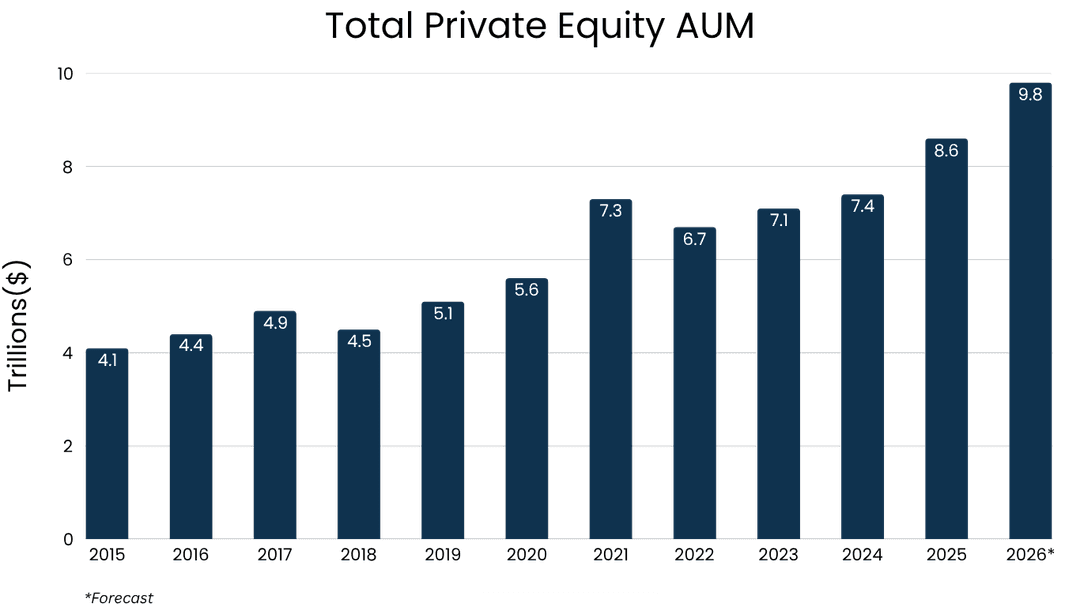
A big part of that growth is coming directly from wealthy individuals who want more control over where their capital goes and stronger results to show for it.
Over 48% of high-net-worth investors now say they plan to increase their private equity allocations over the next two years, up from just 29% back in 2019. The draw is real. You get a shot at higher long-term gains, and your portfolio stops dancing to the rhythm of daily market noise.
And there’s another factor that matters a lot. Private equity often gives you the chance to own a piece of companies before they ever go public or get acquired. These are the kinds of opportunities that used to be locked away inside massive institutional portfolios.
Today, new fund structures, digital platforms, and lower minimums are pulling back the velvet rope for wealthy individuals who know where to look. If you want to understand why investing across multiple asset classes and geographies is becoming the new standard, private equity sits right at the center of that conversation.
What Is Private Equity Investments?
For HNW allocation data, we anchor to the Capgemini World Wealth Report and the UBS Global Wealth Report. Both run consistent year-on-year survey methodologies that let us measure shift rather than just stock.
For underlying deal data, we use PitchBook and Preqin as our primary sources. Where the two diverge, we read the methodology footnote before drawing conclusions.
Private equity is straightforward at its core. You’re putting money directly into private companies, businesses that aren’t listed on any public exchange, or buying them outright through dedicated funds. Unlike picking up shares of Apple or Tesla on the open market, private equity lets you own a piece of companies long before they ever ring an opening bell.
These investments typically flow through private equity funds, which pool capital from multiple investors to buy, build up, and eventually sell businesses at a profit.
The typical life cycle of a private equity fund runs 8 to 12 years. During that window, fund managers, often called general partners or GPs, scout out promising companies, roll up their sleeves to accelerate growth, and then position for an exit through an IPO or a strategic sale.
You, as an investor putting up capital, are known as a limited partner or LP. When the fund exits those businesses, you share in the profits.
This is a hands-on style of investing. As Blackstone CEO Stephen Schwarzman often puts it, “Private equity isn’t just about capital, it’s about building better companies.” That means the teams running these funds don’t simply buy and wait. They actively drive value by improving operations, pushing into new markets, and making targeted acquisitions.
For high-net-worth investors, this approach delivers something the public markets rarely can.
- Early access: owning growth-stage businesses that could become the next big thing.
- More control: since fund managers often sit on boards and directly influence business decisions.
- Alignment: because GPs usually invest their own money alongside investors, everyone’s interests stay tied to growing the company’s value.
To put it simply, here’s a quick snapshot of how private equity typically works in practice.
| Step | What Happens |
|---|---|
| Fundraising | Private equity firms raise money from investors. |
| Investment Period | They buy companies with strong growth potential. |
| Value Building | Help these companies grow and improve operations. |
| Exit | Sell or take the company public, aiming for profit. |
| Distribution | Return capital and profits to investors. |
This model has stayed remarkably consistent over the decades. But what’s changing fast is who gets to participate. As the next sections show, more wealthy investors are stepping into private equity every year, drawn by higher returns, steadier portfolios, and exclusive deals once reserved strictly for the institutional giants.

Historically Higher Returns
One of the strongest reasons you’d move money into private equity is the most obvious one: the returns. Over the long run, private equity has consistently beaten public markets, often by a wide margin. For investors who want their wealth growing faster than a standard stock and bond mix can deliver, that performance edge matters.
Look at the numbers. Based on global fund data covering the past 20 years, private equity has delivered average annual net returns of 13% to 14%, compared to around 8% for global public equities over the same stretch, as the Financial Times has reported in its private markets coverage.
Even over the last decade, private equity held its lead with average annual returns of about 12%, while global stock indices hovered closer to 7% to 8%.
As BlackRock’s Larry Fink recently put it, “Private markets continue to outpace public markets, and we believe this will only accelerate in the coming years.”
His view lines up with forecasts suggesting private equity could keep delivering excess returns of 400 to 600 basis points over public stocks through 2026, especially as more institutional and individual wealth flows into these funds.
Why does private equity generally do better? A few clear reasons stand out.
- Active involvement: Private equity firms don’t just buy shares and hope for the best. They work closely with management teams, restructure operations, expand into new markets, or bring in new leadership to unlock value.
- Longer time horizons: Unlike public shareholders worried about quarterly earnings, private equity investors focus on multi-year growth strategies, which often produce bigger payoffs.
- Access to exclusive deals: Many of the best investment opportunities never make it to the public markets. Private equity funds often scoop up these companies early, then grow them behind the scenes.
There’s also a disciplined exit approach built into the structure. Private equity funds operate on clear timelines to sell businesses, typically targeting a sale or IPO once the company has hit key growth milestones. That structured approach locks in returns rather than letting gains drift with the mood of public markets.
So it’s no surprise that high-net-worth investors keep moving toward these numbers. Many see private equity as a way to put their money to work in strategies that aim to beat the market, not just follow it, as one managing director at a leading private equity advisory recently put it. If you want to sharpen your overall approach, understanding how to manage risk across your portfolio becomes even more important when private equity is part of the mix.
Reduced Portfolio Volatility
Beyond the return potential, many high-net-worth investors move into private equity because it smooths out the ride. Public markets can swing violently on a single headline or a shift in investor sentiment. Private equity offers a different kind of calm.
Part of that comes down to how private equity is structured. These investments aren’t priced every second like stocks on an exchange, so they simply don’t reflect daily market noise.
As a result, private equity valuations tend to move more gradually. That cushions your portfolio against the sharp swings you’d otherwise feel with public equities.
Recent studies show just how meaningful this effect can be. Data from global wealth reports in 2024 found that adding a 20% allocation to private equity in a typical balanced portfolio cut annual volatility by roughly 1.5 percentage points, dropping from around 10.2% to 8.7%, while actually lifting overall expected returns at the same time.
KKR’s co-CEO Scott Nuttall has said it well: “Private equity gives investors the chance to ride out short-term storms and focus on long-term value creation.” That’s exactly why more wealthy families are shifting capital here. You want assets that won’t jolt every time economic data prints or a geopolitical story breaks.
Private equity also tends to have low correlation with traditional public assets. When stock markets pull back hard, private equity often holds its ground far better.
During the sharp market decline in early 2020, the average global private equity fund marked down by only 6%, compared to drops of more than 20% across major public equity indices, as Reuters noted in its analysis of private market performance during the downturn.
For high-net-worth investors who already carry substantial exposure to listed stocks and bonds, that steadier ride is genuinely valuable. Private equity adds a layer of diversification that can protect your wealth through very different market cycles.
Access to Exclusive Opportunities
One of the most compelling draws of private equity is getting access to deals the broader market never sees. These aren’t stocks trading on an open exchange. You’re talking about direct stakes in private companies that are still building momentum, sometimes long before they become names everyone recognizes.
As a senior partner at Carlyle recently put it, “Private equity is all about investing where others can’t, long before a company ever rings the opening bell.” Getting in that early is where real value is created. By the time a company goes public, much of the upside is already priced in for everyone else.
Take some of the most well-known examples. Leading private equity funds backed companies like Airbnb, Stripe, and SpaceX years before those businesses made global headlines or hit the public markets. Investors in those early rounds often saw multiples on their capital that would be nearly impossible to replicate through listed equities.
The data backs this up. According to a 2024 global private capital study, more than 62% of private equity-backed companies that exited over the past five years generated at least a 2.5x return on invested capital. That compares to a roughly 1.5x median multiple seen in comparable public market buy-and-hold strategies over the same period.
And it’s not just high-growth tech. Private equity funds take controlling stakes across traditional industries too, manufacturing, healthcare, consumer goods, places where hands-on operational improvements and smart strategy can drive performance gains that passive public investing simply can’t match.
For wealthy investors, there’s one more layer worth knowing about. Many private equity deals come with co-investment opportunities. That means you can put additional capital directly into specific companies alongside the main fund, often at lower fees and with greater upside potential.
As Bain and Company highlighted in a recent private equity outlook, co-investment volumes have doubled since 2018, which tells you exactly how much private capital wants direct exposure to individual deals.
All of this adds up to something that public markets genuinely can’t offer you. You get to own slices of promising businesses and industry transformations before the rest of the world catches on.
As one analyst summed it up, “This is where value is created, not just traded.”
Increased Accessibility
Not long ago, private equity was almost exclusively a playground for large institutions, pension funds, sovereign wealth funds, and massive endowments. Minimums often started at $10 million or more, putting these investments well out of reach for even most high-net-worth individuals.
But that’s changing fast, and it’s one of the clearest reasons you’re seeing wealthy investors flock to private equity right now.
Over the past few years, private equity firms have actively worked to open the door to more private capital. The business case for doing so is obvious.
As Blackstone’s President Jon Gray often says, “The future of our industry is tapping the enormous pool of individual wealth that’s still largely unallocated to private markets.”
The numbers show just how much runway exists. Even today, less than 5% of total high-net-worth assets globally sit in private equity, compared to over 25% for big institutions. That gap is a massive opportunity.
To close it, the industry is getting creative. Many firms have launched feeder funds and semi-liquid private equity products that allow individuals to invest with minimums starting around $100,000, far below what traditional buyout funds have historically required.
At the same time, online platforms are simplifying how wealth managers and individual investors access vetted private equity opportunities, with streamlined onboarding and digital reporting that fits how wealthy clients want to manage their portfolios today.
There’s also been a sharp rise in evergreen private equity structures. These are funds without a fixed end date that instead allow investors to commit and redeem capital at scheduled intervals. That flexibility is a big deal compared to traditional 10-year lock-ups, making private equity far more appealing to HNWIs who want long-term exposure but with periodic liquidity built in.
Recent data shows how fast this shift is moving. Between 2018 and 2024, the share of global private equity capital coming from private wealth channels doubled, and forecasts suggest it could reach 20% by 2027.
Put simply, more of the world’s private equity funding is coming straight from wealthy families and individuals than at any point in the asset class’s history.
Easing of Regulations
Another key reason more high-net-worth investors are moving into private equity is the regulatory environment shifting in their favor. For decades, strict rules kept private markets largely off-limits to most individuals. But regulators have started to recognize that wealthy, investors deserve more ways to diversify beyond the traditional stock and bond playbook.
In the U.S., updates from the SEC have broadened the definition of an accredited investor, making it easier for professionals with certain credentials or relevant experience to qualify, even if they don’t clear the old wealth thresholds. That change alone opened private equity access to thousands of new investors practically overnight.
As one senior partner at a top global private equity firm put it, “Regulators are starting to see that investors deserve more avenues to grow and protect their wealth.”
Meanwhile in Europe, new frameworks like the ELTIF 2.0 regulations, rolling out through 2026, are streamlining how private equity funds can market to and onboard private investors across the region.
These updated rules aim to cut through paperwork, offer more flexible redemption options, and lower the barriers so that private wealth can flow more freely into long-term investment projects.
In 2024, private equity funds across Europe raised a record €174 billion, with about 28% of that capital coming directly from private wealth channels. That’s up sharply from 19% just five years ago, and it’s helping build a much broader investor base beyond the traditional pension and insurance giants. You can see a similar pattern playing out in the growing world of ESG and values-driven investing, where regulatory shifts are also reshaping who participates.
Regulators are also taking extra steps to protect investors while encouraging access. Many of the new rules put a strong emphasis on better transparency, clearer fee disclosures, and improved investor education. The goal is a smart balance, giving you more ways to invest in private equity while making sure you fully understand the risks and structures involved.
As BlackRock’s Larry Fink commented recently, “Private markets will play an ever-larger role in portfolios, and regulation is evolving to make sure that happens responsibly.”
It’s easy to see why private equity is becoming such a major focus for high-net-worth investors heading deeper into 2026. You’re looking at the promise of higher returns, steadier portfolios, access to exclusive deals, and a proven hedge against inflation, all at a time when public markets look increasingly uncertain.
With new fund structures making private equity easier to access, and regulations evolving to support more private wealth participation, this shift looks set to build further in the years ahead.
For many wealthy investors, private equity isn’t just an alternative anymore. It’s becoming a core part of how you grow and protect your capital for the long run.
We last reviewed this analysis in May 2026.


Stefanos Moschopoulos
Stefanos Moschopoulos founded The Luxury Playbook in Athens and has spent the better part of a decade following the auction calendar, the en primeur releases, and the watchmakers, gallerists, and shipyards the magazine covers. He writes the field guides and listicles that anchor the Connoisseur section — pieces built on Phillips and Christie's results, Liv-ex movements, and conversations with collectors he has met across Geneva, Bordeaux, Basel, and Monaco. His own collecting habits sit closer to watches and wine than art, and it shows in the level of detail in the magazine's coverage of those categories. Under his direction, The Luxury Playbook now publishes long-form field guides, market-defining year-end listicles, and the Voices interview series with the founders behind the houses and the brands.