


The Athens real estate market in 2026 is entering a decisive period of maturation. What began as a post-crisis recovery has now shifted into sustained growth, driven by rising international demand, record-high tourism figures, and a robust pipeline of urban redevelopment. Compared to other European capitals, Athens offers compelling value — combining capital upside with one of the highest rental yields in Southern Europe.
As Greece’s economic capital, Athens is pulling in investors who want long-term value, strong short-let returns, and a foothold in a fast-reforming EU real estate market. If you’re looking for a European city that still has room to run, this is one worth watching closely.
Through the first quarter of 2026, residential prices in Athens have climbed 7.6% year-over-year, outpacing inflation and exceeding price growth in many other Eurozone cities. That performance is being driven by continued investor interest in short-term rental conversions and long-stay housing for students and professionals alike.
At the same time, developments like The Ellinikon Megaproject are reshaping the city’s urban coastline, pushing demand and values sharply higher along the Athens Riviera.
For you as an investor, the market now offers two distinct tracks. Revitalized central neighborhoods give you liquidity and rental yield, while emerging suburban zones offer long-term appreciation potential. The balance between tourism-driven returns and domestic rental stability is giving Athens a unique edge in 2026.
Table of Contents
Overview of The Athens Real Estate Market
As of Q2 2026, the Athens real estate market keeps its upward momentum, supported by sustained foreign investment, strong domestic demand, and ongoing infrastructure improvements. Property prices in the capital have now surpassed pre-2008 levels in several districts, marking a full recovery and the start of a new growth phase.
The average residential sale price in Athens currently sits at €2,450 per square meter, reflecting a 7.6% year-over-year increase that few European cities can match right now.
Central areas like Exarchia, Koukaki, and Pangrati are leading in price growth, while the southern suburbs and seafront districts along the Athens Riviera are commanding a premium thanks to proximity to The Ellinikon and high tourism interest.
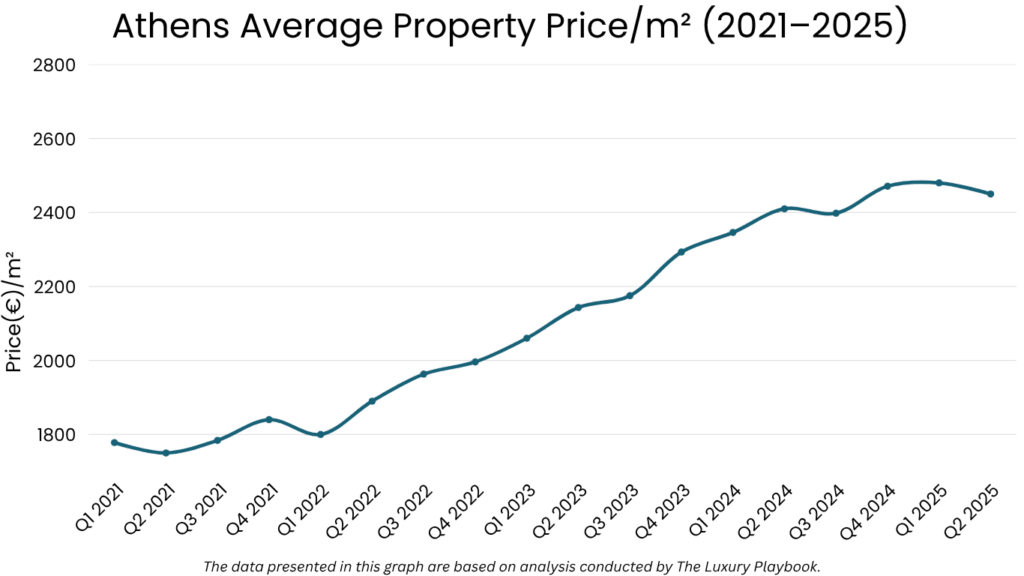
The median apartment price in central Athens runs roughly €170,000 to €230,000, depending on condition, floor level, and proximity to metro stations. Renovated units in heritage buildings or Airbnb-ready layouts tend to move faster and closer to asking price than anything else on the market.
Transaction volumes are holding strong. In Q2 2026, over 9,000 residential transactions were recorded across Athens, with nearly 40% involving foreign buyers. The average time-on-market for centrally located apartments has dropped to 58 days, down from 73 days a year earlier — a clear signal of increased buyer urgency and tighter inventory in the most sought-after neighborhoods.
Investment demand keeps being fueled by the Greek Golden Visa program, which now requires a minimum investment of €500,000 in central Athens. That threshold has narrowed the buyer pool at the high end, but it has also intensified competition for lower-priced, high-yield units sitting below it. According to Bloomberg, Golden Visa programs across Southern Europe have reshaped buyer behavior in major city markets over the past two years.
- Average residential prices at €2,450/sqm, up 7.6% YoY.
- Median apartment values range from €170K to €230K, with faster turnover on renovated units.
- 9,000+ transactions in Q2 2025, nearly 40% from foreign investors.
- Time-on-market averages 58 days, down 15 days from 2024.
- Increased investor focus on Airbnb-capable and sub-€500K properties.
The Athens housing market in 2026 is highly liquid, price-positive, and increasingly segmented by investor type and location. With constrained supply, rising demand, and new infrastructure supporting growth, the market gives you genuine opportunities across a wide range of budgets and strategies.

Neighborhood Analysis
Athens is made up of highly diverse neighborhoods, each with its own pricing dynamics, rental demand profile, and investment potential. From heritage-rich urban centers to upscale coastal districts and rapidly developing suburbs, you can choose your entry point based on your risk tolerance and yield objectives. If you want a framework for evaluating which zone fits your goals, it helps to understand how to find the right real estate market for investment before you commit.
Koukaki
Koukaki has evolved into one of Athens’ most popular residential and investment areas. Known for its walkability, neoclassical architecture, and proximity to the Acropolis Museum, the district pulls in both short-term rental operators and long-stay tenants with equal force.
The median home price in Koukaki sits at approximately €2,950 per square meter, reflecting a 9.1% year-over-year increase. Renovated one-bedroom apartments priced between €200,000 and €230,000 often sell within 30 to 45 days. High tourism foot traffic and reliable year-round demand for furnished rentals give this neighborhood a distinct advantage.
Koukaki is one of the most liquid and high-yielding neighborhoods in the city for both short-term and long-term rental investors. If yield is your priority, this is where you start your search.
Pangrati
Pangrati offers a solid balance between affordability and lifestyle. Located just east of the city center, the neighborhood has seen a surge in demand among younger buyers and international investors looking for a low-cost entry into a rising zone.
The median home price in Pangrati stands at €2,450 per square meter, with a 7.4% annual increase. Apartments under €180,000 are especially competitive, with fast absorption for units close to metro stations and green spaces.
Glyfada
Located on the Athens Riviera, Glyfada ranks among the city’s most prestigious and sought-after coastal neighborhoods. It draws luxury buyers, diplomats, and Golden Visa investors who want proximity to both the beach and high-end retail.
The median home price in Glyfada is €4,250 per square meter, up 6.2% year-over-year. High-spec villas and penthouses often exceed €600,000, while modern two-bedroom apartments in low-rise buildings trade between €320,000 and €420,000.
Neos Kosmos
Neos Kosmos is an emerging central neighborhood benefiting from infrastructure upgrades, modern residential projects, and spillover demand from nearby Koukaki. The area is still affordable relative to its location and carries strong rental momentum.
The median home price in Neos Kosmos is €2,150 per square meter, with a 6.8% increase year-over-year. Investors are targeting small apartments under €160,000 for refurbishment and short-let conversion — a strategy that continues to deliver solid returns when executed well.
Marousi
Marousi ranks as one of the most active northern suburbs of Athens, offering strong fundamentals for family buyers and long-term tenants. The area is home to corporate offices, medical centers, and international schools, making it attractive for mid- to high-income residents.
The median price in Marousi sits at €2,800 per square meter, up 5.9% compared to Q2 2025. Modern apartments and maisonettes range from €250,000 to €400,000, depending on size and proximity to amenities.
Marousi combines stable rental demand with solid capital preservation, especially if your investment horizon runs medium to long term. It’s the kind of neighborhood that won’t make headlines, but it will deliver consistent returns.
Neighborhood Median Prices and Price per Square Meter
Athens_Neighborhood_Home_Prices_2025.csv
Athens Rental Market Overview
The Athens rental market in 2026 ranks among the strongest in Southern Europe, defined by high occupancy, yield-focused demand, and limited new rental supply. As both local and international tenant bases expand, landlords are benefiting from rising lease rates and longer-term rental commitments, especially in centrally located and tourist-adjacent neighborhoods.
Average rents in Athens have increased by 5.2% year-over-year, with the strongest growth coming from one- and two-bedroom apartments suited for short- and mid-term leasing. The city’s mix of affordability, vibrant urban life, and tourism appeal keeps drawing tenants from across the EU, the Balkans, and Asia. As the Financial Times has noted, Southern European rental markets have outperformed broader European averages for three consecutive years.
Average Rent Prices by Unit Type
- Studio Apartments: €420/month (~€5,040/year)
- 1-Bedroom Apartments: €590/month (~€7,080/year)
- 2-Bedroom Apartments: €770/month (~€9,240/year)
- 3-Bedroom Apartments: €960/month (~€11,520/year)
- 4-Bedroom Apartments: €1,250/month (~€15,000/year)
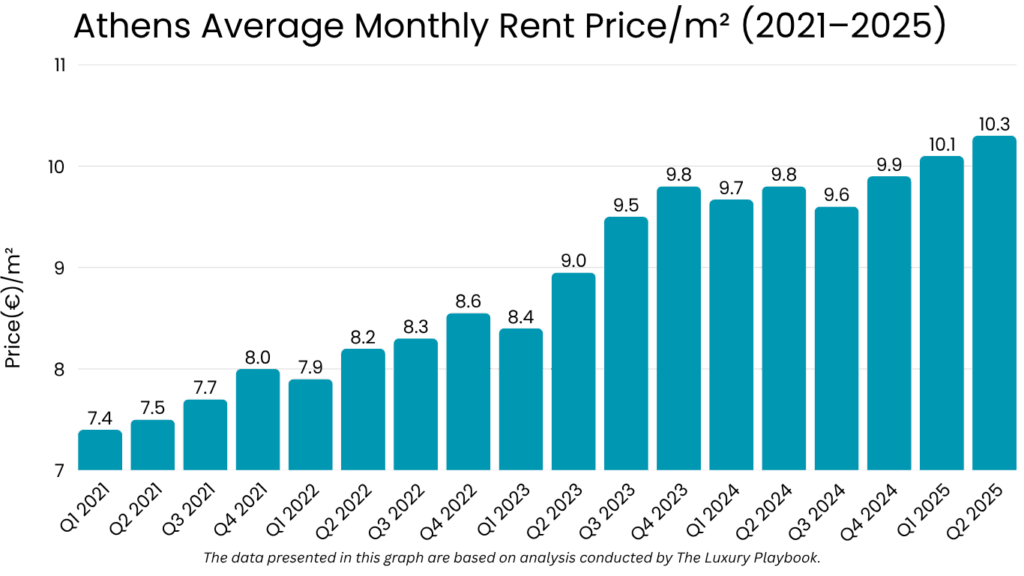
Rent levels vary across the city based on district, proximity to metro stations, and building condition. Renovated apartments in tourist zones or near universities consistently achieve higher rates and attract tenants faster than unrenovated stock.
Rent by Neighborhood
- Koukaki: One-bedroom apartments average €700/month, driven by high short-let demand and year-round tourism appeal.
- Pangrati: Two-bedroom units lease for €780–€850/month, particularly in newer buildings near cafes and parks.
- Glyfada: Three-bedroom sea-view apartments rent for €1,400/month, while smaller units start at €850/month.
- Neos Kosmos: Studios lease at €450/month, with strong demand from students and young professionals.
- Kypseli: One-bedrooms range from €480 to €560/month, offering value for longer-term tenants and mid-income residents.
Vacancy and Leasing Trends
Athens maintains a low vacancy rate of 3.9%, with the tightest supply concentrated in city-center districts and areas popular with digital nomads and students. Landlords are increasingly preferring 12-month renewable leases over short stays, particularly in zones where Golden Visa investment thresholds have tightened the economics of Airbnb conversions.
Tenant demand is strongest near universities, metro stations, and tourist corridors. Lease turnover stays high in studio and one-bedroom units, which gives you as a landlord the flexibility to reprice more frequently in a rising market.
Investor’s Outlook
Rental yields in Athens stay highly attractive, particularly for small apartments in central districts. Gross returns of 6% to 9% are typical for well-located, renovated properties, while suburban units in newer developments average 4.5% to 6% annually. Regulatory stability and low property tax rates further strengthen your net income performance.
Athens delivers reliable rental returns, backed by tight supply and growing tenant diversity that supports income-driven investment strategies. For landlords focused on cash flow, the city’s rental market gives you some of the most resilient yields available anywhere in the EU. Building the right real estate investment portfolio around Athens assets can make a meaningful difference to your overall returns.

Factors Influencing The Athens Housing Market
The Athens housing market in 2026 is shaped by a complex blend of macroeconomic trends, regulatory shifts, urban development, and investor sentiment. Together, these forces drive pricing, influence investor strategy, and determine long-term growth across both the residential and rental sectors. Understanding each one gives you a clearer picture of where the real opportunities lie.
- Strong Foreign Investment: Athens remains a top destination for international buyers due to its affordability within the EU, lifestyle appeal, and favorable residency programs. Foreign investors accounted for nearly 40% of residential transactions in Q2 2025, with demand concentrated in central Athens and along the Riviera. The Greek Golden Visa continues to serve as a major catalyst, despite the recent €500,000 minimum investment rule in prime districts.
- Infrastructure & Urban Redevelopment: Major infrastructure projects—most notably The Ellinikon coastal redevelopment—are reshaping the city’s southern landscape. As this €8 billion project progresses, neighboring areas such as Glyfada, Elliniko, and Voula are seeing accelerated price growth, increased investor activity, and new high-spec residential supply.
- Tourism Recovery & Airbnb Demand: Tourism in Greece has surpassed pre-pandemic levels, with Athens benefiting as both a primary and transit destination. This trend has fueled demand for short-term rentals in areas like Koukaki, Plaka, and Monastiraki. Despite regulatory efforts to limit saturation, Airbnb continues to play a key role in the pricing dynamics of small city-center apartments.
- Rising Construction & Renovation Costs: Renovation-driven investment remains a cornerstone of Athens’ property market, especially in older urban stock. However, rising material and labor costs have compressed margins for flippers and increased acquisition thresholds. This trend is encouraging investors to focus on finished or lightly refurbished properties to reduce capex exposure.
- Rental Market Imbalance: A mismatch between supply and tenant demand persists across most central districts. Many units remain underutilized due to legal restrictions, inheritance issues, or reluctance to upgrade aging stock. This supply bottleneck has allowed rents to rise faster than inflation, keeping gross yields attractive even as purchase prices climb.
- Financing Conditions: Access to mortgage financing has improved slightly, with more Greek banks offering competitive rates for local buyers. However, the market remains largely cash-driven, especially for international investors. Low loan-to-value ratios and moderate credit demand have kept the housing market less exposed to financial volatility.
Athens Housing Market Forecast for 2026
The Athens housing market is expected to stay on a growth trajectory through 2026, though the pace of appreciation may moderate compared to the previous two years. Demand will keep being supported by international investment, limited new supply in central zones, and sustained rental pressure — particularly in neighborhoods near universities, infrastructure nodes, and coastal redevelopment areas.
While rapid gains may ease slightly, Athens is forecast to hold its position as one of the most attractive European markets for yield-focused and mid-term capital growth investors. The fundamentals are solid, and the pipeline of demand shows no signs of drying up.
Property prices in Athens are projected to increase by 4% to 6% in 2026. With the current average at €2,450 per square meter, prices are expected to climb toward €2,580 to €2,630 per square meter depending on neighborhood, condition, and investor activity. Central districts like Koukaki, Neos Kosmos, and Pangrati are likely to outperform, driven by demand spillover and a genuine scarcity of new stock.
Luxury zones like Kolonaki, Glyfada, and Voula will stay stable, driven by lifestyle buyers and Golden Visa investors. That said, affordability constraints and stricter short-term rental regulations may cap further aggressive price surges in those areas.
Inventory will stay tight in 2026, particularly in the resale apartment segment. Some new development projects will complete in the south and northeast suburbs, but central Athens will remain undersupplied due to zoning rules, preservation restrictions, and limited land availability.
Properties in renovated buildings close to transit and education hubs are expected to show the strongest price resilience and liquidity. If you’re buying to hold, those are the assets worth targeting.
Rental prices are forecast to rise by 3% to 5%, supported by continued pressure from tourism, student housing shortages, and low availability of modern long-term lease units. One-bedroom apartments could reach €630 to €650 per month, while short-let rates will stay robust in zones with strong tourism infrastructure and limited regulatory pressure.
Vacancy rates are expected to stay below 4% in most city-center districts. The balance between domestic long-term leases and short-term rentals will become increasingly neighborhood-specific, with certain districts leaning more heavily into one segment over the other.
From a macroeconomic standpoint, Greece’s improved credit rating, low property tax burden, and stable eurozone membership will keep attracting foreign buyers looking for relatively secure, income-producing assets. Reuters has tracked Greece’s credit trajectory over recent years as a key signal for international real estate capital allocation.
Demographic trends — especially digital nomads, retirees from Western Europe, and regional student migration — will further support occupancy and pricing momentum well into the second half of the decade.

Is It Worth Buying a Property in Athens?
Buying property in Athens in 2026 can offer you tangible benefits, particularly if you’re targeting income-generating assets or medium-term capital appreciation. But as the market grows more competitive and segmented, you need to weigh the city’s genuine strengths against its structural limitations with clear eyes.
Residential prices are forecast to rise by 4% to 6% in 2026, supported by limited supply, international buyer interest, and neighborhood-level regeneration. Central districts like Koukaki, Pangrati, and Neos Kosmos offer good liquidity and rental demand, while coastal zones like Glyfada and Voula hold long-term lifestyle value for the right buyer profile. You can also explore the Estia real estate developer review to understand what quality development looks like in this market.
Rental yields stay competitive across the market. One-bedroom apartments in well-located areas typically deliver gross returns between 6% and 9%, depending on lease structure and property condition. Demand from tourists, students, and young professionals supports year-round occupancy in central Athens.
That said, there are real constraints to factor in. Regulatory shifts around short-term rentals could impact your ROI in tourist-heavy areas. Renovation costs have risen sharply, which may narrow profit margins for value-add strategies. Liquidity in luxury and suburban zones can be uneven, and legal due diligence in older buildings is not optional — it’s essential.
You should also know that returns are highly localized. Neighborhood selection, building quality, and tenant targeting play a defining role in overall performance. Athens has become a reliable property market within the EU, but it does not offer the scale, institutional transparency, or financing depth of larger Western capitals. According to Forbes, savvy investors in emerging European markets consistently outperform by focusing on hyper-local dynamics rather than city-wide averages.
Athens presents a viable opportunity for investors with a clear strategy, a realistic time horizon, and a focus on income and urban value creation. It is not a speculative market. But it is one of Europe’s most affordable and resilient urban centers for property acquisition — and that combination is hard to find.
Other Market Forecasts & Overviews
Thessaloniki Real Estate Market Overview & Forecast
Mykonos Real Estate Market Overview & Forecast
Santorini Real Estate Market Overview & Forecast
FAQ
Are Athens property prices expected to rise in 2026?
Yes. Prices are forecast to increase by 4% to 6% across most residential zones.
Is Athens a good place to invest in real estate?
Yes, especially for investors targeting strong rental yields, urban regeneration, and long-term value.
What are the best neighborhoods to invest in Athens?
Top areas include Koukaki, Pangrati, Glyfada, Neos Kosmos, and Marousi—each offering distinct rental or capital appreciation potential.
Are rental yields in Athens attractive?
Yes. Gross rental yields range between 6% and 9%, particularly in central districts and renovated apartments.
Does Greece charge property or capital gains tax on real estate?
Yes, but taxes are relatively low. Greece offers competitive annual property taxes and tax exemptions under specific conditions for foreign buyers.