
Few watches command a room the way the Rolex GMT-Master II does. In 2026, it pulls attention from collectors, seasoned travelers, and serious investors all at once. Originally built for airline pilots in the mid-20th century, the GMT-Master II has grown into something far bigger than its origins, a global icon that fuses genuine functionality with undeniable prestige.
Today, wearing one says a lot. But owning one says even more. Beyond telling the time across two zones, the GMT-Master II acts as a store of value, a statement piece, and a credible long-term investment in the luxury timepiece space.
Unlike fast-moving fashion trends or tech-driven wearables that age quickly, the GMT-Master II is built on legacy. Its dual-timezone capability, premium materials, and timeless design have helped it thrive across generations. As of 2026, this model anchors Rolex’s professional watch line, with secondary market premiums regularly beating retail prices and a depreciation risk that looks modest compared to most traditional asset classes.
As more investors look to diversify into hard luxury goods, watches like the GMT-Master II are gaining serious traction. Its performance over the past decade has outpaced many mid-cap equities and left several rival luxury models behind. What truly sets it apart is a rare combination of liquidity, scarcity-driven price dynamics, and deep global demand across every major continent. If you want to understand why Rolex and its peers are fueling the secondary watch market boom, the GMT-Master II is one of the clearest examples you’ll find.
By the time you finish reading this, you’ll have a full picture of the GMT-Master II’s investment case, covering its history, model variations, key features, pricing behavior, ROI performance, and whether it belongs in your portfolio right now.
Table of Contents
History of The Rolex GMT-Master II
The story of the Rolex GMT-Master II starts with a simple but urgent problem: how do you track two time zones at once without carrying two watches?
Back in the 1950s, Pan Am pilots flying long-haul transatlantic routes needed exactly that. Rolex answered in 1954 with the original GMT-Master, equipping it with a fourth hand and a rotating 24-hour bezel. For its time, that was a genuine engineering breakthrough, and it quickly became the watch of choice for commercial pilots and globe-trotting professionals.
Fast forward to 1982, and Rolex made a bold move with the GMT-Master II. On the surface it looked familiar, but underneath it was an entirely different machine. The defining upgrade was the independently adjustable hour hand.
That single change made the watch far more practical. You could now set local time without touching your GMT reference, a feature that frequent flyers and international executives immediately appreciated.
From there, the GMT-Master II kept evolving. Aluminum bezels gave way to the now-iconic Cerachrom ceramic. The Caliber 3185 was eventually replaced by today’s refined Caliber 3285 movement. Rolex kept pushing the engineering forward without ever losing the soul of the original design. That balance between innovation and heritage is genuinely rare in any product category.
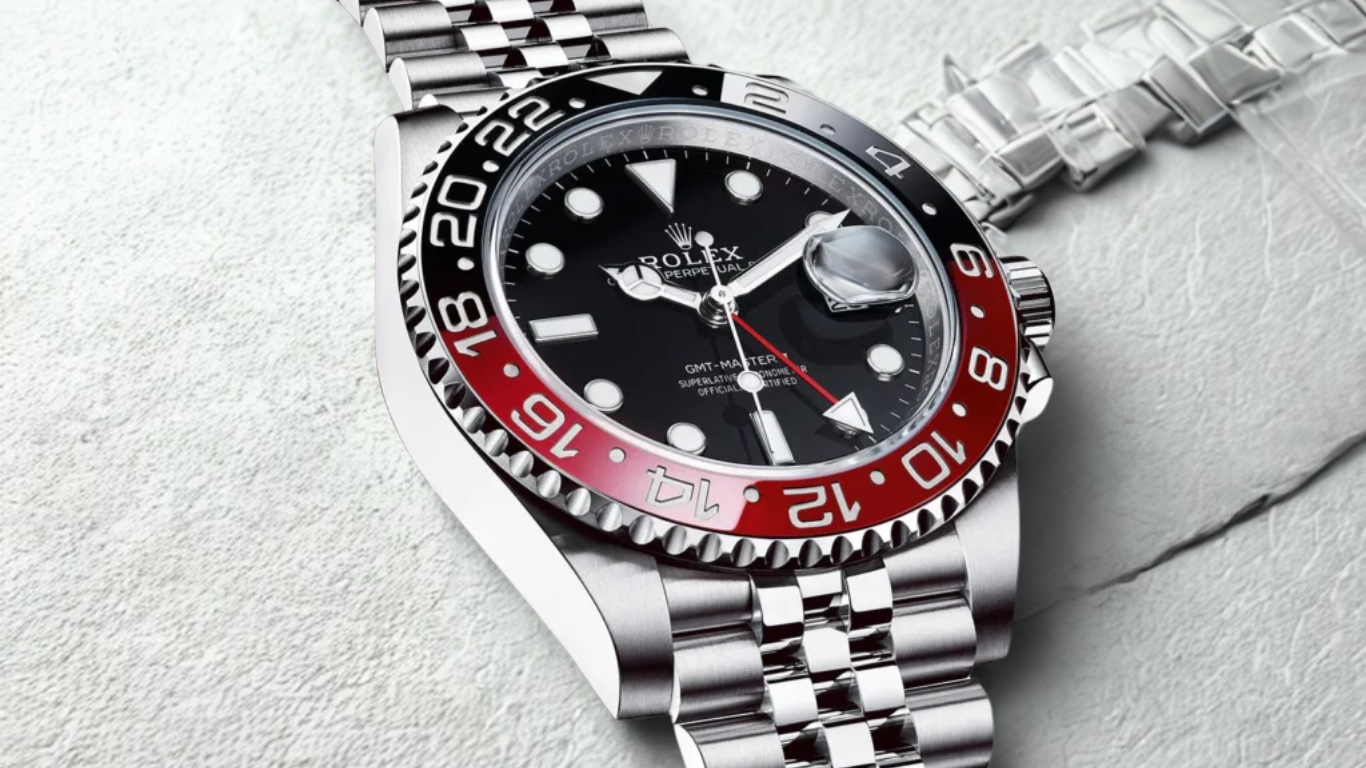
A major turning point arrived in the early 2000s when models like the “Batman” (black and blue bezel) entered the scene, alongside the revival of the “Pepsi” (red and blue bezel) on Jubilee bracelets. These weren’t just cosmetic refreshes. They sent a clear signal to the market that the GMT-Master II had crossed into collectible, investment-grade territory.
Today, the GMT-Master II sits at the crossroads of performance and prestige. Whether you spot it on the wrist of a transatlantic business traveler or watch it clear six figures at Christie’s watch auctions, the message is the same. This watch has real staying power, and its story is far from over.

Different Models of The Rolex GMT-Master II
The GMT-Master II lineup is carefully curated, offering a set of variations that balance iconic design, serious mechanical capability, and strong investment potential. Each model brings something distinct to the table, whether that’s a nostalgic colorway, a premium material choice, or a technical edge that collectors specifically seek out.
Among the most recognizable is the “Pepsi” bezel, with its distinctive red and blue Cerachrom ceramic insert. Built originally to help transatlantic pilots distinguish day from night hours at a glance, it has since become one of the most coveted references in all of modern watchmaking.
Currently offered in white gold and Oystersteel with a Jubilee bracelet, the Pepsi sits at roughly $10,900 at retail. But on the secondary market, demand pushes full-set models in excellent condition well into the $17,000 to $20,000 range, sometimes higher depending on provenance and timing.
Equally strong is the “Batman,” which debuted in 2013 with a black and blue ceramic bezel, the first two-tone Cerachrom Rolex ever produced. A 2019 update added the Jubilee bracelet and the more efficient Caliber 3285. Retail sits around $10,700, but secondary market values routinely clear $15,000 for clean examples.
For those drawn to warmer tones and bolder aesthetics, the “Root Beer” GMT delivers a rich mix of Everose gold and black Cerachrom, available in full gold or two-tone Rolesor configurations. These trade at roughly $15,250 at retail but frequently exceed $20,000 on the open market, driven by limited supply and growing collector appetite.
On the quieter end of the spectrum, the black bezel Oystersteel variant offers a cleaner, more understated look. It carries every mechanical and functional advantage of its more colorful counterparts but appeals strongly to professionals who prefer low-key luxury. Still, like every GMT-Master II, getting one at retail almost always means navigating a waitlist.
Every current GMT-Master II model runs on the Caliber 3285, which delivers a 70-hour power reserve, Chronergy escapement, and COSC Superlative Chronometer certification with accuracy held to plus or minus 2 seconds per day.
The lineup gives you genuine diversity without any compromise on quality, whether your taste runs sporty, refined, or firmly in collector-grade territory.
rolex_gmt_models_2025.csv
Features of The Rolex GMT-Master II
The GMT-Master II earns its reputation on more than good looks. The engineering behind it is deliberate and practical, and each core feature adds directly to its value as both a luxury timepiece and a long-term investment worth holding.
- Dual Time Zone Tracking: One of the key reasons collectors and travelers gravitate toward this watch is its ability to display two time zones at once. The 24-hour hand—paired with a rotating Cerachrom bezel—lets you track your local time and a second time zone simultaneously. It’s practical, intuitive, and ideal for those managing international business or travel.
- Rolex Caliber 3285 Movement: At the core of the GMT-Master II is the Caliber 3285—a next-gen automatic movement developed entirely in-house. It boasts a 70-hour power reserve, Rolex’s Chronergy escapement for improved efficiency, and COSC + Superlative Chronometer certification, ensuring accuracy within +2/-2 seconds per day. In short: it’s built to perform and to last.
- Cerachrom Bezel Insert: The bezel isn’t just for aesthetics—it’s crafted from Rolex’s proprietary Cerachrom ceramic, which is virtually scratchproof and resistant to fading. Whether you choose the classic Pepsi (red/blue), the sleek Batman (black/blue), or the more understated Root Beer (brown/black), you get a bezel that will hold its color and character for decades.
- Oyster and Jubilee Bracelet Options: You can pair your GMT-Master II with either the Oyster bracelet (more sporty and robust) or the Jubilee bracelet (more refined and dressy). Both feature the Easylink comfort extension system, which allows for quick 5mm adjustments—a small but welcome detail during long flights or warmer days.
- Triplock Winding Crown & Water Resistance: The watch is water resistant up to 100 meters, thanks in part to its Triplock crown system. While it’s not a diver’s watch, it can easily handle rain, sweat, and even swimming—making it reliable across environments.
- Anti-Magnetic and Shock Protection: Inside the movement is Rolex’s blue Parachrom hairspring, which provides protection against magnetic fields and physical shocks. This is especially relevant for everyday wearers and investors alike—long-term durability translates into sustained value.
- Timeless Aesthetics and Versatility: Beyond the specs, the GMT-Master II has a versatile presence. It looks just as natural with a suit as it does with weekend attire. This wearability boosts demand across demographics and markets, helping ensure it remains one of the most liquid and desirable Rolex references.

Rolex GMT-Master II Pricing
When it comes to pricing, the GMT-Master II has carved out its own tier in the high-luxury sports watch category. This isn’t a watch that simply holds value. It commands it. And in 2026, that pricing story keeps getting more interesting.
Over the past several years, retail prices have crept steadily upward, pushed by Rolex’s annual price adjustments and by demand that keeps outrunning supply. But the real story plays out on the secondary market. Whether you’re chasing a current “Pepsi” or hunting a discontinued gem, one pattern shows up consistently across references, strong liquidity paired with genuine appreciation.
On paper, MSRP for a steel GMT-Master II lands between roughly $10,900 and $11,600 USD in 2026. In practice, you’ll almost certainly pay more on the secondary market, sometimes well above that, depending on the reference, condition, and how urgently you want it.
Limited production runs, regional allocations, and Rolex’s deliberately tight supply strategy have created persistent premiums across most variants. For investors and collectors, buying at retail isn’t just the ideal scenario, it’s become a genuinely rare one.
Recent Production Models
Recent Production Models
Discontinued and Collector-Focused GMT-Master II Models
Discontinued & Collector-Focused GMT-Master II Models
As of 2026, GMT-Master II demand holds especially strong across North America, Europe, and the Middle East. Cities like New York, London, Dubai, and Singapore lead in resale velocity, with the highest activity around full-set, unworn models with clean paperwork.
Worth noting is that left-hand-drive “Sprite” models are seeing higher-than-expected traction among younger collectors and left-handed buyers. And vintage aluminum bezel GMTs, particularly “Coke” and “Pepsi” references, are being snapped up by enthusiasts chasing slimmer case profiles and a purer expression of classic Rolex design. Japan’s quiet watch revolution is also feeding into this vintage appetite, with Japanese collectors increasingly active in the global GMT market.
What’s Driving GMT-Master II Pricing?
- Scarcity by Design: Rolex controls supply tightly. Even ADs receive limited stock, making retail acquisition increasingly rare.
- Model Iconography: “Pepsi,” “Batman,” and “Root Beer” nicknames fuel pop culture demand, which converts directly into premium resale.
- Steady Appreciation: Unlike flashier references, GMTs climb with consistency. Year-over-year appreciation rarely dips into negative territory.
- Crossover Appeal: Whether you’re buying for travel, investment, or legacy, the GMT-Master II ticks multiple boxes.
Rolex GMT-Master II Historical ROI and Performance
The Rolex GMT-Master II has locked in its place as a modern icon. But beyond the status it carries on the wrist, it has quietly become one of Rolex’s most consistent long-term performers when you look at value retention and price appreciation side by side.
Yes, the Daytona and the Submariner get most of the headlines. But the GMT-Master II holds its own, and in some ways outperforms both, thanks to its dual-time functionality, broad global recognition, and a resale liquidity that serious watch investors have come to rely on.
Collectors and investors are increasingly treating the GMT-Master II as a strategic hold. Steel references with Cerachrom bezels, discontinued variants like the “Coke” and “Batman,” and newer entries like the “Sprite” have delivered steady year-on-year growth, typically in the 5 to 9 percent range. That kind of consistency is hard to find in most asset classes. According to Bloomberg’s coverage of the luxury watch market, hard luxury assets like investment-grade timepieces have drawn growing attention from wealth managers looking beyond equities.

Auction Statistics and Market Trends
From 2020 through 2026, GMT-Master II resale values have shown robust and measurable appreciation across the key references, a track record that few competing models can match across the same window.
- At a 2024 Phillips auction, a 126710BLRO “Pepsi” full set sold for $20,500, nearly 78% above its $11,600 MSRP—with clean examples consistently trading above $19,000.
- A 2013 “Batman” 116710BLNR, initially retailing at ~$8,950, was sold in 2025 for $17,500, reflecting a compound annual growth rate (CAGR) of 7.6% over 12 years.
- Vintage 16710 “Coke” bezel models now regularly fetch between $13,000–$16,000, with boxed and unpolished units occasionally commanding over $17,000. This marks a near double-digit CAGR from prices in the $4,500–$5,500 range during the early 2010s.
- The newly released 126720VTNR “Sprite”—a left-handed crown configuration with green/black bezel—is showing 30–40% premiums over retail within 18 months of release.
Modern GMTs running the Caliber 3285, fitted with solid end-links and Jubilee or Oyster bracelets, trade consistently at or above MSRP in global resale markets. Steel sports Rolexes rank among the most liquid and in-demand asset classes you can own in the watch investment space. Rolex’s Deepsea follows a similar demand logic, but the GMT-Master II’s broader appeal gives it an edge on resale velocity.
Current Market Behavior and Forecast
As of 2026, the GMT-Master II secondary market is shaped by a handful of clear forces worth understanding before you buy or sell.
- Strong price stability for all steel variants with Cerachrom bezels.
- Elevated interest in discontinued and low-production runs.
- Regional preference patterns: “Root Beer” and “Sprite” models are outperforming in Asia-Pacific and the Middle East; vintage “Pepsi” and “Coke” variants are dominating auction attention in Europe and North America.
Buyers are paying meaningful premiums for boxed, unworn, unpolished references. And they’re scrutinizing the details more than ever, bezel alignment, bracelet stretch, and the completeness of papers all factor into final pricing in ways that weren’t as visible even three years ago. Fratello’s GMT-Master II buying guide covers exactly what to look for when evaluating condition and completeness.
Entry-Level, Mid-Tier & High-End Investment Tiers
If Rolex holds its tightly controlled production model and keeps evolving the GMT-Master II line with the same mix of precision and scarcity, this watch will anchor serious watch portfolios for years to come.
Its blend of real functionality, brand recognition, and a value trajectory that bends consistently upward makes it one of the most well-rounded and resilient watches you can own as an investment.
Who Should Invest In A Rolex GMT-Master II In 2026?
The GMT-Master II is pulling in a wider spectrum of buyers than ever before, from first-time luxury watch purchasers to seasoned portfolio builders who want resilient, asset-backed value. If you’re thinking about stepping into timepiece investing, this model offers a compelling mix of liquidity, long-term appreciation, and brand strength that’s genuinely hard to replicate at this price point. And if you’re weighing your options across the broader Rolex lineup, it’s worth reading a head-to-head comparison of Rolex versus Breitling to see how the brand holds up against its closest competition.
Here’s a breakdown of who stands to benefit most from putting money into this model in 2026.
- First-Time Watch Investors: If you’re entering the luxury watch space and want your first purchase to hold or even gain value, the GMT-Master II is a smart choice. Steel variants like the “Pepsi” or “Batman” are relatively easy to liquidate, globally recognized, and tend to hold their value even if worn regularly. It’s a reliable entry point that rarely disappoints.
- Collectors Seeking Stable Appreciation: While other models may spike and crash with trends, the GMT tends to appreciate slowly and steadily, averaging 5–9% annually across key references. It’s an anchor piece—something you can hold for 5–10 years and expect solid ROI with minimal volatility.
- Buyers Focused on Liquidity and Resale Potential: Platforms like WatchBox and Chrono24 list thousands of GMTs, and the model moves quickly—often within days when priced competitively. It’s one of the most liquid Rolex models in existence.
- Investors Interested in Limited or Discontinued References: For those who can secure rarer models like the “Coke,” “Sprite,” or vintage 1675s, long-term upside is considerable. These references have lower production numbers and often outperform newer models, especially when unpolished and in original condition.

Rolex GMT-Master II Alternatives
The GMT-Master II sets a high bar in the dual-time watch category, but it’s far from your only option in 2026. For collectors, enthusiasts, and investors who want functionality paired with prestige and a credible long-term value case, several strong alternatives are worth your attention, some with fewer barriers to entry, others with arguably greater upside. Hodinkee’s roundup of the best GMT watches offers a solid starting point if you want to see how the field lines up before making a final call.
- Tudor Black Bay GMT: Often described as the GMT-Master II’s younger sibling, the Tudor Black Bay GMT brings many of the same practical advantages in a slightly more rugged and accessible package. Priced around $4,400 at retail, it mirrors the iconic “Pepsi” bezel and includes a COSC-certified movement. While it doesn’t offer the same luxury cachet as Rolex, Tudor’s growing collector recognition and its status under the Rolex umbrella make it a credible option for value-focused investors.
- Omega Seamaster Planet Ocean GMT: Omega’s Planet Ocean GMT leans into technical excellence and bold styling. It comes equipped with the brand’s signature co-axial movement and is water-resistant to 600 meters, offering a different kind of versatility. Priced near $7,900, it appeals to those who want robust engineering in a sport-luxury format. Although Omega watches typically appreciate more slowly than Rolex, they hold value well and benefit from brand equity and precision engineering.
- Grand Seiko Spring Drive GMT: For those looking to break away from traditional Swiss names, Grand Seiko offers exceptional craftsmanship and proprietary Spring Drive movements that combine mechanical and quartz principles. Their GMT models typically retail between $6,500 and $8,500 and feature immaculate dial finishing, smooth glide seconds, and understated refinement. These watches are gaining recognition in global markets, especially among collectors who value originality and micro-level finishing.
- Breitling Chronomat GMT 40: Breitling’s modern GMT entry brings aviation heritage into a sleek, wearable design. The Chronomat GMT 40 targets the modern traveler, combining a practical second-time-zone feature with updated styling. With a retail price around $5,600, it’s an attractive choice for younger professionals entering the world of luxury watches. Investment-wise, Breitling GMTs hold respectable value, though they trail Rolex in terms of resale power and collector demand.
- Rolex Explorer II (Ref. 226570): Staying within the Rolex family, the Explorer II offers GMT functionality in a more discreet and utilitarian design. It trades flashy bezels for a clean white or black dial and a fixed 24-hour bezel, favored by travelers and professionals alike. Priced at $9,650 retail, the Explorer II is experiencing a quiet surge in demand, with resale values climbing 4–6% annually. It’s an often-overlooked option that’s becoming a stealth investment favorite.
FAQ
Is the Rolex GMT-Master II a good investment in 2025?
Yes, the Rolex GMT-Master II remains a strong investment in 2025. Its consistent resale value, limited production, and enduring demand contribute to annual appreciation rates of 5–8% for most models—often higher for discontinued or rare versions.
Which GMT-Master II models are most likely to appreciate?
Models like the Pepsi (Ref. 126710BLRO) and Batman (Ref. 126710BLNR) are top performers due to their collector appeal and historical significance. Special editions or discontinued models tend to appreciate faster in the secondary market.
What is the current retail price of the Rolex GMT-Master II?
As of 2025, most GMT-Master II models retail between $10,700 and $12,300, depending on the reference and bracelet configuration. However, secondary market prices can range from $14,000 to over $20,000, especially for sought-after versions.
Why is the GMT-Master II often priced higher on the secondary market?
High demand, limited supply, and waitlists at authorized dealers drive up resale prices. Collectors are often willing to pay a premium to skip the wait and secure rare or discontinued models.
How does the Rolex GMT-Master II compare to other Rolex models for investment?
While the Daytona and Submariner also perform well, the GMT-Master II strikes a balance between functionality and collectability. It often sees similar appreciation, especially in popular color variants and early production runs.
Is it better to buy a new or pre-owned GMT-Master II?
If you’re able to buy at retail from an authorized dealer, that’s ideal. However, pre-owned models in excellent condition often hold or exceed retail pricing, especially if they come with box and papers.
How often does Rolex release new GMT-Master II models?
Rolex typically updates the GMT-Master II line every few years. Changes often include new bezel colors, movement upgrades, or material variations. Limited releases can significantly impact market dynamics and collector interest.