


The art world’s gender gap is staggering, even after decades of conversation about equity and representation. Between 2008 and 2019, roughly $196.6 billion was spent at auction globally, yet only about $4 billion of that went to works by female artists, according to Forbes.
That’s roughly 2% of total spending. Think about that for a moment. You’re looking at a $192 billion gender gap in a market that prides itself on recognizing genius and quality wherever it appears. The numbers tell you something uncomfortable about who the market was actually paying attention to.
A BBC-backed analysis highlighted in The Guardian found that female artists’ work has been rising roughly 29% faster on secondary markets than their male counterparts since 2022, starting from that historically suppressed base. That’s not a small gap closing. That’s a structural shift.
By 2024 and into 2026, younger collectors, especially Gen Z women, are putting meaningfully larger shares of their art budgets toward female artists. That’s accelerating the institutional and private rebalancing that people have talked about for years but rarely executed with any real conviction.
Table of Contents
Key Takeaways & The 5Ws
- From 2008–2019, women artists captured only about 2% of global auction spending (€4B out of €196.6B), implying a roughly €192B gender gap that highlights how deeply female talent was historically undervalued.
- Since 2022, works by women have been rising around 29% faster on the secondary market than works by men, helped by younger collectors—especially Gen Z women—consciously redirecting capital.
- Yayoi Kusama anchors the blue-chip tier with multi-million-dollar results, more than 70% of lots beating estimates, and primary and secondary markets that still appear to be catching up to her pricing power.
- Bridget Riley is in a late but powerful re-rating phase: 1960s–70s museum-grade paintings now reaching multi-million-pound prices while still trading at discounts to comparable male peers in Op Art and Minimalism.
- Tracey Emin has shifted from “controversial” to canonized contemporary, with landmark works like My Bed demonstrating that confessional, personal art can sustain institutional pricing and strong auction demand.
- Ayako Rokkaku and Daisy Dodd-Noble represent the higher-beta end of the thesis: young, fast-moving markets with record-breaking sales, meaningful upside, and equally real volatility and career-risk.
- Who is this about?
- Female artists across generations—from blue-chip names like Yayoi Kusama, Bridget Riley, and Tracey Emin to rising figures like Ayako Rokkaku and Daisy Dodd-Noble—and the collectors, especially Gen Z women, allocating more capital toward them.
- What is happening?
- A structural re-pricing after long-term undervaluation: women still represent a small share of total auction value, but their prices are growing faster than men’s, and several artists show strong auction momentum and tightening primary–secondary spreads.
- When is the shift most visible?
- The underpayment is clearly visible across 2008–2019 (and earlier), while the acceleration is most visible from 2022 through 2025, as new records, estimate-beating results, and collector behavior increasingly favor women artists.
- Where is it playing out?
- Across the global art market—major auction centers such as London, New York, and Hong Kong, plus key contemporary hubs—where Kusama’s sustained demand, Riley’s Op Art revaluation, Emin’s landmark sales, and breakthroughs for Rokkaku and Dodd-Noble are being priced in.
- Why are prices catching up now?
- Because decades of structural exclusion created suppressed starting prices, and now changing collector demographics, institutional rebalancing, and cultural attention on equity are unlocking latent value—making both top-tier and emerging female artists central to cultural impact and long-horizon return potential.

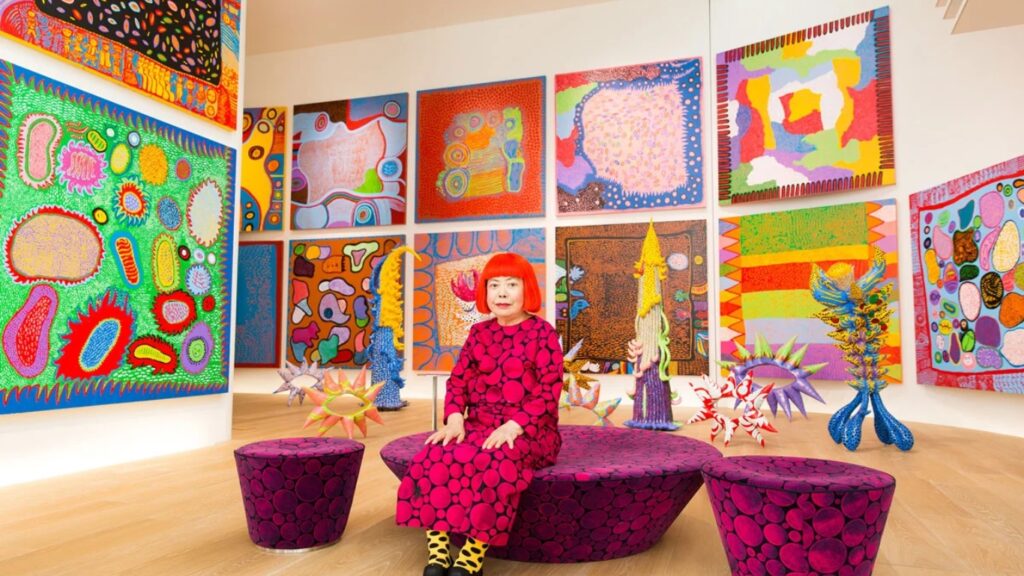
Yayoi Kusama
Kusama commands the highest auction prices of any living female artist, a position she has held for years and keeps reinforcing with results that would be extraordinary for any artist, regardless of gender.
Her Infinity Net painting achieved $10.5 million at Phillips in 2022, according to The Art Newspaper. That number sets a benchmark separating her from nearly every other contemporary woman artist when it comes to pure auction firepower.
The irony worth knowing is that Kusama famously reached out to Georgia O’Keeffe early in her career, seeking support. O’Keeffe’s response gave her meaningful encouragement during a period when the New York art establishment was largely dismissing her.
That relationship, often reduced to a simple mentor story, makes it fitting that Kusama has now surpassed even O’Keeffe’s records for a living female artist. O’Keeffe still holds the all-time auction record for any woman artist overall, but Kusama owns the present.
The consistency of Kusama’s auction performance matters just as much as the headline numbers. Maddox Gallery reported that in 2022, over 70% of her works sold above their estimates at auction. Demand isn’t just meeting expectations. It’s repeatedly blowing past them.
That pattern tells you something useful. Auction houses are still setting conservative estimates, and buyers keep proving them wrong. For you as a collector, that dynamic creates real opportunity in primary market acquisitions and gallery purchases, where Kusama’s work may still be priced on assumptions that no longer reflect where her secondary market actually trades. If you’re thinking about where to place serious capital over the next decade, artists at this level deserve a place in the conversation.
Bridget Riley
Riley’s market reached a new level of recognition with two sales that established her as one of Britain’s most valuable living artists. Her 1966 painting “Untitled (Diagonal Curve)” sold for roughly £4.3 million in 2016, well beyond its estimated value, proving that serious collectors were willing to pay museum-quality prices for optical art done right.
The 2022 sale of “Gala” reset that benchmark at £4,362,000 at Christie’s London. That result confirmed the earlier number wasn’t a lucky outlier. It was the beginning of a sustained revaluation.
These prices matter because Riley has been producing significant work since the 1960s, establishing optical art as a serious movement and influencing generations of artists working with pattern, color, and perception. Despite that historical weight and decades of continued productivity, her market lagged male peers for far too long.
The recent sales suggest that gap is finally closing. Collectors are recognizing that Riley’s contribution to post-war British art equals or exceeds that of male artists whose work has commanded premium prices for far longer. The market is catching up to what the institutions already knew.
Major museum-quality pieces from the 1960s and 1970s still trade below what comparable works by male optical and minimalist artists fetch, which leaves room for appreciation as institutions compete to acquire her best pieces. Later works and prints offer more accessible entry points if you want exposure to an artist whose historical significance only grows clearer with time.

Tracey Emin
Emin’s defining market moment came in 2014 when “My Bed” sold for roughly £2.54 million at Christie’s London, dramatically exceeding estimates and setting a record for the artist nearly 15 years after the work’s controversial Turner Prize debut, according to The Guardian.
That sale proved Emin’s work had moved well beyond provocative curiosity into genuinely collectible art that serious buyers would pay museum-acquisition prices to own. The piece itself, an unmade bed surrounded by the debris of a depressive episode, was exactly the kind of confessional, emotionally raw work that made Emin famous and that the market had historically undervalued compared to more conventional production.
Her collector base mixes institutional buyers with high-profile celebrity collectors whose ownership keeps her work visible and in demand. Madonna, Elton John, and the late George Michael are among the notable names who have collected Emin’s work, according to The Art Story. That kind of cultural cachet often translates into sustained market interest that goes beyond pure artistic merit.
The celebrity connection matters less for validating quality, which critics and institutions have already handled, and more for keeping the broad awareness alive that holds prices strong when contemporary art markets soften.
Emin’s works regularly exceed their estimated auction values, which tells you that auction houses still haven’t fully calibrated to where her market actually trades. For you as a collector, that creates an opening to acquire work at prices that may look high relative to estimates but prove entirely reasonable when the hammer falls well above those conservative projections.

Ayako Rokkaku
Rokkaku offers a completely different investment thesis. Born in 1982, she has reached price levels that typically take decades of career development to achieve. She set three consecutive auction records in 2022, with paintings breaking past the $1 million mark, according to Artnet News.
One untitled 2017 painting achieved roughly $1.3 million, more than double its high estimate. That kind of aggressive bidding only happens when collectors fear missing their chance on an artist whose trajectory looks exponential.
The speed of Rokkaku’s market development is extraordinary by any standard.
Artnet News described her as the best-selling Japanese painter of her generation and the sixth best-performing Japanese artist of all time by total sales value. Those are remarkable positions for someone who has been actively exhibiting for fewer than twenty years. Her work combines childlike imagery with a sophisticated color sense and compositional instincts that feel accessible while demonstrating genuine painterly skill.
The editioned print market she has developed creates entry points for collectors who can’t yet commit to six or seven-figure paintings but want exposure to an artist whose prices show no sign of slowing. Think of it as building a position early.
The risk with Rokkaku is real, though. Markets for young artists can be volatile, driven by fashion and speculation rather than the sustained institutional validation that supports more established figures. Her prices have risen so quickly that there’s limited historical data on how her work holds through market cycles or whether demand persists as her career matures. If you’re weighing alternative assets, it’s worth understanding how art fits alongside other stores of value, the way physical gold compares to paper gold is a useful mental framework for thinking about tangible versus speculative exposure.

Daisy Dodd-Noble
Dodd-Noble represents the kind of emerging artist opportunity where auction performance is demonstrating rapid market recognition for talent that most collectors simply hadn’t heard of just a few years ago.
Her painting “Purple Forest” from 2021 blew past its £10,000 to £15,000 estimate to sell for £69,300 at Christie’s London in June 2023, exceeding expectations by over 4.5 times. That result lands even harder when you consider how early it came in her public timeline.
Phillips notes that her first solo exhibition in London was in 2020 at Roman Road Gallery, meaning she went from debut solo show to achieving nearly £70,000 at Christie’s in just three years.
This kind of rapid price acceleration usually means the market has identified genuine talent before the artist has built the exhibition history and institutional validation that normally underpins such prices. Buyers are betting on trajectory rather than track record. That introduces real risk, but it also creates the potential for substantial returns if Dodd-Noble keeps developing and her work enters major collections.
The subject matter in her paintings, often natural landscapes and forests rendered with rich, layered color palettes, has broad appeal while demonstrating technical sophistication that signals serious artistic ambition rather than purely decorative work.
The investment thesis for Dodd-Noble requires you to accept that you’re buying near the beginning of what could become a major career, or one that plateaus after early enthusiasm fades. That’s the honest version of the story.
For collectors who want exposure to potentially transformative appreciation and are comfortable with the reality that early success doesn’t always translate into long-term market strength, Dodd-Noble offers exactly that high-risk, high-reward profile. It’s the kind of bet that makes sense as part of a diversified collection, the same way emerging wine regions are attracting speculative capital from collectors willing to move before the crowd arrives.
Her work is still accessible at price points where you can build a meaningful position without committing enormous capital. But that window may close quickly if her market keeps developing at the pace the Christie’s result suggests. The collectors who move early on stories like this are the ones who get to tell them later.