


If you’re looking at the UK property market right now, the opportunities are real and they’re varied. Research consistently points to a handful of standout locations where rental demand is strong, infrastructure is improving fast, and growth projections are hard to ignore.
The way people work and live has shifted dramatically, and UK property investment trends are moving with it. The smartest money is flowing toward cities and regions with deep educational roots, healthy job markets, and active local investment. Those are the signals that tell you where real growth is heading.
Key Takeaways
- Identifying lucrative prospects within the vibrant landscape of the UK’s property investment realms.
- Examining favourable property investment trends across the UK’s diverse economic terrains.
- Highlighting top locations for property investment that promise both stability and growth potential.
- Analyzing rental yields and their implicative returns within targeted investment hotspots.
- Assessing the macroeconomic and infrastructural influences shaping property values in 2023.
- Understanding the significance of strategic location choices in maximising investment revenues.
- Navigating the competitive edge provided by cities with burgeoning education hubs and job markets.

Understanding the UK Property Market Analysis
When you dig into the UK property market, the fundamentals are genuinely compelling. You’re looking at a country of 67 million people, a GDP of $3.1 trillion, and an economy built on diverse pillars that have proven resilient through multiple cycles.
The UK led the G7 with 4.0% GDP growth in 2023, which tells you something about the underlying strength here. Its commercial real estate market alone is valued at around 250 billion euros, drawing capital from both domestic players and international institutions. Even as US investment sentiment dipped elsewhere, American firms actually increased their UK allocations, and that says a lot about where sophisticated money sees value.
If buy-to-let is your focus, getting a firm read on the market before you move is everything. Manchester is a perfect case study. Its property scene has attracted serious international capital, which underlines just how far the global appetite for UK real estate investment has spread.
In places like Falkirk in Scotland and Waltham Forest in London, properties are moving fast. Quick turnover in a market is a reliable indicator of strong demand and healthy liquidity, both things you want to see before committing capital.
| Statistic | Value | Implication for Real Estate |
|---|---|---|
| UK Population | 67 Million | Large consumer base for residential and commercial real estate. |
| UK GDP (2023) | $3.1 Trillion | Economic strength suggesting robust investment capacity. |
| GDP Growth Rate (2023) | 4.0% | Indicates an expanding economy, potentially driving demand for property. |
| U.S. Exports to UK (2023) | $157.1 Billion | Reflects strong trade relations and investment prospects. |
| Jobs Supported by UK Investments | 2.6+ Million | Suggests a robust job market underpinning the real estate sector. |
| Foreign Investment in UK Real Estate (2023) | Approx. £20 Billion | Significant international capital flowing into the real estate market. |
| Growth in UK Property Inquiries Post-Brexit | 60% Jump | Surging interest in UK properties, especially from overseas investors. |
| Fastest-selling Real Estate Market | Falkirk, Scotland | Homes selling in 20 days; high demand and turnover rate. |
If you’re serious about UK real estate, watching these numbers closely is non-negotiable. The market has genuine complexity, economic forces shift, and the details matter enormously when you’re deploying significant capital.
The smartest approach is thorough on-the-ground research, with a sharp focus on location quality, employment health, and affordability relative to local incomes. Get those three right and you’ve built a solid foundation for a successful property investment.

Best Places to Invest in Property in the United Kingdom
The UK property investment picture keeps evolving, and right now the sharpest attention is on cities like Leeds, Manchester, and Liverpool. These are the markets consistently showing up at the top of serious investors’ lists. Cross-border capital flows into UK property are growing, with the US alone expected to channel around $13 billion into British real estate. And the asset preference is shifting too. Residential and logistics properties are pulling ahead of office space as the primary targets for smart money.
Manchester’s credentials speak for themselves. It’s become one of the most watched property markets in the UK, offering a rare mix of new development pipeline, cultural energy, and genuine job creation. These are exactly the ingredients that sustain a healthy real estate market over the long term. Before the mid-2010s, the UK was capturing over 70% of European property investment flows, and low financing costs have helped keep that momentum alive.
Across Europe broadly, housing market returns are modest. Paris, for example, tends to deliver yields in the 3% to 4% range. But Central and Eastern Europe is worth keeping on your radar too. Cities like Prague, Warsaw, and Bucharest are attracting growing capital flows and offer return potential that more established Western European markets simply can’t match right now.
The window of opportunity in Leeds, Manchester, and Liverpool is open, but it won’t stay that way forever. These cities are drawing serious attention and serious capital, and for good reason. If you’re building a UK property strategy, these three belong at the centre of your thinking.
Derby
Derby is one name that keeps coming up in serious UK property market analysis, and the numbers back it up. Property prices in Derby rose by 9% in 2022, and as inflation stabilises and the broader economy finds firmer footing, the conditions for sustained growth are falling into place.
Derby’s job market is a major part of the story. Rolls-Royce alone anchors a significant employment base in the city, and that kind of anchor tenant for a local economy matters enormously to property investors. With wages projected to grow by 8.3% in 2023 and 5.4% in 2024, the purchasing power feeding Derby’s housing demand is only getting stronger. The Financial Times has tracked UK regional wage growth as one of the key drivers reshaping property demand outside London.
Property Affordability
Derby’s housing prices still look reasonable relative to local earnings, and that ratio is one of the cleanest signals of genuine investment opportunity. As incomes rise through cuts to national insurance and a 7% lift in the minimum wage in 2024, more buyers and renters can compete in Derby’s market. That expanding demand base points toward strong capital growth potential.
New Property Supply and Demand Dynamics
Supply in Derby is tight, and demand for buy-to-let properties is running well ahead of available stock. When that gap persists, prices tend to move in one direction. Add in the wage growth story, particularly in the services sector, and Derby shapes up as a market where getting in early could reward you well.

Nottingham
Nottingham has been putting up numbers that are hard to ignore. The city’s real estate saw a 10.9% price increase last year, which is strong by any measure. But what makes Nottingham genuinely interesting is that this price growth is running alongside high rental yields, meaning you’re not having to choose between capital appreciation and income.
The affordability story in Nottingham adds another layer. Housing prices are accessible relative to comparable UK cities, and the demand-supply imbalance is firmly in the landlord’s favour right now. Nottingham also fits neatly into a broader movement toward impact-conscious investing, where returns and positive community outcomes go hand in hand.
A study found that 56% of people in the UK are interested in some form of impact investing, meaning they want their capital to generate returns and do something meaningful. But only 9% have actually made the move. That gap between intention and action is exactly where real estate can play a powerful role, and Nottingham is well positioned to benefit.
Nottingham checks the boxes for both growth and community value. UK regeneration initiatives have directed real resources into the city, and the results are showing up in the property market.
| Statistic | Implication for Nottingham Real Estate |
|---|---|
| 56% interest in impact investing | Demonstrates a public leaning toward investments with societal benefits, reinforcing Nottingham’s strong market growth as an attractive avenue. |
| 9% actual investment in impact areas | Indicates potential growth space for Nottingham’s market, inviting savvy investors to act on burgeoning interest. |
| 10.9% property price growth in Nottingham | Confirms Nottingham’s position as a burgeoning area for long-term value creation in the UK property market. |
So Nottingham brings together financial performance and broader social impact in a way that few UK cities can match right now. For investors who want their portfolio to work hard on multiple levels, this is a market worth exploring seriously.

Leeds
Leeds has built a reputation for consistency in the UK property market, and in a world of volatile markets, consistency is worth paying for. While other parts of the country experience sharp swings, Leeds keeps delivering steady, reliable performance. That stability is exactly what attracts investors who are building long-term wealth rather than chasing short-term spikes, making it one of the genuinely strong picks among the best places to invest in property in the United Kingdom.
Even when national prices dipped 0.2%, Leeds was holding its ground and looking for the next move up. Compared to the volatility you get in London, that kind of measured growth is actually a feature, not a limitation.
| Region | Annual Price Change | Average House Price |
|---|---|---|
| Leeds | 4.8% | £173,260 |
| Northern Ireland | 4.6% | £178,000 |
| Scotland | 3.7% | £179,148 |
| Wales | 1.2% | £202,533 |
| London | 1.6% | £519,505 |
Leeds doesn’t chase dramatic highs, and it doesn’t suffer dramatic lows. Month-on-month values have been ticking up around 0.4%, which is the kind of steady compounding that serious property investors genuinely value.
A well-balanced mix of commercial and residential space, combined with solid transport infrastructure, makes Leeds a market with genuine depth. When you’re placing serious money, depth matters.
- Economic Reliability: Standing robust with strategic business districts.
- Investment Prospects: Leeds’s market is ripe with development initiatives.
- Market Stability: Undeterred by national market wavering, it signifies secure investments.
Investors who think in decades rather than quarters keep finding their way back to Leeds. As a place for smart, durable capital allocation, it consistently earns its place at the top of any property investment analysis for high-net-worth individuals.

Manchester
Manchester keeps reinforcing its status as one of the UK’s premier property investment destinations. A slight pullback in new construction starts in 2023 barely registered against the city’s broader five-year momentum.
Demand for city centre rentals in Manchester is outpacing supply by a meaningful margin, and that imbalance is pushing yields higher. Ten residential schemes were completed in 2023 alone, a strong showing given the headwinds the broader UK market was facing at the time. Commercial real estate data from CoStar confirms Manchester’s position as a leading UK investment market.
Suburb Investment Opportunities
Greater Manchester offers you a wider canvas than the city centre alone. The suburbs attract a diverse tenant base and draw directly from Manchester’s economic engine. 2023 brought a wave of new investment into these areas, and the pipeline for office and student housing development heading into 2024 and beyond looks healthy.
Talent and Investment Opportunities
Manchester’s ability to attract talent is one of its most underappreciated investment assets. Three major office schemes totalling 381,000 sq ft were completed in 2023, and looking ahead, around 1.5 million sq ft of new office space is expected to come to market, with 38% already pre-let before completion. That level of pre-letting tells you the confidence in Manchester’s commercial market is genuine.
The focus in Manchester’s office sector is increasingly on quality over quantity. Refurbishments jumped from 21% to 53% of new activity between 2022 and 2023, with four significant projects breaking ground in 2023. The City Core and Southern Arc are the two zones worth watching most closely.
New-build offices in Manchester are pulling in major corporate tenants, and that corporate anchor effect ripples through the entire local property ecosystem. From residential demand to retail to hospitality, Manchester’s fundamentals keep feeding each other in a way that rewards investors who get in and stay in.

Liverpool
Liverpool is a compelling case for investors willing to do their homework. The opportunity is real, but so are the nuances. Getting this market right requires a clear-eyed look at both the upside and the specifics on the ground.
Liverpool City Centre’s Steady Market Dynamics
Liverpool’s city centre has a foundation that holds up well through economic shifts. Strong infrastructure, quality schools, and a genuine civic identity keep it on a steady growth path. For investors looking at the best places to invest in property in the United Kingdom, Liverpool’s centre has the kind of staying power that supports long-term positions.
Moving beyond the city centre opens up additional Liverpool opportunities, but it demands a deeper understanding of local dynamics. The best buy-to-let returns here often come from knowing the neighbourhood-level detail that broad market data doesn’t capture.
| Region | Annual Price Change | Average House Price | Notes |
|---|---|---|---|
| UK overall | 0.3% | £281,000 | Stable year-over-year |
| England | -1.1% | £298,000 | Annual drop, especially in East |
| Wales | 1.9% | £219,213 | Steady growth |
| Scotland | 3.7% | £179,148 | Healthy rise, competitive market |
| Northern Ireland | 4.3% to 4.6% | £181,383 to £194,743 | Strong annual growth, leads UK regions |
| North West England | 3.7% | £232,315 | Healthy price growth, good potential |
| Liverpool | 0.4% to 1.6% | £519,505 to £539,917 | Largest average price, slight annual increase |
The full picture of Liverpool’s property market is layered. For investors who take the time to understand the regional shifts within the city, the rewards can be substantial. Rushing in without that local knowledge is where people get it wrong.

Newcastle
Newcastle is quietly becoming one of the more interesting stories in UK property investment. The combination of academic strength and a diversifying job market creates a distinctive opportunity set, particularly for investors focused on the student and young professional rental segments. Bloomberg has highlighted UK regional cities as offering stronger real estate returns than London in the current cycle.
Newcastle’s universities are not just educational institutions. They’re economic anchors that generate sustained housing demand year after year. Top-tier academic institutions attract ambitious young people, and ambitious young people need places to live. For property investors, that’s a structural tailwind.
Rental yields in Newcastle have historically lagged behind other northern cities, but that’s been changing. Getting into this market as the yield improvement story unfolds, before it’s fully priced in, is exactly the kind of timing that builds strong long-term returns.
Institutional players are already moving. Projects backed by operators like Legal and General signal that serious capital is reading Newcastle the same way, and when institutional money confirms a thesis, it tends to accelerate the timeline for individual investors too.

Belfast
Belfast’s property prices are still sitting around 22% below their 2008 peak. Think about what that means for a moment. You’re entering a market with genuine room to run, strong rental yields, and solid economic fundamentals underpinning the growth story. For investors scanning the best places to invest in property in the United Kingdom, Belfast deserves a serious look.
The US is the single largest source of foreign direct investment into Belfast, accounting for 45% of inflows over recent decades. More than a quarter of that US capital is flowing into software and IT, which tells you something important about the quality of Belfast’s workforce and its long-term economic direction. Invest Northern Ireland publishes detailed data on the city’s inward investment figures for anyone wanting to go deeper on the numbers.
Belfast also offers a cost of living that undercuts both Great Britain and the Republic of Ireland, which matters for attracting talent and sustaining population growth. The city’s relatively high economic inactivity rate is worth watching too, but not as a negative. It signals an untapped workforce that, as it moves into employment, could accelerate local economic momentum in ways that directly feed property demand.
The Belfast City Council has set up an £18.7 million City Centre Investment Fund. It aims to transform the city center to meet modern needs for connectivity, green areas, and a vibrant city life.
- Boosting employment in Belfast’s city center is key to the city’s revival strategy, which aims to create a thriving work environment.
- Increasing the number of people living in the city center will make it lively, even after work hours.
- Updating the retail sector responds to changing shopping habits, keeping the city current.
- Emphasizing tourism helps with broader economic growth, highlighting Belfast’s historic and cultural appeal.
- Developing centers for learning and innovation moves Belfast towards a knowledge-based economy.
- Aiming for a city that prioritizes green, walkable, and bike-friendly areas maps out a sustainable future.
Belfast’s long-term strategy is built around creating a city that earns recognition on the global stage. The focus on shared spaces, innovation, and community investment is creating exactly the kind of environment that attracts both residents and capital over the long run.

Cardiff
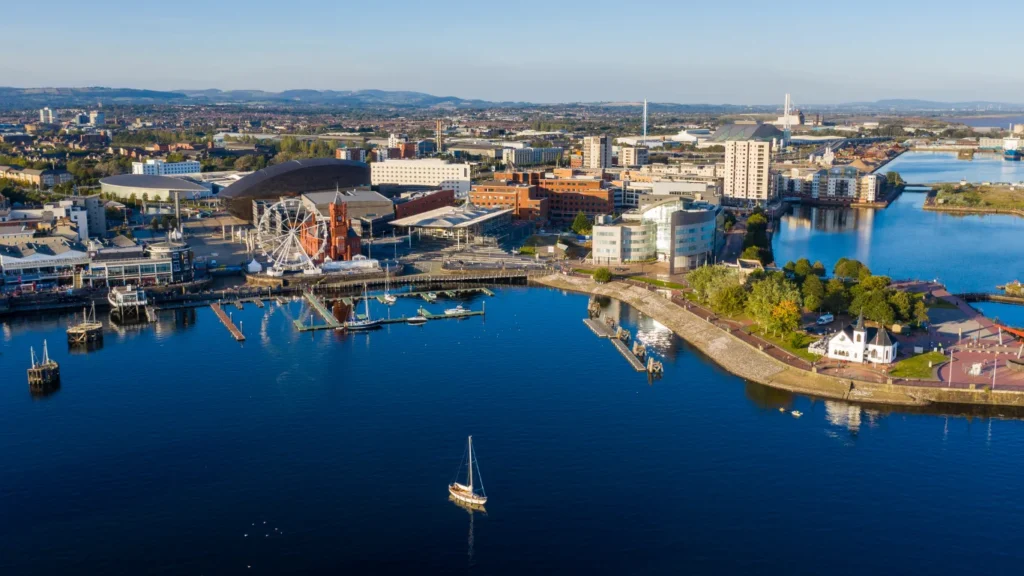
Cardiff is emerging as a genuinely exciting prospect in the UK property market. As Wales’s capital, it’s projected to see meaningful population growth driven by urban development, business expansion, and job creation, all of which translate directly into property demand.
With an urban population of 84.6% in 2023, Cardiff has a dense, active residential market. Inward investment from both domestic and international sources is picking up, and the city is developing a reputation as a hub for talent and innovation that echoes Manchester’s trajectory over the past decade. You can also explore real estate partnership structures as a smart entry point into markets like Cardiff if you’re looking to spread risk while accessing growth.
| Cardiff Property Market Indicator | Data (2023 est.) | UK Comparison |
|---|---|---|
| Population Growth Rate | Leadership in UK growth projections | 153rd nationwide |
| Urban Population | 84.6% | Mainly clustered around major cities including Cardiff |
| Net Migration Rate | 3.2 migrant(s)/1,000 population | 41st nationwide |
| Life Expectancy | 80 years for males and 84.2 years for females | Total population expectancy 82.1 years |
The demographic data backs the story up. A net migration rate of 3.2 migrants per 1,000 population keeps feeding fresh demand into Cardiff’s housing market. With a large urban population base and growing inflows of new residents, the pipeline of real estate opportunity in Cardiff looks durable.
Cardiff rewards patient investors who are willing to track its evolution closely. The demographics are moving in the right direction, the investment climate is improving, and the return potential in a competitive UK market is among the more compelling cases you’ll find outside the big northern cities.
Emerging Locations Beyond the Big Cities
The biggest cities capture most of the headlines, but some of the sharpest returns in UK property right now are showing up in regional markets that most investors overlook. Middlesbrough is one of the clearest examples. Low entry prices and high rental yields are a rare combination, and Middlesbrough currently offers both. The city’s economic momentum is building, making it an increasingly attractive target for buy-to-let investors who want strong cash flow alongside long-term appreciation.
Durham brings a different kind of appeal. Its historic character and world-class university create a steady, self-renewing demand base from students, academics, and the businesses that cluster around great institutions. For investors building diversified portfolios, that blend of heritage and modern economic activity is genuinely valuable.
Overlooking the UK’s smaller regional markets is a mistake that costs investors real money. These areas are showing strong growth signals and a stability that some larger cities can’t match right now. In many cases, the returns you can generate in these regional hotspots will outperform what you’d see in the more crowded big-city markets. As they continue to develop, they’re proving to be among the most rewarding places to put serious property capital in the UK.
FAQ
What are the best UK property investment hotspots for 2023?
The top places for UK property investments in 2023 are Derby, Nottingham, Leeds, Manchester, Liverpool, Newcastle, Belfast, and Cardiff. These spots stand out due to property price growth, good rental income, job opportunities, and transport links.
Why is Derby considered a phenomenon in property price growth?
Derby’s seen as amazing because property prices grew by 9% in 2022. High job rates from big employers and a lack of new homes predict more market growth and opportunities for investors.
Why should investors explore regional hotspots beyond big UK cities?
Investing in regional hotspots beyond the big cities can lead to great investment returns and growth opportunities. Places like Middlesbrough and Durham offer affordability, high yields, and a unique local charm. They’re good for investors looking for new growth areas.