
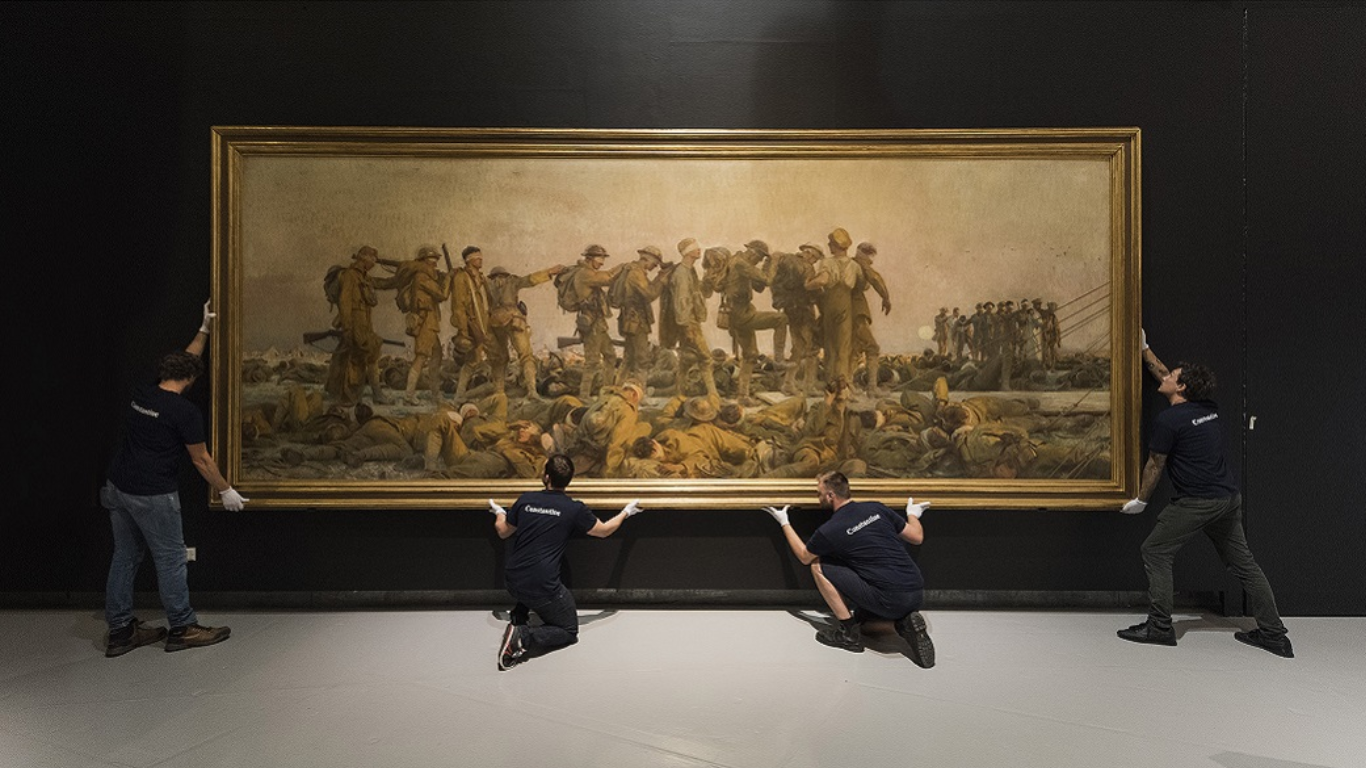

Moving fine art is not just a logistical exercise. It is one of the most consequential decisions you will make as a collector or investor, because a single lapse in judgment can destroy what centuries could not. A sudden vibration, an uncontrolled temperature spike, or a moment of careless handling can cause irreversible damage, stripping an artwork of both its beauty and its financial worth. The stakes could not be higher.
Art has firmly established itself as one of the most compelling alternative investment classes available to you. The global art market clears over $65 billion annually, and behind every transaction sits a logistics operation sophisticated enough to rival any financial institution. But acquiring a masterpiece is only half the story. Protecting it, transporting it, and preserving it over time is what separates serious collectors from those who learn costly lessons the hard way.
Table of Contents
The Importance of Expert Art Handling
Handling fine art is a discipline all its own. It demands specialized knowledge, an almost surgical precision, and a level of attention most people never encounter in any other field. These are not ordinary objects you are moving. They are fragile, acutely sensitive to environmental shifts, and in most cases, completely irreplaceable. A tear in a canvas, a surface abrasion on a bronze, a destabilized layer of 300-year-old pigment, any one of these can happen in seconds and cannot be undone.
For you as a collector or investor, professional art handling is not a luxury add-on. It is the baseline requirement for protecting both the artistic integrity and the financial value of what you own.
Art handlers are trained specialists who understand the structural vulnerabilities of every medium, whether oil on canvas, works on paper, monumental sculpture, or complex mixed-media installations. Moving a 19th-century Impressionist painting calls for an entirely different approach than transporting a contemporary stainless-steel piece by Jeff Koons. The best handlers assess these nuances before they ever touch a work, then implement the right measures to keep risk to an absolute minimum.
Take paintings as an example. They must always be lifted by the sturdier outer frame, never by the canvas or stretcher bars, because direct pressure on those surfaces creates stress the fabric was never designed to absorb. Delicate sculptures, on the other hand, travel in custom cradles lined with vibration-dampening materials that absorb shocks during transit. These are not arbitrary protocols. They are the difference between a pristine arrival and a conservation emergency.
The physical side of handling is only part of the picture. Expert professionals also think constantly about the environment surrounding a work, because artworks are just as vulnerable to invisible threats as they are to physical ones. Temperature swings, humidity fluctuations, and even brief exposure to natural light can cause fading, warping, or chemical breakdown of materials. Trained handlers work in climate-controlled environments, use specialist gloves, acid-free materials, and conservation-grade protective enclosures as standard practice.
For you as an investor, the value of this expertise goes straight to your bottom line. An artwork’s condition is inseparable from its market value. Any deterioration, whether visible to the naked eye or detectable only under specialist examination, will erode its desirability and weaken its resale position.
Pre-Transportation Planning and Preparation
Moving fine art does not begin when someone lifts the piece off the wall. The real work starts weeks earlier. A well-executed transport operation is a meticulously planned process in which every variable, from environmental conditions to structural vulnerabilities to legal documentation, is mapped out before anything moves.
The first and most critical step is a comprehensive condition assessment. Before your artwork leaves its current location, specialists conduct a detailed physical examination, identifying existing weaknesses such as structural fragility, micro-cracks in paint layers, or prior restoration work that might make the piece more susceptible to stress during transit. Everything gets documented in formal condition reports, backed by high-resolution photography, creating an official record for your insurer and a benchmark for inspections at the destination.
Once the condition is on record, the next priority is customized packaging and crating. Fine art crates are precision-engineered structures, not standard shipping containers. Each one is built to the exact dimensions and material properties of the piece it will carry, incorporating acid-free lining materials, high-density conservation foam, internal suspension systems to absorb vibration, and airtight sealing to control moisture exposure.
- Shock-absorbing interiors to mitigate vibrations during movement.
- Climate-controlled insulation to shield against fluctuations in temperature and humidity.
- Acid-free wrapping materials to prevent chemical reactions that could degrade an artwork’s surface.
For the most delicate works, such as paper-based pieces or fragile ceramics, a double-crating system adds another layer of protection by encasing an inner crate inside a reinforced outer shell. Some high-value pieces even travel in purpose-built travel frames, which allow the work to be examined or displayed at intermediate stops without anyone needing to handle it directly.
Environmental control is equally non-negotiable at the planning stage. In transit, your artwork should be kept within a stable temperature range, typically 18 to 22 degrees Celsius, with humidity held between 40 and 55 percent. Specialized sensors and real-time monitoring systems track these conditions throughout the journey, flagging any deviation before it has a chance to cause damage.
Before anything moves, insurance and legal documentation must be fully secured. High-value pieces require comprehensive coverage against physical damage, theft, and unforeseen incidents. For international shipments, you also need to address customs declarations, import and export permits, and compliance with cultural heritage regulations in every jurisdiction involved. Skipping this step does not save time. It creates exposure that no amount of expert handling can fix after the fact.
Local Transportation Methods
Moving fine art across a city might sound straightforward compared to an intercontinental shipment, but the risks are real and the margin for error is just as thin. Short-distance transit still exposes your artwork to mishandling, packaging failures, and environmental fluctuations, and any of those can compromise a piece that has survived for generations. For collectors, investors, and institutions, getting local transportation right is not a lesser concern. It is the same standard of care applied at a smaller scale.
The single most important factor in local art transportation is the vehicle itself. Professional art transport trucks are not ordinary moving vans with extra padding. They are fitted with climate-controlled systems that maintain a stable interior temperature of 18 to 22 degrees Celsius and humidity between 40 and 55 percent throughout the journey. This matters especially for oil paintings, wooden sculptures, and works on paper, all of which react to atmospheric changes in ways that can be difficult or impossible to reverse.
Beyond climate control, these vehicles use air-ride suspension systems specifically designed to absorb road vibrations. You might not think twice about a pothole or sudden braking, but at the surface of a centuries-old painting, those micro-impacts can create fractures in the paint layer or shift a sculpture’s internal structure. Shock-absorbing flooring and padded interiors add another layer of protection, reducing movement inside the cargo space and preventing accidental contact between pieces.
Loading and securing technique matters just as much as the vehicle. Artworks are never stacked or angled in ways that create pressure distortions. Instead, they are held in place with museum-grade straps and protective barriers, keeping them stationary from the moment the doors close to the moment they open again. Large paintings typically travel upright inside reinforced crates, while three-dimensional pieces and sculptures ride in custom-built foam enclosures shaped to their exact form.
The people handling your work are as important as the equipment around it. Unlike general movers, trained art handlers understand the structural vulnerabilities of different materials and know exactly how to move a piece without creating new risks. Many high-value works also travel with a dedicated courier or conservator onboard, someone whose sole job is to oversee every stage of the journey and conduct an immediate condition check on arrival.
Security is the final piece of the puzzle, and for high-profile works, it deserves serious thought. Some pieces travel in discreet, unmarked vehicles to avoid drawing attention. Others move under GPS tracking or with security personnel present. The right approach depends on the value and visibility of the work, but it should always be decided in advance, not improvised on the day.
Local transportation may cover shorter distances, but it demands the same level of care, planning, and environmental control as any long-haul shipment. The value of what you are moving does not change based on the number of miles on the route.

National and International Transportation Methods
Moving fine art across national borders or between continents introduces a completely different set of complexities. Transit times are longer, regulatory requirements are stricter, and the number of hands touching the work multiplies. Unlike local transportation, where you can control almost every variable, long-distance shipping demands meticulous coordination across multiple service providers, customs authorities, and destination handlers.
Air Freight
Air freight is the preferred method for transporting high-value art internationally, and for good reason. Speed reduces exposure time, and fewer handling touchpoints mean fewer opportunities for something to go wrong. Private chartered flights or dedicated cargo holds in commercial aircraft are the standard for fragile, high-value pieces. As Robb Report has covered, the art logistics industry has built an entire ecosystem around air transport precisely because the alternative methods carry too much risk for irreplaceable works.
During air transport, artworks travel in custom-built, climate-controlled crates engineered to withstand changes in air pressure and in-flight turbulence. Internal suspension mounting systems absorb vibrations, while high-density foam padding cushions the piece against any shocks. For truly irreplaceable works, a courier, typically a conservator or senior art handler, accompanies the shipment, personally overseeing loading, transit, and unloading at every stop.
Sea Freight
Sea freight comes into play for large-scale artworks, exhibition collections, or bulk shipments where air transport is impractical. But it is a slower option by a significant margin, often adding weeks to a journey rather than hours, which means longer exposure to fluctuating conditions. Waterproof sealing, humidity control, and reinforced crating are all essential when shipping by sea. That said, rough weather, extended port handling, and customs delays make this method better suited to non-urgent, large-volume shipments where time is not a critical factor.
Customs and Regulatory Compliance
International art transportation is not just a logistics challenge. It is a legal one. Art frequently falls under cultural heritage laws, export restrictions, and destination-specific taxation policies that vary widely from country to country. Getting this wrong does not just delay a shipment. It can result in seizure, fines, or permanent legal complications.
- Many countries impose export restrictions on artworks considered national treasures, requiring special permits or government approval before they can leave their country of origin.
- Import duties and taxes vary significantly, and failure to declare the artwork properly can result in legal consequences or confiscation.
- Compliance with the UNESCO Convention on Cultural Property (1970) and the Washington Principles on Nazi-Confiscated Art is essential when handling historical or disputed pieces.
To navigate this complexity, reputable art shipping firms employ specialized customs brokers who manage all required documentation before an artwork crosses any border. Ownership records, insurance certificates, condition reports, and provenance documentation must all be current and in order. Partnering with a firm that has deep experience in cross-border art logistics is not optional for serious collectors. It is the only sensible approach.
Security Measures for High-Value Artworks
Fine art is among the most targeted categories for theft and trafficking worldwide, which makes security a primary concern during any long-distance shipment. GPS tracking, discreet unmarked packaging, and carefully planned routing all reduce the risk of interception or theft. For particularly valuable or historically significant works, private security personnel or law enforcement escorts may accompany the shipment for its entire journey.
Choosing the right logistics partner makes all the difference here. Firms that specialize in fine art transportation bring the full package, custom crating expertise, legal compliance capabilities, risk management protocols, and the kind of institutional relationships that make complex international moves go smoothly. If you are building a serious art collection as part of a broader investment strategy, working with one of these specialists is not a cost. It is a safeguard for your assets.
Specialized Transportation Methods for Specific Artworks
Not every artwork can travel the same way. Size, material composition, fragility, and historical significance all shape the logistics approach, and a method that works perfectly for one piece could be catastrophic for another. The best art transport professionals do not apply a standard playbook. They build a custom solution for every work they handle.
Sculptures and Large-Scale Installations
Moving sculptures and large-scale installations is a logistical challenge that demands engineering-level thinking. Pieces made from marble, bronze, glass, or resin present unique risks at every stage of handling. Many require partial or full disassembly for safe transit, purpose-built armatures or custom steel frames to distribute weight evenly, and specialized lifting equipment to prevent stress on structurally vulnerable points.
- Disassembly and modular transport – If the artwork was designed in sections, professional handlers carefully disassemble it into smaller, manageable components to reduce stress during transit.
- Custom-built supports and crates – Each section of the sculpture is placed in a tailored protective enclosure, often with foam padding and vibration-dampening materials.
- Heavy-lifting equipment – Specialized cranes, hoists, and forklifts are used to maneuver large or weight-sensitive pieces. Load distribution is calculated to prevent pressure imbalances that could lead to fractures or instability.
A thorough reassembly plan is non-negotiable before anything leaves the origin site. Conservators and structural engineers often oversee the entire process, particularly for mechanically complex or fragile pieces, to ensure that what arrives at the destination can be restored to its exact original form without compromise.
Paintings and Works on Canvas
Paintings demand a level of precision that leaves no room for improvisation. Cracking, warping, and pigment loss can result from even minor errors in handling or packaging. The technique applied depends on the artwork’s age, the tension of the canvas, and the specific paint medium used. Older works with brittle paint layers may need additional facing applied before travel, while modern canvases with more flexible surfaces require different foam profiles and crating geometry to prevent contact with interior walls during transit.
- For fragile or unframed paintings, transport in a custom travel frame minimizes stress on the canvas and stretcher bars.
- Oil paintings and historic works demand stable climate conditions, as temperature fluctuations can cause canvas expansion or contraction. Special crates with humidity control systems are employed to mitigate these risks.
- Oversized paintings may be transported rolled in protective tubes (if the material allows) or in large flat crates with additional structural support to prevent bowing.
Every choice in the process, from the crate design to the orientation of the work during transport, is made to ensure the painting arrives exactly as it left. No shortcuts, no assumptions.
Works on Paper, Prints, and Fragile Materials
Paper, parchment, and textile-based works are among the most vulnerable objects you can ship. Moisture infiltration, UV exposure, and even the friction of repeated handling can cause damage that is either impossible or extraordinarily expensive to reverse. These materials require acid-free interleaving, custom-cut archival mounts, humidity-buffering materials inside sealed enclosures, and handling exclusively with clean nitrile gloves.
- Archival-quality enclosures – Acid-free, lignin-free folders and Mylar sleeves provide a protective barrier against environmental contaminants.
- Flat storage crates – To prevent curling or creasing, works on paper are transported in rigid, cushioned enclosures that maintain even pressure distribution.
- Minimal handling – Gloves made of non-abrasive, cotton-free materials (such as nitrile) are used to prevent oil transfer and deterioration.
For illuminated manuscripts, rare prints, or ancient documents, conservation specialists may also introduce low-oxygen environments during transit to slow the natural degradation of organic materials. These techniques add complexity and cost, but for objects of this rarity, they are the only responsible approach.
Mixed-Media and Technological Artworks
Contemporary and mixed-media works present a different category of challenge entirely. Neon installations, works incorporating plastics or found objects, video art, and pieces with embedded digital components each carry vulnerabilities that traditional art transport protocols were never designed to address. Neon elements require custom shock-mounts and pressure-equalized casing. Plastics and resins can off-gas or deform under heat. Digital screens need anti-static packaging and careful orientation during transit.
- Electronic components must be stabilized against impact and power fluctuations during transit. Battery backups and shock-resistant casings are often integrated into packing solutions.
- Neon and glass-based artworks are crated with built-in stabilization structures, preventing pressure points that could cause fractures.
- Textile-based or soft sculptures are vacuum-sealed in breathable fabric enclosures to protect them from moisture and dust while maintaining structural integrity.
These works push the boundaries of conventional art logistics, and getting them to their destination intact requires close collaboration between the artist, conservators, and specialist handlers who have worked with unconventional materials before. This is not an area where you want to improvise.

Handling and Installation Process at Destination
The final stage of your artwork’s journey is where many collections suffer damage that the entire preceding operation was designed to prevent. Unpacking, acclimatization, and installation at the destination are just as high-stakes as the transportation itself. A single misstep during unloading or mounting can undo every precaution taken along the way.
Condition Reassessment Upon Arrival
Before anyone moves an artwork out of its crate, a thorough condition inspection takes place. Handlers work directly from the original condition report and pre-shipment photographs, checking for any changes in the work’s physical state. They are looking for new cracks or fractures in the paint surface, any shift or deformation in a sculpture’s structure, new abrasions or pressure marks on the surface, and any sign of moisture infiltration or humidity-related warping.
- Surface cracks, abrasions, or paint detachment for paintings.
- Structural shifts, fractures, or stress points for sculptures.
- Moisture-related damage for works on paper, textiles, or organic materials.
If anything looks different from how it left, the piece does not go up on the wall. It goes to a conservator first.
Controlled Acclimatization
Acclimatization is one of the most frequently overlooked steps in fine art handling, and skipping it is one of the most common causes of post-transit damage. Your artwork has just traveled inside a carefully controlled environment. Moving it directly into a room with different temperature and humidity levels forces materials to adjust faster than they can safely manage, and the result can be warping, paint flaking, or canvas expansion that was entirely preventable.
The standard protocol holds the artwork in a controlled staging area for 24 to 48 hours, allowing environmental conditions to shift gradually until the work has stabilized. Only then does installation begin.
Safe Unpacking and Handling Procedures
Once the artwork has acclimatized, it is carefully removed from its crate following strict handling protocols. Professional handlers wear clean nitrile gloves throughout the process and use acid-free padding and conservation-grade tools at every point of contact. The artwork never touches an unprotected surface, and no one improvises a grip or shortcut under time pressure.
Specific precautions include never lifting a painting by its canvas or stretcher bars, always supporting sculptures from their most structurally stable points, keeping all tools and packaging materials away from the artwork’s surface, and documenting every step with photographs in real time.
- Paintings are lifted only by their reinforced frames, never by their stretcher bars or canvas.
- Sculptures are moved using engineered supports, never relying on protruding elements or fragile bases.
- Works on paper remain encased in protective sleeves until they are ready for framing or display.
Each action is taken with the artwork’s structural integrity as the only priority.
Installation and Mounting Best Practices
Whether you are installing a work in a private residence, a gallery, or a museum, the mounting method must be matched to the artwork’s weight, medium, and structural characteristics. Heavy oil paintings require wall anchors rated well above the piece’s actual weight. Sculptures need purpose-built plinths or armatures that distribute load evenly. Works on paper should never be exposed to direct contact with non-archival materials during framing or mounting.
- For paintings and framed artworks, museum-grade hanging systems are used, incorporating:
- D-rings and security brackets to distribute weight evenly.
- Shock-absorbing mounts that prevent frame warping over time.
- UV-protected glass enclosures for light-sensitive works on paper.
- For sculptures and freestanding pieces, structural considerations include:
- Weight-distribution calculations to prevent tipping or stress fractures.
- Earthquake-resistant mounting (in seismic regions) to minimize movement.
- Protective barriers or climate-controlled enclosures for highly fragile pieces.
After installation, lighting and environmental conditions are dialed in carefully. UV-filtering glass or lighting, controlled ambient humidity, and distance from heat sources are all adjusted to ensure the work is displayed in an environment that protects it over the long term, not just for opening night.
A final condition report is created once installation is complete, documenting the artwork’s state in its new location. This record becomes the baseline for all future conservation assessments and confirms that the entire handling process met the highest professional standards. Think of it as the closing statement on a transaction you want to get exactly right.
Factors to Consider When Selecting an Art Handling Company
Choosing the right art handling company is one of the most consequential decisions you will make as a collector or investor. The long-term safety and value of your artwork depend almost entirely on the expertise of the people you trust with it. Not every logistics firm is equipped for fine art, and the gap between a generalist mover and a genuine specialist is enormous.
Experience and Industry Reputation. The track record of any art handling firm tells you more than any brochure ever will. Fine art logistics requires a deep understanding of historical, modern, and contemporary works, each with its own vulnerabilities and handling requirements. Companies with years of experience working alongside major museums, top auction houses, and high-profile private collectors have already solved problems that less experienced firms have never encountered.
When evaluating a firm, look for verifiable references from institutions you recognize, a portfolio of complex projects they have executed successfully, and any industry accreditations or affiliations that indicate peer recognition within the field.
- How long has the company been in operation?
- Have they handled artworks similar in value and material to your collection?
- Do they have experience working with major galleries, museums, or private collectors?
- Can they provide references from past clients?
Reputable companies build long-term partnerships with leading cultural institutions precisely because their reliability has been tested and proven at the highest level.
Range of Services Offered. The best art handling companies do not just move things from one place to another. They provide an end-to-end solution that covers condition assessments and documentation before transit, custom crating and conservation-grade packaging, climate-controlled transportation by road and air, customs clearance and regulatory compliance for international moves, storage in purpose-built art facilities, and professional installation at the destination.
- Custom crating and packing tailored to specific artwork dimensions and material sensitivities.
- Climate-controlled transportation for optimal environmental protection.
- Expert installation and mounting services using museum-grade hardware.
- Temporary or long-term storage in conservation-grade facilities with humidity and temperature control.
- Security monitoring and real-time tracking for high-value shipments.
A firm that specializes exclusively in fine art logistics will always outperform a general transport provider when it comes to delicate, high-value objects. The infrastructure, the training, and the institutional knowledge are simply not comparable.
Security and Risk Management. High-value art attracts attention you do not want. Theft, loss, and accidental damage are real risks at every stage of transit, and your handling company’s security protocols need to be robust enough to address all of them. Look for GPS tracking on all vehicles, vetted and background-checked staff, secure chain-of-custody documentation, and clearly defined incident response procedures.
- GPS tracking systems for real-time monitoring of shipments.
- Secure, unmarked transport vehicles to prevent targeted theft.
- Strict chain-of-custody documentation from pickup to delivery.
- 24/7 surveillance and restricted-access storage facilities for artworks in transit.
Some firms also offer armed escorts for exceptionally valuable works during international transportation. If your collection includes pieces at that level, this is a service worth asking about directly.
Insurance and Liability Coverage. Even with the best handling in the world, unforeseen events happen. Your art handling company must carry comprehensive insurance that covers damage, loss, and theft, and you need to understand exactly what their policy covers and what it excludes. Ask for written confirmation of coverage limits, verify that the policy applies door to door rather than just during transport, and check whether the firm’s liability extends to works in temporary storage.
- What types of insurance policies are available? (e.g., transit insurance, storage insurance, liability coverage)
- What is the insured value limit per shipment?
- Does the company work with specialized art insurance firms?
Beyond what the transport provider carries, securing your own independent insurance policy is always advisable. It gives you full coverage regardless of any gaps or limitations in the logistics firm’s policy, and for a collection of real value, it is simply good practice. If you are working with a boutique asset manager to oversee your alternative investments, they can often connect you with specialist art insurance brokers who understand exactly what your collection needs.
Trained Personnel and Certifications. Fine art handling is a highly specialized skill set, and staffing quality is where many firms fall short. The best companies employ dedicated art handlers with formal training in conservation principles, registrars who manage documentation and chain-of-custody records, and conservators or conservation consultants who can assess condition issues in real time and make informed decisions on the spot.
- Certified art handlers with experience in museums and galleries.
- Conservators and restoration experts who understand material vulnerabilities.
- Installation specialists who ensure artworks are securely mounted in their final location.
Certifications from bodies such as the American Institute for Conservation or membership in the International Convention of Exhibition and Fine Art Transporters signal that a firm operates to global best practice standards. These credentials are not just marketing. They are evidence that the people handling your collection have been held to a professional standard by peers who know the field. If you are serious about building a portfolio of alternative assets that hold and grow in value, the firm you choose to protect those assets deserves the same level of scrutiny you apply to any other investment decision.
FAQ
What is the safest way to transport fine art?
The safest method depends on the artwork’s size, medium, and fragility. For high-value pieces, custom crating, climate-controlled transport, and professional handling are essential. Air freight is typically the most secure for international shipments, while ground transport with air-ride suspension and GPS tracking is ideal for domestic moves.
How do art handlers prevent damage during transit?
Art handlers use custom-built crates, shock-absorbing materials, and climate-controlled packaging to protect artworks from vibrations, impact, and environmental fluctuations. Pieces are carefully positioned and secured within transport vehicles to prevent movement.
Is insurance necessary for art transportation?
Yes. Art transportation involves inherent risks, including accidental damage, theft, and environmental exposure. Specialized art insurance policies cover potential losses, ensuring financial protection for collectors and investors.