

Crypto-backed property finance is scaling fast because it solves a specific problem for wealthy Bitcoin and Ethereum holders: how to unlock real estate liquidity without selling digital assets.
Enness Global reported a 214% rise in visits to its crypto-finance webpages over the past year, with over 100 crypto-secured loans arranged and a 30% increase in lenders offering these products, according to Mortgage Professional. What used to look like a niche workaround is increasingly behaving like a mainstream tool in high-net-worth finance, especially for borrowers whose balance sheet is strong but whose wealth sits in volatile, tax-sensitive assets.
The logic is simple. Instead of selling cryptocurrency and triggering a taxable disposal, borrowers post Bitcoin or Ethereum as collateral and borrow against it, preserving upside exposure while funding property purchases.
In practice, the borrowed funds can cover a deposit, bridge liquidity for completion, or in some cases finance the entire purchase price, while the crypto remains locked in custody as security. For buyers who believe their crypto will appreciate over time, the appeal is obvious: keep exposure to the asset while still acquiring real estate.
Three cities have emerged as clear leaders in this market, each offering a different mix of regulation, tax treatment, and lender depth that makes crypto-backed property transactions easier to execute at scale: Dubai, London, and Miami.
Table of Contents
Key Takeaways & The 5Ws
- Crypto-backed property finance lets wealthy Bitcoin and Ethereum holders unlock real estate liquidity without selling, helping avoid taxable disposals while keeping upside exposure.
- Dubai, London, and Miami are emerging as core hubs, combining crypto-friendly lenders, luxury real estate inventory, and tax or regulatory dynamics that make these deals workable at scale.
- Lenders increasingly accept major coins as collateral, with specialist players commonly quoting mid-single to high-single digit interest rates and loan sizes aligned with prime and luxury property price points.
- What began as a niche workaround is becoming a repeatable high-net-worth tool, especially for globally mobile buyers whose balance sheets are crypto-heavy but whose income profiles do not fit traditional mortgage underwriting.
- Who is using this?
- High-net-worth and crypto-rich buyers holding sizable Bitcoin/Ethereum positions, plus specialist lenders and brokers in Dubai, London, and Miami that structure property loans against crypto collateral.
- What is the structure?
- The borrower pledges crypto into custody and borrows fiat to fund a deposit or a full purchase, instead of selling coins and triggering capital gains tax.
- When is it scaling?
- Rapidly over the last 12–24 months, supported by rising demand signals, a growing number of crypto-secured loans arranged by specialists, and more lenders adding these products.
- Where is it concentrated?
- Dubai (clear virtual-asset regime and zero capital gains tax for individuals), London (prime property paired with UK HNW tax logic), and Miami (a US crypto hub with no state income tax and dedicated crypto-mortgage platforms).
- Why do borrowers choose it?
- Because it delivers fast liquidity for high-value real estate, avoids crystallizing crypto gains today, and lets borrowers keep exposure to assets they expect to appreciate over time.

Dubai
Dubai has become a natural hub for crypto-collateral real estate because regulatory clarity, international buyer inflows, and tax efficiency align in ways few other markets can match. Lenders active in the UAE commonly accept major cryptocurrencies including Bitcoin, Ethereum, Litecoin, and Cardano as collateral for property-related borrowing, according to Enness Global.
That breadth matters for high-net-worth borrowers because it allows them to unlock liquidity across a wider portfolio rather than relying on a single asset.
Dubai created a dedicated virtual asset regime through Law No. 4 of 2022 and established the Virtual Assets Regulatory Authority to supervise crypto activity across the emirate, with the Dubai International Financial Centre treated separately under its own framework.
For lenders, this kind of clarity is not cosmetic. It affects how custody is handled, how collateral can be enforced in adverse scenarios, and whether the entire structure can be relied on in a jurisdiction with predictable rules.
Execution can also be faster than a traditional mortgage for borrowers with complex income profiles. Specialist brokers often emphasize that underwriting focuses heavily on collateral quality, property valuation, and an exit plan, rather than prolonged income verification. That can be a decisive advantage for crypto-heavy clients who may have substantial net worth but irregular cash flows that do not fit standard bank templates.
Dubai’s activity concentrates heavily in the luxury segment, where loan sizes justify bespoke underwriting and where buyers are most motivated to avoid forced crypto sales.
In practice, these products target high-net-worth clients, with brokers commonly citing around £100,000 as a typical minimum crypto portfolio to access meaningful property finance, and prime Dubai inventory quickly pushes borrowers far above that threshold.
Areas such as Dubai Marina, Palm Jumeirah, and Downtown Dubai naturally skew toward seven-figure price tags, which fits the profile of borrowers using crypto as high-value collateral rather than as a small supplement.
The tax layer is a major part of Dubai’s appeal. The UAE generally does not impose capital gains tax on individuals, according to PwC Tax Summaries. For internationally mobile buyers, pairing a “don’t sell the crypto” strategy with a zero-capital-gains environment can create a powerful incentive to transact in Dubai.
A UK or US resident who sells Bitcoin to fund a purchase may face substantial tax on the disposal. A buyer who borrows against crypto instead avoids crystallizing gains, and in Dubai, that advantage sits inside a jurisdiction that is already structurally tax-efficient for individuals.
This combination, clear rules, lender willingness, fast execution, and tax efficiency, helps explain why Dubai is often described as the fastest-growing market for crypto-backed real estate.
It attracts the exact demographic most likely to use these structures: globally mobile high-net-worth individuals with meaningful digital asset exposure who want property diversification without liquidating positions they expect to keep appreciating.

London
London’s crypto-backed property channel has expanded as a specialist solution for high-net-worth buyers who are asset-rich in cryptocurrency but prefer not to crystallize gains.
Enness Global and other specialist lenders commonly expect minimum crypto holdings of around £100,000 as a baseline, with the product skewing toward prime residential and buy-to-let deals where loan sizes justify tailored underwriting.
The mechanics resemble what’s available in Dubai, but execution must fit UK constraints and lender risk controls. Pricing is typically quoted in the 3.5% to 8.9% range according to Mortgage Professional, with structures varying by institution. Some lenders convert crypto to fiat before completion to reduce volatility risk during the transaction period.
Others retain the digital assets under custody throughout the term, allowing borrowers continued exposure to crypto price movements while the asset remains pledged as collateral.
Supply-side growth is one of the most important shifts. A 30% increase in lenders offering crypto-secured lending signals rising institutional comfort with digital assets as collateral, even if it remains concentrated in private banking, specialist finance, and bespoke credit teams. More lenders in the market also changes borrower leverage: pricing becomes more competitive, terms become more standardized, and the product starts looking less like a one-off exception and more like a repeatable structure.
At the same time, disposing of cryptocurrency triggers capital gains tax at rates up to 18% or 24% depending on income band for gains from what UK tax authorities classify as “other chargeable assets,” according to GOV.UK guidance.
For a buyer sitting on a large unrealized gain, selling to fund a property purchase can create an immediate tax bill that borrowing against the position avoids. In that sense, crypto-backed property finance is not only about liquidity. It’s also about keeping optionality while postponing a taxable event.
London’s prime property market produces ideal use cases because many buyers have substantial wealth but do not present as clean “income profiles” under traditional underwriting. Buyers targeting areas such as Kensington, Chelsea, Notting Hill, or Canary Wharf often hold wealth across multiple asset types, sometimes across jurisdictions, and crypto-backed lending can fit those realities more naturally than a standard mortgage designed around salaried employment.

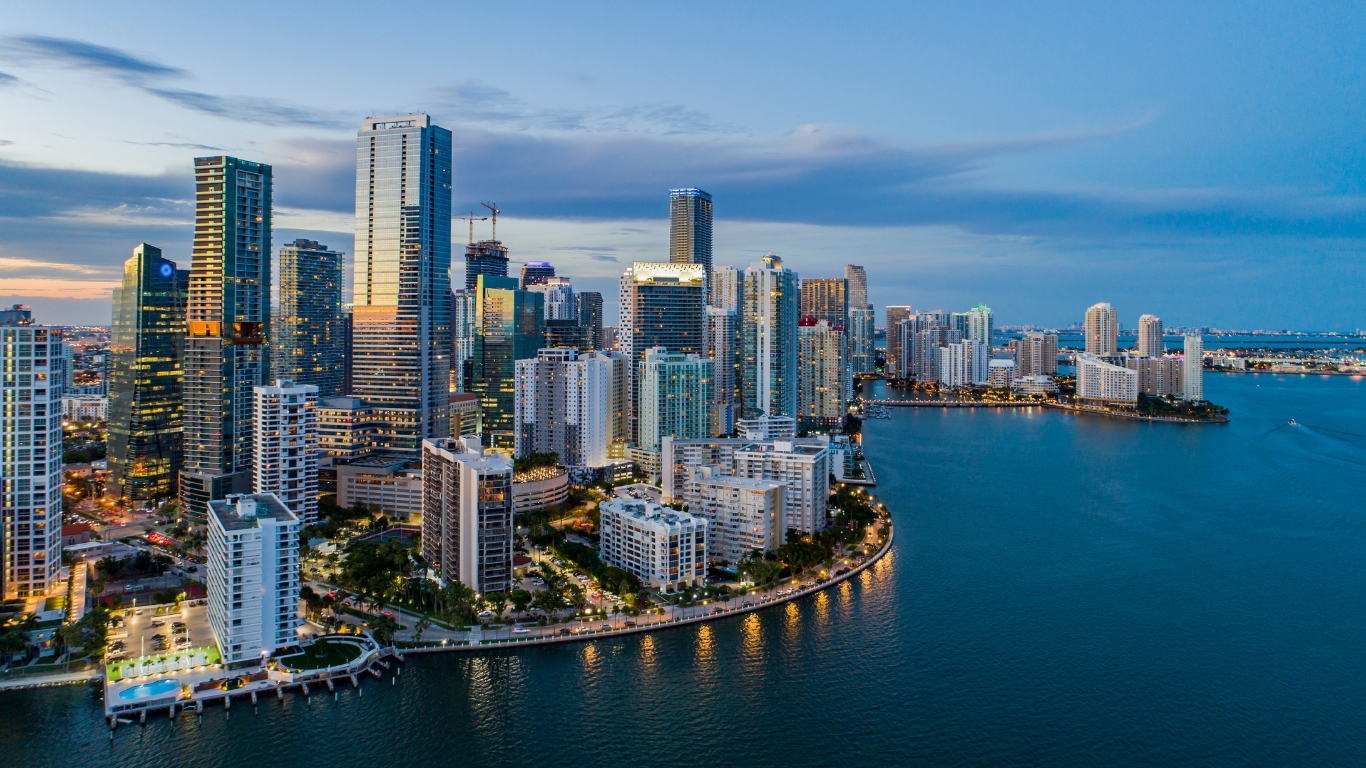
Miami
Miami has positioned itself as the symbolic US epicenter for crypto-real-estate narratives because it combines a crypto-friendly brand identity with a lender ecosystem willing to underwrite against digital collateral.
That positioning received high-profile validation when Mayor Francis Suarez said that “Milo’s crypto mortgage let me buy property without selling my Bitcoin,” according to Newswire.
For a market that thrives on status signals, that kind of public endorsement helps move the idea from novelty to legitimacy in the eyes of luxury buyers and real estate professionals.
Milo is the most visible crypto mortgage platform in the US. The company reports more than $250 million originated across its mortgage products, according to National Mortgage Professional, with Miami representing a meaningful concentration of activity.
Milo markets up to $5 million loan amounts and up to 100% financing for qualified borrowers using Bitcoin as collateral, terms that compete with what borrowers see in Dubai and London, even though the US environment is often perceived as less uniform on crypto regulation.
It’s also worth noting that crypto’s role in US housing finance isn’t limited to crypto-collateralized mortgages. Redfin research found that 12.7% of young recent buyers used cryptocurrency earnings to help fund down payments, suggesting that digital assets are already part of the housing capital stack even when the mortgage itself is conventional.
As crypto ownership broadens, it is likely to show up more frequently in property transactions, sometimes through collateralized structures, and sometimes simply as the source of cash.
Miami’s appeal goes beyond financing availability. Florida’s tax structure is a material draw for crypto holders who can choose where to live. The state has no personal income tax, and while federal capital gains tax still applies, the lack of state-level income tax can create meaningful savings compared with high-tax jurisdictions.
Combined with a strong luxury property ecosystem and a culture that actively courts crypto wealth, Miami becomes a natural landing zone for buyers looking to convert digital wealth into prime real estate without fully exiting their crypto positions.
The luxury segment drives the most visible transactions. Waterfront condominiums in Brickell and Miami Beach, single-family homes in Coral Gables and Coconut Grove, and new luxury developments across the city are increasingly being purchased using Bitcoin and Ethereum as collateral.
As these transactions become more common, brokers, developers, and closing teams have refined processes to handle volatility concerns and custody logistics during escrow, making execution smoother than it was in the earlier “headline-only” phase of crypto real estate.

FAQ
Do I need to be a resident of Dubai, London, or Miami to get a crypto-backed mortgage there?
Not necessarily. Dubai actively welcomes international buyers without residency requirements. London lenders generally work with non-residents but may require UK bank accounts or additional structuring. Miami is most restrictive for non-US residents due to American banking regulations, though some specialist lenders can arrange financing for foreign nationals with substantial crypto holdings.
How long does it take to close on a property using cryptocurrency as collateral?
Crypto-backed transactions typically close faster than traditional mortgages. Dubai transactions can complete in 2-4 weeks, London deals usually take 4-8 weeks, and Miami closings range from 3-6 weeks. The main timeline variables are property appraisal, legal due diligence, and whether the lender converts crypto to fiat before completion.
Can I use altcoins besides Bitcoin and Ethereum as collateral?
Acceptance varies by jurisdiction. Dubai lenders commonly accept Bitcoin, Ethereum, Litecoin, and Cardano, with some considering other top-20 cryptocurrencies case-by-case. London and Miami lenders typically restrict collateral to Bitcoin and Ethereum due to liquidity and custody considerations. Smaller altcoins may be accepted at higher collateral ratios or after conversion to Bitcoin/Ethereum.