
The world's biggest residential property markets - the U.S., the U.K., Germany, France, Canada, Australia, China - now trade at price-to-income ratios two standard deviations above their 25-year medians. Knight Frank's Global House Price Index for Q4 2025 makes the position explicit. The question is whether that constitutes a bubble or a structural repricing.
Savills and JLL both pushed back on the bubble framing in their 2025 outlooks. The case for repricing rests on persistent under-supply, the post-2020 shift toward larger homes and the lingering tailwind of pandemic-era savings. The case for a bubble rests on affordability ratios that have, on any historical reading, broken.
- The world's biggest housing markets including Canada, Australia, the UK, parts of Europe and selected Asian centres continue to face bubble-versus-fundamental debate.
- We see UBS Global Real Estate Bubble Index placing selected markets at elevated bubble-risk tiers, with the structural drivers varying meaningfully by jurisdiction.
- Construction activity, household leverage, price-to-income ratios and demographic shifts all factor into the cross-market bubble assessment in different combinations.
- Mortgage rate normalisation through 2025 and 2026 has tested affordability in many markets, with corrections appearing in selected segments but not uniformly across the global complex.
- International capital flows, particularly from Asia into the Anglo-Pacific markets, continue to shape demand dynamics in ways that complicate purely-fundamental analysis.
- For most considered international observers we view bubble analysis as requiring jurisdiction-specific structural assessment rather than reflexive cross-market generalisation.
- Who is this for?
- International investors and policy observers tracking global housing market dynamics, alongside the advisers and analysts framing those cross-border discussions.
- What is happening?
- A read of the world's biggest housing markets and the bubble question, covering Canada, Australia, the UK, European centres and selected Asian markets.
- When did this emerge?
- The article reflects 2025 and 2026 conditions through UBS Global Real Estate Bubble Index and broader cross-market data alongside our observations.
- Where is this happening?
- The piece covers the global housing market complex, including Canada, Australia, the UK, parts of Europe and selected Asian centres.
- Why does it matter?
- Bubble analysis shapes investment and policy decisions, which is why jurisdiction-specific structural assessment matters more than reflexive headline reaction.
The Data Knight Frank, Savills and the IMF Have Been Flagging
Knight Frank's Global Residential Cities Index ranked 44 of its 150 covered cities as posting double-digit annual price growth into Q3 2025. The Bank for International Settlements and the IMF's House Price Watch have both flagged the cluster of advanced-economy markets as posting valuations that historically resolve into multi-year corrections, not gentle plateaus.
FT Property reporting has consistently pointed to the same names: Sydney, Toronto, Auckland, Lisbon, Amsterdam, German Tier-1 cities. Christie's International Real Estate's Q4 review put it more plainly: discretionary buyers in these cities are pausing. The pause is the signal that conviction at current pricing is thinner than the headline indices suggest.
The framework we'd apply: when prime and broad-market diverge sharply, the broad market typically resolves the gap. Right now, the gap is unusually wide in most of these jurisdictions.
Why London Prime Is Not the Bellwether Some Assume
Knight Frank's PCL index has been down 4 to 8 percent depending on the postcode through 2025, but that is not the broad-market warning many take it for. London prime, despite its visibility in the international real estate conversation, has been weakened specifically by tax and regulatory changes rather than by demand collapse.
The non-dom regime overhaul, the SDLT surcharge on additional dwellings and the post-Brexit cumulative friction layer have all stripped specific buyer cohorts from the bid book. We covered this dynamic in our piece on the post-Brexit cumulative friction layer. London is a regulatory story, not a valuation story.
Mansion Global and Bloomberg's London property desk read the situation the same way. The dislocation is migrating buyers toward Dubai, Madrid and selected U.S. coastal markets rather than triggering a generalised pullback.
The U.S. Divergence Distorting the Headline
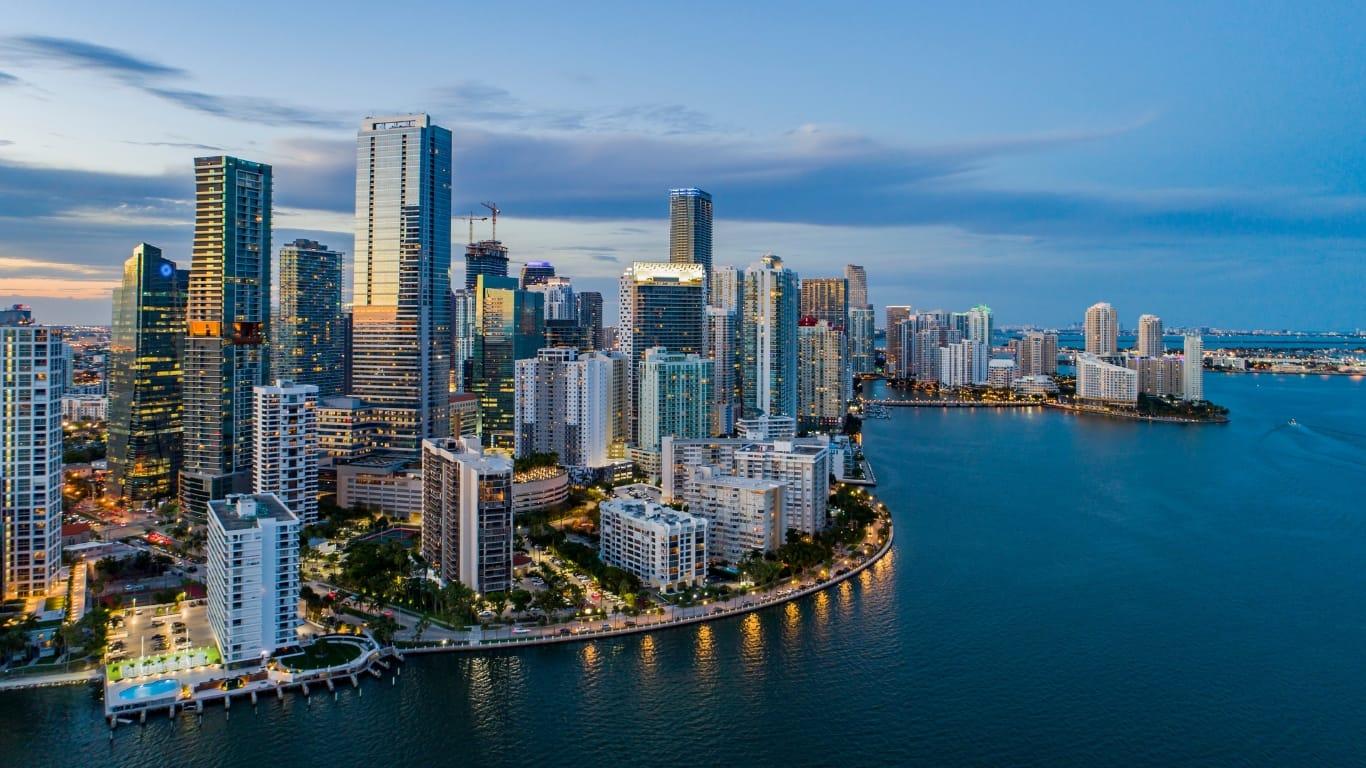
The U.S. headline is misleading. New York's broader market has been flat to soft, while specific Manhattan luxury inventory has continued to clear at near-record values. Miami, Aspen and the Hamptons have continued to print new benchmarks even as the broader U.S. sits stable.
This is the same divergence we mapped in our coverage of Miami's Red-Hot Housing Market Is Starting To Look Like A Bubble. Cushman and Wakefield's U.S. residential research has flagged this gap as the structural feature of the cycle: cash buyers at the high end face a different demand curve than rate-sensitive buyers at the median.
For the bubble question, the U.S. position resolves into a useful frame. The median market is approximately at fair value on a rate-normalised basis. The prime tier is meaningfully above.
That is not a generalised bubble. It is a barbell.
Emerging Market and Safe-Haven Flows
The Knight Frank Wealth Report tracks UHNW capital migration year on year, and the 2025 update flagged a record share of cross-border residential purchases by Asia-based principals into Dubai, Singapore, Lisbon and selected U.S. markets. That is the bid that often gets missed when commentators frame the bubble question off domestic affordability metrics alone.
Savills' International Residential desk and Sotheby's International Realty's cross-border data both point to the same conclusion. Dubai, in particular, has effectively absorbed the marginal HNW buyer who would historically have gone to London. We've covered this in our piece on Where the World's Wealthy Are Buying Property in 2026.
The implication is that pricing in safe-haven markets is supported by a structurally larger cross-border buyer base than at any point in the past two decades. That base will not collapse on a rate move.
The China Overhang That Changes the Global Numbers
China's residential market remains in a multi-year correction, with new-build values in Tier-2 and Tier-3 cities down 25 to 40 percent from 2021 peaks, according to Bloomberg and Reuters reporting. That distorts every global price-to-income aggregate. Strip China out and the advanced-economy picture looks meaningfully more contained.
The IMF's Global Housing Watch has been clear that China's correction is the largest single drag on the global aggregate and is unlikely to resolve before 2027 at the earliest. The implication for the bubble question is that the cross-border capital that previously absorbed Chinese-developer product is now flowing into Singapore, Dubai, Tokyo and selected European markets.
What This Means for Buyers
The framing that holds up is not bubble-versus-correction, but bifurcation. Broad-market median property in the rate-sensitive advanced economies (the U.K., Canada, Australia, New Zealand, parts of the EU periphery) is in the fragile cohort. Prime, supply-constrained, cross-border-bid product is in the resilient cohort.
The asymmetry is meaningful. The 2008 cycle taught the market that when correction arrives, the broad market and the prime tier sell off together. The 2025 cycle is, so far, behaving differently.
Cushman and Wakefield, Knight Frank, JLL and CBRE have all flagged the same divergence in their 2025 outlooks.
Buyers concentrating on freehold, supply-constrained, cross-border-marketed inventory in jurisdictions with regulatory protection have the strongest defensive position. Those underwriting median market exposure on the assumption of continued double-digit appreciation are the most exposed.
We last reviewed this analysis in May 2026. The picture has not materially changed and the bifurcation thesis has only firmed up since.