
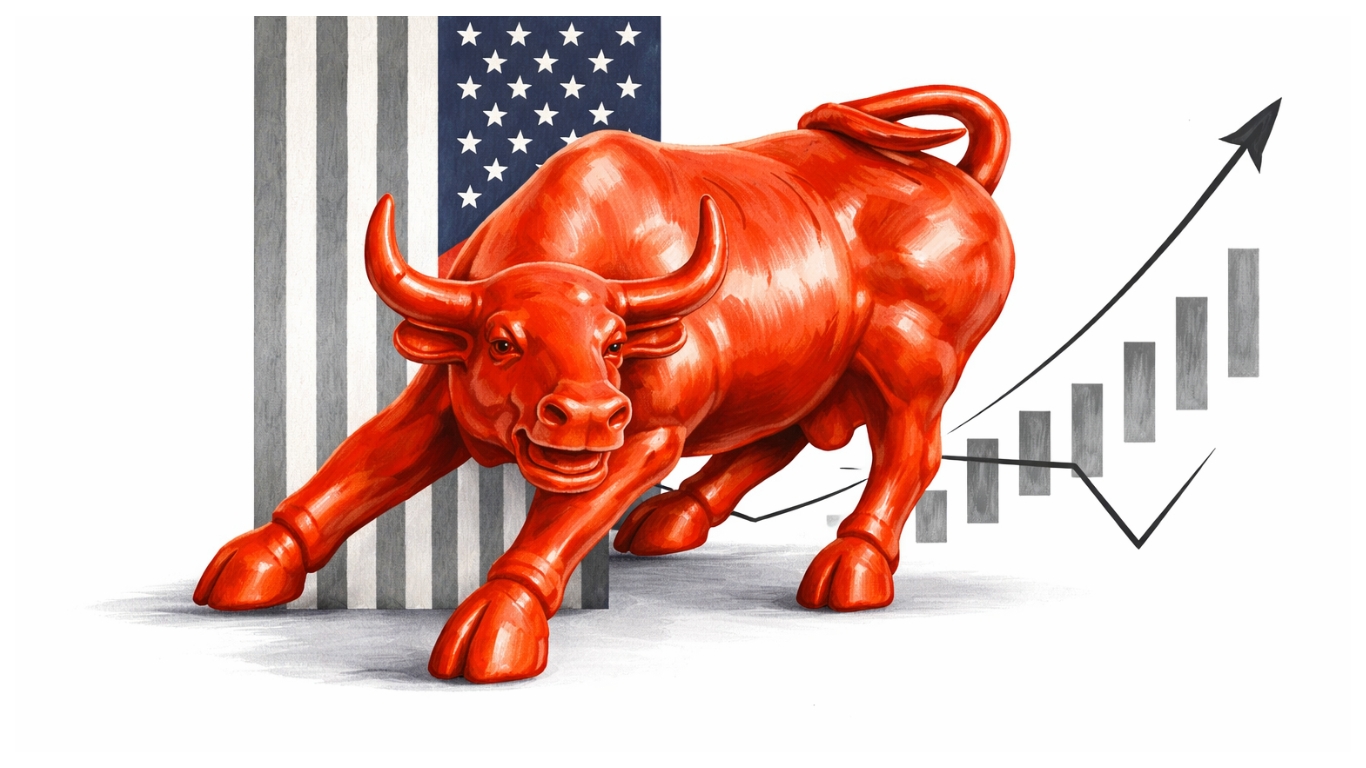

The S&P 500 crossed 7,000 points for the first time in January 2026, marking a historic milestone that extends the market’s remarkable winning streak into its fourth consecutive year of double digit returns.
The index’s climb from 6,000 in late 2024 to 7,000 in approximately eight weeks stands as the fastest 1,000 point gain in recent market history, outpacing previous rallies that took months or quarters to achieve similar magnitude moves.
This velocity raises fundamental questions about whether momentum reflects durable underlying strength or speculative excess that precedes inevitable correction.
Determining whether 7,000 represents a sustainable new plateau or a dangerous bull trap requires weighing multiple forces pulling markets in opposite directions. Earnings fundamentals from market leaders including Microsoft, Meta, Tesla, and Apple reporting during late January provide concrete evidence of whether corporate profits justify current valuations or disappoint relative to optimistic expectations already priced into shares.
However, sector concentration risks stemming from Big Tech’s overwhelming dominance, stretched valuation metrics relative to historical norms, and external shocks ranging from tariff threats to geopolitical tensions create credible scenarios where reversal from record levels occurs with shocking speed, leaving investors who chased momentum nursing substantial losses.
Table of Contents
Key Takeaways & The 5Ws
- The S&P 500’s surge through 7,000 in January 2026 was an unusually fast 1,000-point move, extending a four-year streak of double-digit returns while raising concerns about fragility.
- Bulls argue strong earnings—especially from AI and data-center beneficiaries—plus the prospect of lower interest rates make 7,000 a fundamentally justified base rather than a bubble top.
- The AI build-out is producing real revenue and profit growth in chips, cloud, and infrastructure, supporting the view that this is not a repeat of the “build it and hope” dot-com capex cycle.
- Bears worry AI spending may not translate into profits commensurate with the trillions being invested, echoing prior episodes where heavy capex preceded painful equity repricing.
- Political and policy risk—especially tariff threats and unpredictable headlines—creates gap risk where a single announcement can erase weeks of gains in a day.
- Extreme index concentration in a handful of mega-cap tech names means the S&P 500’s record level rests on a narrow foundation, increasing downside risk if Big Tech stumbles.
- A balanced stance is staying invested while adding hedges (options, stop-loss discipline, diversifiers) so upside participation does not come with unlimited downside if 7,000 proves to be a bull trap.
- Who is involved?
- Equity investors across the spectrum—retail traders chasing momentum, long-only managers benchmarked to the S&P 500, and hedge funds balancing upside continuation with crash risk—plus corporate executives whose capex, buybacks, and compensation are tied to equity levels, and policymakers/central bankers shaping rates and liquidity.
- What is happening?
- A historic breakout: the S&P 500 moved from 6,000 to 7,000 in roughly eight weeks, sparking a debate over whether this is a durable new regime driven by earnings and AI-led growth—or an overextended market vulnerable to reversal due to concentration, politics, and AI monetization uncertainty.
- When does it matter most?
- The key inflection is January 2026, when the index first cleared 7,000 on one of the fastest 1,000-point advances on record. The “truth moment” runs through subsequent earnings seasons and the remainder of 2026 as AI capex either converts into visible profit growth and rate cuts materialize—or the narrative breaks.
- Where is the impact concentrated?
- In U.S. large-cap equities, especially the S&P 500, with global spillovers into international portfolios benchmarked to U.S. indices and cross-asset strategies linked to equity volatility. The key battlegrounds are mega-cap tech, semiconductors, and AI infrastructure, plus sectors that could benefit from rotation if tech pauses.
- Why is the debate so intense?
- Because the market is being pulled between two powerful forces: real earnings growth, an AI capex super-cycle, and likely rate cuts that mathematically support higher valuations—versus the risk that AI returns are overestimated, policy shocks land without warning, and a hyper-concentrated index cannot hold record levels if a few leaders disappoint.

Earnings Strength, AI Boom, Policy Tailwinds, And Institutional Forecasts Supporting 7,600+ Targets
The bull case for continued market strength rests primarily on record earnings growth that provides fundamental support beyond pure momentum or sentiment. Deutsche Bank analysts are predicting one of the strongest quarters for earnings growth since the 2008 financial crisis, excluding the distorted pandemic recovery period when comparisons against 2020’s collapse artificially inflated growth rates.
This matters enormously because actual corporate profit expansion justifies higher valuations when earnings rise faster than stock prices appreciate, creating what market technicians describe as an “earnings into multiple expansion” scenario. Under this interpretation, the 7,000 level becomes a new floor established by improved fundamentals rather than a ceiling that represents speculative excess destined for correction.
If companies deliver the earnings that analysts project, current price to earnings multiples remain reasonable relative to interest rate environments and historical precedents during previous economic expansion periods.

Supporting this earnings optimism, the artificial intelligence infrastructure investment cycle continues validating technology sector leadership through concrete business results rather than speculative promises.
ASML, the Dutch semiconductor equipment manufacturer essential to chip production, is forecasting bumper 2026 sales driven by AI boom demand for cutting edge processors. Nvidia shares climbed 1.3% ahead of its earnings report, with investors anticipating continued revenue growth from AI chip sales to hyperscale data center operators.
The broader semiconductor and AI infrastructure sector is demonstrating revenue and profit expansion that validates the massive capital expenditure spending by Microsoft, Meta, Google, and Amazon on data centers, specialized processors, and AI research and development.
If artificial intelligence productivity gains materialize as Goldman Sachs research suggests, citing evidence of “emerging productivity boost” from enterprise AI adoption, current valuations appear reasonable relative to multi year earnings power that sustained technology investments will generate rather than representing bubble territory based on unrealistic expectations.
At the same time, Federal Reserve interest rate policy provides a monetary tailwind that increases the present value of future corporate earnings regardless of whether the economy accelerates or moderates. Market strategists broadly expect US interest rates to decline over the coming year regardless of who replaces Jay Powell as Federal Reserve chair when his term expires in May 2026, as inflation pressures moderate and labor market normalization allows the central bank to reduce restrictive policy settings.
Lower interest rates make stocks more attractive relative to bonds by reducing the discount rate applied to future earnings, mechanically increasing justified valuations even if profit growth remains constant. The Fed’s decision to hold rates steady at its January meeting signals patience with the current economic trajectory rather than alarm about overheating that would require tightening, supporting risk assets through an accommodative stance that prioritizes sustainable expansion over preemptive inflation fighting.
These fundamental and policy supports gain reinforcement from institutional price targets and positioning that create momentum carrying markets higher through self fulfilling dynamics. Goldman Sachs maintains a year end 2026 target of 7,600 for the S&P 500, representing an 8.5% gain from current levels and positioning slightly above the average forecast from major investment banks.

The Bear Case For Bull Trap
Despite these compelling bull market arguments, meaningful skepticism exists around whether Silicon Valley’s vast artificial intelligence investments will actually pay off at scales justifying current technology valuations.
The enormous enthusiasm surrounding AI applications and infrastructure masks what some analysts describe as “fears in some quarters that Silicon Valley’s vast AI investments may fail to pay off” in revenue growth and productivity gains proportional to capital deployed. Microsoft, Meta, Google, and Amazon collectively spend hundreds of billions annually on data centers, specialized chips, and AI research and development.
If this unprecedented capital expenditure fails to translate into commensurate revenue expansion or demonstrable productivity improvements that show up in profit margins, current valuations embed significant disappointment risk.
Historical precedents from the 2000 dot com bubble saw massive infrastructure spending on fiber optic networks and data centers precede catastrophic crashes when monetization models failed to materialize at anticipated scales, leaving investors holding equity in companies that had burned billions building capacity for demand that never arrived.
Compounding these fundamental concerns, Trump administration policy unpredictability creates unhedgeable tail risks that can trigger sharp corrections from seemingly stable market environments. The proposed Greenland tariff threats, despite their minimal direct economic impact on American commerce, caused a 2.1% single day market drop that demonstrated vulnerability to erratic policymaking divorced from conventional cost benefit analysis.
President Trump’s enthusiastic “Truth Social” celebration of the 7,000 milestone signals a direct political stake in market levels that could encourage increasingly aggressive policies if rising stock prices provide positive feedback reinforcing the perception that his approach succeeds.
However, this same dynamic creates asymmetric downside risk if tariffs or trade wars escalate beyond what corporate earnings can absorb through pricing power or operational adjustments. Markets priced for policy continuity and predictability face severe repricing when political leadership prioritizes symbolic victories or campaign promises over economic optimization.

Perhaps most structurally concerning, the extreme sector concentration and dependence on Magnificent Seven stocks creates a market that lacks the breadth required to sustain record levels if technology leadership falters. S&P 500 gains remain “largely driven by booming tech sector” performance, with the top seven stocks including Apple, Microsoft, Alphabet, Amazon, Nvidia, Meta, and Tesla representing over 30% of total index weight.
This concentration means that if Big Tech earnings disappoint relative to elevated expectations or if the AI narrative shifts as investors question return on investment timelines, the index lacks sufficient breadth across other sectors to sustain 7,000 through rotation into undervalued areas.
Narrow market leadership, where a handful of stocks drive index performance while the median stock underperforms, has historically preceded significant corrections as rotation attempts fail when broader market fundamentals prove too weak to support valuations that technology transfers can no longer justify.
For investors the prudent approach likely involves maintaining equity exposure to avoid missing continued strength if the bull market extends, while implementing downside protection through options strategies, stop losses, or portfolio hedging that limits damage if the 7,000 level proves to be a local peak rather than a launching point for further gains.
The costs of protection may seem unnecessary if markets continue climbing, but the velocity of the recent rally and concentration of gains in a narrow group of technology stocks creates conditions where reversals, if they occur, will likely happen too quickly for investors to exit positions without substantial losses once momentum shifts decisively.