

Forex trading is the largest and most liquid market on the planet, with daily trading volume exceeding $6 trillion. That number alone should tell you something about the scale of opportunity sitting inside this market. Among the hundreds of currency pairs you can trade, the major pairs are where most of the action happens. They are the most traded, most recognized, and most accessible entry points for anyone serious about forex. Whether you are just starting out or you have been at this for years, understanding what major pairs are and how to trade them well can make a real difference to your results.
Table of Contents
What Are Major Pairs in Forex?
Major pairs in forex are the most heavily traded currency pairs in the world, built around the globe’s most powerful currencies. Every major pair features the U.S. dollar (USD) on one side, matched with another top-tier currency such as the euro (EUR), the Japanese yen (JPY), the British pound (GBP), the Swiss franc (CHF), the Canadian dollar (CAD), the Australian dollar (AUD), or the New Zealand dollar (NZD). The USD’s presence in all of these pairs is no accident. As the world’s primary reserve currency, the dollar brings a level of liquidity and stability to these pairs that you simply will not find anywhere else in the forex market.
List of Major Currency Pairs
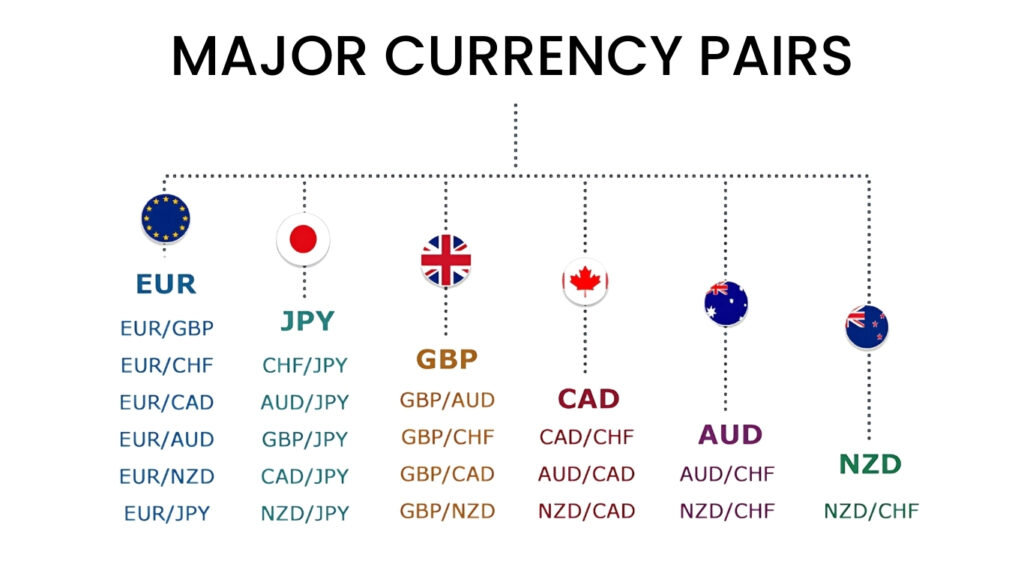
The seven currency pairs widely recognized as the major pairs are the ones you will want to know inside and out.
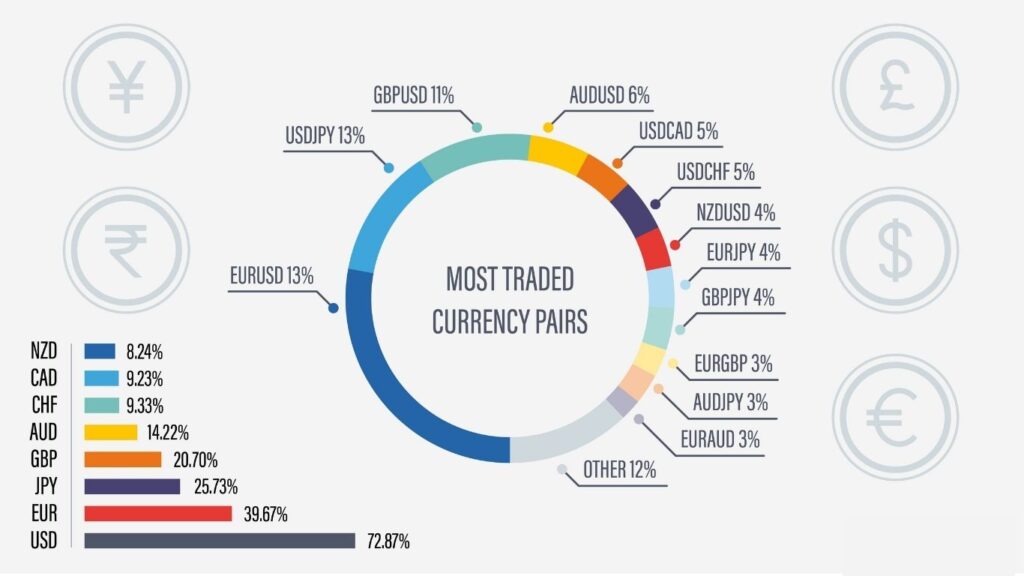
- EUR/USD (Euro/US Dollar): The most traded currency pair, accounting for nearly 30% of all forex transactions.
- USD/JPY (US Dollar/Japanese Yen): The second most traded pair, representing the world’s two largest economies.
- GBP/USD (British Pound/US Dollar): Also known as “Cable,” this pair represents two of the oldest currencies.
- USD/CHF (US Dollar/Swiss Franc): Known as the “Swissie,” this pair often acts as a safe haven during market volatility.
- USD/CAD (US Dollar/Canadian Dollar): Nicknamed the “Loonie,” this pair is heavily influenced by oil prices.
- AUD/USD (Australian Dollar/US Dollar): The “Aussie” is linked to commodity prices, particularly gold.
- NZD/USD (New Zealand Dollar/US Dollar): Known as the “Kiwi,” it is influenced by agricultural exports and commodity prices.
What sets these major pairs apart from the rest of the forex universe is their high liquidity, tight spreads, and enormous daily trading volume. That combination makes them attractive to retail traders and institutional players alike, and it is a big reason why so many traders start here and never feel the need to go anywhere else.
Characteristics of Major Currency Pairs
Before you put real capital to work, you need to understand what actually defines these pairs and why they behave the way they do. Major pairs like EUR/USD, GBP/USD, USD/JPY, and their counterparts each carry a distinct personality shaped by the economies behind them. Here are the key features that set them apart and that you should keep front of mind as you build your approach.
1. High Liquidity: Major currency pairs carry the deepest liquidity in the entire forex market. That means you can buy or sell quickly without moving the price against yourself in a meaningful way. The practical benefit for you is lower transaction costs and tighter spreads. The EUR/USD pair, for example, regularly trades with spreads as tight as 0.1 pips during peak hours, so you can move in and out of positions with minimal slippage. That kind of efficiency is hard to find in other markets.
2. Volatility and Predictability: Major pairs tend to sit in a comfortable middle ground, offering enough price movement to generate real profit potential without the chaotic swings that make some exotic pairs nearly untradeable for most people. The GBP/USD pair, for instance, typically sees a daily range of around 100 to 150 pips, which gives day traders and scalpers plenty of room to work with. You get the action you need without the volatility becoming unmanageable.
3. Sensitivity to Economic Indicators: Major pairs react sharply to economic news, central bank decisions, and geopolitical events. The EUR/USD, for example, is highly responsive to announcements from both the European Central Bank and the U.S. Federal Reserve. When GDP figures, inflation data, employment reports, or interest rate decisions land, you can expect these pairs to move. managing your forex risk around these events is something every serious trader needs to think about carefully.
4. Commodity Correlations: Several major pairs have strong ties to global commodity prices, and understanding those connections can give you a real edge. The USD/CAD, for instance, tends to move in sync with crude oil prices because Canada is one of the world’s leading oil exporters. The AUD/USD follows gold prices closely given Australia’s position as a top gold producer. When you track commodity markets alongside your currency charts, you start to see signals that many traders miss entirely.

How to Trade Major Currency Pairs
Trading major currency pairs well takes more than just knowing the ticker symbols. You need a thoughtful approach that blends macroeconomic awareness, sharp technical skills, and disciplined risk control. The good news is that pairs like EUR/USD, GBP/USD, and USD/JPY give you plenty to work with. Their liquidity, tighter spreads, and sensitivity to global events create an environment that rewards traders who do their homework. As Reuters regularly covers, currency markets respond faster than almost any other asset class to economic shifts, which means your preparation matters as much as your execution.
But to navigate these pairs effectively, you need to bring both fundamental and technical thinking into your strategy. One without the other leaves you working with half the picture.
A solid grounding in fundamental analysis is non-negotiable. Economic indicators and central bank policies drive currency values more than almost anything else. Interest rates, GDP growth, inflation, and employment figures all feed directly into how a currency is priced relative to its counterpart.
A better-than-expected U.S. Non-Farm Payrolls report, for example, will often push the dollar higher across the board. Dovish commentary from the Federal Reserve, on the other hand, can weaken it in a hurry. Those shifts create real opportunities in pairs like EUR/USD and GBP/USD if you are watching and positioned correctly.
Staying on top of scheduled data releases and geopolitical developments lets you anticipate sentiment shifts before they fully play out in price. That is where the edge lives.
While fundamental analysis tells you why a currency might move, technical analysis helps you figure out when and where to act. Chart patterns, historical price levels, and a well-chosen set of indicators are your tools here. Moving averages are among the most widely used, with the 50-day and 200-day lines giving you a clear read on trend direction. A crossover between these two lines, whether a golden cross or a death cross, can signal a meaningful shift in momentum. Technical analysis tools and indicators are worth mastering early if you want to trade with confidence.
The Relative Strength Index (RSI) and Bollinger Bands add another layer, helping you spot overbought or oversold conditions and gauge how much volatility is building in a pair. When you layer these tools together, you start identifying high-probability setups rather than just guessing at direction.
Risk management is not optional in forex trading. In a leveraged environment, it is the thing that keeps you in the game long enough to actually make money.
Smart traders typically limit their exposure to 1 to 2% of their total capital on any single trade. That discipline is what separates professionals from people who blow up their accounts.
If you are working with a $10,000 account, that means risking no more than $100 to $200 per position. It sounds conservative, and it is. But that conservatism is exactly what lets you survive drawdowns and stay in a position to recover. Stop-loss orders are a critical part of that picture, acting as your last line of defense against a small loss becoming a catastrophic one.
Leverage deserves a special mention because it is so easy to misuse. Major pairs often come with generous leverage options precisely because of their liquidity. But a 50 to 1 leverage ratio, for example, means you are controlling $50,000 with just $1,000 in margin. A 1% move against you wipes out half your invested capital if you are not managing that exposure carefully. The Financial Times has documented how leverage misuse is one of the most common ways retail forex traders end up losing money.
So treat leverage as a precision tool, not a shortcut. Apply it only to trades where the risk-to-reward profile genuinely justifies it, and always keep adequate margin in reserve.
The forex market shifts constantly, shaped by economic data, political events, and swings in global sentiment. Safe-haven currencies like the U.S. dollar, Japanese yen, and Swiss franc tend to attract capital during periods of uncertainty or stress. That is a pattern you can plan around.
When optimism returns and risk appetite picks up, pairs like GBP/USD or AUD/USD often become more attractive hunting grounds. Flexibility is not a nice-to-have here. It is essential. The traders who stay rigid in their approach are the ones who get caught on the wrong side of a major market shift.
Strategies for Trading Major Pairs
1. Trend Following Strategy: Trend following is exactly what it sounds like. You identify the direction the market is already moving and place trades that align with that momentum rather than fighting it. Major pairs are well-suited to this approach because their liquidity tends to produce cleaner, more sustained trends. Moving averages, MACD, and trendlines are the go-to tools for spotting entry and exit points within a trend.
Take the EUR/USD in an established uptrend. Rather than chasing the move at its peak, you would look for the price to pull back to a support level or wait for a bullish signal from your indicators before entering. Patience in trend following is what separates a good trade from a reckless one.
2. Range Trading Strategy: Range trading works best when the market is moving sideways, oscillating between clearly defined support and resistance levels. Major pairs like EUR/USD and USD/CHF can spend extended periods in range-bound conditions, and that creates a repeatable opportunity if you know how to read it. Oscillators like the RSI or Stochastic are your best friends here, helping you identify when price is pushing into overbought or oversold territory within the range. You buy near support, sell near resistance, and let the price do its thing. Bloomberg’s markets coverage often highlights exactly these kinds of range formations when volatility compresses ahead of major announcements.
3. Breakout Strategy: Breakout trading is about identifying the levels where price has repeatedly stalled and then positioning for the move when it finally breaks through. Major pairs are particularly responsive to this approach during high-volatility windows like economic data releases or central bank meetings, when the catalyst for a breakout is clear and well-defined.
If the EUR/USD has been grinding in a tight range and then surges through a key resistance level after a strong economic announcement, that breakout can carry real momentum. Traders who spot those setups early and manage their entries well stand to capture a meaningful portion of the move.
3. Carry Trade Strategy: The carry trade is a longer-term play built around interest rate differentials. You borrow in a currency with a low interest rate and deploy that capital into a currency offering a higher rate, pocketing the difference known as the carry. Pairs like AUD/USD and NZD/USD have historically been popular for this approach given their relatively higher interest rates. Understanding the differences between brokers and market makers matters here too, since execution costs can quietly eat into your carry returns over time.
That said, carry trades are not without risk. Economic stability, inflation trends, and central bank policy shifts can all move against you quickly, compressing or reversing the rate differential you were counting on. You need to monitor those factors continuously and be willing to exit when the macro picture changes.
FAQs About Major Currency Pairs
What is the most important pair in forex?
The EUR/USD (Euro/US Dollar) is the most important pair in forex, accounting for nearly 30% of all forex transactions.
Which forex pair pays the most?
The forex pair that “pays the most” often depends on the trading strategy and market conditions. Generally, pairs with higher volatility, like GBP/JPY or GBP/USD, offer more opportunities for profit due to their large price swings. However, higher potential returns come with higher risk, and these pairs require careful risk management.
What is the most predictable forex pair?
The USD/CHF (US Dollar/Swiss Franc) is often considered one of the most predictable forex pairs. It is known for its stable movements, especially during periods of market uncertainty, due to the Swiss franc’s status as a safe-haven currency.