
The Rolex Yacht-Master has been turning heads in serious investor circles for the better part of a decade now. It stepped out from the shadow of its more famous siblings and carved out a genuinely unique position in collector portfolios.
What makes this watch so compelling is its dual identity. You get a refined luxury sports watch with surprisingly strong resale fundamentals, and none of it depends on hype or speculation to hold up.
If you’re looking to diversify beyond the obvious Submariner and Daytona choices, the Yacht-Master is what savvy collectors are quietly calling Rolex’s understated profit performer. And they’re not wrong.
While everyone else chases waitlists and pays wild premiums for overhyped references, a growing group of strategic buyers is waking up to something different. This nautical-inspired timepiece offers what’s become genuinely rare in luxury watches: real value backed by precious metals, controlled supply, and steady appreciation rather than rollercoaster volatility. As luxury assets increasingly replace stocks as the preferred store of value for the elite, the Yacht-Master is quietly positioning itself as one of the smarter plays in the category.
Table of Contents
Key Takeaways
Navigate between overview and detailed analysisKey Takeaways
- The Rolex Yacht-Master has evolved from a niche maritime luxury piece into one of Rolex’s most stable long-term investments, delivering over 200% appreciation since 2010 with moderate volatility.
- Discontinued references like the Rolesium 16622 (1999–2012) and Everose 116655 (2015–2022) have appreciated 20–50% in the past decade, showing how scarcity and metal value drive returns.
- Current models such as the Yacht-Master 40 ref. 126622 trade around $14,000–$17,000, holding near-retail prices with strong liquidity, while the 42 mm 226659 in white gold offers discounted entry with long-term upside.
- Compared with hype-driven models like the Submariner or Daytona, the Yacht-Master benefits from controlled supply and stable pricing, appealing to investors seeking steady, low-speculation growth.
- Its combination of precious-metal content, moderate production, and diversified collector base makes it an effective portfolio hedge within the Rolex ecosystem and a lower-risk entry to luxury-watch investing.
The Five Ws Analysis
- Who:
- Collectors and investors seeking Rolex exposure without the volatility of the Daytona or Submariner; institutional and private buyers favoring tangible, inflation-resilient assets.
- What:
- A premium nautical sports watch blending tool-watch functionality with luxury materials such as Rolesium, Everose gold, and platinum, now viewed as a mid-term investment vehicle.
- When:
- Originally launched in 1992, with its modern investment momentum accelerating after 2019 as discontinued references and precious-metal variants gained traction.
- Where:
- Demand is strongest in the U.S., U.K., and Asia—markets that value both precious-metal scarcity and wearable luxury; secondary-market hubs include Chrono24 and WatchCharts.
- Why:
- The Yacht-Master offers genuine value growth without hype cycles—steady appreciation, intrinsic metal backing, and consistent resale liquidity make it a “quiet compounder” among Rolex investments.
The Origins of the Rolex Yacht-Master
The Yacht-Master story starts in 1992, when Rolex introduced what would become their premium maritime-inspired sports watch. It was designed for yachting enthusiasts who wanted something more elegant than the utilitarian Submariner, and from day one it occupied a different kind of space.
This wasn’t simply another dive watch. Rolex made a deliberate move to merge functional roots, think water resistance and sharp legibility, with luxury materials that elevated the entire concept into something altogether more refined.
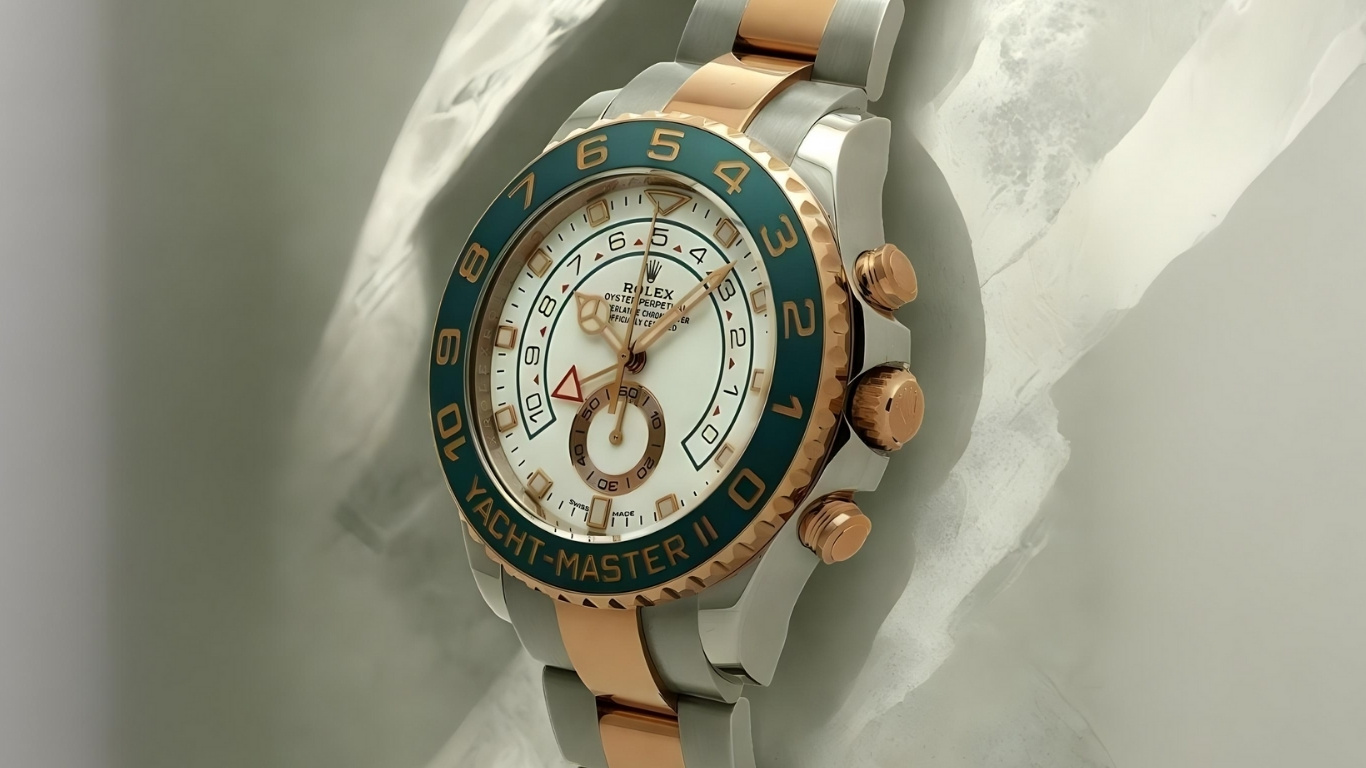
The innovation extended to materials too. Rolex introduced “Rolesium,” a proprietary combination of steel and platinum that created a distinctive look while folding in genuine precious metal value. That material choice told you everything about the Yacht-Master’s ambitions. It wasn’t a pure tool watch. It wasn’t purely dress either. It occupied a compelling space between everyday sport and precious metal luxury that very few other Rolex references have ever managed to inhabit.
Early market reception was decidedly mixed. A wave of skepticism emerged from collectors who questioned whether Rolex really needed another maritime watch when the Submariner already owned that category.
But as designs matured across subsequent decades, that initial hesitation gave way to real collector appreciation. The Yacht-Master’s unique character and refined execution gradually set it apart from more common sport references, and the people who paid attention early were rewarded for it.
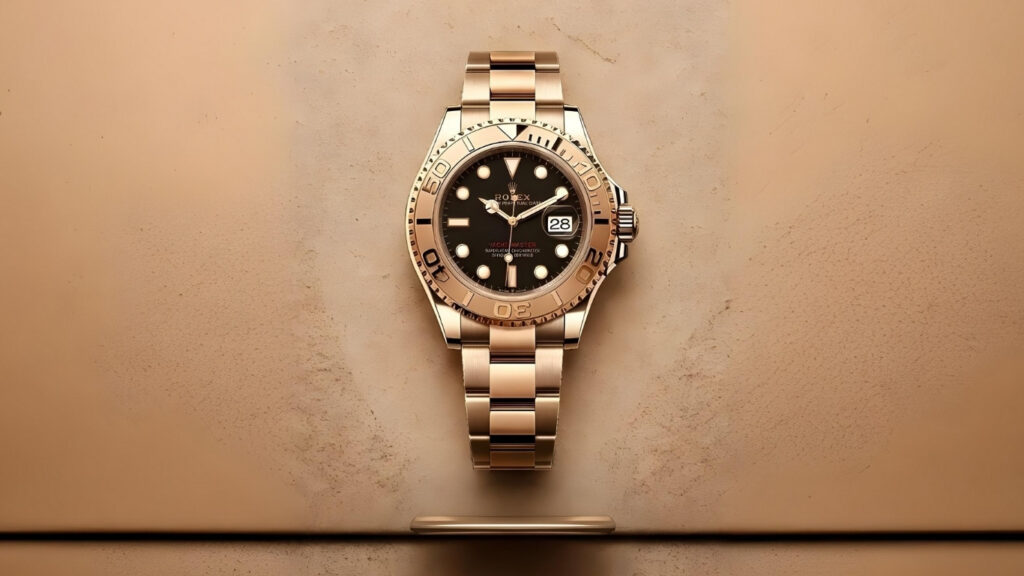
How the Yacht-Master Evolved From Lifestyle Watch to Investment Asset
The shift from lifestyle accessory to legitimate investment asset didn’t happen overnight. Rolex refined the formula steadily, and collectors slowly recognized the distinctive value underneath. In the 1990s and early 2000s, the Yacht-Master occupied awkward territory, seen more as a luxury accessory than a serious tool watch, and that perception limited its collector following for years.
Then the formula started changing. The introduction of Everose gold, innovative Oysterflex rubber bracelets, and distinctive bi-directional bezels modernized the entire line. Suddenly you had real differentiation that pulled in buyers seeking alternatives to standard sport models.
These material and design innovations transformed perceptions, with our analysts noting how unique metal treatments and discontinued references began attracting serious investment attention.
The real turning point came with the Yacht-Master 42, launched in 2019. It merged enhanced sportiness with precious metal appeal in a way that captured attention across completely different collector demographics. That reference marked the moment the Yacht-Master fully crossed over from overlooked alternative into genuinely desirable model with its own devoted following.
Demand for discontinued models and niche configurations added further investment momentum. Discontinued references including the Rolesium 16622 from 1999 to 2012 and the Everose gold 116655 from 2015 to 2022 saw appreciation of 20% to 50% over the past decade. Early adopters who spotted the value before broader markets caught on were handsomely rewarded.
Market Prices, Resale Performance, and Demand for the Yacht-Master
Current market dynamics put the Yacht-Master squarely in the accessible Rolex luxury category, but with genuine investment characteristics underneath. Retail pricing in 2026 ranges from around $10,600 for the Yacht-Master 37 reference 268622 all the way up to $28,800 and beyond for high-end versions like the Yacht-Master 42 reference 226659 in white gold. That spread creates meaningful entry points across different budget levels while keeping the collection firmly in premium territory. You can explore how this compares across the broader market in our breakdown of the best luxury watch brands to invest in.
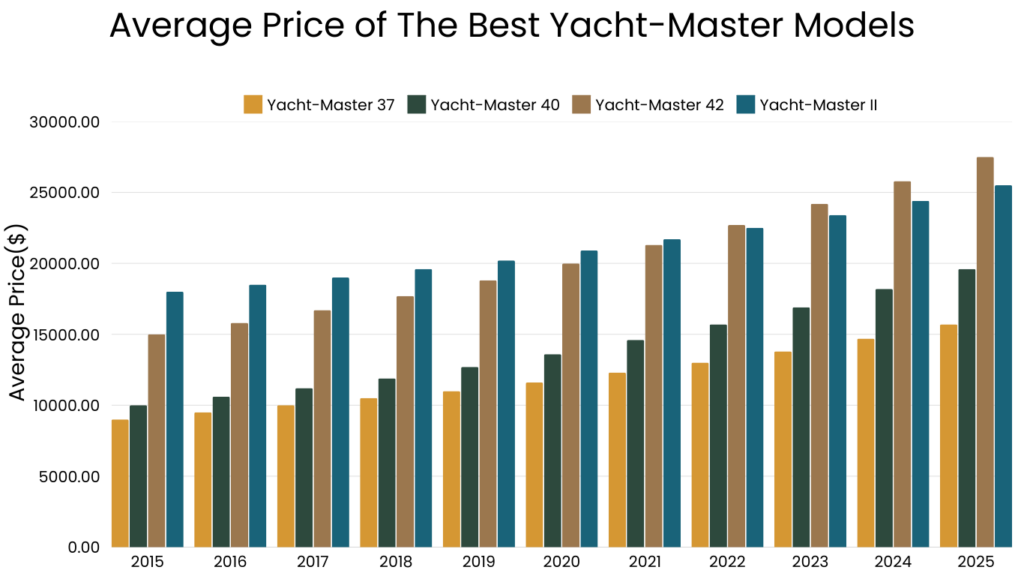
On the secondary market, WatchCharts data places average Yacht-Master prices around $15,000, with ranges spanning from roughly $5,000 to $35,000 depending on the specific reference and materials involved.
This spectrum indicates mature market segmentation where different variants appeal to distinct buyer profiles from entry luxury to serious precious metal collectors.
Dig into specific references and interesting performance patterns start to emerge. The popular Rolesium 126622 in 40mm trades at approximately $13,386 in secondary markets according to WatchCharts, with Chrono24 listings clustering around $14,000 to $17,000.
Precious metal variants tell a stronger story. Both the Yacht-Master 40 reference 126655 and the Yacht-Master 42 reference 226659 show solid resale characteristics, with Everose and platinum versions holding up particularly well.
The white gold 226659 shows something worth paying close attention to. Rolex lists retail at $35,000, but WatchCharts documents secondary values around $25,527, sitting roughly 27% below retail. For a savvy investor, that discount creates a genuine opportunity to acquire precious metal Rolex at a real saving, while betting on long-term appreciation as the reference matures and the market catches up.
Broader historical context adds encouraging perspective. Research tracking Yacht-Master average prices across all references shows the collection starting around $4,995 in 2010, peaking near $21,900 in April 2022, then correcting roughly 29% to settle around $15,613 by 2026. A correction after a peak that steep is healthy, not alarming.
That trajectory reflects approximately 212% appreciation from 2010 baselines, demonstrating that despite corrections, long-term holders have achieved substantial gains that exceed most traditional investments over equivalent periods.
Discontinued models are worth watching closely. Auction traction for early Rolesium references and unique configurations is picking up as collectors recognize genuine scarcity. Older references like the 16622 now appear on Chrono24 around $8,990 for decent examples, while WatchFinder offers two-tone 16623 models near $11,200. Those are accessible entry points into discontinued references that may appreciate meaningfully as surviving examples in excellent condition grow harder to find.
Liquidity is quietly improving too. Collectors are rotating out of overvalued Submariners and Daytonas and looking for alternatives with better value propositions. That rotation benefits the Yacht-Master directly, bringing in new buyers who might have previously dismissed it as less collectible but now recognize its distinctive appeal and relative value in an expensive Rolex market.
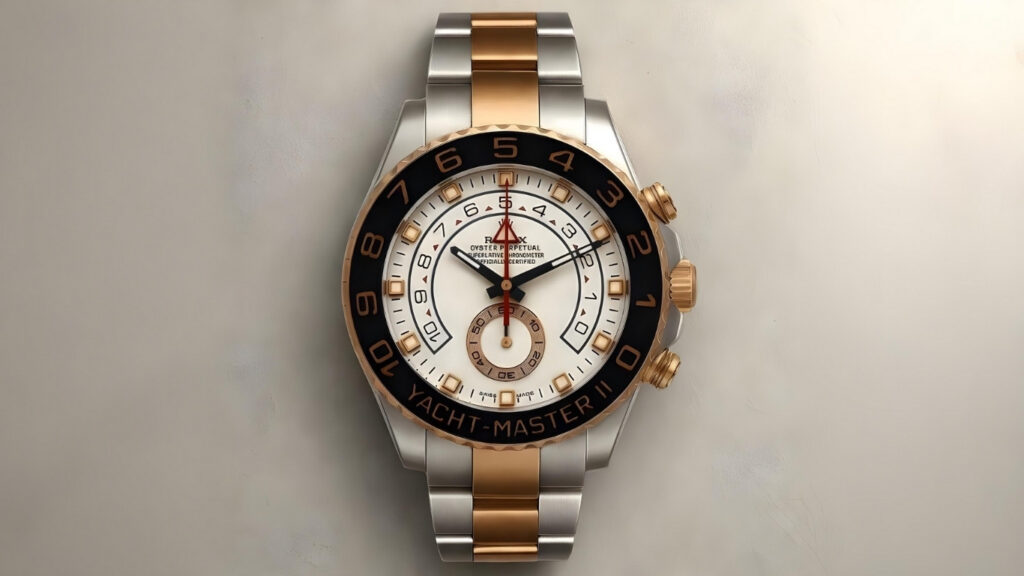
Why the Rolex Yacht-Master Appeals to Savvy Investors in a Cooling Watch Market
The investment case for the Yacht-Master centers on characteristics that speak directly to risk-averse investors who want Rolex exposure without speculation or extreme volatility. You get a compelling blend of luxury appeal and functional credibility, creating dual value propositions that support prices through both aesthetic desirability and genuine utility. And that’s a combination that holds up across different market conditions.
On the stability front, the Yacht-Master shows far less price volatility than hype-driven models. Strong retention gets support from intrinsic metal value and controlled scarcity working together. Jonathan’s Fine Jewelers notes that models using precious metals including rose gold, white gold, and platinum directly benefit from rising material costs, with Rolex passing higher input costs through retail price increases in 2026. For you as an investor, that creates natural inflation hedging where the physical metal value provides a downside floor that steel models simply cannot match.
That floor matters more than people realize. When sentiment shifts or the broader watch market softens, precious metal Yacht-Masters don’t fall as hard because the metal itself holds value regardless of collector trends.
And the Yacht-Master is increasingly seen as an insider’s Rolex. That matters because it keeps the reference less exposed to the speculative flipping and hype cycles that create dangerous bubbles in other references. The people buying Yacht-Masters tend to be genuine enthusiasts and strategic collectors, not flippers chasing a quick score.
According to our research, the model is gaining respect as an investment Rolex precisely because it avoided the extreme speculation that damaged other models’ stability, making it attractive to sophisticated buyers seeking portfolio diversification without chasing headlines.
Beyond pure financial considerations, the Yacht-Master offers real diversification within Rolex portfolios dominated by sport models. If you’re already holding Submariners, GMT-Masters, or Daytonas, adding a Yacht-Master gives you exposure to different market dynamics, material compositions, and collector demographics that don’t move in perfect lockstep with your more common references. That’s portfolio construction thinking, not just watch collecting. It connects directly to the kind of core-satellite investment strategy that experienced portfolio managers use to balance stability with targeted upside.
Liquidity metrics add an important layer of nuance to how the Yacht-Master actually trades compared to alternatives.
Digital Liquidity Index analysis covering 2023 to 2026 shows the steel Yacht-Master 40 reference 126622 achieving a respectable 0.80 score on a zero to one scale, with median selling times around 30 days and trading just 2% below retail. That doesn’t match the Submariner’s 0.90 score or the Daytona’s perfect 1.00, but it tells you the steel Yacht-Master maintains strong liquidity that allows relatively quick exits without having to take painful discounts. Hodinkee’s market coverage has tracked similar trends in how the steel Yacht-Master holds its ground even during broader market pullbacks.
Rolex Liquidity Comparison: Yacht-Master vs Submariner vs Daytona (2023 to 2026)
This investment performance analysis compares Rolex Yacht-Master, Submariner, and Daytona models across steel sports, two-tone, and full gold categories. The data covers secondary market prices, retail premiums and discounts, median days to sell, and digital liquidity index scores for a comprehensive read on where each model actually stands in the market.
| Category / Model ▼ | Avg Secondary Price (USD) ▼ | Retail Price (USD) ▼ | Digital Liquidity Index ▼ | Median Days to Sell ▼ |
|---|
But moving into precious metal variants reveals important liquidity trade-offs you need to understand before committing capital. The Everose gold Yacht-Master 40 reference 126655 shows a 0.40 liquidity score with median selling times extending to 46 days, trading roughly 9% below retail according to our analysis. The Financial Times has noted similar dynamics across the broader luxury watch market, where precious metal references consistently take longer to move than their steel counterparts.
For you as an investor, that means precious metal Yacht-Masters require longer holding periods and genuine patience to realize full value. But the metal content provides an intrinsic value floor that makes this trade-off entirely justifiable for the right portfolio strategy. If you’re thinking long-term and you want a hard asset with Rolex pedigree, the math still works in your favor.
FAQ
Is the Rolex Yacht-Master a good investment in 2025?
Yes, the Yacht-Master is a strong investment due to limited production, premium materials, and steady appreciation, with the collection gaining 212% from 2010 to 2025 and discontinued references like the Rolesium 16622 and Everose Gold 116655 showing 20-50% appreciation over the past decade.
Which Rolex Yacht-Master model holds its value the best?
The Rolesium Yacht-Master 40 (ref. 126622) and Yacht-Master 42 (ref. 226659) in white gold are among the best for value retention, both consistently trading above retail on the secondary market with strong liquidity and expected continued appreciation.
What is the resale value of a Rolex Yacht-Master?
Resale value depends on model and materials: stainless steel and platinum models like the 126622 trade around $14,000-$17,000, while gold models can exceed $30,000 in the secondary market.
Will discontinued Rolex Yacht-Master models increase in value?
Yes, discontinued models like the Rolesium 16622 (1999-2012) and Yacht-Master 116655 (Everose Gold, 2015-2022) have historically seen 20-50% appreciation after discontinuation, making them excellent investment pieces.
How much does a Rolex Yacht-Master cost in 2025?
Retail prices start at $10,600 for the Yacht-Master 37 (ref. 268622) and go up to $28,800+ for the Yacht-Master 42 (ref. 226659) in white gold, with secondary market prices varying from $12,000 to over $40,000 depending on the model.