
Basel’s real estate market in 2026 ranks among Switzerland’s most resilient and strategically positioned places to put your money. Sitting at the crossroads of three countries, bordering both Germany and France, the city is a tri-national hub for finance, pharmaceuticals, and logistics. That geography isn’t just interesting on a map. It creates a uniquely stable property market driven by cross-border economic integration and steady population growth that doesn’t stop when global sentiment shifts.
What defines the Basel housing market is a combination of regulatory discipline, persistent cross-border workforce demand, and housing zones that simply don’t have enough supply. If you’re a long-hold investor focused on dependable income and capital security, that’s a compelling foundation to build on.
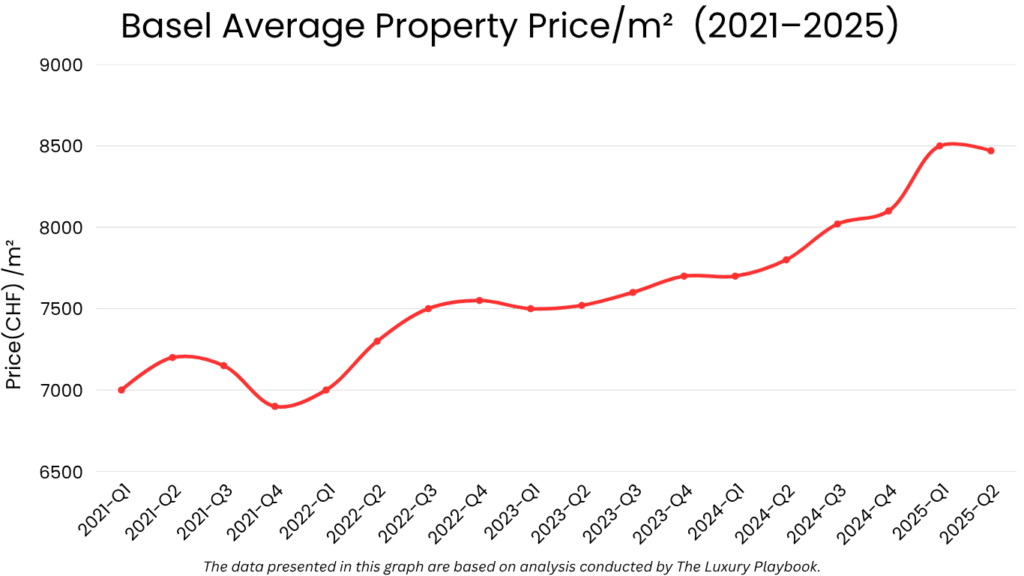
Residential prices in Basel average around CHF 8,500 per square meter. In the most sought-after neighborhoods like Gellert, Bruderholz, and St. Alban, you’re looking at CHF 9,500 to CHF 10,500 per sqm. Yes, that’s below Zurich and Geneva. But that’s actually part of the appeal. Switzerland’s broader real estate market has been pricing out investors in its top-tier cities, and Basel offers a broader demand base, far less speculative pressure, and stronger rental turnover thanks to its international employment base.
Short-term appreciation here is modest, but Basel delivers stable gross yields between 3.0% and 4.0%, especially in areas with a large professional tenant base. That consistency is the point.
Entry pricing stays moderate by Swiss standards, and Basel’s long-term fundamentals are anchored in economic diversification and borderless mobility. For investors who want to balance rental income with steady value preservation, this city gives you a rare combination of both.
Table of Contents
Overview of The Basel Real Estate Market
As of Q2 2026, the average price per square meter for residential property in Basel sits at approximately CHF 8,470, reflecting a moderate year-over-year increase of around 2.3%. The market is moving, but it’s moving with purpose rather than hype.
High-demand pockets like Gellert, St. Alban, and Bruderholz consistently register CHF 9,500 to CHF 10,500 per sqm, and luxury units occasionally push past CHF 11,500. These aren’t bargain prices, but they’re priced to perform over time rather than spike and retreat.
Compared to Zurich or Geneva, Basel gives you a more accessible entry point as a buyer while still benefiting from strong market fundamentals. That combination is harder to find than it sounds.
The ownership market skews local, but investor interest keeps growing, especially among Swiss institutional buyers and private landlords looking for mid-term income with low volatility. Foreign ownership is possible under Switzerland’s real estate laws, though approvals for non-residents are typically limited to specific categories such as new builds in designated zones or commercial-to-residential conversions. Worth factoring into your acquisition strategy from day one.
Development activity in Basel stays measured. New housing supply is constrained by strict building codes and limited available land, especially in central districts. Projects tend to focus on urban infill, redevelopment, and energy-efficient renovations rather than outward expansion. That supply constraint is a feature, not a flaw, if you already own.
Rental properties run at strong occupancy rates, especially those targeting professionals in life sciences, logistics, and finance. Cross-border workers commuting daily from Germany and France add another layer of demand pressure across both the rental and sales segments. Understanding how double taxation treaties affect cross-border real estate investments is worth your time if you’re buying here as a foreign national.
- Average property price in Basel is CHF 8,470 per square meter, with high-end areas reaching over CHF 10,500.
- Year-over-year price growth at 2.3%, reflecting steady demand and tight inventory.
- Most new supply comes from infill projects and renovations, not large-scale construction.
- Buyer activity dominated by local Swiss professionals and institutional landlords.
- Foreign investment remains selective, with opportunities tied to specific legal structures or new developments.
The Basel housing market keeps offering a balanced investment environment, ideal for anyone seeking consistent rental yields, moderate appreciation, and long-term asset stability in one of Europe’s most economically integrated cities. The fundamentals don’t need to shout to be compelling.
Neighborhood Analysis
Basel is made up of distinct residential zones, each with its own pricing character, tenant profile, infrastructure quality, and investment appeal. The city’s mix of historic quarters, family-oriented districts, and cross-border commuter hubs creates a diversified market whether you’re buying to occupy or buying to rent.
Gellert
Gellert ranks among Basel’s most desirable residential areas. Leafy streets, proximity to city parks, and excellent school options make it a natural draw for affluent families and professionals. You’re buying into a high-barrier, low-yield submarket here, but one with strong long-term capital preservation baked in.
Median home prices in Gellert exceed CHF 10,000 per sqm. Detached homes and larger flats typically range from CHF 1.8M to CHF 3M. Rental returns are modest, but demand stays stable and properties rarely sit vacant for long.
Bruderholz
Bruderholz sits on an elevated ridge and earns its reputation for spacious homes, tranquility, and genuine privacy. This suburban-feeling district draws upper-middle-class families and expatriate executives who want long-term leases and minimal disruption.
The average price per square meter in Bruderholz runs around CHF 9,800. Single-family homes typically fall between CHF 1.6M and CHF 2.5M. Rental demand is steady, though yield margins are slightly compressed because acquisition costs are high.
St. Alban
St. Alban blends architectural heritage with proximity to Basel’s historic center and the Rhine. Renovated townhouses and upscale apartments attract professionals and boutique investors who want character alongside investment performance.
Prices in St. Alban range from CHF 9,500 to CHF 10,500 per sqm, with apartments typically selling between CHF 1.2M and CHF 2M. Rental supply is limited here, which works in your favor as a landlord by supporting strong tenant retention and steady upward pressure on rents.
Wettstein
Wettstein has become a highly desirable area thanks to its proximity to Novartis and Roche headquarters, river access, and modern infrastructure. Single professionals and corporate tenants gravitate toward it, and the demand shows no sign of softening.
Property values in Wettstein average CHF 9,200 per sqm, with newer buildings nudging slightly above that. Well-located one-bedroom and two-bedroom units deliver the best rental yield performance in this district.
Kleinhüningen
Kleinhüningen is a redevelopment zone in Basel’s north, benefiting from the Rhine port area revitalization project. It gives you the most affordable entry point into the city’s housing market and attracts both first-time buyers and yield-driven investors who know where to look.
Prices in Kleinhüningen hover around CHF 7,200 per sqm. Smaller apartments are priced between CHF 600K and CHF 950K. Rental yields here are among the highest in Basel, often hitting 4% or more, especially for energy-efficient or upgraded units. If yield is your primary goal, this is the district to watch.
Neighborhood Median Prices and Price per Square Meter
Basel_Neighborhood_Home_Prices_2025.csv
Basel Rental Market Overview
Basel’s rental market in 2026 stays structurally tight. Low vacancy rates, strong tenant demand, and stable rental income define the picture. As a tri-border city with a large expatriate workforce, Basel pulls professionals from across Switzerland, Germany, and France, and many of them prefer renting due to work mobility, regulatory complexity around foreign purchases, or lifestyle flexibility. That’s your tenant pool, and it’s a good one.
Vacancy rates in Basel sit below 1.2%, especially in central districts like Wettstein, St. Alban, and Iselin. That tightness gives landlords real pricing power, particularly for modern, well-maintained units near major employers or transport corridors. European rental market dynamics tracked by the Financial Times consistently flag low-vacancy Swiss cities as among the most landlord-friendly environments on the continent.
Average Monthly Rent by Property Type (2026)
- 1-Bedroom Apartment: CHF 1,600 – CHF 2,200
- 2-Bedroom Apartment: CHF 2,400 – CHF 3,200
- 3-Bedroom Apartment: CHF 3,300 – CHF 4,500
- Large Family Homes: CHF 4,800 – CHF 6,200
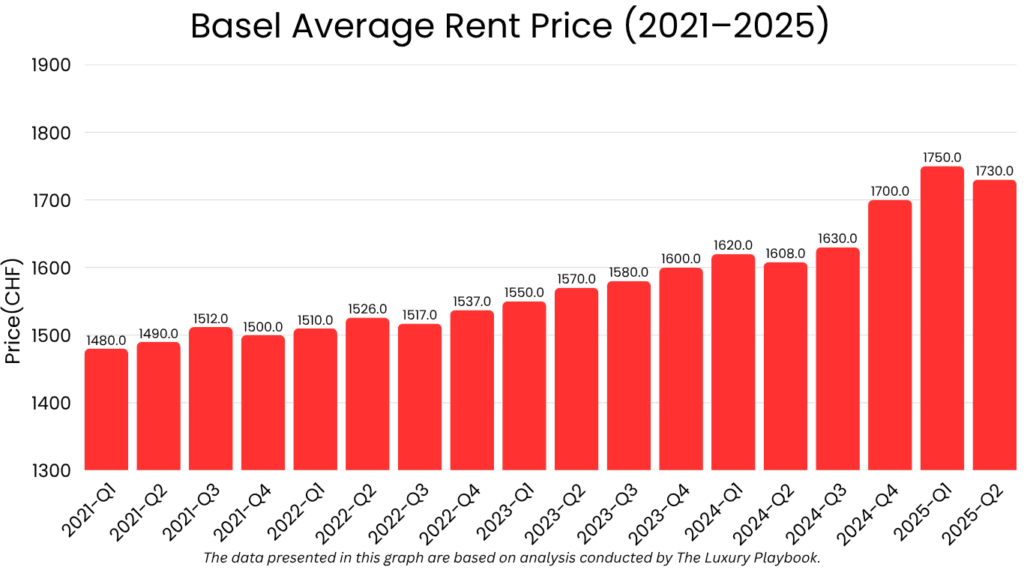
Rental yields in Basel range between 3.0% and 4.2%. The highest-performing properties tend to sit in mid-market areas like Kleinhüningen, Matthäus, and parts of Iselin. Lower acquisition costs, consistent tenant turnover, and strong demand from working professionals and cross-border commuters make these zones worth a closer look.
The rental pool in Basel is dominated by a specific mix of tenants worth understanding before you buy.
- Life sciences professionals employed by Novartis, Roche, and other pharmaceutical firms.
- Finance and logistics employees connected to regional headquarters or cross-border operations.
- International university staff and postgraduate students, particularly near areas like Hirzbrunnen and Wettstein.
- Long-term corporate expats and diplomatic staff, typically seeking multi-year leases on premium apartments.
Lease structures follow Switzerland’s tenant-friendly regulations, and long-term agreements are standard. Rent increases must track indexed adjustment rules and are subject to review under cantonal legislation. Know the rules before you set your return expectations.
Subletting and short-term leases are heavily restricted unless local housing authorities specifically permit them. If you’re thinking about running an Airbnb-style operation here, think again.
Rental Yield Ranges by Area
- Kleinhüningen, Matthäus: 3.8% – 4.2%
- Iselin, Gundeldingen: 3.4% – 3.8%
- Wettstein, Bachletten: 3.1% – 3.5%
- Gellert, Bruderholz: 2.8% – 3.1%
Basel’s rental market gives income-focused investors a reliable yield environment with low tenant turnover, strong lease integrity, and resilient pricing even when the broader economy shifts. Gross returns are moderate, but stability and tenant quality are the real competitive advantages you’re buying into.
Factors Influencing the Basel Housing Market
The Basel housing market in 2026 is shaped by a combination of economic, regulatory, demographic, and structural forces. These are the factors driving the city’s consistent property performance and its appeal to income-focused and long-term real estate investors.
- Cross-Border Economic Integration: Basel’s strategic location at the intersection of Switzerland, Germany, and France supports high labor mobility and regional investment flows. Thousands of cross-border commuters work in Basel daily, reinforcing demand for rental housing across the city and surrounding suburbs.
- Limited New Construction: Land scarcity and zoning restrictions limit large-scale development in Basel. Most new housing is delivered through redevelopment or densification rather than greenfield construction. As a result, supply growth remains subdued, placing upward pressure on both sales prices and rental rates.
- Institutional and Pharmaceutical Anchors: Global employers such as Roche, Novartis, and Lonza maintain headquarters or major R&D operations in Basel, generating a steady stream of high-income professionals. These institutions support long-term demand for both ownership and rental housing—particularly in premium neighborhoods near transit and business hubs.
- Price-to-Income and Affordability Trends: While Basel is more affordable than Zurich or Geneva, the price-to-income ratio continues to rise, especially for entry-level buyers. As affordability challenges increase, more residents are turning to long-term rentals, further boosting landlord leverage and multi-family demand.
- Tenant Protection and Legal Framework: Swiss housing law is heavily weighted in favor of tenants. Rent increases must follow indexed cost benchmarks, and lease terminations must follow formal procedures. While this limits rent escalation, it provides predictable, low-risk tenancy environments, particularly for institutional landlords.
- ESG and Renovation Incentives: Basel is leading Swiss cantons in promoting energy-efficient retrofitting and green-certified buildings. Investors upgrading older stock to meet new standards may benefit from tax incentives, grants, and higher tenant retention due to improved energy cost performance.
- Regional Infrastructure Improvements: Ongoing investment in Basel’s public transit and cross-border connectivity—such as the Rhine Railway Corridor and tram links into Germany—enhance accessibility and raise the profile of previously overlooked neighborhoods like Kleinhüningen and Hirzbrunnen.
Basel Housing Market Forecast for 2026
The Basel housing market is set to maintain its steady, low-volatility growth through 2026 and beyond. Anchored by its position as a Swiss economic hub and reinforced by tight supply, Basel offers predictable price appreciation and strong rental performance, especially in professionally managed and energy-upgraded residential assets.
This isn’t a speculative market. But it offers high-confidence returns supported by core fundamentals, and that’s exactly what long-hold and income-oriented investors should be prioritizing right now.
Residential property prices in Basel are forecast to grow by 2.5% to 3.5% through 2026, with stronger appreciation in neighborhoods undergoing infrastructure upgrades or redevelopment such as Kleinhüningen, Hirzbrunnen, and Wettstein. Bloomberg’s real estate coverage has consistently flagged Swiss mid-tier cities as a buffer against volatility across European property markets.
Well-maintained assets in prime districts like Gellert and Bruderholz will hold their premium positioning. That said, price gains in these areas may be more modest given their already high valuations. You’re buying stability, not acceleration.
The average price per square meter is projected to rise to somewhere between CHF 8,800 and CHF 9,000, depending on unit size, energy certification, and location. New construction stays highly constrained, so buyers will keep competing for quality resale units, especially in mid-market and commuter-connected neighborhoods.
On the rental side, average rent growth is forecast between 2.8% and 4.2%, with the strongest pressure coming from one to two-bedroom formats suited to singles, professionals, and cross-border commuters. New rental product is minimal, and tenant competition will favor landlords who offer well-located, energy-efficient, and furnished inventory.
Investor activity is expected to pick up modestly, especially from Swiss-based family offices and long-term institutional buyers seeking stable euro-franc diversification. Assets delivering net yields above 3.5% in up-and-coming areas like Matthäus or Iselin will be especially competitive, while fully renovated central apartments will stay core wealth preservation holdings for serious portfolios. If you want to understand how Basel compares to Europe’s most exclusive property destinations, the contrast tells you a lot about where the smart money is positioning.
Is It Worth Buying a Property in Basel?
Buying property in Basel in 2026 offers real advantages if you’re a conservative investor focused on income stability, low vacancy, and long-term capital protection. The case is clear, but it depends entirely on what you’re trying to achieve.
This market isn’t built for aggressive capital growth or speculative flips. But it performs exceptionally well at maintaining asset value and delivering consistent rental income, and that matters inside Switzerland’s tightly regulated property environment.
The strength of the Basel housing market sits in its fundamentals. Stable tenant demand, vacancy rates below 1.2%, and regional economic resilience are the pillars. If you’re targeting gross rental yields between 3.0% and 4.2% with minimal volatility, this market aligns well with that objective.
Basel pulls Swiss institutional landlords, income-focused family offices, and private investors who prioritize currency-secure, inflation-resistant income. If that description fits you, the city is worth serious attention.
But Basel is not the right call if you want fast appreciation or short-term rental arbitrage. Price growth is steady but modest, typically running between 2% and 4% annually. Tenant-friendly laws restrict lease flexibility, and rent increases must follow formal procedures. Acquisition costs including notary fees, transfer taxes, and renovation expenses can compress your initial returns if you don’t plan for them carefully. Reuters real estate reporting on Swiss property frequently highlights the regulatory gap between buyer expectations and on-the-ground realities for foreign investors.
For yield-oriented investors comfortable with Switzerland’s legal framework, Basel gives you one of the country’s most stable, secure, and efficient real estate markets. That said, it’s a poor fit for anyone chasing speculative upside or operational flexibility through short-term leasing models. Know what you want before you commit.
Other Market Forecasts and Overviews
Zurich Real Estate Market Overview and Forecast
Geneva Real Estate Market Overview and Forecast
Lausanne Real Estate Market Overview and Forecast
Bern Real Estate Market Overview and Forecast
Gstaad Real Estate Market Overview and Forecast
St. Moritz Real Estate Market Overview and Forecast
FAQ
Are Basel property prices expected to rise in 2026?
Yes. Forecasts suggest an increase of 2.5% to 3.5%, depending on location and property type.
What is the average price per square meter in Basel in 2025?
The average price is approximately CHF 8,470 per square meter, with premium districts exceeding CHF 10,000/sqm.
Is Basel a good city for real estate investment?
Yes—for investors focused on long-term rental income, low volatility, and capital preservation. It’s less suited to speculative or short-term strategies.
Which Basel neighborhoods offer the best investment value?
High-performing districts include Kleinhüningen, Matthäus, Iselin, and Wettstein, where yields range between 3.5% and 4.2%.
What is the typical rental yield in Basel?
Gross yields generally fall between 3.0% and 4.2%, depending on property quality, size, and tenant segment.
Is the rental market in Basel regulated?
Yes. Swiss tenancy laws protect tenants, limit rent increases, and restrict lease termination. Landlords must follow formal procedures.
Can foreigners buy property in Basel?
Yes, but with conditions. Foreign non-residents face restrictions under Lex Koller. Swiss residents and corporate entities face fewer limitations.