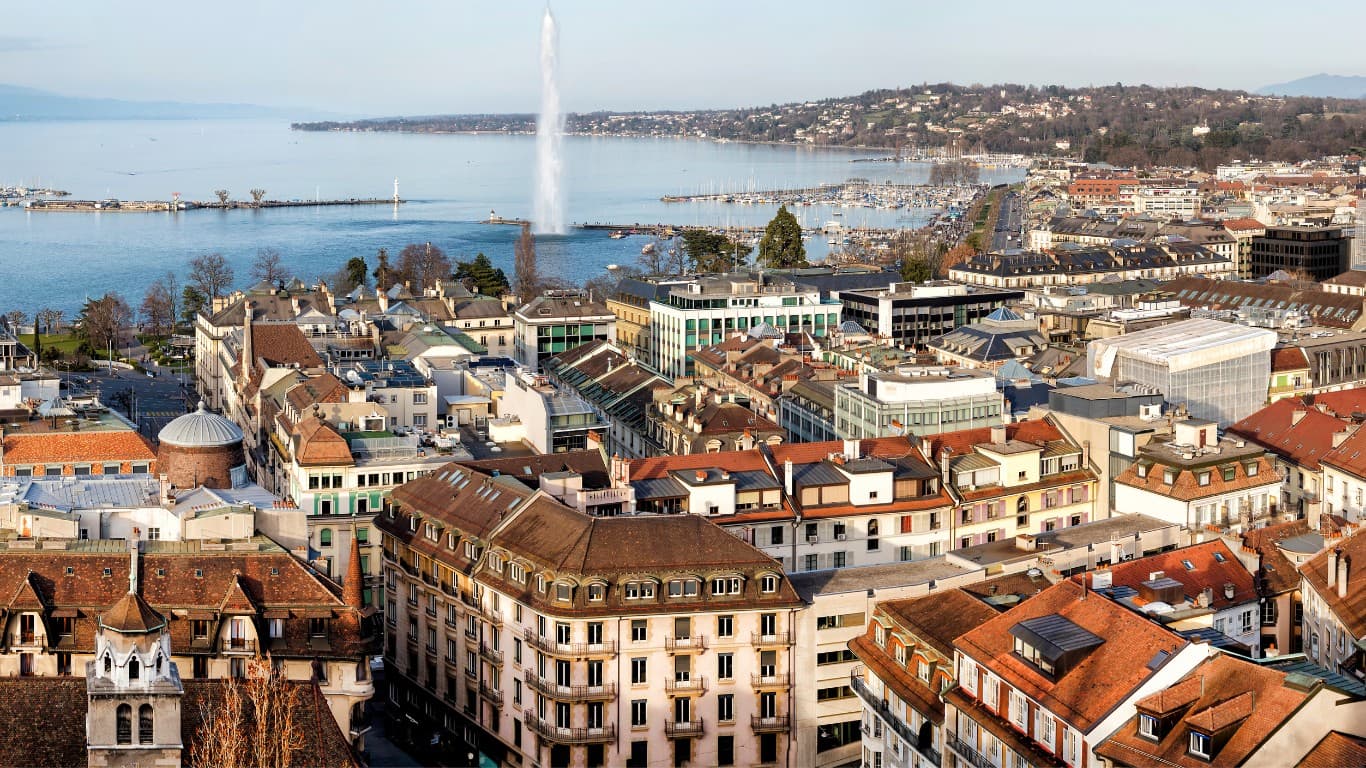
The Geneva real estate market in 2026 still reads as one of the most institutionally distinctive in Europe, anchored by the United Nations European headquarters, the World Health Organization, the WTO, and the densest private-banking cluster on the continent. Average residential pricing across the city sits near CHF 16,500 per square metre, with the Rive Gauche communes of Cologny and Vandoeuvres routinely trading above CHF 28,000 per square metre. Knight Frank's Wealth Report and Prime Index keep Geneva inside Europe's top tier alongside Zurich, Monaco and Mayfair.
The buyer profile reflects that institutional gravity. We watch the city through Cologny lakeshore listings priced for diplomatic and asset-management buyers, not the speculative cross-border money that drives Dubai Marina or Limassol.
Savills's World Cities Prime tracking and Engel & Völkers Geneva both describe a market where supply is rationed at the prime end and the structural buyer is local, EU-resident or institution-affiliated. Mansion Global has covered the recent Cologny off-market trades that confirm the depth.
- Geneva property continues to trade at among the highest levels in Switzerland, with the international organisation employer base and constrained supply supporting persistent price firmness.
- We see Cologny, Vandoeuvres and the lakeside arc anchoring the upper end of the Geneva market, with seafront stock attracting the strongest demand from qualifying buyers.
- Wuest Partner and BFS data show Geneva residential appreciation continuing through 2025 and 2026, with affordability metrics among the most stretched in Europe.
- Lex Koller restrictions shape the Geneva buyer mix in fundamentally different ways than open European markets, with the framework continuing to define participation.
- Lump-sum taxation in Vaud, accessible via cross-cantonal arbitrage, continues to support international resident interest in the Lake Geneva region more broadly.
- For most considered Swiss buyers we view Geneva as offering distinctive structural advantages, with appreciation tied to the city's unique international institutional anchor.
- Who is this for?
- Swiss residents and qualifying international buyers evaluating Geneva property, alongside the advisers, brokers and family office staff framing those decisions under Lex Koller.
- What is happening?
- A market overview and forecast for Geneva real estate, covering Cologny, Vandoeuvres, the lakeside arc, Lex Koller dynamics and the lump-sum tax context.
- When did this emerge?
- The article reflects 2026 market conditions through Wuest Partner, BFS and UBS Real Estate data alongside our own observations.
- Where is this happening?
- The piece focuses on Geneva, including Cologny, Vandoeuvres and the lakeside arc, with reference to the broader Lake Geneva region.
- Why does it matter?
- Geneva pricing reflects unique structural drivers within the Swiss market, which is why understanding the international institutional base matters before any acquisition.
The Geneva property market today
Switzerland's Lex Koller framework remains the binding constraint. Non-resident foreign nationals face quota-based restrictions across all cantons, with Geneva applying its own additional layer of cantonal review.
The result is a market where domestic, EU-resident and institution-affiliated demand drives almost every prime transaction. Time on market for restored Rive Gauche villas has compressed sharply since 2023.
Geneva sits inside Knight Frank's Prime Index tracker alongside Zurich and Lugano. Pricing is firm rather than speculative, supported by the Swiss franc as a structural currency hedge and by a banking sector that absorbs cyclical shocks more cleanly than peer European capitals.
- Average city pricing around CHF 16,500 per square metre
- Cologny / Vandoeuvres trophy pricing above CHF 28,000 per square metre
- Lex Koller restrictions on non-EU foreign buyers
- Domestic and institution-affiliated demand sets the floor
Neighbourhoods defining Geneva in 2026
Cologny and Vandoeuvres remain the prime Rive Gauche communes. Lake-frontage villas command the deepest premiums and the longest hold times.
Champel is the established hill above the Old Town. Mature trees, embassy-grade detached houses, and proximity to private schools anchor the family-buyer demographic.
Cité-Centre and the Old Town concentrate the restored eighteenth-century stock. The Place du Bourg-de-Four and Cathédrale Saint-Pierre define the cultural register.
Eaux-Vives draws the most consistent lake-adjacent buyer interest at the upper-mid tier. Carouge, the historic Sardinian-influenced commune across the Arve, offers the most distinctive heritage stock at slightly more accessible pricing.
What we hear from agents on the ground
Pictet, Lombard Odier, Mirabaud and the broader Geneva private-banking cluster continue to anchor the buyer base. The international institutional layer (UN agencies, WHO, the Red Cross) supports the rental segment more than the sales segment, but a steady share of senior diplomats convert into ownership inside their posting cycle.
Engel & Völkers Geneva and Christie's International Real Estate both describe a market where off-market activity now dominates above CHF 10 million. Sotheby's International Realty has reported similar patterns across Cologny and Champel.
The architectural register matters here in a way it does not in most cross-border conversations. Le Corbusier was born in nearby La Chaux-de-Fonds, and French-speaking Switzerland has long supported one of Europe's most consequential architectural cultures.
Geneva versus Zurich in 2026
The two Swiss flagship markets reward different buyers. Zurich's prime is structurally anchored by Swiss banking, asset management and the broader corporate sector, with Goldküste lakeshore pricing that mirrors Geneva's Rive Gauche but skews more toward UHNW family principals.
Geneva's prime is institution-driven first and banking-driven second. The diplomatic concentration is the differentiator, and the cultural calendar (Geneva Motor Show, Watches and Wonders fair-side activity) gives the city an international relevance Zurich does not match in the same months.
Both sit firmly inside the Knight Frank Wealth Report's European top tier. Both remain protected by Lex Koller, which keeps speculative cross-border money out and the floor under pricing structurally firm.
How Geneva compares with Monaco, Mayfair and Dubai Marina
Geneva trades around CHF 28,000 per square metre at the trophy tier. Monaco prime now sits closer to EUR 55,000 per square metre according to Savills's World Cities Prime tracking, putting Geneva at roughly half the Monaco premium for comparable lake-frontage stock.
Mayfair prime sits near GBP 30,000 to GBP 40,000 per square metre, which puts Geneva in the same neighbourhood at the high end. Dubai Marina prime sits closer to AED 22,000 per square metre (around CHF 5,400), or roughly a fifth of Geneva at the trophy line.
The comparison most readers actually want is Geneva against Limassol, where Cyprus PR pathways have drawn the Russian-speaking buyer pool. Limassol prime now trades near EUR 8,000 per square metre, well below Geneva. The buyer logic is genuinely different: Geneva is the institution-anchored asset, Limassol is the residency-led play.
What we expect through year-end 2026
We expect pricing to remain firm with growth of 1 to 3 percent through the back half of 2026. The Rive Gauche trophy segment is likely to outperform on the basis of structural scarcity rather than active demand surges.
Knight Frank's most recent Prime Index reading supports the trajectory. The Swiss National Bank's policy stance and the franc's defensive character continue to make Geneva a credible flagship in the global comparison set.
The institutional buyer base is not going anywhere. Swiss political and economic stability continues to underpin the floor.
What this means for buyers
Geneva rewards the buyer who treats real estate as a multi-generational anchor rather than a cyclical trade. Lex Koller closes the door on speculative cross-border money, which protects the floor but raises the friction for non-EU purchasers who need to qualify through residence or institutional affiliation.
For EU residents and institution-affiliated buyers, the Rive Gauche villa stock remains one of the most defensible European prime assets we cover. For everyone else, the rental route through a Geneva posting is the realistic entry point, with conversion to ownership a longer-horizon question.
We last reviewed this analysis in May 2026.
Frequently asked
How is the Geneva property market evolving in 2026?
Pricing is projected to grow 1 to 3 percent through the year. Rive Gauche trophy properties are expected to outperform on structural scarcity rather than demand surges.
Which areas are seeing the most buyer attention?
Cologny, Vandoeuvres, Champel, Cité-Centre and Eaux-Vives draw the most consistent prime demand, with Carouge holding the most distinctive heritage stock at slightly more accessible pricing.
Can foreign nationals buy property in Geneva?
Partially. Lex Koller restrictions apply to non-resident foreign nationals. EU residents face fewer restrictions than non-EU buyers, and the canton applies an additional layer of review.
What distinguishes Geneva from Zurich?
Geneva is institution-driven through the UN, WHO, WTO and the Red Cross. Zurich is anchored more directly by Swiss banking, asset management and corporate headquarters.


Savvas Agathangelou
Savvas Agathangelou co-founded The Luxury Playbook and has spent years reporting from the prime postcodes the magazine covers — Mayfair, Knightsbridge, the Athens Riviera, Dubai's Palm crescents, and the southern Mediterranean coastlines where the world's wealthy keep coming back. His background is in international hospitality, and that frame shapes how he writes about property: the developer's choices, the architect's signature, the agency's bench of named brokers, the building's service standard once the buyer moves in. He files developer spotlights, agency profiles, and the seasonal "Properties That Defined" listicles, and he hosts the magazine's founder-and-leadership interviews on the Voices side.