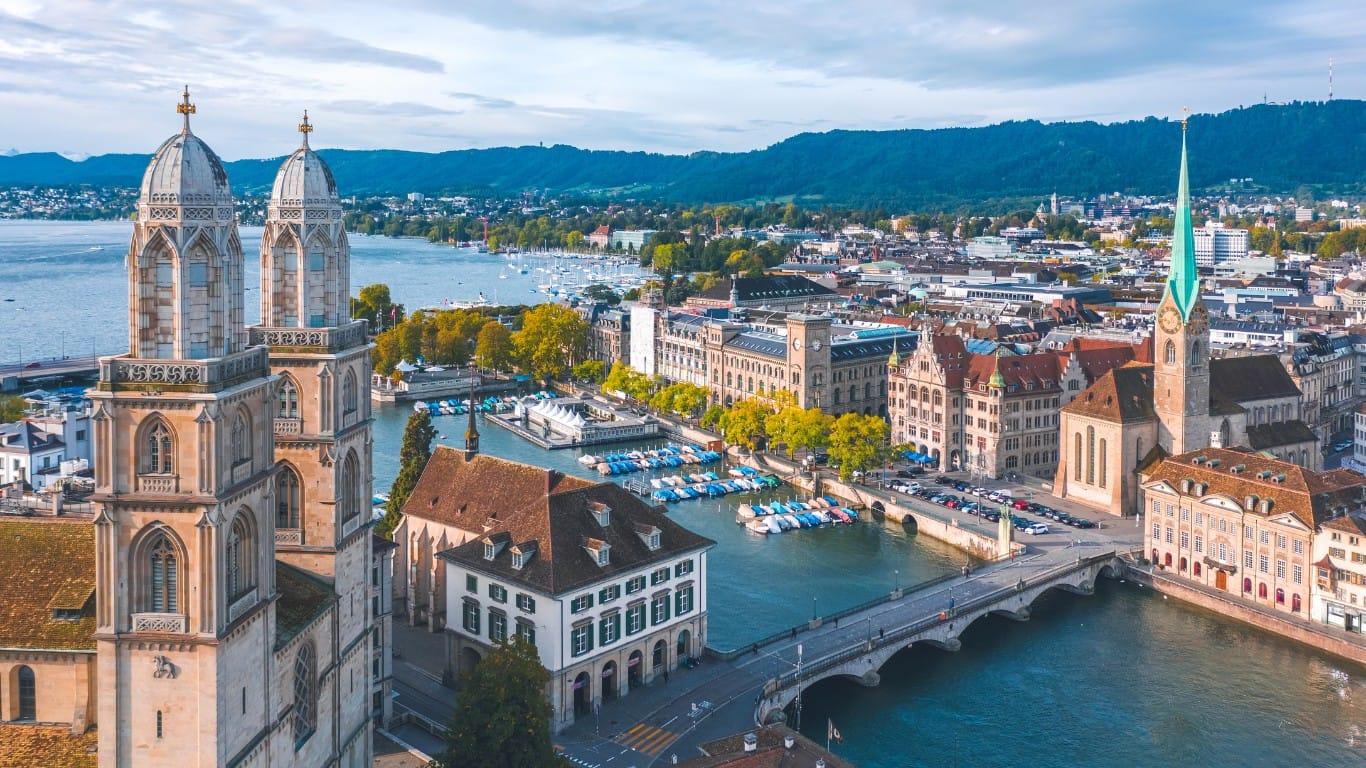
The Zurich property market remains one of the most institutionally important property markets in Europe. The financial capital of Switzerland, anchor of the country's banking and asset management sector, and a city whose property market has consistently behaved as a defensive, low-volatility store of value.
As of Q2 2026, average residential prices in the city centre sit at approximately CHF 18,000 per square metre, with prime lakeshore properties in the Goldkuste (the Gold Coast on Lake Zurich's eastern shore) regularly exceeding CHF 28,000 per sqm. Knight Frank's Wealth Report has consistently tracked Zurich among the most expensive prime residential markets in continental Europe, alongside Geneva and London. The city's structural advantages (political stability, currency strength, financial-services anchor, and one of the most considered architectural traditions in central Europe) combine to produce a market that operates on a notably different rhythm from the broader European prime conversation.
The architectural register that defines the Zurich prime offer reflects the city's role as a centre of architectural Modernism. Le Corbusier's Pavillon Le Corbusier (1967), the Herzog and de Meuron-designed Schaudepot for the Migros Museum, the contemporary Prime Tower by Annette Gigon and Mike Guyer, and the broader work of Swiss architects (Peter Zumthor's continuing influence, Diener and Diener, EM2N, Caruso St John on the more recent commissions) place the city at the centre of contemporary residential design. Restored eighteenth- and nineteenth-century townhouses in the Niederdorf and the prime Quartier Zurichberg neighborhoods sit alongside the contemporary residential developments along the lakeshore.
- Zurich remains the most resilient Swiss residential market, with constrained supply, deep institutional employer base and persistent international demand supporting continued price firmness.
- We see central neighbourhoods including Enge, Wollishofen and the Gold Coast arc along Lake Zurich anchoring the upper end of the local prime segment.
- Wuest Partner and UBS Real Estate data confirms continued residential appreciation in Zurich through 2025 and into 2026, with affordability metrics remaining stretched.
- Lex Koller restrictions limit foreign buyer participation in Swiss residential property, with the framework shaping the buyer mix in fundamentally different ways than open markets.
- Yields on Zurich residential rental stock remain compressed by international comparison, reflecting the persistent capital appreciation expectations baked into Swiss prime pricing.
- For most considered Swiss buyers we view Zurich as the safe-haven core of the Swiss market, with appreciation tied to continued employer base growth and constrained supply.
- Who is this for?
- Swiss residents and qualifying international buyers evaluating Zurich property, alongside the advisers, brokers and family office staff framing those decisions under Lex Koller.
- What is happening?
- A market read of Zurich property in 2026, covering the Gold Coast and central neighbourhoods, sustained appreciation, Lex Koller dynamics and the rental yield landscape.
- When did this emerge?
- The article reflects 2026 market conditions through Wuest Partner, BFS, UBS Real Estate and SNB data alongside our own observations.
- Where is this happening?
- The piece focuses on Zurich, including Enge, Wollishofen and the Gold Coast arc along Lake Zurich.
- Why does it matter?
- Zurich pricing reflects genuine structural advantages within the Swiss market, which is why understanding the supply and regulatory dynamics matters before any acquisition.
The Zurich property market today
Switzerland's Lex Koller framework restricts foreign property ownership. Non-resident buyers face significant restrictions on residential purchases. The Zurich market is structurally driven by domestic and EU-resident demand, with very limited inventory in the prime lakeshore segments.
Time on market for prime properties is meaningfully longer than the broader European average, reflecting the considered pace of high-stakes transactions.
The senior Swiss brokerages (Sotheby's International Realty Switzerland, Engel and Volkers Zurich, Christie's International Real Estate, the established Swiss private-bank-aligned advisory operations) all describe a market structurally weighted toward owner-occupier and multi-generation family ownership rather than transactional buyer activity. Mansion Global's recent Zurich coverage has profiled the same dynamic.
- Average city centre prices: approximately CHF 18,000 per sqm
- Prime Goldkuste lakeshore: above CHF 28,000 per sqm
- Lex Koller restrictions on foreign ownership
- Domestic and EU-resident demand drives transaction activity
Zurich neighborhoods defining the prime tier in 2026
Goldkuste
The Goldkuste is the Gold Coast on Lake Zurich's eastern shore, running through Kusnacht, Erlenbach, Herrliberg and Meilen. The most prestigious residential band in the city's metropolitan area, prime villa stock with lake frontage commands the strongest premiums. The combination of Lake Zurich frontage, southerly exposure, and proximity to Zurich's financial-services and academic infrastructure has made the Goldkuste one of the most consistently expensive residential bands in central Europe.
Niederdorf and Old Town
Niederdorf and Old Town contain restored medieval and Baroque townhouses in the historic core, with restored period properties commanding premium pricing. The architectural integrity of Zurich's old town (one of the best-preserved medieval cores in central Europe) supports the premium.
Zurichberg
Zurichberg is the prime hillside neighborhood with mature villas and panoramic city views. The combination of mature tree cover, considered period architecture, and the proximity to the University of Zurich and ETH academic infrastructure has made the area one of the most-watched prime residential corridors.
Seefeld and Wollishofen
Seefeld and Wollishofen are the established lakeside districts with consistent buyer demand. The Seefeld in particular has consolidated as one of the most-watched contemporary residential neighborhoods, supported by the steady refinement of the area's restaurant and cultural infrastructure.
Hochschulquartier and Oerlikon
Hochschulquartier and Oerlikon are the academic and emerging mixed-use districts. The University of Zurich and ETH-anchored Hochschulquartier has been one of the more interesting development corridors of the past decade; the Oerlikon redevelopment continues to introduce contemporary residential inventory.
The Swiss architectural context
The Swiss architectural tradition that anchors the Zurich contemporary residential offer is one of the most considered in central Europe. Herzog and de Meuron's continuing presence in the city (Basel-based but with substantial Zurich projects), Peter Zumthor's continuing influence on the broader Swiss architectural conversation, Diener and Diener and EM2N's residential commissions, and the contemporary work of Caruso St John (their Bremgarten and Mannedorf commissions specifically) all place the city's architectural conversation at the centre of contemporary European residential design.
The Swiss-modernist tradition (Le Corbusier's continuing influence through the Pavillon and the broader work, the Swiss school of restraint that runs from Max Bill through the contemporary studios) produces a residential architectural character that distinguishes Zurich from the more ornate central-European traditions. The contemporary commissions read as continuations of a coherent design tradition rather than departures from it.
What is shaping the Zurich property market in 2026
The structural drivers are clear: Switzerland's banking and financial-services sector (UBS following the absorption of Credit Suisse in 2023, Julius Baer, Pictet's Zurich presence, the broader Swiss private-banking sector), Swiss political and economic stability, the Swiss franc as a defensive currency, and the country's strict immigration framework that limits population pressure on housing supply.
The Lex Koller restrictions structurally limit foreign demand, which has historically supported the market's defensive character.
The continued buildout of the city's academic and research infrastructure (ETH Zurich's expanding research clusters, the University of Zurich's continuing growth) supports the demographic stability that anchors the broader market. The Glattal-Lakeshore corridor's continued development extends the contemporary residential offer.
Where the Zurich property market reads now
Prices are projected to remain firm through the back half of 2026 with modest growth of 1 to 3 percent, consistent with Zurich's defensive market character. Prime Goldkuste and Zurichberg properties are expected to outperform; the inland Niederdorf restoration market continues to see steady demand from domestic and EU-resident buyers seeking architectural depth in the historic core.
What this means for buyers
For the buyer who values one of the most defensively positioned property markets in Europe, the Swiss franc as a structural currency anchor, and architectural depth in a city at the centre of contemporary Modernism, the Zurich property market continues to read as one of the most structurally important property markets in continental Europe. Though Lex Koller restrictions limit international buyer participation meaningfully, the structural-resilience case remains intact.
We last reviewed this analysis in May 2026.
Frequently asked
How is the Zurich property market evolving in 2026?
Prices are projected to remain firm with modest 1 to 3 percent growth through 2026, characteristic of the city's defensive market profile. Knight Frank's Wealth Report consistently tracks Zurich among the most expensive prime residential markets in continental Europe.
Which Zurich areas are seeing the most buyer attention?
The Goldkuste (Kusnacht, Erlenbach, Herrliberg, Meilen), Zurichberg, restored Niederdorf and the lakeside Seefeld are drawing the most consistent demand. Prime Goldkuste lakeshore stock above CHF 28,000 per sqm remains the standout segment.
Can foreign nationals buy property in Zurich?
Partially. Non-resident buyers face significant restrictions under the Lex Koller framework. EU residents face fewer restrictions than non-EU nationals, and resident Swiss buyers can transact without restriction.
What distinguishes the Zurich prime market?
The combination of Switzerland's financial-services anchor, the Swiss franc's defensive character, and the architectural depth of one of Europe's most consequential cities for contemporary Modernism, anchored by named Swiss architects including Herzog and de Meuron, Peter Zumthor, Diener and Diener, and Caruso St John's recent commissions.
How does Zurich compare against other European prime markets?
Zurich prime pricing at CHF 18,000 to CHF 28,000 per sqm sits in line with prime Mayfair or Monaco, well above prime Athens or the Cote d'Azur, and is structurally insulated by the Lex Koller framework and the Swiss franc's defensive character.