
Audemars Piguet has captured unprecedented attention as auction results and secondary market momentum accelerate beyond even optimistic projections.
Fresh Phillips and Christie’s sales demonstrate remarkable strength for vintage “A-series” Royal Oak pieces and contemporary openworked references, while modern models continue commanding substantial premiums over retail in secondary markets that suggest genuine rather than speculative demand.
Building on this performance, AP’s combination of genuine heritage dating back to 1875, strictly limited production capped around 50,000 pieces annually and brand exclusivity maintained through family ownership have elevated it into financial safe-haven status within the luxury watch world.
Table of Contents
Key Takeaways
Navigate between overview and detailed analysisKey Takeaways
- Audemars Piguet’s market momentum is broad-based: vintage A-series Royal Oaks and modern openworked pieces are posting strong auction results, while contemporary models continue to trade at notable premiums over retail.
- Family ownership and tightly controlled output (≈50,000 watches/year) underpin scarcity and long-term brand discipline, supporting “blue-chip” positioning within luxury watches.
- Liquidity is real, not theoretical—core Royal Oak references (e.g., 16202ST) show fast median selling times and substantial annual transaction counts, giving investors credible exit options.
- Performance is segment-specific: top-quality or historically important pieces are holding firm or advancing, while more common references can soften—selection matters more than brand name alone.
- The boom looks sustainable on fundamentals (heritage, scarcity, innovation), but watch for cooling in over-hyped steel Royal Oaks; diversified exposure across AP families can reduce concentration risk.
The Five Ws Analysis
- Who:
- Serious collectors, family offices, and investors seeking blue-chip watch exposure with strong liquidity and scarcity.
- What:
- Audemars Piguet—an independent, family-owned Swiss maison (est. 1875) whose Royal Oak and related lines lead auction and secondary performance.
- When:
- Strength accelerated into 2025, with recent Phillips/Christie’s results confirming demand across vintage and modern references.
- Where:
- Global auction hubs (Geneva, Hong Kong, New York) and secondary markets where Royal Oak family pieces dominate AP trading volumes.
- Why:
- Controlled production, historical significance, and sustained collector sentiment create durable value retention and selective appreciation, especially in iconic and limited references.
The Legacy of Audemars Piguet
The Audemars Piguet story begins in Le Brassus, Switzerland, where Jules Louis Audemars and Edward Auguste Piguet founded their watchmaking workshop in 1875. This remote Vallée de Joux location, far from Geneva’s established watch district, fostered independence and creative freedom that would define the brand’s character across nearly 150 years.
What started as a partnership between two skilled craftsmen evolved into one of Swiss watchmaking’s most respected houses, yet the company never lost its essential character as a family enterprise dedicated to horological excellence above all else.
This independence matters profoundly for investment value. While most luxury watch brands now operate under massive conglomerates like LVMH or Richemont, Audemars Piguet remains privately held and family controlled.
Wikipedia documents this unusual status among top maisons, noting how private ownership enables long-term strategic thinking focused on heritage rather than quarterly profits.
When a family’s reputation depends on every watch bearing their name, quality becomes non-negotiable in ways corporate structures struggle to replicate.
The technical innovations emerging from this independent spirit have shaped modern watchmaking in fundamental ways, as Audemars Piguet pioneered perpetual calendar complications that automatically adjust for leap years and varying month lengths, developed intricate skeletonized movements that transform mechanical necessity into visible artistry, and created avant-garde designs that challenged watchmaking conventions when competitors played it safe.
The 1972 Royal Oak launch represented perhaps the brand’s most audacious innovation, as Wikipedia notes. Gérald Genta’s stainless steel luxury sports watch redefined what haute horlogerie could be, proving that precious metal wasn’t prerequisite for genuine luxury.
This family heritage creates emotional connections that support values beyond pure financial calculations. Collectors aren’t simply buying watches but investing in preserving independent Swiss watchmaking traditions threatened by industry consolidation.
When you acquire an Audemars Piguet, you become part of a nearly 150-year story of craftsmanship, innovation, and independence that resonates with buyers seeking authenticity in an increasingly corporate luxury landscape.
The production numbers reinforce this exclusivity in concrete terms. Wikipedia estimates reveal approximately 50,000 watches produced annually, orders of magnitude below mass luxury competitors manufacturing hundreds of thousands of pieces.
This scarcity proves deliberate rather than accidental, as the family could easily expand production to meet demand but chooses restraint to preserve the very exclusivity that makes AP special.
Auction Results and Market Performance with Record-Breaking Momentum
The 2025 auction season has delivered results demonstrating sustained collector enthusiasm across Audemars Piguet’s diverse catalog.
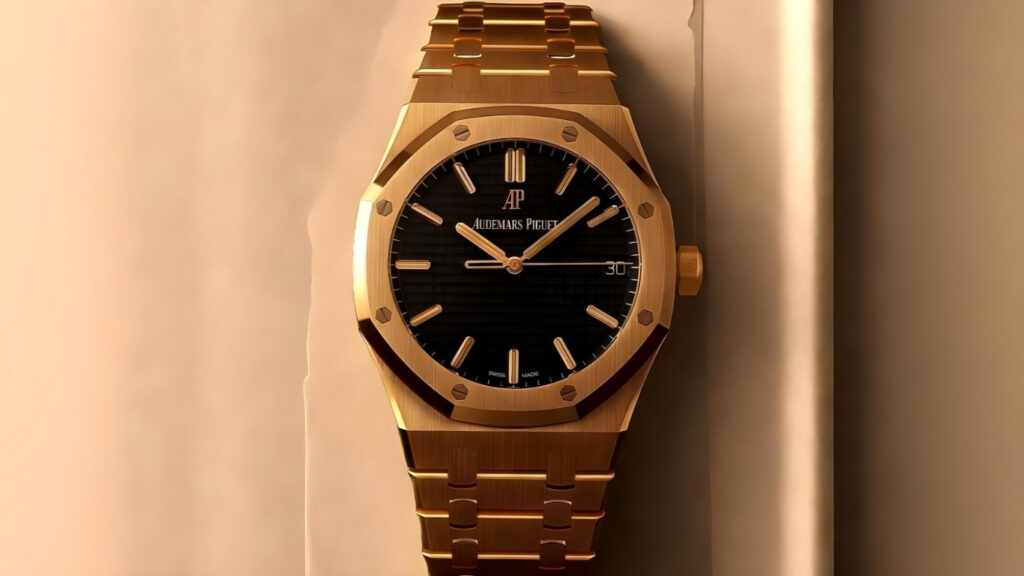
Phillips New York achieved $107,950 for an early 1972 A-series Royal Oak 5402ST, significantly exceeding its $50,000 to $100,000 pre-sale estimate, while Phillips Hong Kong realized HK$1,219,200 during May 2025 for a Royal Oak Jumbo Openworked reference 16204BA in gold, meeting or exceeding its HK$600,000 to HK$1,000,000 estimate.
For investors, these results confirm that AP’s high-end offerings maintain strong demand even at price points exceeding $150,000, indicating the brand appeals across wealth tiers rather than depending solely on entry-level enthusiasm.
More accessible references provide equally important signals about market health. Christie’s Hong Kong online sale documented HK$176,400 for a Royal Oak Offshore 26170TI in titanium, showing ongoing demand for sport chronographs appealing to younger collectors. Phillips achieved CHF 48,260 for a Royal Oak Tourbillon Chronograph 25977ST, further confirming depth of interest across AP’s portfolio.
These mid-tier results matter because they demonstrate the brand maintains liquidity at various price points rather than concentrating all strength in six-figure rarities, creating exit opportunities for investors regardless of which segment they’ve chosen.
At the same time, EveryWatch analysis reveals Royal Oak references accounted for 4,254 auction sales between mid-2024 and mid-2025, representing approximately 33% of all Audemars Piguet watches sold at auction. This concentration underscores how one family drives brand value, but it also reveals remarkable transaction volume creating the liquidity that serious investors require.
When thousands of pieces trade annually through auction channels, it confirms you’re dealing with an established market rather than a thin, speculative bubble where finding buyers becomes challenging.
Secondary market pricing provides additional context about value levels and trends. WatchCharts data shows Royal Oak pieces averaging roughly $45,000 with ranges spanning approximately $7,000 to $314,000 depending on specific reference, materials, and complications.
This spectrum indicates genuine market segmentation where different variants serve distinct collector demographics, from aspirational first-time buyers stretching to afford steel sport models through serious investors deploying hundreds of thousands into complicated pieces.
The Overall Market Index ticked up 0.6% during September while Audemars Piguet dipped slightly at 0.2% month-over-month according to WatchCharts and Phillips documentation. However, auction results from Hong Kong, New York, and Geneva remained firm, suggesting stabilization with selective strength in sought-after references rather than broad-based weakness.
This divergence between index movements and auction performance indicates that top-quality pieces continue finding enthusiastic buyers even as more common references experience pricing pressure, rewarding collectors who focus on historically important examples.
Why Investors Are Treating Audemars Piguet as a Blue-Chip Asset
The family-owned structure producing approximately 50,000 watches annually creates price floors that mass-output competitors manufacturing hundreds of thousands of pieces cannot match. This isn’t temporary allocation strategy that management could reverse if profits disappoint but rather fundamental philosophy where family reputation depends on maintaining exclusivity across generations.
Collectors prize Audemars Piguet’s creative control and distinctive design lineage spanning the Royal Oak, Royal Oak Offshore, and Royal Oak Concept families. This independence helps values weather market swings because the brand avoids dilution occurring when corporate owners pressure manufacturers to increase volumes or compromise design integrity for short-term profits.
You see this playing out in real time as AP maintains discipline while competitors chase trends, creating differentiation that sophisticated collectors reward through sustained demand.
Practical liquidity metrics provide reassurance for investors concerned about exit strategies, as WatchCharts documents the Royal Oak 16202ST achieving median selling times of just 39.5 days with 114 recorded sales over 12 months.
These numbers matter because they prove you can exit positions relatively quickly without accepting distressed pricing, unlike illiquid alternatives where finding buyers requires months of patience and significant discounts. This liquidity creates confidence supporting premium buying in primary markets, as collectors know they’re not locked into purchases but rather acquiring tradable assets with established market infrastructure.
A 2019 to 2024 study featured by Business Insider found high-end watches including Audemars Piguet offered low volatility combined with returns approximating global equities. While illiquidity caveats apply since watches can’t be sold instantly like stocks, this research supports positioning luxury timepieces as portfolio diversifiers complementing traditional holdings.
For wealth managers advising clients on alternative asset allocation, AP’s combination of uncorrelated returns with tangible ownership creates compelling diversification benefits.

The Best Audemars Piguet Models for Collectors and Investors in 2025
To systematically evaluate which Audemars Piguet references offer the strongest investment potential, our research team at The Luxury Playbook developed the Value Dynamics Index, a proprietary scoring system that moves beyond subjective opinions toward data-driven assessment.
The VDI measures five equally weighted factors that matter most to serious investors: liquidity, which determines how quickly you can exit positions; volatility, revealing price stability and discount frequency; ROI growth, tracking appreciation versus MSRP; scarcity and retention, measuring finite supply and percentage of pieces trading near or above retail; and sentiment, quantifying collector demand and market buzz.
Each metric is normalized on a zero to one scale where higher scores indicate stronger investment profiles, with the composite VDI representing the average across all five factors. This methodology provides objective framework for comparing investment characteristics across AP’s diverse collections, revealing which families reward different investor profiles and time horizons.
Audemars Piguet Collections Value Dynamics Index (VDI): Investment Performance Analysis
Comprehensive investment-grade performance analysis of Audemars Piguet watch collections using the proprietary Value Dynamics Index (VDI). This scorecard evaluates Royal Oak, Royal Oak Offshore, Royal Oak Concept, Ladies Royal Oak, Code 11.59, Jules Audemars, and Millenary across five critical metrics: Liquidity, Volatility, ROI Growth, Scarcity and Retention, and Sentiment Strength.
| Collection ▼ | VDI Composite ▼ | Liquidity ▼ | Volatility ▼ | ROI Growth ▼ | Scarcity ▼ | Sentiment ▼ |
|---|
The Value Dynamics Index (VDI) is a proprietary metric developed by The Luxury Playbook Analysts to measure the investment-grade performance of Audemars Piguet watch collections. VDI uses five equally weighted factors, each normalized on a 0-1 scale (where 1 = exceptional performance):
Based on global resale data from Chrono24, WatchCharts, Timeless Luxury Watches, Chronohunter, Jamais Vulgaire, Bezel, Sebastian Charles, and Goldammer, VDI quantifies how each collection performs as both a long-term collectible and financial asset.
Is Audemars Piguet’s Market Boom Sustainable or Nearing Its Peak?
Assessing sustainability of AP’s strong 2025 performance requires examining both supporting factors and cautionary signals with intellectual honesty. The case for continued strength rests on fundamentals that aren’t easily disrupted.
Production capped around 50,000 annual pieces ensures scarcity remains genuine rather than manufactured through temporary allocation games that management could reverse if financial pressures mount. This structural advantage creates long-term value stability unavailable from brands that could flood markets overnight if strategy shifts.
Consistent innovation maintains collector enthusiasm across generations in ways that matter for sustained demand. The brand’s artistic independence enables creative risks like the Royal Oak Concept that keep AP relevant for younger collectors while vintage pieces appeal to traditional enthusiasts. This demographic breadth means the brand isn’t depending on single generation’s preferences but rather building multi-generational following that should support values through inevitable shifts in fashion and taste.
When both 30-year-old tech entrepreneurs and 60-year-old traditional collectors covet your products, you’ve achieved rare positioning that transcends age cohorts.
However, counterpoints deserve serious consideration. Market cooling for certain hyped Royal Oak references where speculation rather than genuine collecting drove recent gains suggests not all AP pieces will deliver comparable returns.
WatchCharts data showing slight brand index declines through late 2025 indicates that select references, particularly non-halo Royal Oaks and standard Offshores, can drift when buying discipline weakens. This means blanket bullishness on everything bearing AP’s name would be naive, as performance increasingly diverges based on specific characteristics rather than brand association alone.
Sophisticated investors are responding by diversifying across AP collections rather than concentrating entirely in Royal Oak steel models. This behavior benefits overall brand stability by distributing demand across more references, reducing the concentration risk that could trigger rapid corrections if enthusiasm for any single family wanes. However, it also means individual model performance varies more dramatically than during periods when rising tides lifted all boats equally.
FAQ
Which Audemars Piguet watch holds value best?
The Royal Oak Jumbo Extra-Thin (Ref. 16202ST) holds value exceptionally well, achieving a 0.83 VDI score with secondary market prices around $67,600 versus $37,900 retail (78.5% premium), selling in median 39.5 days with 114 annual transactions.
Do AP watches go up in value after purchase?
Yes, especially limited editions and discontinued models; Royal Oak and Royal Oak Offshore watches often increase in value shortly after boutique sell-out, particularly in steel, ceramic, or skeletonized versions, with vintage A-series pieces like the 5402ST reaching $107,950 at 2025 auctions.
Is Audemars Piguet more exclusive than Rolex?
Yes, AP produces roughly 50,000 watches annually compared to over 1 million by Rolex, making AP watches significantly more exclusive and often harder to acquire through official channels, with waitlists for Royal Oak and Offshore models extending several years.
How long should I hold an Audemars Piguet watch for investment?
Holding for 5-10 years maximizes ROI, especially for references with historical significance or low production; however, some models like limited editions or discontinued pieces can appreciate substantially within 2-3 years after discontinuation.
Are AP watches hard to get from boutiques?
Yes, most high-demand references including Royal Oak and Offshore models are boutique-exclusive and allocated to preferred clients, with waitlists extending several years for steel sport models, making secondary market purchases often the only accessible option for new collectors.