


India presents a compelling demographic proposition that no wine industry executive can ignore. With a population exceeding 1.4 billion people, now larger than China’s due to the latter’s demographic decline, and a rapidly expanding middle class gaining disposable income and exposure to Western consumption patterns, India theoretically offers the kind of generational growth opportunity that transformed China into the world’s largest red wine market by volume within two decades.
Current wine consumption per capita remains minimal, suggesting massive headroom if cultural adoption accelerates along the trajectory that Chinese consumers followed from the early 2000s through the 2010s boom years.
Market research firms project India’s wine market will hit $520 million by 2028 and potentially reach $1 billion by 2034, figures that would represent substantial growth from today’s base and justify the expanding presence of European, Australian, and New World producers establishing distribution networks and brand awareness campaigns.
However, these projections demand critical examination. Are they realistic given the regulatory barriers, cultural differences, and punitive tax structures that China never faced during its wine market development?
The answer to this question determines whether India represents the next great wine investment opportunity or simply a mirage built on wishful demographic projections that ignore fundamental structural obstacles preventing mass market adoption.
Table of Contents
Key Takeaways & The 5Ws
- India’s demographics and rising middle class make it look like “the next China” for wine on paper, but structural realities make that outcome far from guaranteed.
- If India even reaches a fraction of China’s former per-capita wine consumption, the market could be multiple times larger than today’s $520m–$1bn projections, especially if India also becomes a regional hub.
- Punitive tax structures and state-by-state fragmentation make imported wine three to five times more expensive than in many markets, limiting true mass-market potential.
- Cultural and religious attitudes toward alcohol sharply reduce the addressable population, meaning large parts of India may never become wine consumers regardless of income growth.
- The realistic opportunity is a premium, urban, state-specific strategy—not a copy-paste of the China playbook—so “India as the next China” should be treated as a high-risk, selective bet rather than an inevitability.
- Who is this for?
- Global wine producers, importers, distributors, and alternative-asset investors weighing whether to commit serious capital to India, plus family offices and funds treating India as a long-duration demand story rather than a short-term export target.
- What is the real opportunity?
- A risk–reward case for India versus China’s historical wine trajectory, where upside is demographic-driven but ceilings are set by taxes and regulation—making premium, focused positioning more realistic than mass-market scale.
- When does it matter most?
- From now through roughly 2034, as the middle class expands, tax and trade negotiations evolve, and early movers either entrench brand and distribution or discover that structural barriers cap growth well below China-style scale.
- Where will demand concentrate?
- In more liberal, economically dynamic states and major cities—Mumbai, Delhi, Bengaluru, Goa, parts of Maharashtra—while also watching India’s potential role as a South Asian re-export and education hub serving neighboring markets.
- Why is “India as the next China” risky?
- Because India may be the last enormous untapped wine market on paper, but taxation, regulatory fragmentation, and culture determine the addressable market—so only investors who position state-by-state and premium-first avoid the “India mirage.”

What Makes India Compelling Compared To China’s Wine Market Evolution?
The demographic tailwinds supporting India’s wine market potential actually surpass the advantages China possessed when its wine consumption began accelerating in the early 2000s. India’s population of 1.4 billion skews substantially younger with a median age of 28 compared to China’s rapidly aging population with median age of 39, creating a longer runway for consumption growth as younger cohorts mature into peak earning and spending years.
The expanding middle class, projected to reach over 600 million people by 2030 according to various economic forecasts, will drive consumption of premium goods including wine as status signaling and lifestyle aspiration. China’s wine boom was fundamentally driven by similar middle class emergence during its economic miracle decades, but India’s scale is potentially larger and the demographic dividend extends decades longer before aging dynamics create the consumption headwinds now confronting Chinese wine markets.
Beyond demographic scale, the current low consumption base creates exponential growth potential that early-stage markets uniquely offer.
India’s wine market already exceeds $415 million in total value with the imported segment accounting for only $30.5 million, indicating domestic production dominates but also revealing that consumption per capita remains minimal compared to China’s peak consumption levels.
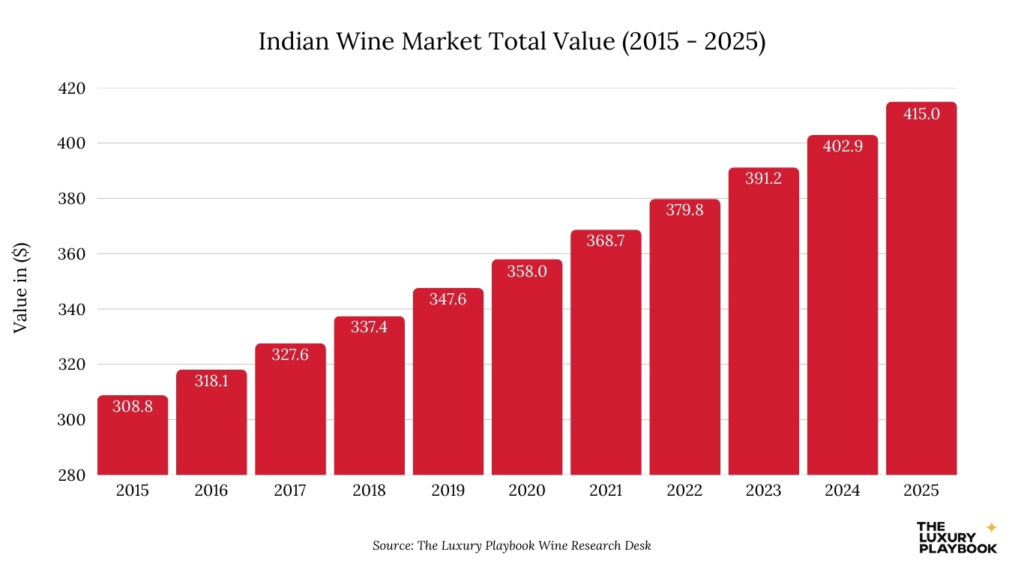
If India eventually reaches even 25% of China’s per capita wine consumption at its height, a conservative scenario given the demographic and economic similarities, the Indian market could exceed $5 billion in value, dramatically dwarfing the current $1 billion projection for 2034 and creating opportunity for producers who establish brand recognition and distribution infrastructure during these formative years.
Early indicators suggest this growth trajectory may already be accelerating beyond base case projections, as Italian wine exports to India surged 14% year over year in the most recent data, with Italy now ranking as the 4th largest wine supplier to India after Australia, France, and surprisingly Singapore which serves as a re-export hub.
This growth rate outpaces the broader Indian wine market average, suggesting European producers are gaining share through quality positioning and targeted marketing. Coordinated industry efforts like the Vinitaly India Roadshow, which brought 30 Italian wineries to New Delhi and Goa for consumer education and trade relationship building, demonstrate the kind of sustained European commitment that characterized early China market development in the 2000s when producers recognized the strategic importance of establishing presence before markets matured.
Perhaps most intriguingly, India is positioning itself as a South Asian re-export hub in ways that China never developed during its wine market expansion. Unlike China, which remained primarily a domestic consumption market despite its scale, India’s geographic position and improving trade infrastructure allow it to serve as a distribution gateway for neighboring countries including Pakistan, Bangladesh, Sri Lanka, and Nepal.
While each of these markets remains small individually, collectively they represent populations exceeding 500 million people at various stages of economic development.
If India successfully establishes itself as the regional wine hub with distribution networks, expertise, and consumer education infrastructure, it could anchor a regional market exceeding $2 billion beyond its own domestic consumption, creating network effects that justify producer investment even if Indian domestic adoption disappoints relative to optimistic projections.

What Structural Barriers Could Prevent India From Achieving China-Level Wine Market Status?
Despite these compelling fundamentals, severe structural barriers threaten to prevent India from replicating China’s wine market trajectory regardless of demographic advantages or economic growth.
The prohibitive tax structure stands as perhaps the single largest obstacle, making imported wines 3 to 5 times more expensive in India than similar bottles sell for in China even accounting for that market’s own tariffs and consumption taxes.
While China maintained import tariffs on wine, they remained relatively predictable and moderate, allowing producers to calculate total landed costs and price products competitively for middle class consumers. India’s tax regime combines high import tariffs with state level taxes that vary dramatically across jurisdictions, creating pricing chaos that deters mass market adoption.
A bottle of imported wine that might sell for $15 in China could easily cost $45-$75 in India after all taxes, pushing it beyond the reach of middle class consumers who represent the volume growth opportunity and relegating wine to ultra-premium positioning accessible only to wealthy urbanites.
Compounding the tax burden is regulatory fragmentation across India’s 28 states that contrasts sharply with China’s centralized control during its market development phase. Each Indian state sets its own alcohol regulations, licensing requirements, distribution rules, retail restrictions, and even prohibition status, with several states maintaining complete alcohol bans that eliminate entire regional markets.
This creates a patchwork where strategies that work in Maharashtra fail completely in Gujarat, while Tamil Nadu requires entirely different approaches than Delhi. Contrast this complexity with China where national policies created relatively uniform market access, allowing brands to develop scalable distribution strategies and benefit from economies of scale as they expanded across provinces.

At the same time, cultural and religious resistance fundamentally limits the addressable market in ways that China never experienced. Significant portions of India’s population abstain from alcohol for religious reasons, particularly among Hindu and Muslim communities where traditional values discourage or prohibit alcohol consumption, while cultural norms in many regions stigmatize drinking particularly among women who represent crucial consumption growth drivers in developed wine markets.
Unlike predominantly secular China where cultural barriers to wine adoption proved minimal and alcohol consumption carried positive social connotations when done moderately, India’s cultural environment means the actual addressable market may comprise only 40 to 50% of the total population rather than the 80%+ penetration theoretically possible in China.
This fundamentally caps total market potential regardless of economic growth or successful marketing campaigns, as entire demographic segments will simply never become wine consumers due to deeply held religious and cultural beliefs that economic development does not erode.
For wine producers and investors evaluating India’s potential, the market presents a classic risk-reward proposition where demographic scale and low current penetration create theoretical upside that structural barriers may prevent from materializing.
The opportunity likely exists for premium positioned brands targeting wealthy urban consumers in progressive states where regulatory environments are relatively favorable and cultural acceptance higher, but the mass market opportunity that transformed China remains questionable.
India may ultimately develop into a significant wine market measured in hundreds of millions or even low billions of dollars, but expecting it to replicate China’s trajectory toward becoming a top-tier global market likely underestimates the power of tax policy, regulatory fragmentation, and cultural resistance to prevent the broad-based adoption that demographic projections alone suggest should occur naturally.