As traditional investment markets turn turbulent heading into 2026, contemporary art has stepped up as a serious hedge and a genuine capital growth vehicle for sophisticated investors. And this isn’t some niche passion-project category anymore. Contemporary artworks tied to high-performing movements have consistently delivered double-digit returns, outpacing many equities and luxury collectibles over the past decade.
Collectors are no longer buying purely for aesthetics. Today’s buyers dig into auction trends, liquidity cycles, and institutional demand before they sign a single check.
According to the Artnet Price Database and the 2024 Art Basel and UBS Global Art Market Report, the contemporary art segment now accounts for over 55% of all fine art auction sales, with works by post-1970 artists posting the highest compound annual growth rates across the entire sector.
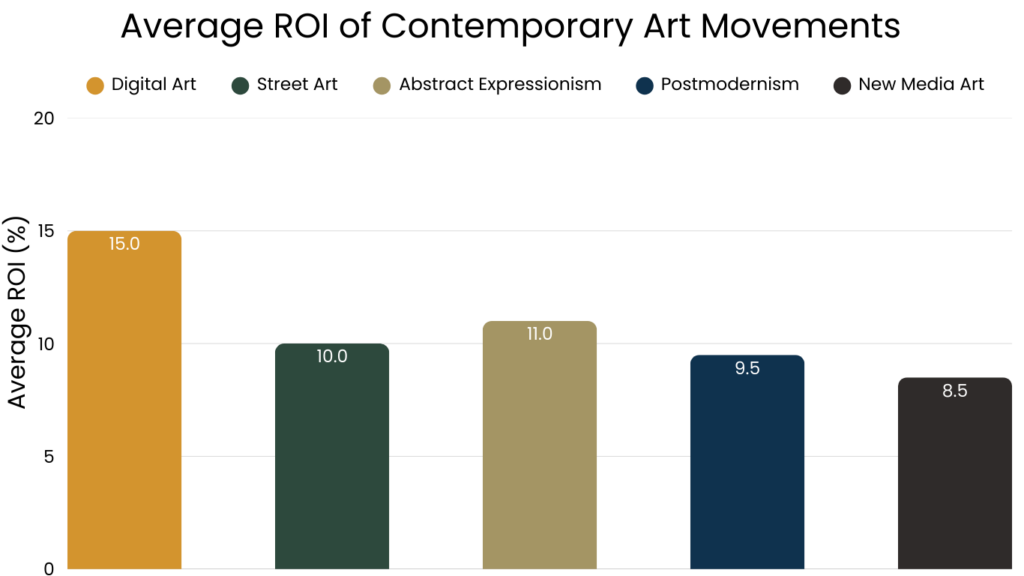
Smart investors are targeting specific contemporary art movements with proven market trajectories and real institutional validation. Street Art, once confined to urban walls, now commands seven-figure results at Christie’s. Abstract Expressionist works tied to second-generation American painters have posted 12-year ROI averages above 10%, backed by museum acquisitions and strong secondary market demand. If you want to understand how Christie’s, Sotheby’s, and Phillips auction sales signal shifts in the art market, the patterns emerging in these movements tell the whole story.
On the pricing side, blue-chip works across the top contemporary movements range from $50,000 to $2 million, with emerging artists offering entry points well below $20,000. But even within those tiers, the data is clear. Early buyers who align acquisitions with museum support and curatorial momentum see consistent appreciation and real liquidity access within five to eight year holding periods.
What follows is a breakdown of the best contemporary art movements to invest in for 2026, evaluated by historical performance, current momentum, average price points, and ROI metrics.
Table of Contents
History of Contemporary Art
The story of contemporary art is rooted in rupture, a clean break from the artistic past and from traditional ideas about how art gets valued. Emerging in the post-World War II era, it walked away from the academic techniques and idealism of modernism and embraced fragmentation, conceptual frameworks, and socio-political critique. This was never just about aesthetics. It became about ideology, experimentation, and authorship.
Most market analysts anchor the start of the contemporary era in the late 1940s, beginning with the rise of Abstract Expressionism in New York. That movement didn’t just reposition the U.S. as a global art capital. It marked a shift toward art as a large-scale, individual, and psychologically charged endeavor, laying the financial groundwork for the blue-chip market you see dominating auction rooms today.
The decades that followed gave rise to Pop Art, Minimalism, and Conceptual Art, each dismantling the idea that art required classical skill. Institutions initially pushed back hard. But by the 1980s, major auction houses and private galleries were aggressively marketing contemporary works and building the collector infrastructure that still drives prices today.
The sales of Jean-Michel Basquiat’s canvases above $100 million and David Hockney’s record-breaking auction at Christie’s sent an unmistakable signal. Contemporary artists had fully crossed into investment-grade territory.
What sets contemporary art apart historically is its tight relationship with media cycles and market timing. Unlike Old Masters, whose values are anchored in rarity and provenance, contemporary works gain value through curatorial visibility, collector demand, and institutional validation. A work appearing in a major biennial, a solo museum show, or a high-profile collaboration can trigger price escalations within months, not decades.
By the 2000s, movements like Street Art, Digital Art, and New Media had gone from fringe to globally prominent, powered by technology, social media virality, and the rise of alternative art platforms.
As of 2026, contemporary art stands as the most liquid and financially dynamic segment of the global art market, drawing in both cultural tastemakers and financial strategists. Its history is still unfolding, but its place in serious investment portfolios is already locked in.
Postmodernism
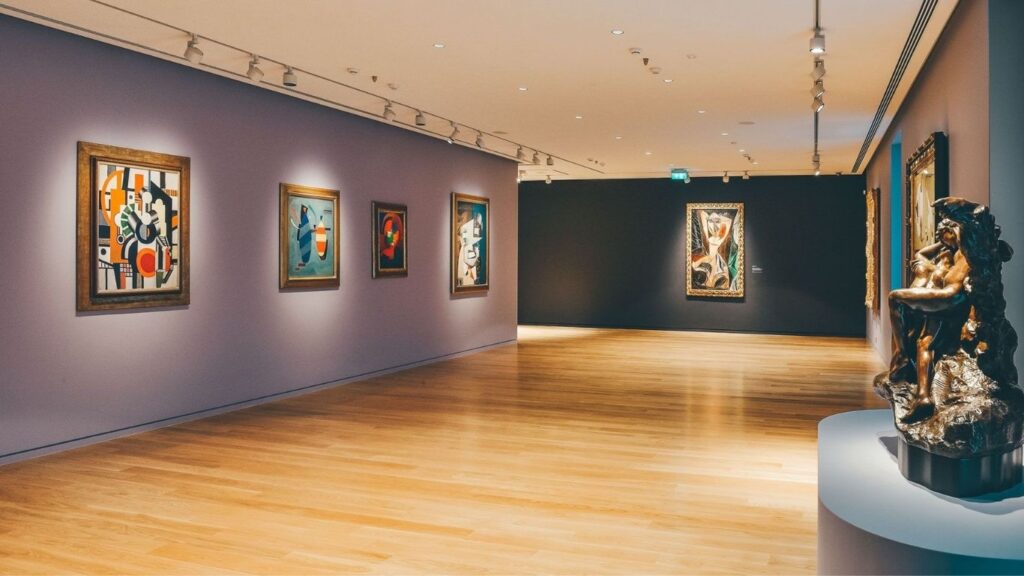
Postmodernism is not simply a style. It’s a direct challenge to the idea that art must have structure, truth, or even originality. The movement emerged in the late 1960s and 1970s as a counter to modernism’s grand narratives, blending irony, cultural critique, and appropriation into visual form.
For investors, Postmodernism sits as a foundational segment of the contemporary art market, a place where theoretical depth meets blue-chip stability.
Artists like Barbara Kruger, Richard Prince, Cindy Sherman, and Jenny Holzer redefined authorship by embedding text, media, and borrowed imagery into their practice. They didn’t merely depict reality. They interrogated it. And that interrogation now translates directly into enduring market value.
Sherman’s Untitled Film Still No. 21, once sold for under $1,000, now fetches over $900,000 at auction, with consistent secondary market demand driven by feminist art history and ongoing institutional acquisition.
What makes Postmodernism attractive to collectors and art funds alike is its critical weight paired with genuine institutional muscle. Major museums including MoMA, Tate Modern, and Centre Pompidou keep featuring retrospectives on Postmodern pioneers, reinforcing long-term valuation year after year.
Works from this movement tend to show lower volatility than newer digital segments, while delivering solid mid-term ROI, typically running from 8% to 11% annually for blue-chip names.
Entry points vary depending on what you’re buying. Photographic editions from Kruger or Holzer can start around $30,000 to $60,000, while original mixed-media works by Prince or Sherman command $500,000 to $3 million depending on period and provenance.
The academic legacy of this movement keeps influencing younger generations of artists, which means Postmodernism stays highly visible in auction catalogues, curatorial essays, and critical discourse.
That persistent relevance, paired with finite supply, ensures enduring demand from institutions, advisors, and collectors across the globe.

Abstract Expressionism
Abstract Expressionism stands as one of the most historically validated and financially durable categories in the contemporary art market. Born from post-war existential unrest and driven by a generation of American painters determined to redefine global visual culture, this movement laid the foundation for New York’s ascent as the world’s epicenter of postmodern art commerce.
Led by figures like Mark Rothko, Willem de Kooning, Franz Kline, and Clyfford Still, Abstract Expressionism was built on gestural brushwork, monumental scale, and raw emotional intensity. These weren’t paintings in any conventional sense. They were declarations. And the market responded accordingly.
Today, works from first-generation Abstract Expressionists have broken the $80 million threshold at auction, with top-tier pieces by Rothko and de Kooning setting benchmarks that rival even the great Impressionists.
But while the market for early Abstract Expressionists is largely institutionalized and dominated by museums and blue-chip galleries, a compelling investment case exists in second-generation and under-recognized figures within the movement. Artists like Joan Mitchell, Norman Bluhm, and Hedda Sterne have seen surging visibility thanks to academic revisionism and growing curatorial focus on female and immigrant artists within the canon. If you want context on how Impressionism compares as an asset class, this deep dive on Impressionism’s characteristics and ROI is worth your time.
Auction data from 2022 to 2024 shows a 32% average price increase for Mitchell’s mid-size canvases, with works crossing the $15 million mark after years of being undervalued relative to her male peers. Bluhm’s works have moved from the $100,000 range to consistently exceeding $500,000, with multiple private equity-backed collectors now active in the market.
From an asset allocation perspective, Abstract Expressionist works offer several key advantages worth understanding before you commit capital.
- Historical liquidity and price transparency
- Low correlation to newer, more speculative art categories
- A proven track record of compound returns (10–12% annually for established names over the last 15 years)
Price entry points vary sharply based on artist and provenance. Works from the core figures are largely held in institutional collections or trade privately above $10 million, while lesser-known contemporaries offer entry between $100,000 and $1.5 million, particularly through curated auctions or gallery estate holdings.
Investors focused on long-term appreciation and portfolio stability often treat Abstract Expressionism as the S&P 500 of the art world. It doesn’t explode overnight, but it doesn’t crash either. What you get is capital preservation, museum validation, and prestige, three qualities very few other art movements can genuinely claim.

Street Art
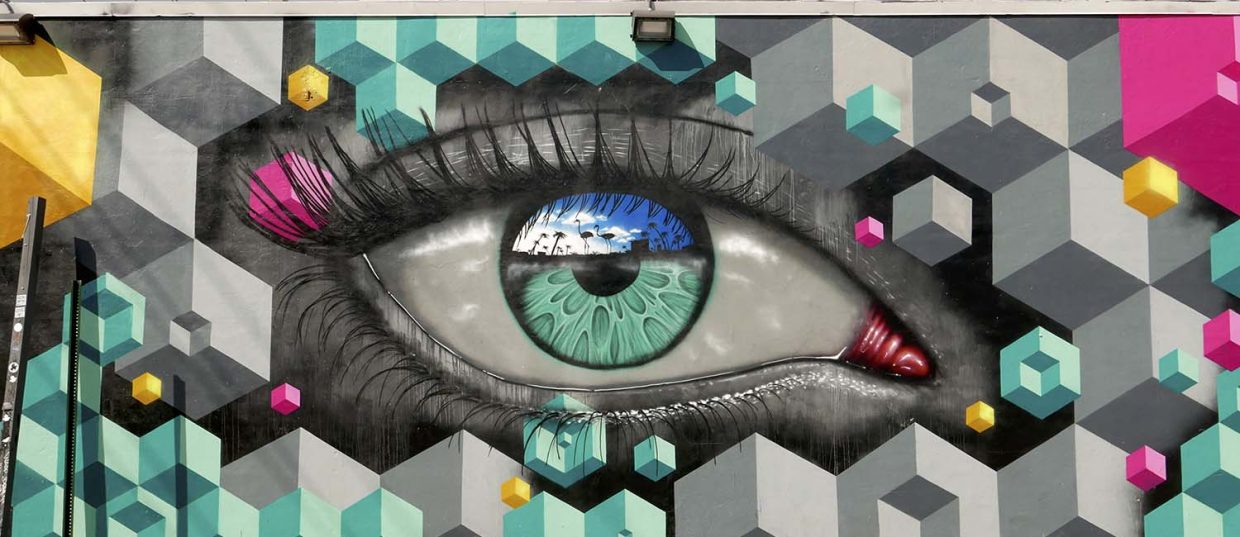
Street Art has undergone one of the most dramatic rebrandings in the history of fine art, moving from an illegal, anti-establishment practice into one of the most lucrative contemporary markets of the 21st century.
Once dismissed outright by institutions and the art establishment, the movement now commands serious attention from hedge fund-backed collectors and international auction houses alike.
At the center of this shift sits the undeniable market gravity of artists like Banksy, JR, Shepard Fairey, and Kaws, figures who have turned subversion into seven-figure commerce. Banksy, in particular, has reshaped auction dynamics entirely, with record-breaking sales including Love is in the Bin, which sold for $25.4 million in 2021 as a shredded version of his own earlier work.
As of 2026, Street Art’s market continues to post 8% to 12% annual ROI, driven by scarcity, mainstream appeal, and Banksy’s deliberate refusal to participate directly in the commercial market.
Beyond the headline names, Street Art’s broader appeal comes from its cross-generational and cross-asset demand. Its visual accessibility, political edge, and pop-cultural ties make it a natural entry point for younger high-net-worth collectors and digital-native investors. You can also explore how fractional art investing and art shares open up this category for collectors at different capital levels.
JR’s large-scale photographic pieces have surged in value, with his auction sales climbing over 180% from 2019 to 2023 and his works entering permanent museum collections and global biennales. Kaws, whose brand straddles fine art and fashion, has seen his editions regularly appreciate 30% to 50% within two to three years of acquisition, especially those tied to early releases or collaborations with global luxury brands.
From an investor’s lens, Street Art offers a compelling combination of factors that are hard to find bundled together in other art categories.
- High short- to mid-term growth potential
- Strong secondary market velocity
- Low entry barriers for print editions and multiples
- Museum validation through recent acquisitions and retrospectives
Entry points vary widely. High-tier originals can reach $1 million to $3 million, while limited-edition prints from Banksy or Fairey can still be acquired for $20,000 to $80,000 depending on edition size, condition, and market timing. The multiples market in Street Art is one of the most liquid in contemporary collecting, giving you exit options that other categories simply don’t offer.
If you want a culturally resonant, high-visibility asset that aligns with global pop influence, generational shifts, and rapid appreciation, Street Art delivers performance and provocation in equal measure.
Digital Art
Digital Art, long overlooked by traditional galleries, has now established itself as a serious asset class, driven by technological innovation, NFT infrastructure, and a generational realignment of what constitutes fine art. In 2026, the question is no longer whether Digital Art belongs in an investment portfolio. The real question is which artists, platforms, and protocols are shaping the category’s next phase of institutional growth.
The catalyst, of course, was Beeple’s record-breaking $69.3 million sale of Everydays: The First 5000 Days in 2021 via Christie’s, a watershed moment that vaulted Digital Art from fringe media to global auction centerpiece.
But what followed was even more telling. A maturing market began drawing a clear line between speculative NFT ephemera and artist-driven, conceptually rich, collector-vetted digital works.
Leading the charge in 2026 are artists like Refik Anadol, Pak, Tyler Hobbs, and Claire Silver, whose work blends data science, AI, algorithmic generativity, and conceptual rigor. These artists are no longer confined to blockchain-native audiences. They’re being collected by major museums, acquired by tech entrepreneurs, and integrated into real-world installations and architectural spaces.
From a performance standpoint, Digital Art has been among the most volatile but highest-yielding segments in contemporary art. Early works by generative art pioneers appreciated between 250% and 1,200% between 2020 and 2023, a range that reflects both the opportunity and the risk built into this category.
While the speculative NFT boom has cooled, the top 10% of digital artists continue to deliver annualized ROI above 15%, especially when backed by institutional credibility and strong on-chain provenance. The Financial Times has tracked this bifurcation closely, noting how collector quality, not platform hype, now drives sustainable price growth.
Price points vary dramatically. High-end digital works from established names range from $150,000 to $2 million, especially those included in curated NFT platforms like Art Blocks, SuperRare, or Feral File. Meanwhile, fractional shares or early drops from emerging digital artists still offer access below $10,000, making Digital Art uniquely scalable across different capital tiers.
For investors with a long-term thesis on dematerialized culture, tokenized ownership, and hybrid digital and physical integration, Digital Art isn’t a passing trend. It’s a structural shift.
The market is still young. But the infrastructure, institutional momentum, and collector ecosystem are maturing fast.
New Media Art
New Media Art sits at the intersection of contemporary theory, emerging technology, and experiential immersion. Often misread as a niche within Digital Art, it’s actually broader and more conceptually layered, encompassing works that use video, sound, installation, robotics, artificial intelligence, and interactive environments to push the boundaries of perception and authorship.
Unlike static canvases or single-sale NFTs, New Media Art tends to be experiential and time-based, often existing as multi-sensory installations, algorithmic projections, or AI-driven systems. Artists like Hito Steyerl, Rafael Lozano-Hemmer, TeamLab, and Bill Viola have pioneered this space, creating works that live across screens, walls, software systems, and immersive architecture.
While New Media Art may lack the immediate secondary market velocity of Street Art or Digital NFTs, it compensates through scarcity, site-specificity, and curatorial prestige. Bill Viola’s video installations, for instance, are highly limited, high-maintenance, and deeply spiritual. They’ve consistently sold in the $300,000 to $800,000 range, with collectors prioritizing museum-exhibited versions for their provenance weight.
Over the past five years, prices for major new media works shown at institutions like ZKM, MoMA, and The Whitney have appreciated between 7% and 10% annually. ARTnews has documented growing resale interest among private collectors who view these pieces as long-term cultural anchors rather than speculative trades.
The growing presence of New Media Art in tech-billionaire and private museum collections has pushed its investment credibility further into the mainstream. Collectors like Patricia Phelps de Cisneros, Julia Stoschek, and even crypto-founders have started acquiring immersive, programmable installations as signature holdings, a clear signal of where high-net-worth interest is moving in the post-screen age. If you’re thinking about how alternative assets like this fit into a broader portfolio strategy, comparing them to other passion assets like classic cars gives you useful perspective on diversification.
Entry points into New Media Art vary widely depending on scale and format. Custom-coded installations by emerging artists can start around $40,000 to $70,000, while established works with strong institutional exhibition history can command seven figures, particularly when editions are tightly controlled or site-specific licensing is required.
For investors looking for intellectual capital appreciation and next-decade relevance, New Media Art gives you a way to future-proof your collection while aligning with cultural, philosophical, and technological shifts that traditional paintings can no longer capture.
This category isn’t just visual. Bloomberg’s arts coverage has increasingly flagged it as environmental, intelligent, and in the eyes of the world’s most forward-thinking collectors, genuinely indispensable.

FAQ
Which contemporary art movement has the highest ROI?
Digital Art currently leads with average ROI between 12% and 18% annually for top-tier artists. Street Art and Abstract Expressionism follow closely, with stable returns between 8% and 12% depending on artist and provenance.
How much do contemporary artworks cost on average?
Entry-level contemporary pieces range from $10,000 to $50,000, while blue-chip works can exceed $1 million, especially if tied to major exhibitions or artists with auction records.
Is Digital Art still a good investment after the NFT crash?
Yes—if focused on artist-led, concept-driven works with curatorial or institutional validation. The speculative layer has cooled, but serious digital artists continue to perform well in both primary and secondary markets.
Which artists should new investors watch in 2025?
Emerging investors should track names like Refik Anadol (New Media), Tyler Hobbs (Generative Art), Tschabalala Self (Postmodernism), and JR (Street Art)—all showing strong collector interest and institutional growth.
Are contemporary art investments liquid?
Liquidity varies. Editions and prints (especially in Street and Digital Art) are more liquid, while installation-based or experiential works require private resale, often with curatorial facilitation.