


In the equity markets, the debate over value vs growth stocks is one of the most enduring conversations you’ll encounter as an investor. These two styles take fundamentally different approaches to portfolio construction, investor psychology, and long-term financial strategy.
But rather than being mutually exclusive, both play essential roles depending on your goals, your time horizon, and how much risk you’re willing to sit with.
Value stocks typically trade below their intrinsic worth based on metrics like the price-to-earnings (P/E) ratio, price-to-book (P/B) ratio, or dividend yield. These are often mature, stable, profitable companies operating in sectors like energy, finance, and consumer goods.
Historically, value investing has appealed to those seeking income stability and downside protection, especially during periods of market uncertainty or rising interest rates.
Growth stocks, on the other hand, are tied to companies expected to expand revenues and earnings at above-average rates. They tend to reinvest profits rather than pay dividends and often carry higher valuation multiples.
You’ll find these companies most often in industries like technology, biotech, or e-commerce, where innovation and market disruption can drive exponential returns over time.
Across multiple decades, financial studies have shown cyclical outperformance between these two strategies. Prolonged periods have existed where value stocks delivered stronger risk-adjusted returns, especially when broader markets were correcting or trading sideways.
At other times, particularly during bull runs led by innovation, growth stocks have surged ahead and delivered impressive capital appreciation.
For you as an investor today, understanding the distinction between value and growth investing goes well beyond academic curiosity. It sits at the center of navigating different market cycles, managing volatility, and aligning your portfolio with shifting macroeconomic conditions. If you want to go deeper on what drives those shifts, these are the economic indicators every investor must know.
Table of Contents
What Are Growth Stocks
Growth stocks are shares of companies expected to grow earnings, revenue, or market share at a much faster rate than the broader market or their industry peers. These firms typically reinvest their profits to fuel expansion through innovation, product development, or entering new markets rather than distributing dividends to shareholders.
You’ll most often find them in high-potential sectors like technology, biotech, and digital services. Growth companies tend to command higher valuation multiples as a result.
Investors are usually willing to pay a premium based on anticipated future performance, which means metrics like price-to-earnings (P/E) or price-to-sales (P/S) ratios often look elevated relative to historical norms.
Take a technology firm that doubles its revenue annually. It might trade at 30x or even 50x its earnings, not because of its current profit, but because of its future earnings potential. This approach leans heavily on forward-looking metrics like expected earnings per share (EPS) or projected free cash flow (FCF) rather than backward-looking fundamentals.
Key Characteristics of Growth Stocks
- High Revenue and Earnings Growth: Outpace industry averages year-over-year.
- Minimal or No Dividends: Earnings are reinvested to support business expansion.
- Premium Valuation: Often trade at elevated P/E, P/S, or PEG ratios.
- Market Sentiment Driven: More sensitive to interest rates and market volatility.
- Innovative Business Models: Tend to operate in rapidly evolving sectors.
Historically, growth stocks have outperformed value stocks during prolonged bull markets, especially when interest rates are low and capital is abundant.
If you have a longer time horizon and a higher risk tolerance, these stocks may offer stronger capital appreciation, though you should be prepared for greater volatility along the way.
In the broader conversation of value vs growth stocks, growth equities tend to perform best when market optimism is high, inflation is under control, and borrowing costs are low. Those are the conditions that support speculative investments and aggressive expansion strategies. To understand how these conditions move in cycles, this breakdown of stock market cycles and how to profit from them is worth your time.
What Are Value Stocks
Value stocks are shares of companies currently trading below their intrinsic or perceived fair value. These stocks typically belong to more mature businesses with stable earnings, predictable cash flows, and well-established market positions.
You buy value stocks with the expectation that the broader market has temporarily mispriced them, and that over time their true worth will be recognized, leading to price appreciation and dividend income.
Unlike growth companies that prioritize expansion, value firms tend to return capital to shareholders through dividends and buybacks. They’re generally less volatile and more defensively positioned when the economy turns.
Common sectors for value stocks include financials, consumer staples, energy, and industrials. These are industries where earnings tend to be more consistent and far less speculative.
Key Characteristics of Value Stocks
- Low Price Multiples: Typically feature lower P/E ratios, P/B ratios, and PEG ratios than growth stocks.
- Stable Dividends: Often provide above-average dividend yields, making them appealing for income-focused investors.
- Undervalued Fundamentals: Trade below historical averages or intrinsic value estimates.
- Resilience in Down Markets: Less susceptible to sharp drawdowns during economic contractions.
- Stronger Short-Term Metrics: Offer solid return on equity (ROE) and free cash flow (FCF) generation.
The value investing strategy, popularized by figures like Benjamin Graham and Warren Buffett, emphasizes capital preservation, margin of safety, and long-term compounding. It typically aligns well with conservative investors seeking steady returns and lower exposure to volatility.
When comparing value vs growth stocks, value stocks tend to outperform during market corrections, high-interest-rate environments, or periods of economic uncertainty. Those are the conditions where earnings predictability and consistent cash flow become far more attractive to serious investors.
Put simply, value investing focuses on buying strong businesses at discounted prices. Think of it as a more defensive, income-generating strategy within a diversified portfolio.

Value vs. Growth Stocks: Key Differences
Value vs. Growth Stocks: Key Differences
Value vs. Growth: Historical Performance
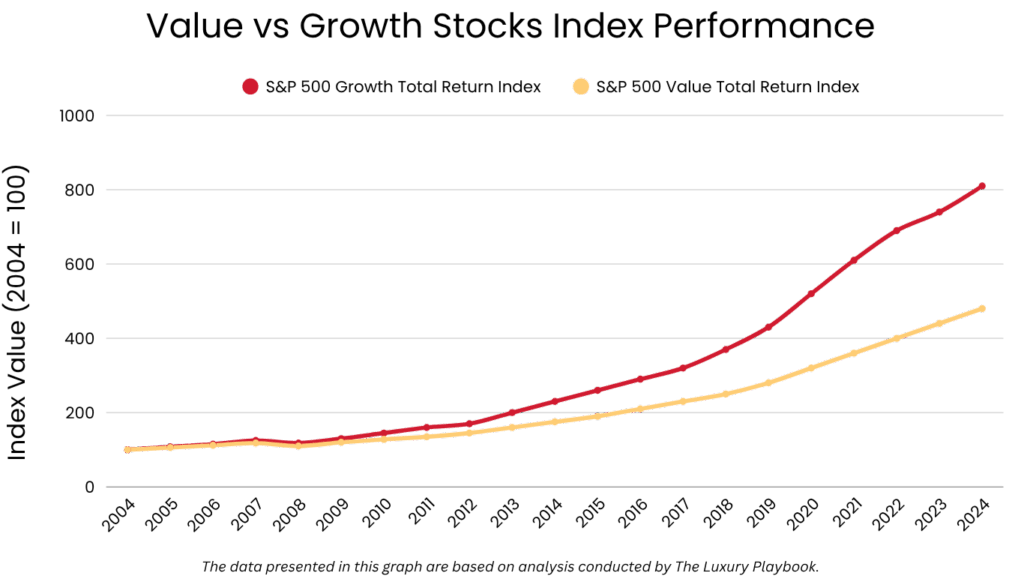
Looking at how value and growth stocks have performed historically gives you the context to make smarter forward-looking decisions. Both styles have had their moments in the sun, but their long-term returns tend to alternate depending on economic cycles, monetary policy, and market sentiment.
From 1926 through 2023, value stocks have historically outperformed growth stocks when measured by total return.
According to long-term datasets analyzing U.S. large-cap equities, value stocks delivered an average annualized return of roughly 10.2%, compared to 9.1% for growth stocks. That return advantage comes from the compounding effect of lower valuations, dividend reinvestment, and lower downside risk during bear markets.
That said, the performance gap has narrowed and at times reversed in certain economic environments.
During the post-2008 recovery and tech-led bull markets from roughly 2009 to 2021, growth stocks dominated. The NASDAQ-100 Index delivered over 18% CAGR, driven by mega-cap tech giants like Apple, Amazon, and Alphabet.
Value stocks regained momentum in 2022 and 2023 amid rising interest rates, inflationary pressures, and a declining appetite for speculation. During that stretch, the Russell 1000 Value Index outperformed the Russell 1000 Growth Index by over 14 percentage points in a single calendar year, a sharp reminder of how fast macro conditions can shift the leadership cycle.
Key data snapshots
- From 2000 to 2010 (a period that included the dot-com crash and the 2008 financial crisis), value stocks outperformed by a wide margin. The S&P 500 Value Index delivered ~2.5% annualized returns, while the S&P 500 Growth Index was nearly flat, with just ~0.2% CAGR.
- Conversely, from 2010 to 2020, growth stocks generated double-digit annual returns, often exceeding 12% per year, fueled by exponential earnings expansion in software, cloud computing, and biotech sectors.
- In inflation-sensitive years such as 2022, value sectors like energy and financials posted returns above 30%, while growth-heavy sectors saw sharp drawdowns of -20% to -35%, reflecting their sensitivity to rising discount rates.
Standard deviation and Sharpe ratios across multi-decade intervals show that value investing offers a higher risk-adjusted return, particularly when dividends are reinvested.
Value portfolios tend to exhibit lower drawdowns, especially during recessionary phases. Growth portfolios are more volatile but can capture outsized gains during expansionary cycles.
The relative performance of value vs growth stocks is cyclical. Growth strategies excel during low-interest-rate, high-liquidity environments. Value investing shines when markets normalize and fundamentals matter more than forward sentiment.
Successful long-term investors often rebalance between the two, recognizing that no single style leads the pack indefinitely.

Examples of Value and Growth Stocks
To bring the distinction between value and growth investing to life, here are well-known stock examples from each category, along with their approximate 10-year return on investment from mid-2014 to mid-2024. This performance data helps clarify the real-world implications of each strategy.
Growth Stocks
- Apple Inc. (AAPL) 10-Year ROI: ~920%
- Amazon.com Inc. (AMZN) 10-Year ROI: ~640%
- NVIDIA Corporation (NVDA) 10-Year ROI: ~3,400%
- Tesla Inc. (TSLA) 10-Year ROI: ~2,400%
- Meta Platforms 10-Year ROI: ~520%
Value Stocks
- Berkshire Hathaway (BRK.B) 10-Year ROI: ~190%
- Johnson & Johnson (JNJ) 10-Year ROI: ~125%
- Procter & Gamble (PG) 10-Year ROI: ~160%
- Coca-Cola Co. (KO) 10-Year ROI: ~100%
- JPMorgan Chase & Co. (JPM) 10-Year ROI: ~190%
Value vs Growth Stocks: Investing Strategies
Building a successful equity portfolio takes more than simply picking a side between value or growth stocks. You need to understand how each category behaves under different market conditions and how their respective strategies align with your long-term goals, risk tolerance, and income needs.
Value Investing Strategy
Value investing revolves around identifying stocks trading below their intrinsic value, as measured by metrics like Price-to-Earnings (P/E), Price-to-Book (P/B), and Free Cash Flow (FCF). The strategy is built on a simple but powerful idea, that the market occasionally misprices stocks and savvy investors can capitalize on those inefficiencies.
Key Traits of a Value Investing Strategy
- Low Valuation Multiples: Value investors typically seek stocks with a P/E ratio below the market average. For example, as of mid-2024, the average P/E of the S&P 500 is approximately 22, while many value stocks trade at P/E ratios of 12–16.
- Consistent Dividends: Value stocks often offer dividend yields between 2%–4%, creating a passive income stream while waiting for price appreciation.
- Risk Mitigation: Due to lower valuation and historical performance during economic downturns, value stocks generally offer lower downside volatility. For instance, during the 2022 market drawdown, the S&P 500 Value Index outperformed the Growth Index by nearly 10 percentage points.
- Focus on Fundamentals: Value investors emphasize book value, return on equity (ROE), and earnings stability. This makes the strategy attractive to long-term holders seeking capital preservation with moderate appreciation.
Ideal for conservative investors, income-focused portfolios, bear market environments, and retirement accounts with a focus on capital protection.
Growth Investing Strategy
Growth investing targets companies expected to expand revenue and earnings at rates well above the market average. Rather than hunting for low valuations, you’re prioritizing companies with strong top-line expansion, scalable business models, and market leadership in emerging sectors.
Key Traits of a Growth Investing Strategy
- High Revenue Growth: Growth stocks often report annual revenue growth exceeding 20%, especially in sectors such as AI, clean energy, and digital technology.
- Reinvestment Over Dividends: These companies tend to reinvest profits rather than pay dividends. For instance, Amazon and Tesla famously operated with razor-thin margins for years, prioritizing reinvestment to dominate their respective industries.
- Volatility Acceptance: Growth strategies tend to experience higher drawdowns during market corrections. In the 2020 COVID crash, growth names fell faster—but rebounded sharply, outperforming value by more than 30% from March to August 2020.
- Strong EPS Forecasts: The emphasis is on forward earnings and innovation-driven margins, with a focus on metrics such as the PEG ratio (Price/Earnings-to-Growth) for relative valuation.
Ideal for aggressive investors, tax-advantaged accounts like Roth IRAs, bullish market conditions, and those with a longer time horizon who can stomach price swings without panic-selling.
Hybrid Strategy: GARP (Growth At a Reasonable Price)
If you’re looking for a blend of both worlds, GARP strategies offer real balance. This approach involves investing in companies that are growing earnings but aren’t overvalued relative to their growth expectations.
GARP Characteristics
- Targets PEG ratios below 1.0, signaling undervaluation relative to growth.
- Seeks companies in transition stages—e.g., formerly high-growth firms becoming profitable.
- Offers a smoother ride through market cycles by limiting overexposure to high P/E outliers.
Stocks like Alphabet (GOOGL) and Microsoft (MSFT) often fall into this category thanks to their dual nature of robust growth and solid cash flow. Financial Times markets coverage regularly tracks how GARP-style holdings hold up across different rate environments, and the pattern is worth studying.
Tactical Allocation Based on Market Cycle
- During Economic Expansion: Growth stocks often outperform due to rising risk appetite and access to cheap capital.
- During Economic Contraction: Value stocks tend to outperform as investors rotate toward stability and predictable earnings.
- Rising Interest Rate Environments: Value stocks often maintain performance better since growth stocks’ future cash flows get discounted more heavily.
Many modern investors adopt core-satellite models that allocate a core percentage to diversified index funds and then layer on satellite allocations to either value or growth tilts depending on where the cycle stands. If you’re thinking about how to keep those trading costs lean while rotating between styles, these four ways to reduce trading fees are worth bookmarking.
| Portfolio Type | Core (%) | Growth (%) | Value (%) |
|---|---|---|---|
| Aggressive Growth | 50% | 40% | 10% |
| Balanced Moderate | 60% | 20% | 20% |
| Conservative Income | 70% | 10% | 20% |
FAQ
Which is safer: value or growth stocks?
Value stocks are generally less volatile and considered safer in down markets. Growth stocks carry higher risk but can offer greater upside in bull markets.
Do growth stocks outperform value stocks?
Growth stocks often outperform during economic booms, while value stocks tend to outperform during downturns and recovery periods. Over the long term, both styles have shown periods of dominance depending on market cycles.
When should I invest in value stocks?
Invest in value stocks during economic slowdowns, rising interest rate periods, or when market volatility is high. These stocks provide stability and income through dividends.
When is it better to choose growth stocks?
Growth stocks perform best during low-interest rate environments, technological innovation cycles, and economic expansions when investor risk appetite is high.
Can I invest in both value and growth stocks?
Yes, combining both in a diversified portfolio can balance risk and reward, ensuring performance across different market conditions.
Are growth stocks riskier than value stocks?
Yes. Growth stocks have higher volatility, especially during market corrections, because of their reliance on future earnings projections.
How do taxes impact growth vs value investing?
Growth investors may face higher capital gains taxes from selling appreciated shares, while value investors may benefit from steady dividend income, which may be taxed differently.
What metrics help identify value or growth stocks?
Key metrics include P/E ratio, PEG ratio, dividend yield, earnings per share (EPS), and revenue growth. Value stocks have lower P/E and higher dividends, while growth stocks show higher EPS and revenue expansion.