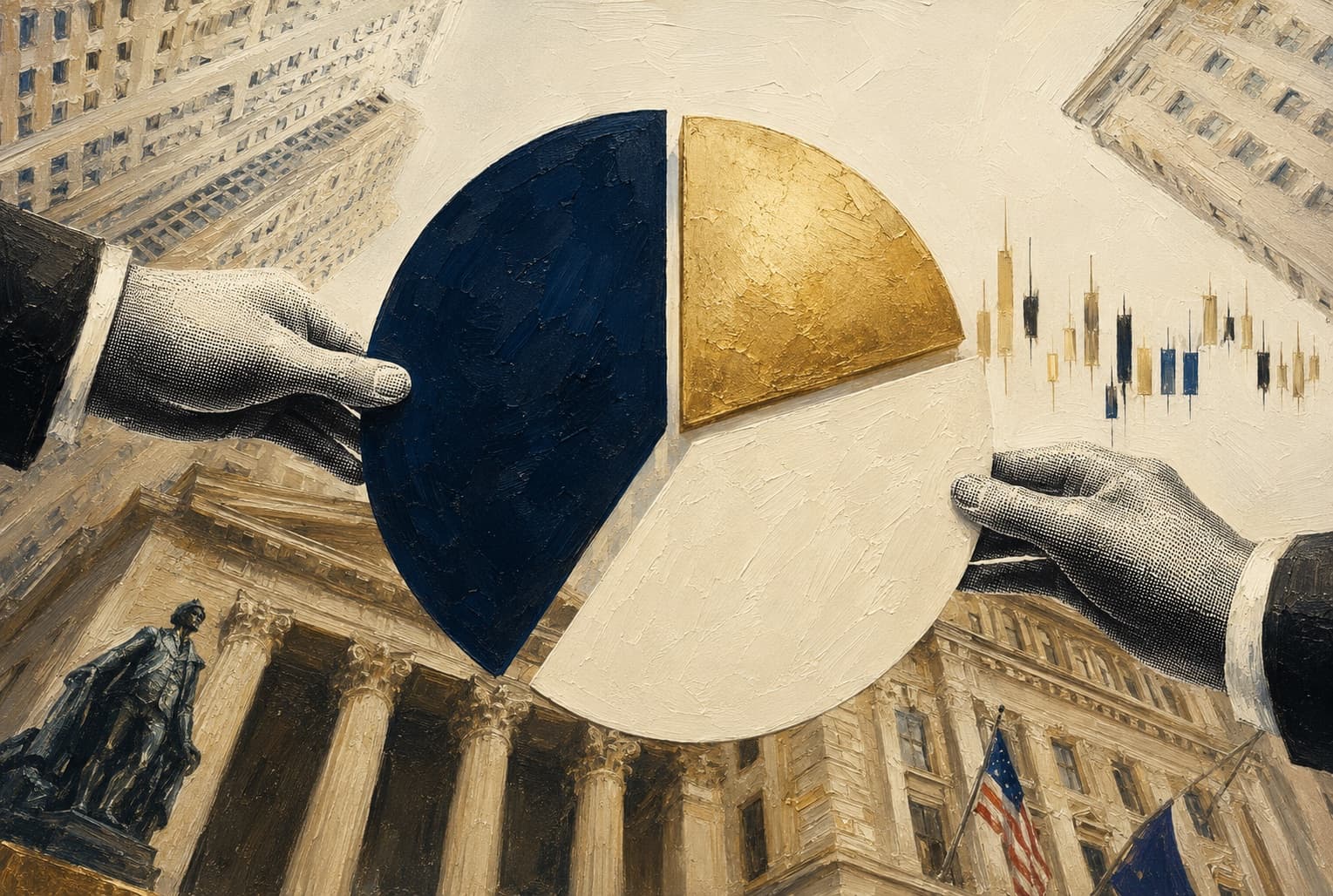
For investing, two strategies tend to dominate the conversation and pull in opposite directions: market timing and dollar-cost averaging, or DCA for short.
Each takes a completely different approach to deploying your capital and managing risk. Market timing tries to predict where the market is headed so you can buy low and sell high. DCA, by contrast, spreads your investment across regular intervals to soften the blow of short-term volatility.
In theory, market timing has obvious appeal. If you could nail the entry and exit points, the returns would be exceptional. But timing the market consistently is brutally difficult, even for the professionals who do this full time.
A DALBAR study analyzing investor behavior from 1991 to 2021 found that the average equity fund investor underperformed the S&P 500 by more than 3% annually, and poor market timing decisions were the primary culprit.
DCA, on the other hand, has earned real traction among risk-averse and long-term investors. It gives you a disciplined, automated way to stay invested without getting caught up in the emotional rollercoaster of trying to predict what the market will do next. By committing a fixed amount at regular intervals, you naturally scoop up more shares when prices dip and fewer when they climb, which pulls your average cost per share down over time.
What follows is a thorough look at both strategies across risk management, profitability, effort, behavioral tendencies, and fit for different types of investors. You will also find real data and performance comparisons to help you decide which approach actually suits your situation.
The timing-versus-averaging question has been studied at length by the major asset managers. Vanguard's long-running research on dollar-cost averaging versus lump-sum investing shows the math behind each approach across multiple market regimes.
The institutional research desks reinforce the framing. Fidelity and Schwab both publish investor-behaviour research showing how few retail investors successfully time the market, and Morningstar's Mind the Gap reports quantify the cost of poor timing.
What is Dollar Cost Averaging?
For deeper context, the breakdown in how dollar-cost averaging works in practice is worth reading alongside this analysis.
Dollar-cost averaging is a systematic investment approach where you commit a fixed amount of capital at regular intervals, regardless of what the market is doing or where the economy stands. Rather than dropping a lump sum all at once, DCA stretches your investment out over time, buying more shares when prices are low and fewer when they are high.
Here is a simple way to picture it. Say you put $1,000 into a broad-market index fund every month. When the share price drops to $50, you pick up 20 shares.
When it climbs to $100, you get only 10. Over time, that rhythm smooths out your cost basis, cushions the impact of volatility, and keeps you from making one badly timed lump-sum bet driven by emotion.
DCA works especially well in volatile or uncertain markets where price swings are frequent and hard to call. It builds consistency and discipline into your investing habit, two qualities that genuinely compound into long-term wealth. And it removes the pressure of hunting for the perfect entry point, which tends to paralyze new investors or cause them to sit on the sidelines and miss the window entirely.
Statistically, DCA can lag behind lump-sum investing during long bull markets. But in sideways or declining markets, the picture often flips in its favor.
A Vanguard study comparing DCA to lump-sum investing across the period from 1926 to 2011 found that lump-sum investing came out ahead roughly two-thirds of the time. And yet DCA still delivered real value as a tool for risk mitigation and behavioral discipline, two pillars of sound financial planning that are easy to underestimate.
DCA is not built to maximize your returns. It is built to manage risk and keep your emotions out of the equation through a structured, long-term approach.
What is Market Timing?
Market timing is the practice of trying to predict where prices are headed, buying when you expect them to rise and selling before they fall. Unlike DCA, which prizes consistency above all else, market timing chases maximum returns by trying to exploit short-term market inefficiencies and shifts in sentiment.
The strategy rests on the belief that certain economic indicators, technical signals, or macro trends can reliably forecast future price moves. Investors who go this route often lean on tools like moving averages, momentum indicators, inflation reports, interest rate shifts, and geopolitical developments to drive their decisions.
The theoretical case is straightforward enough: buy low, sell high. But the real-world execution is a different story entirely. Study after study shows that even professional fund managers cannot consistently time the market with accuracy.
According to DALBAR’s Quantitative Analysis of Investor Behavior, the average equity investor’s returns trail the broader market by a wide margin, largely because of failed attempts to time entries and exits.
That said, market timing can work in specific situations. During sharp corrections like the COVID-19 crash in March 2020, investors who moved quickly during the dip captured serious gains. But pulling that off requires two correct calls, not one.
You need to know when to get out and when to get back in. Miss just a handful of the market’s best days, which tend to cluster during the most volatile stretches, and your long-term returns take a meaningful hit.
A 2023 Fidelity report found that missing the 10 best days in the S&P 500 over a 20-year period could cut your returns by more than half. Staying fully invested throughout produced far more consistent long-term compounding.
Market timing appeals to investors chasing aggressive growth or tactical flexibility, but it carries higher risk, greater complexity, and a track record of underwhelming real-world results.

Risk Management
When you stack market timing against DCA, one of the sharpest differences shows up in how each strategy handles risk.
DCA manages risk by design. Spreading your investments across regular intervals limits how much of your capital is exposed at any one moment and softens the punch of market volatility. Because you are buying at consistent intervals regardless of price, you naturally avoid the trap of going all-in at a single market peak.
Over time, this brings your average cost per share down and removes the psychological pressure of trying to pick the perfect moment to invest.
This approach holds up especially well during uncertain or bearish conditions. If you had been deploying capital monthly through the 2008 financial crisis or the 2022 inflation-driven correction, your long-term compounded returns would have looked healthy, with far less downside exposure during the roughest months.
The automated, systematic nature of DCA keeps you invested during moments of fear and uncertainty, which is precisely when emotional investors tend to make their worst decisions.
Market timing, on the other hand, concentrates risk into specific entry and exit points. That concentration creates the potential for outsized gains, but it also raises your exposure to sharp losses if your read on the market is off. Wait too long to buy or sell too early, and you can miss substantial upside or lock in losses you could have avoided.
Beyond market exposure, timing strategies introduce a whole layer of behavioral risk that can be just as damaging.
- Overconfidence Bias: believing one can consistently predict the market.
- Loss Aversion: the tendency to sell prematurely to avoid potential losses.
- FOMO (Fear of Missing Out): entering a position too late in a rally.
- Anchoring: clinging to outdated market predictions or prior highs.
Historically, investors who rely on timing are more vulnerable to psychological traps like panic selling, chasing momentum, and overconfidence after a few good calls. These errors tend to compound during periods of extreme volatility. On top of that, frequent trading can pile up transaction costs and short-term capital gains taxes, quietly eroding your returns over time.
So for risk management, DCA acts as a built-in dampener. It is well-suited to long-term investors focused on capital preservation and steady growth. Market timing, while capable of generating strong returns in the right hands, amplifies both market risk and behavioral risk in ways that can be difficult to manage.
Returns and Profitability
When you compare returns and profitability, what matters most is how each strategy holds up over time across different market environments. Both DCA and market timing have their moments, and the edge each holds depends on your timing accuracy, how volatile the market is, and where you are in the cycle.
The table below breaks down the key return-related metrics that separate the two strategies.
As the table shows, market timing can outperform on paper, but in practice it demands near-perfect decision-making, something very few investors achieve with any consistency, professionals included.
Research from institutions like Vanguard and Morningstar confirms that missing just the 10 best days in the market can dramatically reduce your long-term returns. That is a punishing cost for getting the timing wrong.
DCA, by contrast, tends to deliver reliable, compounding growth over long time horizons, especially if you prioritize consistency over speculation. It may lag in a fast-rising market, but its ability to bring down your average purchase cost while keeping contributions steady often produces solid real returns with far less stress. If you are thinking about how this fits alongside a core-satellite investment strategy, DCA pairs naturally with the core portion of a diversified portfolio.
Performance in Different Markets
How each strategy performs across different market environments tells you a lot about which one fits your financial goals and risk profile. Market timing and DCA do not react the same way to bull markets, bear markets, or choppy sideways conditions.
In sustained uptrends, market timing done well can pull ahead by a meaningful margin. Identifying the early stages of a bull run and riding the momentum can lead to compounding gains that DCA simply cannot match on a dollar-for-dollar basis during that window. But that assumes you correctly spotted the start of the uptrend, which is easier said than done.
DCA tends to underperform in these conditions because capital goes in gradually and each new purchase comes at a higher price. Still, you are participating in the upward move, and the returns are positive.
Bear markets are where DCA earns its reputation. As prices fall, you are systematically buying more shares at lower prices, which pulls your average cost down. When the market turns, those lower-cost shares amplify your total return.
Market timing during a downturn is a different story. Most investors exit too late or try to re-enter too early, locking in losses or missing the recovery entirely.
In volatile or sideways markets where direction is unclear, DCA again proves the more reliable choice. You avoid overcommitting during false breakouts or bailing out during short-term dips. Market timers tend to struggle badly in these conditions because calling short-term price moves with any consistency is statistically unlikely.
A study by DALBAR found that the average equity investor underperforms the market by roughly 3 to 4% annually due to poor timing decisions. Meanwhile, investors who simply made consistent DCA contributions into index funds tracked closely with S&P 500 performance, adjusted only for fees and time horizon.

Time and Effort
One factor that rarely gets enough attention in this debate is the time commitment and mental energy each strategy demands. For many investors juggling professional responsibilities and personal obligations, how hard a strategy is to execute matters just as much as what it might return.
DCA asks very little of you once it is up and running. The strategy becomes largely automated through recurring deposits into a brokerage account or retirement plan. You do not need to track charts, interpret macroeconomic data, or make judgment calls about when to move.
The set-it-and-forget-it nature of DCA reduces stress, limits the temptation to overtrade, and protects you from your own worst instincts.
Market timing demands a much higher level of involvement and market awareness. You need to spot short-term inflection points and act on them quickly based on forecasts and technical signals.
That analytical burden gets compounded by emotional pressure. Fear, greed, and regret have a way of pushing investors into reactionary trades at exactly the wrong moment. Successfully timing the market requires ongoing access to quality data, the ability to interpret it accurately, and the discipline to act without second-guessing yourself.
- Monitoring daily price movements
- Analyzing economic news and earnings reports
- Reacting quickly to geopolitical and monetary shifts
- Adjusting allocations frequently
The table below puts the time and effort demands of both strategies side by side.
| Factor | Dollar-Cost Averaging (DCA) | Market Timing |
|---|---|---|
| Setup Complexity | Simple | High |
| Ongoing Management | Minimal | Continuous |
| Decision Frequency | Low (e.g., monthly deposits) | High (frequent rebalancing & allocation) |
| Need for Market Analysis | None | Essential |
| Emotional Involvement | Low | High |
| Automation Potential | Very High | Low |
| Risk of Human Error | Low | High |
The barrier to entry for DCA is low, which makes it a natural fit for long-term investors who want results without complexity. Market timing, by contrast, is better suited to experienced or professional investors who can genuinely dedicate the time and resources required to develop a reliable strategy and maintain portfolio oversight. You might also want to explore how sector rotation strategies can complement a more active approach to managing your portfolio.
Suitability for Different Types of Investors
Beyond performance metrics, the right strategy for you comes down to your investor profile, specifically your risk tolerance, how much time you have, and what you are actually trying to achieve. Each approach maps more naturally to certain types of investors, as laid out in the table below.
| Investor Type | Best-Fit Strategy | Reasoning |
|---|---|---|
| Beginner Investors | Dollar-Cost Averaging | Reduces emotional decision-making; simplifies entry without timing the market. |
| Busy Professionals | Dollar-Cost Averaging | Requires minimal monitoring or intervention; suits automated investing. |
| High-Risk Tolerant Investors | Market Timing | Willing to accept higher volatility in pursuit of above-average returns. |
| Data-Driven Analysts | Market Timing | Prefer making decisions based on technical indicators, macro data, and trends. |
| Long-Term Retirement Savers | Dollar-Cost Averaging | Builds wealth steadily over decades; benefits from market downturns through consistent buying. |
| Short-Term Speculators | Market Timing | Focused on capturing rapid gains through strategic entry and exit points. |
| Emotionally Reactive Investors | Dollar-Cost Averaging | DCA avoids panic-selling by removing timing pressure; enforces discipline. |
| Tax-Sensitive Investors | Dollar-Cost Averaging | Limits frequent taxable events; better for managing capital gains over time. |
| Institutional or Professional Traders | Market Timing | Possess tools, resources, and expertise to monitor markets daily and act swiftly. |
| Systematic Passive Investors | Dollar-Cost Averaging | Ideal for automated, diversified portfolios like index funds and ETFs. |
Market Timing vs Dollar-Cost Averaging: Which Is Best For You?
Choosing between market timing and DCA ultimately comes down to who you are as an investor, your personality, your discipline, your depth of market knowledge, and your financial goals. Both strategies have real advantages and genuine drawbacks. And the best choice is rarely just about which one produces the highest number on paper.
It is about which one you can actually stick with and which one fits the way you think about risk and long-term consistency.
Start with this: market timing is statistically difficult to pull off with any reliability. The data is not kind to those who try.
DCA, on the other hand, has a long track record of working for long-term investors. It takes emotion out of the equation, keeps you from falling into the buy high, sell low trap, and statistically brings your average purchase price down over time. For investors who also hold dividend-paying positions, pairing DCA with a disciplined dividend stock strategy can add another layer of compounding to your returns.
During volatile stretches in particular, DCA lets you keep building exposure to your target assets while smoothing out the noise from price swings.
That said, there are moments when lump-sum investing has delivered better absolute returns. In bull markets or in the wake of major corrections, going all-in at the right moment can outpace a methodical DCA approach in pure dollar terms.
Your psychology matters here too. If you know you are prone to emotional investing, chasing momentum, or getting swept up in recency bias, market timing is likely to work against you. But if you have strong analytical tools, genuine market insight, and the discipline to follow a clear framework, tactical asset allocation built around broader economic signals or technical patterns might be worth exploring.
- If you prioritize consistency, automation, and minimizing behavioral mistakes, DCA is often the smarter path.
- If you have a lump sum ready to invest and confidence in your ability to assess market conditions, Market Timing may generate higher returns, but only if executed with discipline.
- Hybrid approaches are gaining popularity too. For example, some investors deploy part of their capital immediately and DCA the rest over time, balancing risk and opportunity.
FAQ
What is the main difference between market timing and dollar-cost averaging?
Market timing involves trying to buy low and sell high by predicting market movements. Dollar-cost averaging spreads investments over time to reduce the impact of volatility.
Which strategy is safer for new investors?
Dollar-cost averaging is safer for beginners. It reduces emotional investing and avoids trying to time unpredictable market movements.
Can market timing ever outperform DCA?
Yes, especially during strong bull markets or after major corrections. However, it requires precise timing and higher risk tolerance.
Why is dollar-cost averaging popular for long-term investing?
It helps build wealth gradually, lowers average cost per share, and reduces the impact of short-term market swings.
Is dollar-cost averaging good in a bear market?
Yes. It allows investors to accumulate more shares at lower prices, improving long-term return potential.
When should lump-sum investing be considered over DCA?
If you have a large amount ready and the market outlook is stable or rising, lump-sum investing may offer better overall returns.
Which strategy is better for emotional investors?
DCA. It removes decision fatigue and emotional biases like fear of missing out (FOMO) or panic selling.
We last reviewed this analysis in May 2026.


Alex Tzoulis
Alex Tzoulis is Co-Owner and Markets Analyst at The Luxury Playbook, specializing in equities, crypto, forex, and global financial markets. His work focuses on analyzing macroeconomic trends, geopolitical developments, and monetary policy, translating them into actionable insights across both traditional and digital asset classes. He leads the platform's financial market coverage, providing structured analysis across stock market investing, trading strategies, and cryptocurrency markets. His expertise strengthens the publication's authority in financial markets and capital allocation, bridging traditional finance with emerging digital investment ecosystems.