
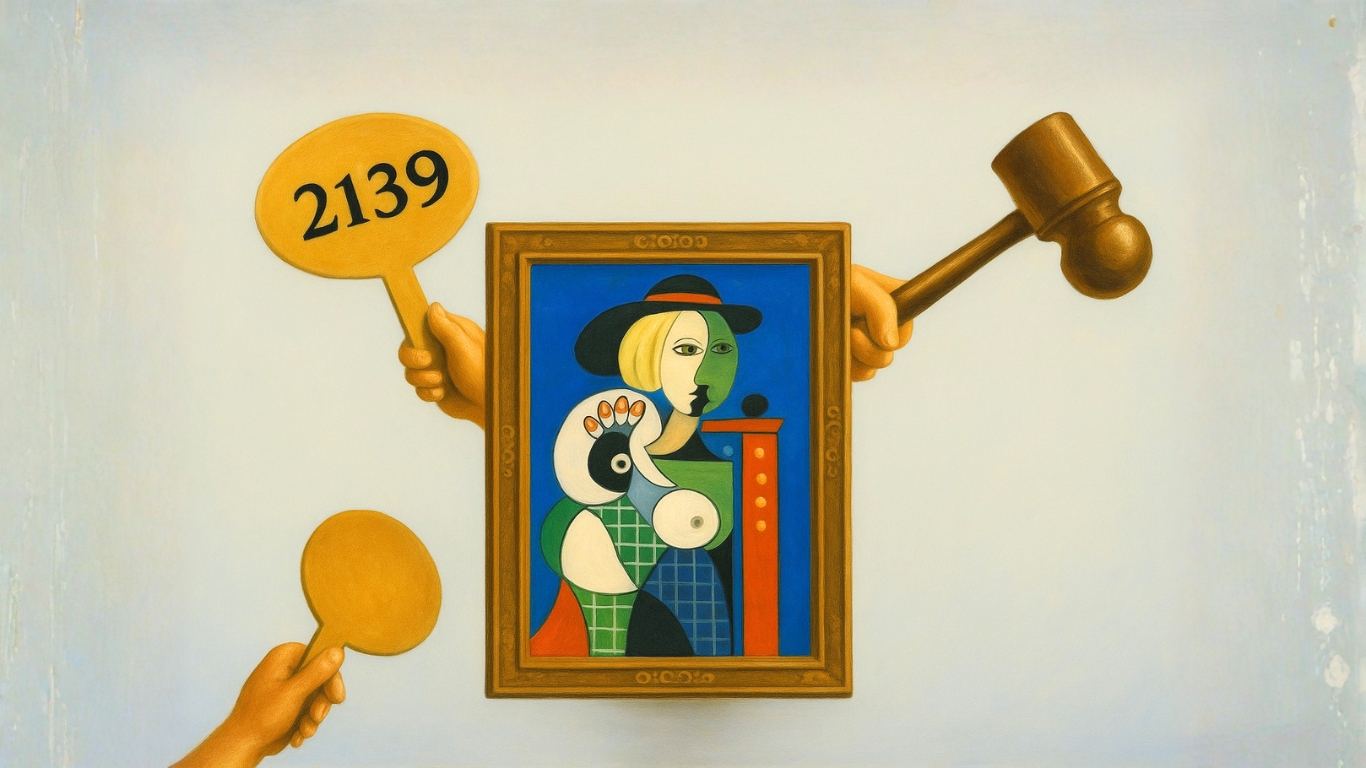

The Art Basel and UBS Art Market Report 2026 delivered a headline that sounds alarming at first glance. Global art market sales fell 12% in 2024 to $57.5 billion, marking the second consecutive annual decline after the post-pandemic peak that had dealers and auction houses celebrating record results.
But beneath that headline sits a considerably more nuanced story than simple market weakness. Transaction counts actually rose roughly 3% during the same period, revealing that the market isn’t shrinking so much as recalibrating. Activity is shifting decisively toward lower price points and away from the trophy lots that dominated headlines during the pandemic boom.
Think of it as correction rather than collapse, with regional contrasts telling very different stories about where strength and weakness actually concentrate.
The net takeaway for anyone trying to understand where the market actually stands is that you’re watching a recalibration away from the frothy top toward broader middle market depth. That shift creates genuine opportunity for collectors willing to look past the headline declines and focus on what’s actually moving. Figurative art, for instance, has quietly held its ground in ways that pure abstraction and speculative contemporary names have not.
Table of Contents
Key Takeaways
Navigate between overview and detailed analysis- Global art sales fell 12% to $57.5 billion in 2024, but transaction counts rose 3%, showing that the market is rebalancing, not collapsing—activity has shifted toward the mid-tier and away from trophy lots above $10 million.
- Public auctions declined 25%, yet private sales rose 14%, signaling a shift toward discretion, stable pricing, and off-market deal-making rather than an exodus of buyers.
- The trophy segment’s drought explains roughly 60% of the overall value decline; lots above $10 million fell 39%, while mid-priced pieces between $50,000 and $500,000 remained active and resilient.
- Collector confidence remains high: 84% of wealthy collectors are optimistic, and 40% plan to buy more art in 2025, with art now averaging 20% of portfolios and Gen Z allocations reaching 26%.
- The mid-market segment is sustaining liquidity, with sub-$1 million lots rising in volume while ultra-contemporary categories softened, reflecting renewed focus on quality and provenance.
- 2026 is expected to bring stabilization, not a speculative rebound—supply constraints, disciplined buyers, and Asian and Gulf growth signal a healthier, more balanced market ahead.
- Who:
- Auction houses, blue-chip galleries, and high-net-worth collectors across North America, Europe, the Middle East, and Asia navigating a post-boom correction.
- What:
- A global art-market recalibration marked by declining dollar volume but rising transaction counts as capital flows from trophy lots into the $50K–$500K mid-tier segment.
- When:
- After consecutive down years in 2023 and 2024, with the Art Basel & UBS 2025 report recording a 12% fall in value and a 3% increase in transactions; stabilization expected from 2026.
- Where:
- Weakness remains in Western auction hubs—New York, London, Hong Kong—while resilience and new buyer growth emerge in Singapore, the Gulf, and broader Asia.
- Why:
- Speculative excess at the top reduced supply, macro tightening curbed inflated pricing, and buyers redirected toward transparent, sustainable segments—creating a leaner, steadier market for informed collectors.
Auction Houses Feel The Pressure As Buyers Grow Selective
Public auction values dropped roughly 25% in 2024, a decline that sounds catastrophic until you understand where those lost sales actually went. Dealer values slipped a much milder 6%, while private sales at auction houses rose approximately 14%, revealing a clear pivot toward discretion and pricing control. Buyers didn’t simply disappear from the market entirely. They got smarter about where they transact.
This shift matters because it changes the nature of price discovery, moving transactions away from the public transparency of auction rooms into private negotiations where neither buyer nor seller wants their activity broadly known.
The scarcity of high-ticket lots explains much of the headline weakness. Lots selling above $10 million at auction fell roughly 39% in 2024 after declining 27% in 2023, a genuine drought at the trophy level that historically drives outsized headlines and total sale volumes. The Art Newspaper’s ongoing auction analysis puts this supply crunch in sharp relief.
Through the first half of 2026, you’re seeing no sales above $50 million and fewer pieces trading in the $30 million to $40 million range compared to 2024. That creates the impression of market weakness when what’s really happening is supply exhaustion at the very top. The major estates and collections that came to market during pandemic years have largely been absorbed, and fresh supply at that level simply isn’t materializing.
Research from our analysts reveals what they call the trophy drought effect, calculating that the decline in lots above $10 million explains approximately 60% of the entire market’s value decline. Market share data shows the trophy segment fell from 23% to 18% of total sales as overall sales dropped from $65.3 billion to $57.5 billion, meaning the segment above $10 million declined roughly $4.7 billion of a $7.8 billion overall fall. The concentration of weakness at the top means the vast majority of the market by transaction count actually held up reasonably well.
Art Basel 2026 saw dealers leaning heavily into mid-priced works as top-end liquidity thinned, with booths featuring more pieces in the $50,000 to $500,000 range rather than the handful of trophy works priced in seven or eight figures that dominated fair presentations during pandemic years. This reflects a realistic read of where buyer interest and available capital concentrate, not dealers simply lowering their ambitions.
With value declining 12% while transactions rose 3% in 2024, the average price per transaction fell approximately 14.6%, neatly explaining how the market can feel busy at fairs and galleries while headline dollar volumes soften. This isn’t collapse. It’s normalization after the speculative excess that drove pricing to unsustainable levels for all but the most exceptional works.
Public auctions declined 25% while private sales at auction houses grew 14% to $4.4 billion, meaning approximately $6.3 billion was lost in public auctions but only about $540 million gained through private channels. That 8.5% offset tells you discretion is rising as a preference among both buyers and sellers, yet not nearly enough to replace the lost trophy turnover that public auctions historically provided during stronger market conditions. Bloomberg’s art market coverage has tracked this private sales surge closely.

Collector Optimism Remains Strong Despite Lower Sales
According to data from the Art Basel UBS Collector Report, 84% of high-net-worth collectors remain optimistic about the short-term market, with 40% planning to buy more over the next 12 months.
While sentiment has pulled back slightly from the particularly ebullient mood of 2023 and 2024, it still shows real conviction that current conditions offer opportunity rather than reason to flee the market entirely. Selling intentions fell to roughly 25%, suggesting collectors view their holdings as worth keeping rather than liquidating into weakness.
Portfolio allocations tell an even more compelling story about genuine commitment to art as an asset class. High-net-worth collectors report approximately 20% of wealth allocated to art in 2026, up meaningfully from 15% in 2024, with Gen Z collectors allocating roughly 26% to art. If you’ve been wondering whether the next generation takes collecting seriously, that number answers your question.
Younger buyers and collectors from emerging markets keep driving participation even as traditional Western buyers grow more cautious. The demographic shift is real, and it’s reshaping which categories and price points attract the most competition.
HNWI Intentions for Purchases and Sales of Art in the Next 12 Months by Generation
High Net Worth Individual collector intentions reveal strong buying appetite across all generations, with Boomers leading at 54% purchase intent, followed by Gen Z at 47%, Millennials at 41%, and Gen X at 33%. Selling intentions stay modest, running between 23% and 32% across cohorts.
Singapore collectors ranked among the most optimistic globally, while Middle Eastern institutions and private collectors continue building collections and supporting new fair platforms that wouldn’t make sense if they viewed the market as structurally impaired. T
Shifting Trends In Collecting And Market Composition
The mid-market range from $50,000 to $500,000 has proven comparatively resilient, with buyers emphasizing provenance, quality, and authenticity over hype-driven names that dominated conversation during pandemic years. Impressionist works with strong documented histories are a good example of the kind of quality-first collecting that’s winning right now.
This shift toward fundamentals rather than momentum creates healthier market dynamics where works sell based on artistic merit and historical importance rather than just social media buzz or celebrity ownership.
Our analysts highlight that mid-market depth is carrying the auction ecosystem through this transition. Auction volumes rose 4% overall with fine art volumes up 6%, driven exclusively by lots below $50,000 which climbed 8%, while lots above $1 million declined roughly 33%. The net effect creates healthier breadth at lower price points while the top cools. That dynamic proves genuinely useful for dealers and collectors targeting the $50,000 to $500,000 range, where real quality stays available without requiring an eight-figure budget.
Category performance through the first half of 2026 showed dispersion consistent with a quality-over-novelty environment. Post-War and Contemporary values fell 28% but volumes rose 5%, revealing buyers reallocating within Contemporary art toward established, well-documented series rather than placing speculative bets on ultra-contemporary or new-to-market names.
The overall fine art auction sales decline of roughly 8.8% to 9% year-over-year in the first half of 2026 came with particular weakness in decorative art and ultra-contemporary segments. The Financial Times arts desk has noted a similar pattern, with buyers distinguishing clearly between collecting categories that have staying power versus those that feel more like fashion trends likely to fade.
Fewer top-lot fireworks doesn’t mean market dysfunction but rather price discovery happening at more sustainable levels without the bidding wars that characterized trophy sales during stronger years.
Offline channels still dominate decisively, accounting for approximately 82% of 2024 sales value. That underlines the continued premium buyers place on relationships and due diligence channels where they can examine works physically and negotiate discreetly. With online stuck at roughly 18% share and private sales growing 14%, serious consignors and buyers are voting clearly for offline and over-the-counter channels where price discovery stays controlled.
Outlook For 2026 And Long-Term Art Market Forecast
The path forward looks more like stabilization than dramatic recovery, shaped by realities that won’t change quickly. High-end supply stays thin because the major estates and collections that came to market during pandemic years have been largely absorbed, and fresh museum deaccessions or significant private collections don’t appear on any near-term horizon. America’s art market restructuring adds another layer of complexity to that supply picture.
Buyers have learned to price-discipline the market after overpaying during speculative peaks, creating conditions that favor steady private sales and selective auctions over the trophy lot fireworks that characterized stronger years. If you’re a patient buyer, that’s actually good news.
Research from our analysts reveals something they call a Value Migration Coefficient, essentially measuring how transaction growth compares to value growth. For 2024, this came to approximately negative 0.25, meaning value migrated down the price curve rather than vanishing entirely. That pattern lines up with consolidation phases rather than collapse, where money doesn’t leave the market but shifts toward more affordable entry points that feel less risky after watching trophy prices crater. Robb Report’s collector intelligence coverage has described a nearly identical dynamic playing out across other passion asset classes.
At the same time, easier financial conditions as interest rates stabilize would help buyers whose wealth effect worked in reverse during the correction years. Asia excluding China and the Gulf regions stand out as the clearest growth opportunities as fair platforms expand and local institutions mature in their collecting programs. These structural trends support market health over years rather than quarters, so think of them as tailwinds rather than a near-term catalyst.
For collectors trying to position intelligently, the message is straightforward. Correction has largely run its course for quality mid-market works while the trophy level faces supply constraints that could persist considerably longer. The optimism in collector surveys despite headline weakness suggests sophisticated buyers recognize opportunity when they see it, viewing current conditions as the moment to acquire quality without competing against speculative froth.