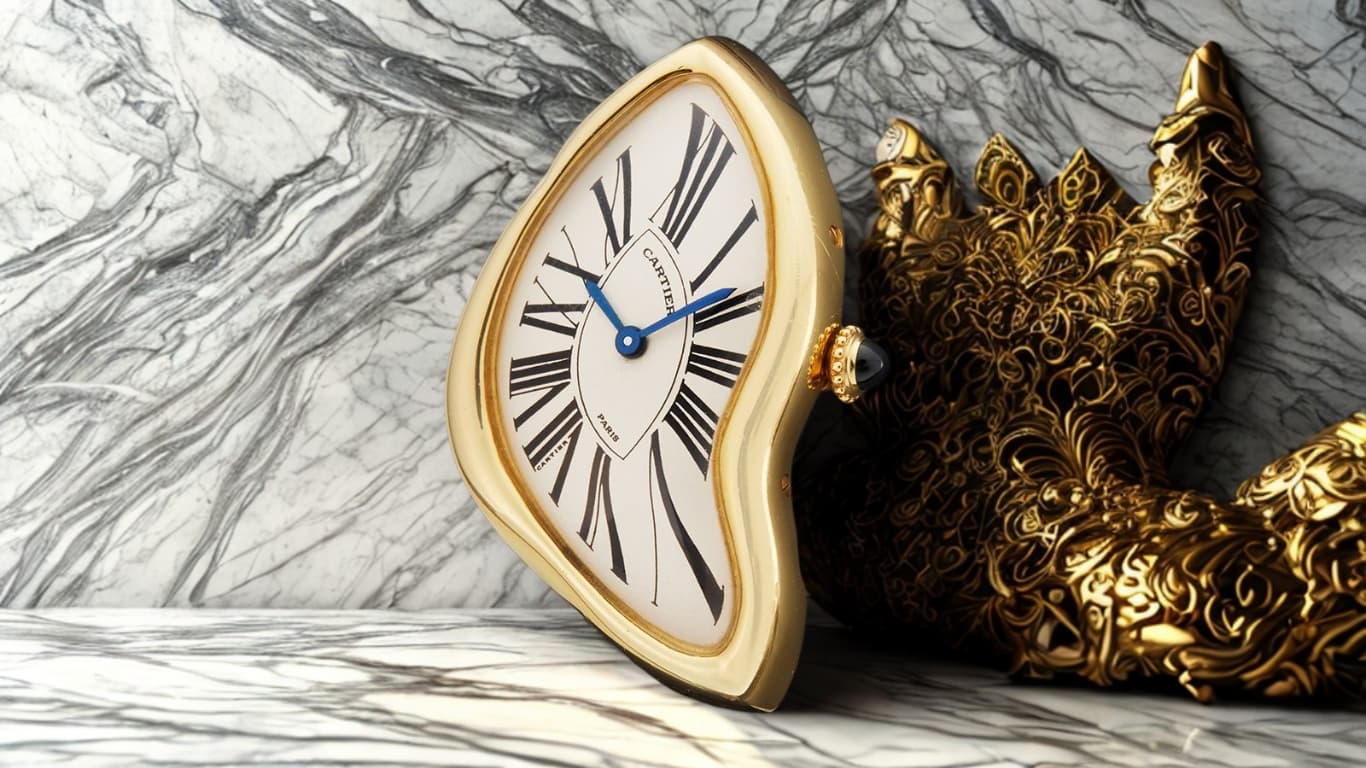
Back in 1967, while London buzzed with cultural revolution, Cartier quietly released a watch that challenged every rule of traditional timekeeping. The Cartier Crash appears to melt before the eye: the case warped, the dial elongated, the numerals stretched to follow the case geometry.
- The Cartier Crash remains one of the most desired shaped-case watches in modern collecting, with the asymmetric case design earning trophy status across the last six decades.
- The original 1967 London Crash, the 1991 Paris reissue, and the 2014 Cartier Privé re-release each anchor distinct collector tiers within the broader Crash category.
- Recent auction results have pushed Crash pricing into seven-figure territory, with the 1967 London Crash references commanding the absolute top of the modern Cartier market.
- We see the Cartier Crash as the strongest single shaped-case watch in modern collecting, with the kind of design originality that no other house has ever convincingly replicated.
- The 2023 Crash Tigree limited edition demonstrated that Cartier can still build genuinely new Crash interpretations that draw the same collector enthusiasm as the originals.
- Service infrastructure and the Cartier Privé programme support long-term Crash ownership, with the brand actively reinvesting in the shaped-case heritage collectors most value.
- Who is this for?
- Top-tier Cartier collectors, shaped-case enthusiasts, and serious students of mid-century Cartier design.
- What is happening?
- A grounded read on why the Cartier Crash stays one of the most desired shaped-case watches, covering the original 1967, the 1991 Paris, and the 2014 Privé re-release.
- When did this emerge?
- The Crash has anchored Cartier shaped-case collecting since 1967, with the 2014 Privé re-release continuing to drive collector momentum through 2026.
- Where is this happening?
- Phillips, Christie's, Sotheby's, and dedicated Paris and London Cartier specialists handle the meaningful Crash secondary market.
- Why does it matter?
- The Crash offers asymmetric case originality and the kind of design lineage that no other house can match, with auction performance validating the trophy status.
Allegedly inspired by a watch damaged in a car accident (the actual origin story is debated among Cartier historians), the Crash became one of the most distinctive shaped-case references in modern watchmaking. The reference now anchors one of the most desired tiers of contemporary serious collecting.
In our coverage of Phillips and Christie's vintage Cartier sales across the past five years, the Crash has consistently surfaced as the headline reference from Cartier London's late-1960s output. The collector base for the line has consolidated noticeably as the supply has remained genuinely thin.
The original 1967 Cartier London Crash
The original Crash was produced at Cartier London under the direction of Jean-Jacques Cartier in 1967, in single-digit annual production with the original case construction and manual-wind movement. The reference ran in tiny quantities through the late 1960s and early 1970s.
Original Cartier London Crash references with documented provenance regularly clear $200,000 to $400,000 at Phillips and Christie's. Exceptional examples (the rarer dial variants, the documented celebrity-association pieces) have cleared substantially higher, with the most recent considered Crash result running into the high six figures.
The contemporary Crash references
Cartier has produced various Crash re-creations across the decades. The 1991 limited series of 400 examples (produced under Cartier Paris with the LP signature), the various Crash Privé references in the 2010s and 2020s, and the contemporary Crash Tigrée and Crash Skeleton variants in the upper Privé tier each anchor a particular tier of modern Crash collecting.
Pricing across the contemporary Crash catalogue runs from around $50,000 in the standard production through $200,000-plus in the elaborate complicated and skeleton variants. The 2015 Crash Tigrée, the 2018 Crash Skeleton, and the 2022 Crash Radieuse all extended the line into the upper Privé register, with each release producing genuine waitlist friction at the boutique level.
Why the Crash endures in serious collecting
Three reasons. First, the design originality. No other modern watchmaker has produced a comparable warped-case reference; the Crash is genuinely sui generis in modern watch design.
Second, the production-constraint discipline. Cartier has produced the Crash in deliberately tiny quantities across decades, which has anchored the collector category around the structural rarity.
Third, the cultural anchor. The 1967 London origin and the associated 1960s cultural moment give the Crash the kind of historical weight that contemporary watch design can't quite duplicate.
The Crash in the wider Cartier shaped-case tradition
The Crash sits at the upper tier of Cartier's shaped-case tradition alongside the Tank, the Tonneau, the Cloche, and the Asymétrique. None of those references duplicate the Crash's warped-case geometry.
The Tank is rectilinear restraint; the Tonneau is the gentle curve; the Cloche is the rotated rectangle; the Crash is the only reference that breaks geometry rather than reinterprets it. Read inside that tradition, the Crash is Cartier's most architecturally ambitious shaped-case work, and the brand has treated it accordingly across the decades.
Cartier's London-period output through the 1960s and into the early 1970s remains the upper tier of vintage Cartier collecting, and the Crash is the headline reference of that period. The 1991 Crash limited series anchored the modern Crash collecting tier in a way the brand has steadily extended through the various Privé releases.
Why Phillips and Christie's treat the Crash differently
Vintage Cartier London Crash examples sit in a particular position at the major auction houses. Phillips' New York and Geneva sales regularly catalogue the references with the same detail given to vintage Patek and vintage Rolex; Christie's Hong Kong has handled some of the strongest Crash results in the past decade.
The Crash sits alongside the other rare modern references that serious collectors pursue at the upper auction-house tier. Clean original 1967 Cartier London Crash references with documented provenance regularly clear $200,000 to $400,000, with the rarer dial variants and the documented celebrity-association examples clearing higher.
The reference's auction-house treatment reflects the structural rarity: Cartier produced the original Crash in single-digit annual quantities, and the surviving population that meets condition and provenance discipline is genuinely small.
The contemporary Crash Privé tier
The Crash Privé references in the 2010s and 2020s sit in their own collecting tier. The Crash Tigrée with its hand-engraved tiger-stripe case-work, the Crash Skeleton with its visible movement architecture, and the various dial-variant Privé releases all produce secondary-market premiums above the original retail.
Clean Crash Privé examples in the standard configurations clear $80,000 to $200,000 depending on reference and box-and-papers completeness. The Tigrée and Skeleton variants run higher, with the most recent Privé Crash results at Phillips' Geneva sales firming above retail by meaningful multiples.
What collectors look for in a serious Crash pick
For modern Crash, the references that come up most consistently in serious collector conversation are the Crash Privé references in the standard configurations, the Crash Tigrée for collectors weighting the case-engraving work, and the various Crash Skeleton variants for collectors operating at the upper tier. Box-and-papers documentation matters; the various special-edition Crash references extend the considered modern Crash collecting tier.
For vintage, the original 1967 Cartier London Crash with credible provenance documentation and unrestored case condition anchors the upper tier. The various 1970s and 1980s Crash references extend the considered vintage Crash collecting tier; originality of dial, hands and case finish all matter substantially.
What this means for collectors
The Crash occupies a particular position in modern watch design that no contemporary reference has duplicated. The combination of design uniqueness, production constraint, and cultural anchor make the Crash one of the most desired pieces among contemporary serious collectors.
The structural conditions that anchor that desire (Cartier's continued production discipline on the line, the limited surviving vintage population, the auction-house treatment that supports the reference as upper-tier collecting) are unlikely to shift quickly. For collectors weighing the line, the original 1967 Cartier London Crash with credible provenance documentation remains the apex acquisition; the contemporary Crash Privé references extend the considered modern Crash collecting tier; the brand's continued single-digit production discipline on each Privé release suggests the line will remain genuinely scarce across the next decade.
We last reviewed this analysis in May 2026.


Stefanos Moschopoulos
Stefanos Moschopoulos founded The Luxury Playbook in Athens and has spent the better part of a decade following the auction calendar, the en primeur releases, and the watchmakers, gallerists, and shipyards the magazine covers. He writes the field guides and listicles that anchor the Connoisseur section — pieces built on Phillips and Christie's results, Liv-ex movements, and conversations with collectors he has met across Geneva, Bordeaux, Basel, and Monaco. His own collecting habits sit closer to watches and wine than art, and it shows in the level of detail in the magazine's coverage of those categories. Under his direction, The Luxury Playbook now publishes long-form field guides, market-defining year-end listicles, and the Voices interview series with the founders behind the houses and the brands.