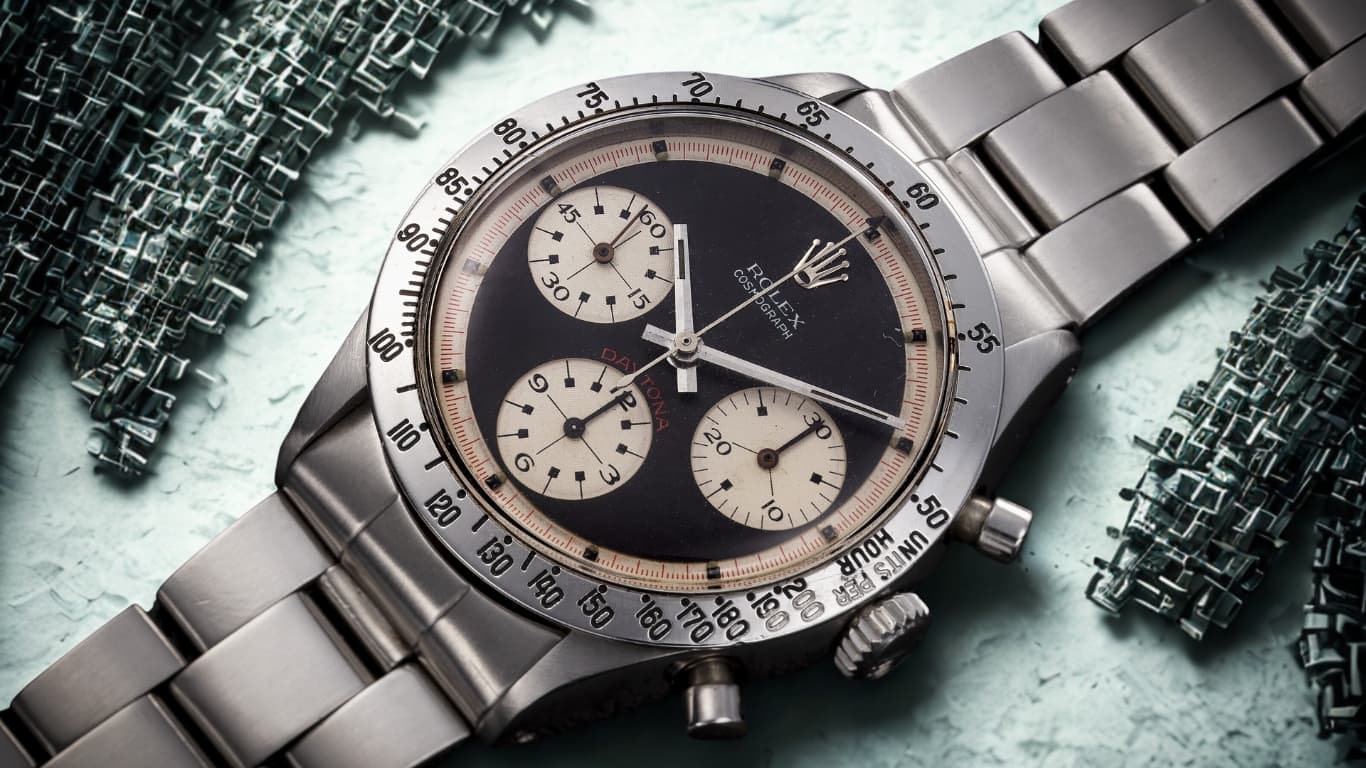
The 2017 Phillips Geneva sale of Paul Newman's own Daytona was the moment watch collecting changed at the top end. The hammer price of $17. 75 million (with the buyer's premium taking the total above $17.
- Paul Newman's personal Rolex Daytona Reference 6239 sold for 17.8 million dollars at Phillips in October 2017, reshaping the entire understanding of celebrity provenance pricing.
- The exotic dial Reference 6239 had previously traded at a fraction of the auction result, with the Paul Newman ownership transforming the value calculus entirely.
- The watch carried the engraved Drive Carefully Me caseback message from Joanne Woodward, which delivered the kind of intimate provenance that defines top-tier collecting.
- We see the Paul Newman Daytona auction as the moment that legitimised celebrity provenance pricing across the broader vintage Rolex and chronograph collecting categories.
- Subsequent provenance-driven sales at Phillips, Christie's, and Sotheby's have validated the broader category, with comparable provenance now informing pre-auction estimates.
- The 17.8 million dollar result still holds as one of the top three highest watch auction sales in history, with only Patek Grandmaster Chime sitting above it.
- Who is this for?
- Trophy-tier collectors, auction-watchers, and serious students of celebrity provenance pricing dynamics.
- What is happening?
- A grounded read on how the 17.8 million dollar Paul Newman Daytona auction changed celebrity provenance pricing across vintage watch collecting forever.
- When did this emerge?
- The Paul Newman Daytona sold at Phillips New York in October 2017, with the impact continuing to shape provenance pricing through 2026.
- Where is this happening?
- Phillips New York hosted the original auction, with subsequent provenance-driven sales continuing through Phillips, Christie's, and Sotheby's globally.
- Why does it matter?
- The Paul Newman Daytona sale legitimised celebrity provenance as a structural pricing factor, reshaping how serious collectors and auction houses approach the category.
8 million) remains the highest auction result for any wristwatch ever sold.
The sale's significance extends well beyond the single number. The combination of single-of-its-kind provenance (the watch had been a gift from Joanne Woodward in 1968 with the back engraved "Drive Carefully Me"), the exotic Paul Newman dial that came to define the variant, and the cultural recognition that crossed entirely outside the watch-collecting world made the sale a moment the broader collecting market hasn't quite forgotten.
In our coverage of the auction-house calendar across the past decade, the 2017 Newman sale appears as the structural pivot. The catalogue treatment, the chain-of-custody documentation discipline, and the broader cultural visibility of major vintage watch sales all date from that specific result.
What actually happened at the 2017 sale
Phillips's October 2017 "Winning Icons" sale in New York featured the Daytona reference 6239 with an estimate of $1 million. The hammer fell at $17.75 million after several minutes of bidding between the room and the phone bidders.
The result substantially exceeded the auction-house pre-sale estimate. The buyer was reported by Phillips as an anonymous private collector, and the watch has not surfaced publicly since the sale. The provenance documentation was the load-bearing element: Newman had received the watch from Joanne Woodward in 1968; he wore it through the 1970s and into the 1980s; the watch passed to Newman's daughter's then-partner, James Cox, in the 1980s; Cox consigned it to Phillips four decades later.
The chain of ownership was documented and credible. Each step was supported by photographs, correspondence, and the original purchase documentation, and the Phillips catalogue note ran to multiple pages of provenance evidence.
What the sale set in motion across the watch market
Three things happened across the watch market in the years following the 2017 sale. First, the broader Paul Newman dial Daytona collecting tier consolidated meaningfully. References with credible exotic-dial provenance moved substantially higher across 2018, 2019 and into 2020, with the considered Paul Newman dial references in clean condition clearing $500,000 to $1.
5 million regularly at the major auction houses.
Second, the broader vintage Daytona market firmed across all references. The rising tide raised the entire category, and the reference 6263, 6265 and various other vintage Daytona configurations all moved higher in the wake of the Newman result.
Third, the auction-house calendar shifted. Vintage watch sales at Phillips, Christie's and Sotheby's became substantially more visible in the broader collecting and cultural press, and the pre-sale catalogues were treated with the kind of attention previously reserved for major contemporary art sales.
How the sale reshaped provenance discipline
The sale also marked a shift in how the broader collecting world thought about provenance. Before the Newman sale, provenance was understood to matter; after it, the documented chain-of-ownership question moved from one of several factors to the central question for any major vintage watch lot.
The auction houses adjusted their catalogue-note discipline accordingly. Phillips, Christie's, Sotheby's and Antiquorum all expanded their provenance-research staffing across 2018 and 2019, and the catalogue notes for major vintage lots now regularly run to substantially more depth than the equivalent notes from a decade earlier.
Specialist dealers refined their provenance-documentation practices. Collectors started building file-by-file documentation of the pieces they acquired rather than treating provenance as incidental.
The cultural anchor that made the Newman sale singular
Paul Newman's cultural recognition extended substantially beyond the watch-collecting world. Newman was an actor, a Formula One-tier racing driver, a philanthropist whose Newman's Own foundation has distributed more than $600 million to charity, and one of the most recognisable American cultural figures of the twentieth century. The watch he wore on screen and at the racetrack became, by the late 1980s, the most-recognised single watch reference in any private collection.
The combination of cultural visibility outside watch collecting, documented intimate provenance (the engraved gift from Joanne Woodward), and the exotic dial that came to be named for him made the watch genuinely sui generis among modern auction lots. No comparable combination has surfaced at the major auction houses since.
What collectors learned from the 2017 sale
The lessons from the 2017 sale extend to the broader market. Provenance documentation matters substantially across all tiers, not just at the upper end. Single-of-its-kind references with documented historical association command premiums that reflect both the rarity and the chain of cultural recognition.
The auction-house calendar is the venue where the most considered vintage watch transactions happen. The pre-sale catalogues are required reading for any serious vintage collector regardless of the specific category they collect.
What this means for collectors
The longer story collectors recognise is that the 2017 Newman sale was less an aberration than a clarification. The conditions that made the result possible (the combination of provenance, design, cultural anchor, and condition) apply across the broader vintage market.
The collectors who learned to read those conditions in detail across the 2017 to 2020 window navigate the contemporary vintage market substantially better than those who didn't. For collectors building toward serious vintage acquisitions in 2026, the post-Newman discipline (provenance documentation as load-bearing, auction-house catalogue notes as required reading, condition exceptionalism as non-negotiable) is the practical framework that the broader market now operates within.
We last reviewed this analysis in May 2026.


Stefanos Moschopoulos
Stefanos Moschopoulos founded The Luxury Playbook in Athens and has spent the better part of a decade following the auction calendar, the en primeur releases, and the watchmakers, gallerists, and shipyards the magazine covers. He writes the field guides and listicles that anchor the Connoisseur section — pieces built on Phillips and Christie's results, Liv-ex movements, and conversations with collectors he has met across Geneva, Bordeaux, Basel, and Monaco. His own collecting habits sit closer to watches and wine than art, and it shows in the level of detail in the magazine's coverage of those categories. Under his direction, The Luxury Playbook now publishes long-form field guides, market-defining year-end listicles, and the Voices interview series with the founders behind the houses and the brands.