
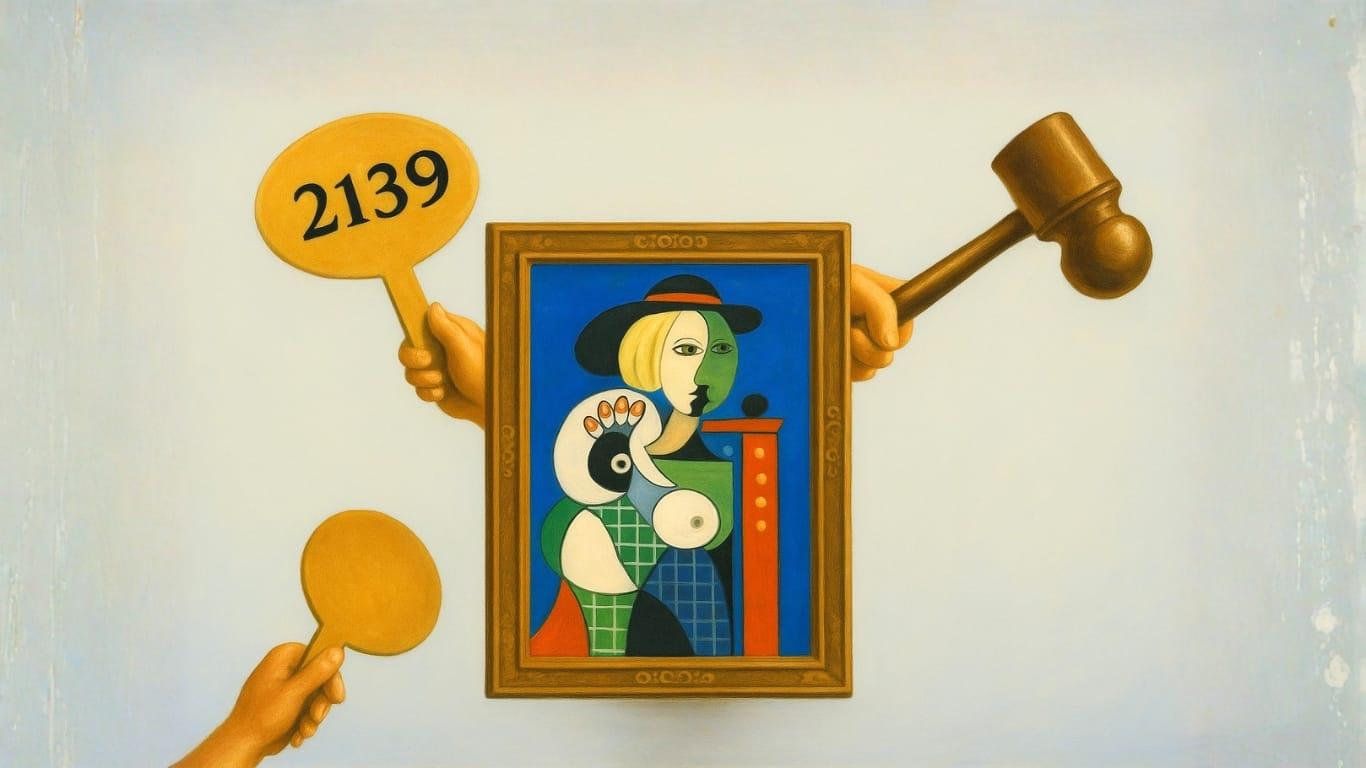
Art market sales declined in 2024 by every aggregate measure the trade tracks, and collector optimism has held more firmly than the totals would suggest. The Art Basel and UBS Global Art Market Report 2024 put global sales at roughly $57.5 billion, down from the 2022 peak, and the auction-house evening sale totals reflected the broader pullback.
The optimism is not denial. It reflects a recognisable pattern from previous market resets: the speculative tier corrects sharply, the mid-tier finds its footing, and the collector base that emerges on the other side is structurally healthier than the one that drove the prior peak. Our coverage of mid-market works outperforming trophy sales traces that resilience in detail.
- Art market sales declined in 2024 by every aggregate measure the trade tracks, with the Art Basel and UBS report putting global sales at roughly fifty-seven point five billion dollars.
- Total global art market sales fell roughly twelve percent year-on-year in 2024, with the decline concentrated almost entirely in the upper auction tier.
- Evening-sale totals at Christie’s, Sotheby’s and Phillips fell roughly twenty-five percent against the 2022 peak, with the twenty-million-dollar-plus tier driving most of the decline.
- Dealer transaction counts actually rose modestly even as total values declined, signalling that the correction is concentrated at the upper register rather than spread across the market.
- Art Basel, Frieze, TEFAF and the regional fair calendar reported attendance levels at or above 2023, indicating the cultural infrastructure of the market remains intact.
- Blue-chip names continued to transact with depth across 2024, though estimates pulled back roughly fifteen to twenty percent from the 2022 peaks at the major houses.
- Who is this for?
- Collectors, advisors and observers of the global art market interested in how the 2024 sales decline coexists with structurally durable collector optimism through 2026.
- What is happening?
- An editorial read on the 2024 art-market decline and the persistent collector optimism, covering total sales, dealer resilience, the speculative correction and the geographic and tier-level shape.
- When did this emerge?
- Most relevant around the May and November evening sales at the major houses and during the Art Basel, Frieze and TEFAF fair cycles that anchor the global calendar each year.
- Where is this happening?
- Centred on the New York, London, Paris and Hong Kong salesrooms and the global gallery and fair networks that together define the broader art-market infrastructure.
- Why does it matter?
- Reading the divergence between sales totals and structural collector behaviour matters because it clarifies what is genuinely correcting and what is simply pausing across the broader segment.
The 2024 numbers, plainly
Total global art market sales fell roughly 12 percent year-on-year in 2024, with the decline concentrated in the upper auction tier. The Art Basel and UBS report attributed the bulk of the drop to thinner participation at the $10M-plus tier, with the dealer segment proving materially more resilient than auction sales.
Dealer transaction counts actually rose modestly, even as total values declined. That divergence between values and counts is the cleanest signal that the correction is concentrated at the upper register rather than spread across the market.
Christie's, Sotheby's, and Phillips evening-sale totals fell roughly 25 percent against the 2022 peak, with the $20M-plus tier driving most of the decline. The under-$5M tier held up materially better, and the under-$1M segment was essentially stable.
Why optimism persists
The structural shape of the correction. Collectors who follow the segment know that the speculative tier always corrects first and hardest, and that the durable mid-market is the segment that signals real demand. The 2024 data shows exactly that pattern.
Gallery primary-market sales held up across the segment, with the Hiscox Online Art Trade Report tracking continued buyer-count growth at the under-$50K tier. The cohort buying at that price point is structurally important to the next decade of the market because they progress into the mid-tier and then the trophy tier over the course of their collecting careers.
Art Basel, Frieze, TEFAF, and the regional fair calendar reported attendance levels at or above 2023, even as transacted value softened. The cultural infrastructure of the market is intact.
What is selling, and what is not
Blue-chip names continued to transact with depth across 2024, though estimates pulled back by roughly 15 to 20 percent from the 2022 peaks. Our blue-chip artists defining 2026 coverage tracks the segment.
The Ultra-Contemporary cohort that ran up sharply in 2021 and 2022 saw multiple notable failures across the 2024 evening sales, with several lots bought-in or selling below estimate. ArtTactic's Ultra-Contemporary index reflects the segment's correction. The cohort is not dead, but the speculative excess that drove its peak prices has clearly left.
The mid-tier was the surprise. Works in the $1M to $15M band by named mid-career artists, particularly the figurative cohort that drove the 2018-2022 contemporary rerating, found bidders consistently. The segment is now the structural floor under the market.
Geographic shifts
Paris emerged as the structural beneficiary. Art Basel Paris drew measurable additional demand into the European fair calendar, and Sotheby's and Christie's both expanded their Paris sale activity in response. Our coverage of Art Basel Paris traces the shift in detail.
Hong Kong rebounded from a thin 2023, with Sotheby's and Christie's both posting stronger evening-sale results in the second half of 2024 than at any point in the prior eighteen months. The Asian collector base, which had narrowed during the regional regulatory tightening, returned in meaningful volume.
The US trophy tier was the weakest geography. New York's November and May evening sales fell more sharply than their London and Hong Kong counterparts, reflecting the concentration of trophy-tier consignments in the US calendar.
The dealer segment's role
Galleries became more structurally important to the market in 2024. The dealer segment's share of total sales rose, the private-market transaction counts grew, and the cohort of established mid-career galleries proved more resilient than either the major mega-galleries or the emerging primary-market galleries.
The pattern is consistent with prior resets. The mega-galleries depend on the trophy tier and the largest private collectors; the emerging galleries depend on speculative cohorts; the established mid-career galleries depend on long-cycle relationships with the serious collector base. That cohort is the most durable through cycles.
Our broader coverage of market trends defining 2026 tracks the dealer segment's structural shift.
The patient collector's advantage
The collectors we cover who built effectively through 2024 share a pattern. They did not chase the falling speculative tier; they used the corrected price environment to deepen positions in artists they already followed. They focused on works with verifiable provenance, museum exhibition history, and clear primary-market discipline.
The same collectors are now structurally well-positioned for the 2025 and 2026 cycle. Our piece on what the 2026 recovery will look like sets out the framework.
What the optimism is actually about
The reset was needed. The 2020 to 2022 cycle had produced a tier of speculative demand that the trade always knew would not sustain, and the houses' programming and gallery primary-market discipline both depended on the speculative flows in ways that distorted the segment's longer-term shape.
The 2024 reset rebalanced the market around the durable demand. The collectors emerging on the other side are the ones who would have stayed regardless, and the artists who continue to find bidders are the ones with institutional and gallery infrastructure that does not depend on the speculative cohort.
That is what the optimism reflects. Not denial of the decline, but recognition that the decline cleared the segment of capital that was always going to leave.
What this means for collectors
The 2024 correction is the cycle's setup, not its punchline. The mid-tier is functioning, the dealer segment is structurally resilient, and the geographic redistribution is opening new transaction channels. Collectors who build through 2025 and into 2026 are doing so in the most favourable price environment the segment has offered in five years.
The discipline that matters is the same as ever: provenance, condition, primary-market validation, institutional comparables. The collectors who applied that discipline through 2024 emerge from the cycle structurally stronger; the ones who chased the speculative tier are still holding the casualties.
We last reviewed this analysis in May 2026.
Frequently Asked Questions
How much did the art market decline in 2024?
Total global art market sales fell roughly 12 percent year-on-year to approximately $57.5 billion, according to the Art Basel and UBS Global Art Market Report 2024. The decline was concentrated at the $10M-plus tier; dealer transaction counts actually rose modestly, indicating the correction was concentrated at the upper register rather than spread across the market.
Why are collectors still optimistic despite the decline?
The shape of the correction. The speculative Ultra-Contemporary tier corrected sharply, but the mid-market ($1M to $15M) found bidders consistently, the dealer segment's transaction counts rose, and gallery primary-market sales held up. The pattern matches prior cycles where the correction cleared speculative capital and left the durable demand intact.
Which segments held up best in 2024?
The under-$5M tier was materially more stable than the trophy tier; the under-$1M segment was essentially flat. Blue-chip names continued to transact with depth at evening sales, though estimates pulled back 15 to 20 percent. The mid-career figurative cohort was the structural floor under the market.
What does the recovery look like?
It will not look like 2022. The speculative cohort that drove the prior peak is unlikely to return at scale, and the trade is not expecting it. The structural shape that emerges is a more mid-tier-led market with stronger dealer-segment participation, more geographically distributed transaction venues, and a more institutionally coordinated collector base.