Walk through a full Gerhard Richter retrospective and the first thing that unsettles you is that it does not look like one artist. There are blurred grey paintings that seem lifted from old photographs, then vast canvases of dragged, scraped colour with no image at all, then a wall of pure grey, then panels of squared off colour samples arranged like a paint manufacturer's chart. The instinct is to assume a group show. The correct reading is the opposite: this is a single painter who refused, across six decades, to choose between representation and abstraction, and who turned that refusal into the most commanding career in living art.
Gerhard Richter, born in Dresden in 1932, is among the most important and the most expensive painters alive. Christie's and Sotheby's have repeatedly placed his work at the summit of their evening sales, where his dragged abstractions have set records for a living European artist. The Tate, which has shown him in depth, frames him as the figure who kept painting itself credible through the decades when it was repeatedly declared dead. We would put it more plainly. Richter proved that a serious painter need not pick a side, and in doing so he became the benchmark the whole living market measures itself against.

Key Takeaways & The 5Ws
- Gerhard Richter was born in Dresden in 1932 and is among the most expensive living painters.
- He works across opposite modes: blurred photo paintings and the squeegee dragged Abstraktes Bild abstracts.
- His range also includes colour chart paintings, grey monochromes, and the Cage and Birkenau cycles.
- His Abstraktes Bild canvases have set auction records for a living European artist.
- He is the painter against whom the rest of the living market is measured.
- Who is this for?
- Collectors and museum visitors drawn to a painter who mastered both realism and abstraction in one career.
- What is it?
- The oeuvre of Gerhard Richter, spanning photo paintings, squeegee abstracts, colour charts, greys and the Birkenau cycle.
- When does it matter most?
- When reading a Richter and registering that the same hand made the blur and the abstraction.
- Where does it apply?
- Across postwar and contemporary collecting, from major museums to every marquee evening sale.
- Why consider it?
- Because no living painter has held both poles of painting with this authority, or set the market's benchmark so firmly.
The Dresden Beginning and the Move West
Richter's biography is inseparable from the century he was born into. He grew up in Dresden, trained in the academic, socialist realist tradition of East Germany, and worked for a time as a mural painter under a state that prescribed exactly what art was meant to do. In 1961, shortly before the Berlin Wall sealed the border, he crossed to the West and enrolled at the Kunstakademie in Düsseldorf, stepping from a world of mandated figuration into one saturated with abstraction, Pop and the first stirrings of conceptual art. That passage between two opposed artistic systems shaped everything that followed.
What he took from it was a deep suspicion of any single doctrine. Having been handed one official truth about painting in the East and then immersed in a rival set of certainties in the West, Richter declined to commit fully to either figuration or abstraction. We read this as the founding move of the whole career. A painter who has watched ideology dictate the image learns to distrust the very idea of the one correct way to paint, and that distrust freed him to work in modes that everyone else treated as mutually exclusive.
The Photo Paintings and the Deliberate Blur
The first great body of work came from photographs. Beginning in the 1960s Richter painted from found images, family snapshots, press cuttings, advertisements, rendering them in oil and then dragging a soft brush across the wet surface so the picture slipped slightly out of focus. The blur is the whole point. It holds the image at arm's length, reminding the viewer that this is a painting of a photograph, not a window onto the thing itself, and it lends even banal source images a strange, grave tenderness.
Those photo paintings include some of the most quietly devastating works of the postwar era, from candid domestic scenes to the charged historical reckonings of the cycle on the Baader Meinhof group. The blur lets Richter approach loaded subjects without slipping into either sentimentality or reportage. We would argue this is where his refusal of doctrine first pays off. By painting the photograph rather than the world, he keeps a cool distance from his material while still letting genuine feeling seep through the haze, and the tension between that detachment and that emotion is what gives the photo paintings their lasting grip.
Postwar abstraction, the lineage Richter's squeegee canvases extend.
The Squeegee Abstracts That Set the Records
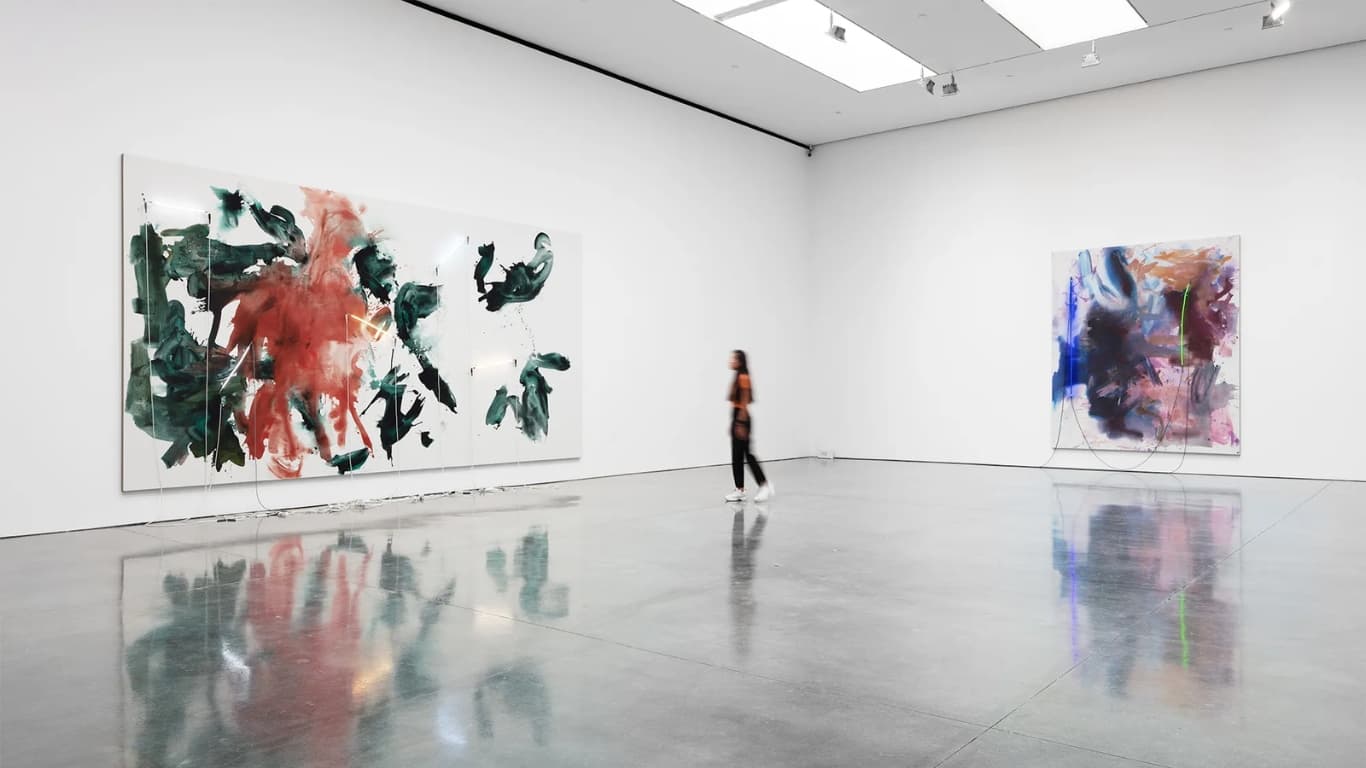
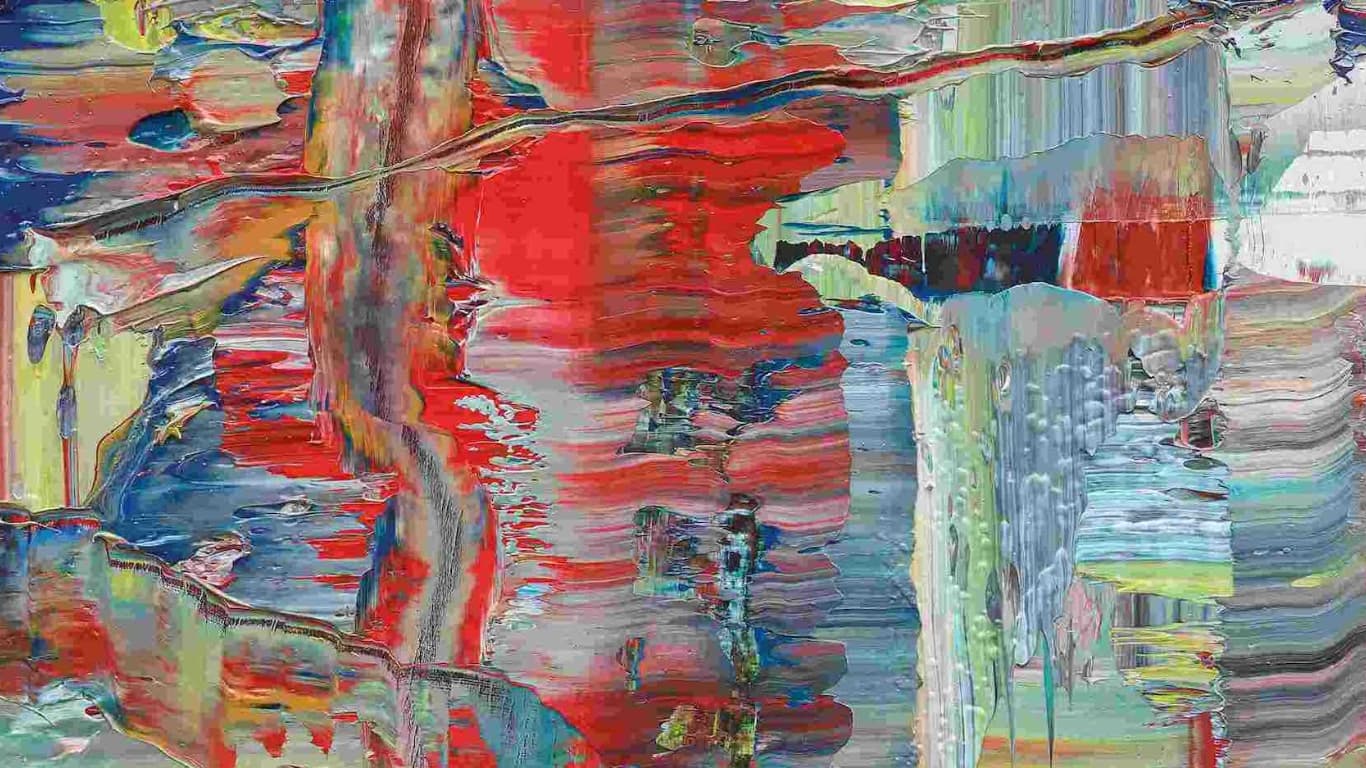
At the other pole sit the Abstraktes Bild canvases, the works most people now picture when the name comes up. To make them Richter loads a long blade, a squeegee, with wet paint and drags it across the surface, pulling, scraping and partly destroying the layers beneath so the finished canvas becomes a dense geological record of its own making. There is no image, no plan that survives contact with the blade, only the accumulated history of additions and erasures. They are abstraction arrived at through a process closer to excavation than composition.
These are the paintings that command the market. The strongest large Abstraktes Bild works have set auction records for a living European artist at Christie's and Sotheby's, and they anchor his standing at the very top of the contemporary field. We find the achievement doubly impressive because it sits in the same body of work as the photo paintings. The man who made the most controlled blurred realism of his generation also made some of the most physically reckless abstraction of it, and the market has rewarded both. For anyone mapping how a serious collection balances its names, Richter is the rare figure who would sit comfortably in both halves of the red chip and blue chip conversation at once.
The Charts, the Greys and the Cage and Birkenau Cycles
Between those two poles Richter opened still more fronts, and each one extends the same restless intelligence. The colour chart paintings array squared off panels of commercial colour in apparently random grids, draining painting of personal expression and turning it into a deadpan system. The grey monochromes go further, reducing the canvas to a single neutral field, painting at its most withholding, a refusal of image that is itself a statement. Neither is a sideline. Both are sustained arguments about how little a painting can contain and still hold the eye.
Then come the great late cycles that fuse his concerns. The Cage paintings, named for the composer John Cage, are large abstractions of extraordinary depth and restraint. The Birkenau cycle, based on photographs taken secretly inside the death camp and then almost entirely overpainted into abstraction, is the most charged work of his later years: the image is there underneath, buried, present and unreachable at once. These cycles sit at the centre of his museum standing, and they show a painter still pushing the boundary between what can be shown and what can only be hinted at. The breadth alone would earn him a place in any modern collector's field guide. It also places him in a postwar lineage of painters who treated the surface itself as the subject, a thread that runs back through figures such as Lucio Fontana and Spazialismo and forward into the abstraction he made his own.
Why Richter Became the Market's Benchmark
Put the whole oeuvre together and the reason for his standing comes clear. Richter is the benchmark of the living market not because he is the most expensive in any single sale, though he often is, but because his work refuses the usual trade off between depth and range. Collectors and institutions trust the name across an unusually wide field: a museum can build a room from the photo paintings, a saleroom can headline an evening with an Abstraktes Bild, and a private collection can hold a grey or a colour chart, and all of it reads unmistakably as Richter. That coherence across contradiction is rare, and the market prices it accordingly.
The result is a kind of gravitational centre for contemporary collecting. When a major Richter surfaces, the room already knows the catalogue, the cycles and the records, and other artists are quietly measured against where his work sits. We think that is the truest mark of his position. He is not merely expensive; he is the reference point, the painter whose secondary market performance is read as a signal for the health of the living field as a whole. A career built on refusing to choose became, paradoxically, the one fixed point everyone else navigates by.
Stand in that retrospective again at the end and the apparent group show resolves into a single argument. Richter spent six decades proving that representation and abstraction were never really opposed, that a painter could hold the blurred photograph and the scraped void in one hand, and that doing so demanded more rigour, not less. The photo paintings keep their cool tenderness, the squeegee abstracts keep setting their records, and the Birkenau cycle keeps showing what painting can carry without ever quite showing it. The most auctioned living painter earned the title by refusing the choice everyone else thought he had to make, and the whole market now takes its bearings from where he stands.

Stefanos Moschopoulos
Stefanos Moschopoulos founded The Luxury Playbook in Athens and has spent the better part of a decade following the auction calendar, the en primeur releases, and the watchmakers, gallerists, and shipyards the magazine covers. He writes the field guides and listicles that anchor the Connoisseur section — pieces built on Phillips and Christie's results, Liv-ex movements, and conversations with collectors he has met across Geneva, Bordeaux, Basel, and Monaco. His own collecting habits sit closer to watches and wine than art, and it shows in the level of detail in the magazine's coverage of those categories. Under his direction, The Luxury Playbook now publishes long-form field guides, market-defining year-end listicles, and the Voices interview series with the founders behind the houses and the brands.