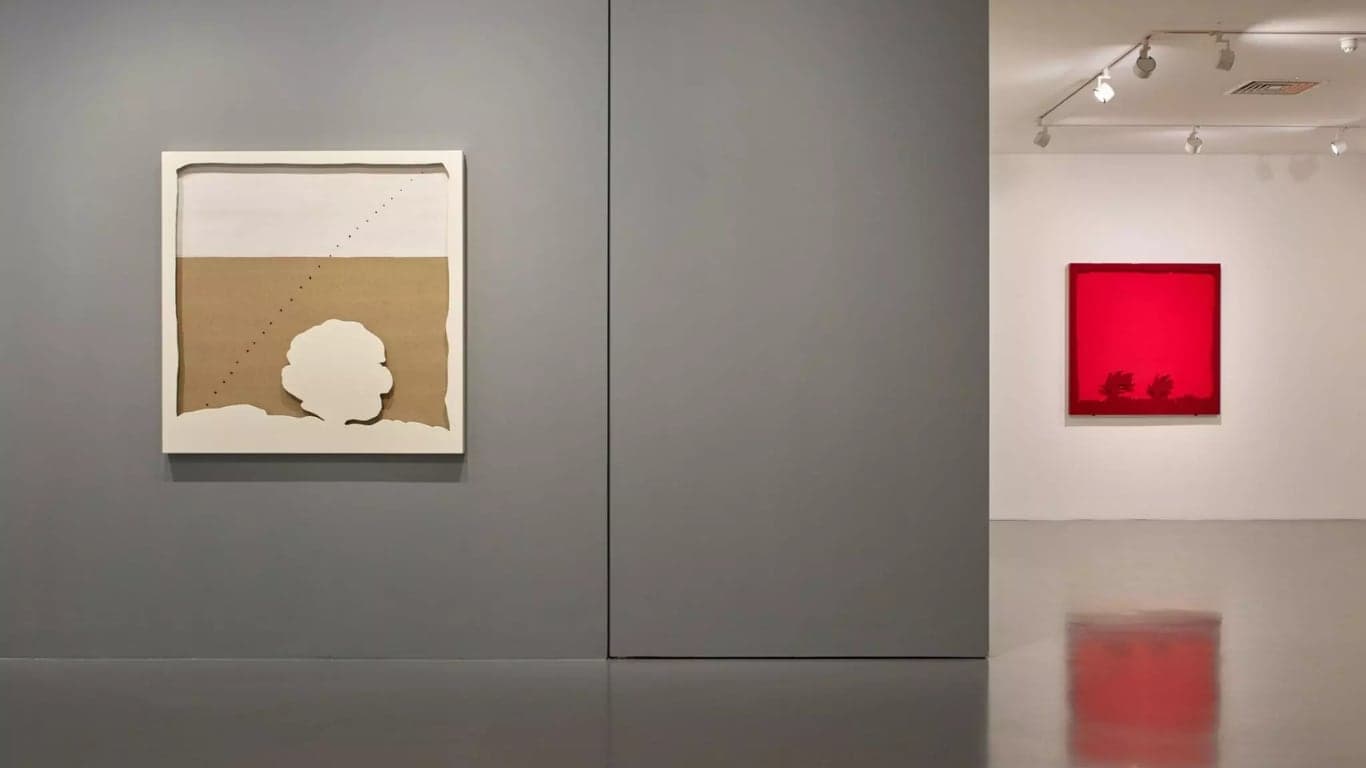
A gallery wall at the Fondazione Lucio Fontana in Milan holds an object that looks, at first glance, like an accident. A monochrome canvas, taut and pristine, opened by a single clean vertical cut. No frame within the frame, no painted illusion, nothing behind it but the wall and a sliver of shadow. The instinct is to read damage. The correct reading is the opposite: this is the most deliberate gesture in twentieth century painting.
Lucio Fontana (1899 to 1968) made that cut on purpose, and he made it the centre of an entire movement. The artist, born in Argentina to Italian parents and shaped by both countries, founded Spazialismo, or Spatialism, and set out its ideas in a sequence of manifestos that began with the Manifesto Blanco, the White Manifesto, issued in Buenos Aires in 1946. The Solomon R. Guggenheim Museum, which has shown his work in depth, frames him as the figure who dragged painting off the wall and into actual space. We would put it more bluntly. Fontana cut a hole in the history of painting, and the art world is still looking through it. For anyone mapping the modern field, he is an unavoidable landmark.

Key Takeaways & The 5Ws
- Fontana founded Spazialismo and announced it in the 1946 White Manifesto.
- His core series, Concetto Spaziale, runs from punctured holes to slashed cuts.
- The cut opens real space; it ends the illusion of painted depth.
- His ideas fed ZERO, Arte Povera and Minimalism across two generations.
- Works are catalogued by number of cuts and canvas colour.
- Who is this for?
- Collectors and museum visitors drawn to postwar Italian art and the moment painting became object.
- What is it?
- Spazialismo, Fontana's movement, and the Concetto Spaziale canvases of holes and cuts that define it.
- When does it matter most?
- When reading a monochrome Fontana and deciding whether you are seeing damage or intent.
- Where does it apply?
- Across postwar and contemporary collecting, from Milan and Venice to every major evening sale.
- Why consider it?
- Few gestures in modern art are this legible, this catalogued, and this culturally settled.
The Argentine Who Came Back to Milan
Fontana's biography refuses a single nationality, and the work is better for it. Born in 1899 in Rosario, Argentina, to an Italian sculptor father, he moved between Buenos Aires and Milan for most of his life, trained partly under the sculptor Adolfo Wildt at the Accademia di Brera, and spent the war years back in Argentina. It was there, with a circle of students, that he drafted the Manifesto Blanco in 1946, a document calling for an art that abandoned the static media of the past and worked instead with space, movement, time and the new materials of the century.
He returned to Milan and kept writing. Across the late 1940s and early 1950s he and a group of fellow artists issued further Spazialismo manifestos, refining a single radical claim: that the future of art lay not in adding more paint to a flat surface but in incorporating space itself. The flat picture, with its centuries of painted perspective and illusionistic depth, had run its course. Fontana wanted the real thing: actual three dimensional space, brought into the work rather than faked on its skin.
Concetto Spaziale: One Title, a Whole Oeuvre
Almost everything Fontana made under the Spazialismo banner carries the same title: Concetto Spaziale, Spatial Concept. It is less a label than a thesis repeated in hundreds of variations. The consistency is the point. Each work is another test of the same idea, and the catalogue raisonné reads as a sustained argument rather than a scatter of singular works.
The first decisive move came in 1949, when he began puncturing the canvas: the buchi, or holes. He took an awl or a blade and pierced the surface in constellations, sometimes hundreds of perforations across a single sheet. Light passed through. Shadow gathered behind. The painting stopped being a window onto an illusion and became a porous membrane between the viewer's space and the space behind it. For an audience trained to read a canvas as a flat field bearing an image, the effect was vertiginous. The wall, suddenly, was part of the work.
The Tagli, and Why the Cut Is Not Destruction
From the later 1950s came the gesture everyone now pictures: the tagli, or slashes. Fontana scored the prepared, often monochrome canvas with a knife in single confident strokes, then backed the openings with black gauze so the eye reads a depth of pure darkness rather than the studio wall. He titled many of them Concetto Spaziale, Attesa or Attese, meaning Wait or Waits. The word matters. It names the held breath before and after the blade, the charged stillness the finished surface keeps.
The lazy reading calls this violence against painting. The accurate reading is the reverse. Fontana was not destroying the canvas; he was opening it. The cut admits real space into the work and retires, in one stroke, the whole inherited project of painting depth onto a flat plane. For five centuries Western painting had simulated three dimensions on two. Fontana simply made the third dimension real and let the simulation go. The slash is an act of construction disguised as a wound, and the calm of the best examples, that taut, unhurried incision, is what separates a major Attesa from a nervous one.
The Line That Runs Through Postwar Art
Influence is the truest measure of a gesture, and Fontana's reach is hard to overstate. The German ZERO group around Otto Piene and Heinz Mack took directly from his clearing of the surface and his interest in light. Italy's Arte Povera generation absorbed his appetite for real materials and real space over illusion. The Minimalists who followed inherited, knowingly or not, his insistence that an artwork is a physical fact in a room rather than a depicted scene.
This is why Fontana sits at a hinge in the story. He belongs to the lineage of the monochrome that runs from Malevich, yet he points forward to everything that treats the object and its environment as the work. Museums from the Guggenheim to the Stedelijk and the Tate have built that argument through their holdings and retrospectives. He is not a curiosity of postwar Milan. He is one of the load bearing figures between modern painting and contemporary installation, and the cut canvas is the joint where the two meet. That structural position is why he still appears on any serious list of the artists defining the market decades after his death.
How the Market Reads a Fontana
For collectors, Fontana offers something unusually rare: legibility. The oeuvre is densely catalogued, the authentication channels through the Fondazione Lucio Fontana in Milan are well established, and the works sort along clear lines. Connoisseurs read a taglio by the number of cuts, whether a single confident slash or a rhythmic series of them, and by the colour of the canvas, with certain reds and the cleanest whites carrying particular standing on the secondary market. The buchi, the spatial environments and the lacquered Fine di Dio "egg" canvases each occupy their own tier of desirability.
The result is one of the most settled fields in postwar collecting. Christie's and Sotheby's place major Concetto Spaziale works in their marquee evening sales, museum demand is constant, and auction records for the strongest cuts and the rarest formats are well documented and frequently revisited. Scarcity within categories does the rest: there is only so much of any given configuration, and the cultural standing of the gesture is no longer in question. A canonical Fontana anchors a portfolio the way blue chip collecting is meant to, with depth of catalogue and institutional demand carrying the weight rather than fashion. When a serious Fontana surfaces, the room already knows exactly what it is looking at.
Stand in front of a Concetto Spaziale and the provocation has not dimmed. The cut still asks the same question it asked Milan in the late 1950s: what is a painting, if not a flat surface bearing an image? Fontana's answer was to take the blade to the premise. He opened the canvas, let real space in, and turned a single gesture into a movement, a market and a permanent line in the history of art. The hole he cut is still there, and we are all still looking through it.
Frequently Asked Questions
- What is Spazialismo?
- Spazialismo, or Spatialism, is the movement Lucio Fontana founded in the late 1940s and announced in the 1946 White Manifesto. It rejected the flat, illusionistic painting of the past in favour of work that brings real space, light and movement into the artwork rather than depicting depth on a flat surface.
- What does Concetto Spaziale mean?
- Concetto Spaziale translates as Spatial Concept. It is the shared title Fontana gave to almost his entire mature output, from the punctured holes of 1949 to the later slashed canvases. The repeated title signals that each work is another variation on a single idea about space and the picture plane.
- Why did Fontana cut his canvases?
- He cut them to open real space inside the work, not to destroy them. The slash, backed with black gauze, ends the centuries old project of painting fake depth onto a flat plane and replaces it with actual three dimensional space. The cut is a constructive gesture, not an act of vandalism.
- How are Fontana's works distinguished?
- Connoisseurs catalogue them by series, whether holes, cuts or environments, then by the number of cuts in a slashed work and the colour of the canvas. Authentication runs through the Fondazione Lucio Fontana in Milan, and these distinctions shape the cultural standing and desirability of any given piece on the secondary market.

Stefanos Moschopoulos
Stefanos Moschopoulos founded The Luxury Playbook in Athens and has spent the better part of a decade following the auction calendar, the en primeur releases, and the watchmakers, gallerists, and shipyards the magazine covers. He writes the field guides and listicles that anchor the Connoisseur section — pieces built on Phillips and Christie's results, Liv-ex movements, and conversations with collectors he has met across Geneva, Bordeaux, Basel, and Monaco. His own collecting habits sit closer to watches and wine than art, and it shows in the level of detail in the magazine's coverage of those categories. Under his direction, The Luxury Playbook now publishes long-form field guides, market-defining year-end listicles, and the Voices interview series with the founders behind the houses and the brands.