Stand in front of a David Hockney swimming pool and the first thing you notice is how little it apologises. The water is the bluest blue, the sky is flat and confident, the splash hangs in the air like a small act of joy caught mid flight. There is no irony in it, no postwar anguish, none of the conceptual hedging that dominated so much of the art around him. Hockney painted pleasure, and he painted it without shame, which for decades made serious people slightly nervous and made everyone else fall in love.
That tension is the subject here, because it explains an unlikely outcome. David Hockney, born in 1937 in Bradford, England, became one of the most celebrated living artists precisely by refusing to be difficult. The Tate, which has shown him across generations, treats him as a national figure, and his retrospectives have drawn record crowds wherever they travel. In 2018 his Portrait of an Artist (Pool with Two Figures) sold at Christie's for 90.3 million dollars, then a record for any living artist at auction. The question worth asking is not whether Hockney is loved. It is how an artist of such open delight, who kept changing his tools and his subjects for sixty years, became a fixed cornerstone of the living market.

Key Takeaways & The 5Ws
- David Hockney was born in 1937 in Bradford, England, and is one of the most celebrated living artists.
- His California swimming pool paintings, led by A Bigger Splash, defined a sun struck visual language.
- His double portraits and brilliant colour gave figuration a renewed confidence in the postwar era.
- In 2018 Portrait of an Artist (Pool with Two Figures) sold for 90.3 million dollars at Christie's, then a record for a living artist.
- He never stopped reinventing, moving through photo collages, Yorkshire and Normandy landscapes and late iPad drawings.
- Who is this for?
- Anyone drawn to contemporary art who wants to understand how Hockney became a cornerstone of the living market rather than a famous name.
- What is it?
- A profile of David Hockney, tracing how pure pleasure and constant reinvention built one of the most durable reputations in living art.
- When does it matter most?
- When reading a saleroom result, queuing for a retrospective, or weighing how an artist sustains relevance across sixty years.
- Where does it apply?
- Across the museum and the auction house, from Los Angeles and London to Yorkshire and Normandy.
- Why consider it?
- Because Hockney is the clearest case of joy and reinvention converging into lasting cultural standing.
The Splash That Set the Record
Begin with the work that now carries the number everyone remembers. Portrait of an Artist (Pool with Two Figures), painted in 1972, shows a man in a pink jacket standing at the edge of a pool, looking down at a second figure who swims beneath the surface in a wash of green and blue. It is a Hockney summary in a single canvas: the water, the Californian light, the charged distance between two people, the colour turned up past the point of naturalism into something closer to memory. When it sold at Christie's in 2018 for 90.3 million dollars, it set a record for a living artist, a threshold that confirmed what curators had long argued.
The figure is worth pausing on. A living painter, working in a traditional medium, commanding a price that placed him among the most valued artists of any era. The result was not a fluke of a frothy market chasing a name. It was the saleroom finally pricing a body of work that had quietly become canonical, the moment the secondary market admitted that Hockney's most famous images belong in the same conversation as the postwar giants. The painting itself, with its sunlit ease, made the scale of the number feel almost contradictory, which is precisely the Hockney paradox.
California, Water and the Bluest Blue
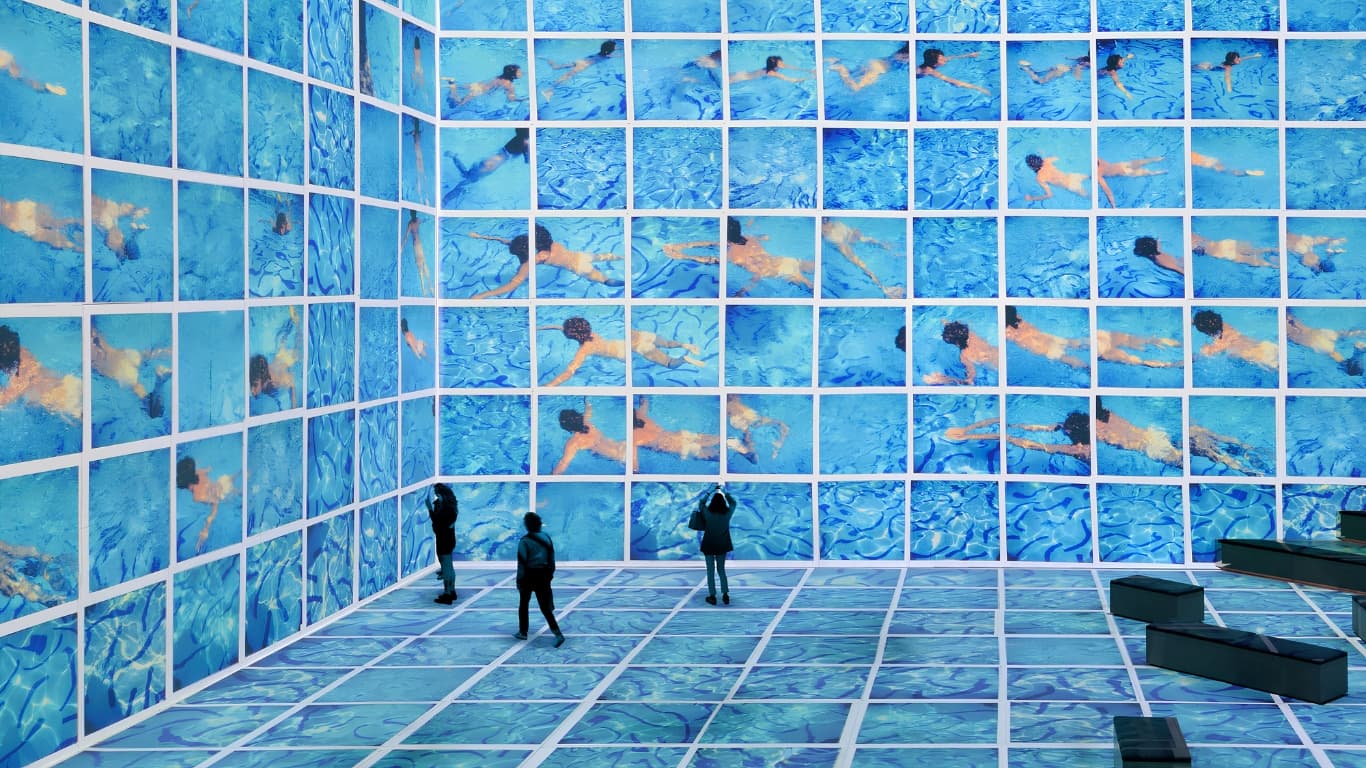
The pools made him, and they did so by accident of geography and temperament. Hockney left grey Bradford and a London art school for Los Angeles in the early 1960s, and the city hit him like a revelation. Here was perpetual sun, modernist houses, and everywhere the swimming pool, that peculiarly Californian symbol of leisure and arrival. He painted it obsessively across the decade, culminating in A Bigger Splash of 1967, in which a diving board, a low pink house and a frozen white explosion of water compose the most economical image of pleasure in modern art.
What Hockney understood, and what gives the pool paintings their staying power, is that water is almost impossible to paint and that the attempt is the point. He devised a whole vocabulary of squiggles, ripples and flat planes to render the unrenderable shimmer of a sunlit surface. The result reads as both utterly relaxed and quietly virtuosic, an artist solving a hard formal problem while pretending to do nothing more than enjoy the afternoon. That combination, technical seriousness worn lightly, runs through everything he has made, and it is the reason the pools never curdle into mere decoration. They are studies in light disguised as holidays.
Contemporary painting, the field Hockney has shaped for six decades.
The Double Portraits and the Charged Room
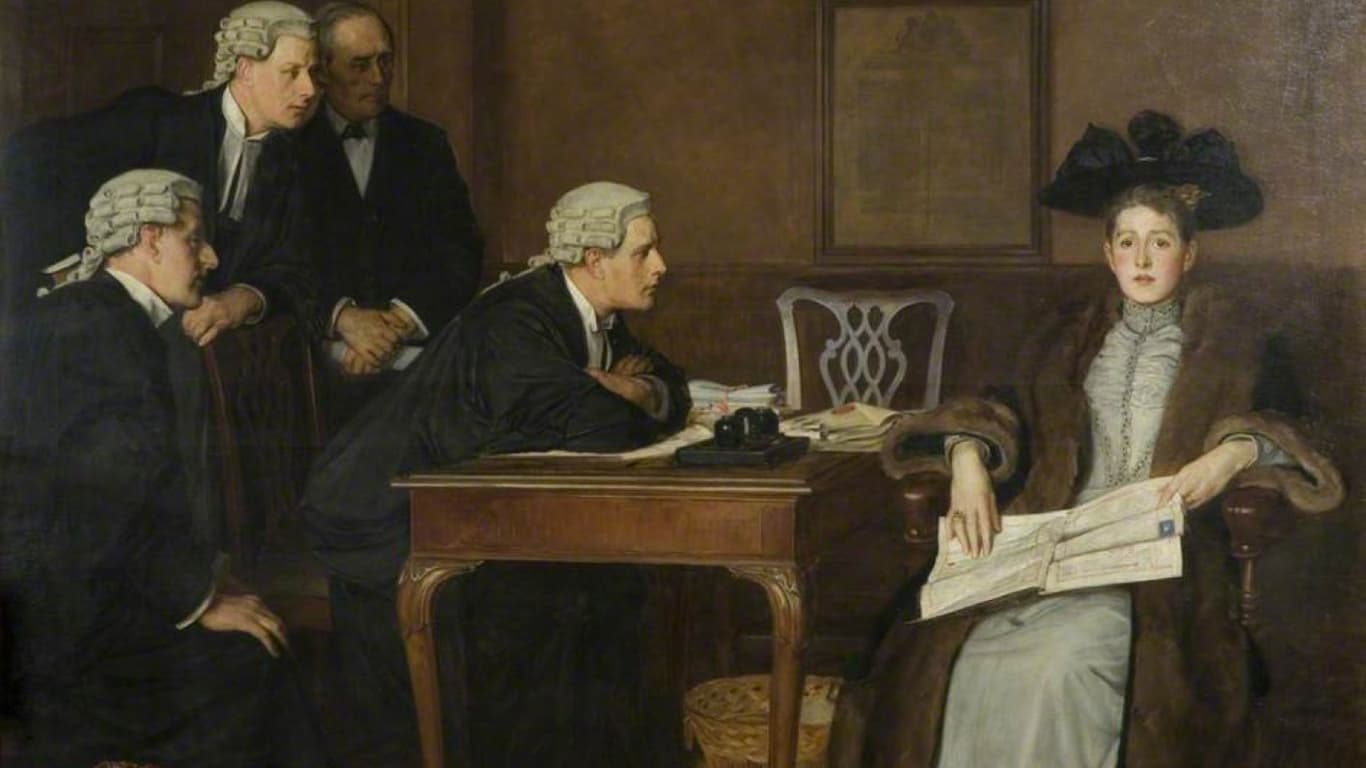
If the pools are Hockney at his most public, the double portraits are Hockney at his most searching. Across the late 1960s and 1970s he painted a series of large canvases showing two people who knew each other well, often couples or friends, arranged in carefully composed interiors. Mr and Mrs Clark and Percy, held by the Tate, is the most celebrated: the fashion designer Ossie Clark and Celia Birtwell in their London flat, a cat on his knee, the space between them holding a whole marriage in suspension.
These paintings reveal a different Hockney, less the sunlit hedonist and more the patient observer of human distance. The figures rarely touch. They occupy the same room and yet seem caught in separate weather, and the tension lives in the gap. He worked from drawings and photographs and long observation, building compositions of almost classical balance to frame relationships that are anything but settled. The double portraits demonstrate that the brilliant colour and the apparent ease were never the whole story. Beneath the pleasure sat a draughtsman of formidable discipline, watching people with unusual care, which is part of why his work sits so naturally alongside the broader story of how contemporary portrait art became a collecting category commanding serious attention.
The Restless Reinventor, From Polaroids to the iPad
The trait that separates Hockney from many of his peers is that he refused to settle into a signature and repeat it. Having conquered the pool and the portrait, he kept dismantling his own methods. In the 1980s he built photo collages, the so called joiners, assembling dozens of individual snapshots into fractured panoramic images that questioned how a single photograph flattens time and movement. He returned to England and painted the Yorkshire landscape on a monumental scale, vast multi canvas views of the Wolds in eye splitting colour. Later, settled in Normandy, he turned to the arrival of spring as his recurring subject.
Then came the tools that startled the purists. Hockney embraced the iPhone and then the iPad as drawing instruments, producing thousands of digital works, some printed at enormous size, capturing sunrises and flowers and the changing French light with the immediacy of a sketchbook. Critics who expected an old master to guard his dignity were startled. He simply did not care about the hierarchy of media. To Hockney a tool is a tool, and the only question is whether it helps you see. That curiosity, undimmed into his eighties, is the engine beneath the longevity. He never became a museum piece because he never stopped experimenting, a quality he shares with the small group of living cornerstones such as Germany's Anselm Kiefer whose relevance compounds with each decade.
Why the Market Treats Him as a Cornerstone
The standing translates into a market of unusual breadth, and the structure of it tells the story. At the top sit the historically significant canvases, the great pools and double portraits of the 1960s and 1970s, which appear rarely and command the headline sums at Christie's and Sotheby's. Beneath them runs a deep and active market for his prints and editions, decades of lithographs, etchings and screenprints that give a far wider circle of collectors a genuine way into the oeuvre. Few living artists offer both a 90 million dollar peak and an accessible entry point with such coherence.
What makes Hockney a cornerstone rather than a passing favourite is the combination of legibility and depth. His images are instantly recognisable, which sustains demand, yet the work rewards close looking, which sustains scholarship. That recognisability has carried his motifs into the wider visual culture, the same current running through the way luxury brands are reshaping the contemporary art market. Provenance and the strength of a given period matter here, as across the secondary market, and the early Californian works carry a weight the later digital pieces do not yet match. The result is a reputation that does not depend on fashion. Museums queue to show him, the public arrives in record numbers, and the most serious works change hands at the level reserved for the canonical. That is what a cornerstone looks like: not a spike, but a floor that holds.
David Hockney set out, more than sixty years ago, to paint the world as it actually delighted him, and he has never been embarrassed by the impulse. While much of the art around him grew anxious and self questioning, he kept finding new ways to render light on water, the space between two people, the colour of a Yorkshire field, the precise blue of a Los Angeles morning. The 90.3 million dollar sale was the saleroom catching up to something his audiences had always known. The crowds queue, the prices hold, and the pools still look as fresh as the afternoon he first saw them. Hockney endures because pleasure, taken seriously and pursued without apology, turns out to be one of the hardest things in art to fake, and he has never once faked it.
Stefanos Moschopoulos
Stefanos Moschopoulos founded The Luxury Playbook in Athens and has spent the better part of a decade following the auction calendar, the en primeur releases, and the watchmakers, gallerists, and shipyards the magazine covers. He writes the field guides and listicles that anchor the Connoisseur section — pieces built on Phillips and Christie's results, Liv-ex movements, and conversations with collectors he has met across Geneva, Bordeaux, Basel, and Monaco. His own collecting habits sit closer to watches and wine than art, and it shows in the level of detail in the magazine's coverage of those categories. Under his direction, The Luxury Playbook now publishes long-form field guides, market-defining year-end listicles, and the Voices interview series with the founders behind the houses and the brands.