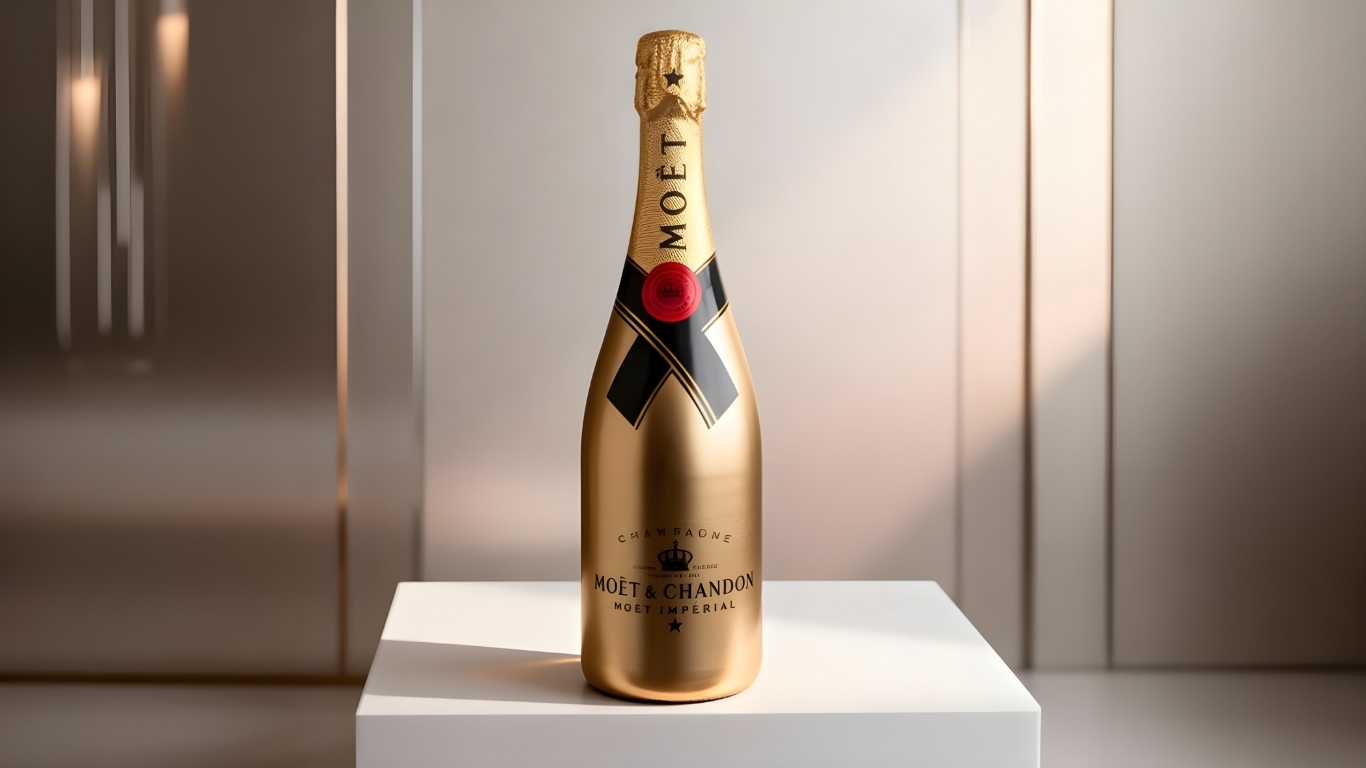

Champagne has always traded on a simple promise: it’s the prestige sparkling wine that signals celebration, status, and French luxury excellence.
For over a century, this positioning held firm regardless of economic conditions or competitive pressure. Champagne wasn’t just wine. It was the beverage you chose when the occasion mattered, when you wanted to communicate that something important was happening, when ordinary wine wouldn’t convey the appropriate significance.
That cultural position supported premium pricing and allowed the region to weather challenges that would have destroyed lesser categories.
The early warning signs that this foundation is cracking appeared gradually but are now impossible to ignore. Total Champagne shipments in 2024 fell to 271.4 million bottles, down 9.2% year-over-year, with exports declining 10.8% and French domestic sales dropping 7.2% according to Comité Champagne.
Meanwhile, price corrections compound the volume pressure in ways that signal structural challenges rather than seasonal softness. Wine Lister reporting summarized by Harpers shows average Champagne prices have fallen approximately 12% globally over the past three years, even as the product remains widely distributed and highly recognized. Inventory buildups add the final element of concern.
Table of Contents
Key Takeaways & The 5Ws
- Champagne is losing its automatic prestige premium: shipments fell about 9.2% in 2024 and average global prices are down roughly 12% over three years, pointing to structural—not seasonal—weakness.
- The hardest hit is the big-house segment: trade confidence in the Grandes Marques is down around 10%, while family maisons and grower Champagne are holding up better as drinkers pivot toward producer identity and terroir.
- For investors, broad Champagne exposure has de-rated: the Liv-ex Champagne 50 is down roughly 20% in two years, with high-volume non-vintage labels most exposed to discounting and inventory clearance.
- The investable niche is narrowing toward genuinely scarce, craft-driven cuvées: grower Champagne, strong family houses, and top prestige bottlings look structurally safer than mass brands.
- Competitive pressure is rising as Prosecco, English sparkling, Cava, and Crémant increasingly take occasions that once defaulted to Champagne, reinforcing the shift toward scarcity-led and terroir-led demand.
- Who is impacted?
- Major Champagne houses, family-owned domaines, grower producers, global retailers, and wine investors deciding whether to hold, cut exposure, or rotate out of big-brand Champagne.
- What is happening?
- A structural reset: volumes, prices, and confidence are weakening for mass labels, while demand is shifting toward smaller producers and alternative sparkling regions with clearer identity and better value.
- When did the downturn become clear?
- From roughly 2022 to 2025, with 2024 shipment declines and a two-year drop of around 20% in the Champagne 50 index signaling a sustained downturn rather than a short-lived dip.
- Where is it playing out?
- Centered in Champagne but visible across key markets such as France, the US, and the UK, and on global fine-wine exchanges where Champagne now competes directly with other sparkling categories.
- Why is Champagne de-rating?
- Because oversupply, changing drinking habits, stronger competition (Prosecco, Cava, English sparkling, Crémant), and aggressive discounting by major houses have eroded the “must-pay-a-premium” effect, pushing investors toward scarcity-led, craft-led cuvées.

Why Are Retailers and Consumers Abandoning Major Champagne Brands?
The Champagne market is not weakening evenly. The brand hierarchy is starting to split into winners and losers, and the pattern reveals where the vulnerability sits.
Trade confidence has dropped hardest for the Grandes Marques, the large houses built on scale and global distribution, with confidence down roughly 10% on average according to Harpers. In contrast, family-owned houses saw a much smaller confidence decline of about 1.6%, while grower Champagnes scored best on confidence metrics.
The message is straightforward: ubiquity is becoming a disadvantage. When a major-house label is everywhere, consumers begin to ask what they are paying for beyond a familiar name.
That question matters because the perceived value has shifted. Younger buyers in particular are increasingly drawn to bottles with a clear place, producer identity, and craft narrative. Grower Champagnes benefit because the story is often simple and credible: a single producer farming their own vineyards, with production limits tied to land rather than marketing ambition.
When a buyer can choose a terroir-driven grower Champagne for the same price—or less—than a mass-distributed label, the major-house premium becomes harder to defend.
At the same time, competition has become real. Prosecco, Cava, Crémant, and English sparkling wine have improved in quality and positioning, giving consumers alternatives that feel “good enough” for the same celebration occasion.
The Guardian notes that people are drinking differently and often drinking less overall, which turns Champagne’s competition into a direct budget decision rather than a status reflex.
If an excellent Prosecco Superiore costs around €20, or a strong English sparkling wine lands around £30, the buyer can still deliver a celebratory experience without stepping up to €50–€70 Champagne. As the perceived quality gap narrows, the Champagne premium starts to look like an optional surcharge rather than a requirement.
Market saturation adds another layer of pressure. Champagne’s luxury feeling depends on scarcity, not availability. When the category is present in every supermarket, at every airport duty-free shelf, and at every corporate event, it loses some of its “specialness.”
The same wide distribution that helped major houses scale globally now works against the exclusivity that makes premium pricing feel natural. Smaller producers benefit precisely because they are harder to find, less promotional, and still feel like discovery rather than default.
Finally, pricing behavior in the United States has sent a signal that retailers and consumers notice. Customs-based reporting tracked by Meininger showed the average Champagne bottle price in the U.S. falling by roughly 23% between October 2024 and September 2025, with producers absorbing significant tariff costs to protect market share. Luxury brands typically protect price first and accept lower volume when necessary.
When major houses accept price compression of that magnitude to defend distribution, it communicates that volume is being prioritized over brand equity. That weakens the category’s core premium logic.

What Does This Mean for Champagne Investors and Collectors?
For investors and collectors, the key issue is that Champagne is no longer moving as a single unified “prestige asset.” The investment case for broad exposure, especially to widely produced, widely available labels, has weakened as falling shipments, excess inventory, and softening prices reinforce each other.
Market benchmarks reflect this shift. The Liv-ex Champagne 50 fell by roughly 20% over the two years ending August 31, 2025 according to VinX, erasing a meaningful share of the pandemic-era surge. The implication is not that Champagne has become uninvestable. The implication is that easy appreciation tied to category momentum is no longer dependable, and selection matters more than ever.
Portfolio strategy now starts with a simple separation: products vulnerable to discounting versus products protected by genuine scarcity.
Mass-market non-vintage Champagne from the biggest houses carries the highest risk because it sits directly in the path of promotions, inventory clearance, and retailer negotiation pressure. These labels are often produced in volumes that require constant throughput.
When demand slows, the system does not gracefully pause—it pushes stock into the market, which usually means price concessions. For investors, that makes broad exposure to non-vintage majors less attractive until inventories normalize.
More defensible positioning exists, but it is narrower. Grower Champagnes and strong family maisons tend to rely less on marketing scale and more on limited vineyard holdings, consistent quality, and collector credibility. Their supply is constrained by land and production reality, not by brand strategy.
Club Oenologique analysis highlights that demand here is often driven more by craft and terroir interest than by pure status signaling, which can remain stable even when the broader category becomes less fashionable.
The timeline for any broad recovery is heavily tied to inventory math. With stock levels estimated at well over five years of supply at recently measured rates, normalization is typically measured in years rather than quarters, as The Real Review notes.
The region is attempting to rebalance through yield limits and reserve mechanisms, but inventory overhang is stubborn. Reducing production helps future flow, but it does not eliminate bottles already sitting in reserve.
Whether the roughly 12% price decline becomes a buying opportunity or the start of a deeper reset depends on a few practical indicators. Inventory levels remain the first gate. As long as oversupply persists, meaningful price recovery struggles regardless of improvements in sentiment.
Domestic French demand matters as well because it provides the category’s cultural anchor. If French consumption continues trending down, Champagne loses the home-market reinforcement that historically stabilized it. Prestige cuvée behavior can also act as an early signal, because top-tier bottlings often show shifts in collector confidence before weakness spreads through broader ranges.
Meanwhile, alternative sparkling categories are benefiting from Champagne’s pressure. Premium Prosecco from producers such as Bisol and Nino Franco, English sparkling wines from estates like Nyetimber and Gusbourne, high-quality Crémant, and grower Champagnes all gain when consumers question whether paying major-house Champagne premiums still makes sense.
Drinks International notes that these categories are capturing occasions and budgets that once defaulted to Champagne, creating practical diversification options for collectors who want sparkling exposure without relying solely on the Champagne region.