


If you’re looking for where to put your money in property right now, Europe deserves your full attention. Some of the best rental real estate markets on the continent are delivering strong, consistent yields while other asset classes wobble. Demand for rental housing is rising in key cities, economic fundamentals are holding firm, and the range of opportunities is genuinely impressive. Whether you’re drawn to Dublin’s tech-fuelled rent rolls or the raw upside of emerging markets like Riga and Bucharest, there’s a European city that fits your strategy. The key is knowing which cities offer the best rental yields and understanding the forces driving them, from tourism and expatriate demand to local economic momentum.
Table of Contents
Cities w/h the Best Rental Yields in Europe
- Dublin, Ireland – 7.33%
- Istanbul, Turkey – 6.63%
- Riga, Latvia – 6.46%
- Bucharest, Romania – 6.36%
- Podgorica, Montenegro – 5.7%
- Lisbon, Portugal – 5.65%
- London, UK – 5.59%
- Brussels, Belgium – 5.54%
- Warsaw, Poland – 5.51%
- Vilnius, Lithuania – 5.47%
1. Dublin, Ireland – 7.76%
Why Dublin?
Dublin has earned its place at the top of the European rental market conversation, and the numbers back it up. With an average rental yield of around 7.76%, it sits among the highest-yielding cities on the continent. The city’s tech sector is the engine behind this, with companies like Google and Facebook anchoring their European operations here, pulling in waves of well-paid professionals who need somewhere to live. That sustained demand is exactly what makes Dublin one of the best rental real estate markets in Europe right now.
Rental Yield Analysis
Dublin’s 7.76% yield isn’t an accident. It’s the direct result of the city’s status as a global tech hub, with Google, Facebook, and Amazon all running their European headquarters out of here. That concentration of high earners drives serious demand for both short and long-term rentals, pushing prices upward across the entire city.
Housing supply is tight, and that’s unlikely to change quickly. Demand keeps outpacing new stock, which means landlords are operating in a strongly favourable market. Properties get snapped up in days, sometimes faster, and that urgency allows landlords to command premium rates without hesitation.
The city’s universities add another layer of demand. Trinity College Dublin alone draws thousands of students who need accommodation, particularly in central areas. As of 2026, the average monthly rent for a two-bedroom apartment in central Dublin runs between €1,734 and €2,500, with the upper end of that range dominating in sought-after neighbourhoods like Ballsbridge, Rathmines, and the Docklands.
Dublin 2 posts the highest average rents at €2,470 per month, with Dublin 4 close behind at €2,345. Areas like Dublin 1, Dublin 6, and South County Dublin sit in the €2,097 to €2,217 range.
West Dublin is the most affordable slice of the market, averaging around €1,734 per month. But even there, rents are strong relative to what it costs to buy, especially for investors who purchased several years ago. That gap between purchase price and rent is precisely what’s pushing Dublin’s yields above the European average.
Economic Factors
The Irish economy has shown real resilience. Growth projections pointed to 1.2% in 2024, climbing to 3.6% in 2025, and the trajectory heading into 2026 looks equally solid.
Inflation has been cooling, touching 2.6% year-on-year, the lowest reading since August 2021. A strong economy combined with a chronic shortage of new housing is a powerful combination for landlords. It keeps vacancy rates low, rental demand high, and Dublin firmly on the radar for serious real estate investors.

2. Istanbul, Turkey – 6.63%
Why Istanbul?
Istanbul sits at the crossroads of Europe and Asia, and that positioning has made it a genuinely compelling rental market. Property prices are affordable by European standards, tourism is relentless, and the numbers are moving in the right direction. With average rental yields of 6.63%, the city gives you a lower-cost entry point into the European property market without sacrificing returns.
Rental Yield Analysis
As of 2026, Istanbul’s gross rental yields on apartments range from 3.75% to 9.72%, with the city average sitting at 6.63%.
That’s a meaningful step up from the sub-6% city average recorded in prior years. The relative affordability of Istanbul property is a key driver here. You’re buying at a lower cost per square metre than almost any Western European city while still charging competitive rents, which naturally inflates your yield.
Tourism, expatriates, and local demand all feed into the rental market simultaneously. Neighbourhoods like Beyoglu, Kadikoy, and Sisli are the sweet spots, popular with tourists and foreign residents who want quality accommodation in central locations. As of 2026, average monthly rents for a centrally located one-bedroom apartment run between €600 and €2,500, depending on how close you are to the action.
Property prices across Istanbul are still well below what you’d pay in comparable European cities. And the devaluation of the Turkish lira has worked in international investors’ favour, making it cheaper to acquire assets while rents in euros or dollars hold their value. That currency dynamic is one of the more interesting levers in Istanbul’s yield story.
Economic Factors
Turkey’s young population and expanding middle class keep rental demand steady and growing. On top of that, Istanbul attracts a consistent flow of foreign capital, particularly from the Middle East, which has supported property values over time. Yes, there’s been economic volatility, but for investors who are primarily focused on yield rather than capital stability, Istanbul rewards the conviction.

3. Riga, Latvia – 7.46%
Why Riga?
Riga is one of Eastern Europe’s most compelling rental markets right now, and not enough investors are paying attention. With an average yield of 7.46%, the Latvian capital is punching well above its weight, delivering returns that rival Dublin’s while asking far less from you at the point of purchase. If you’re looking for the best rental real estate markets in Europe with genuine upside, Riga belongs on your shortlist.
Rental Yield Analysis
Low property prices and rising rental demand are the twin engines behind Riga’s 7.46% yield. The formula is straightforward, and it’s working.
The city is pulling in foreign investment from Northern Europe and beyond, alongside a growing wave of expatriates arriving to work in Riga’s expanding IT and tech sectors. Its proximity to other major European cities and a cost of living that won’t shock your accountant make it a genuinely attractive base for professionals.
Rental demand is strongest in the city centre, particularly in Old Town and Central Riga, where stock is limited and competition among tenants is real.
As of 2026, a one-bedroom apartment in the city centre runs between €600 and €1,200 per month depending on location and specification. The short-term rental market is growing too, with platforms like Airbnb capitalising on Riga’s rise as a destination for business travellers and tourists alike.
Affordable entry costs paired with strong demand creates the kind of yield environment that long-term investors dream about. Add in Riga’s favourable tax treatment for property investors and you’ve got a market that rewards doing your homework early.
Economic Factors
Latvia’s economy has been on a steady growth trajectory, and Riga is absorbing the benefits in the form of increased foreign investment and rising business activity.
Tourism has surged in recent years, which feeds directly into short-term rental demand for properties listed on platforms like Airbnb. The relatively low cost of living and accessible property prices make Riga one of the more efficient markets in Europe for maximising rental returns.
4. Bucharest, Romania – 6.46%
Why Bucharest?
Bucharest doesn’t always get the attention it deserves from international investors, but that’s changing fast. With rental yields averaging 6.46%, Romania’s capital offers one of the most attractive entry points in Eastern Europe, combining affordable property prices with rising demand and a growing economy.
Rental Yield Analysis
Bucharest’s 6.46% average yield is underpinned by low acquisition costs and a rental market that’s being driven by a growing community of expatriates and professionals in the tech and finance sectors. Dig deeper into the numbers and it gets even more interesting. In the Titan district, studio apartments are generating gross yields of 9.02%, while one-bedroom apartments are delivering 8.47%.
Central Bucharest is where expatriates and high-income professionals concentrate, and rental prices reflect that. Two-bedroom apartments in this part of the city typically run between €450 and €650 per month, with neighbourhoods like Dorobanti and Herastrau commanding the top end of that range.
Bucharest’s student population is also a consistent source of rental demand, particularly in areas surrounding universities like the Bucharest Academy of Economic Studies.
What really sets Bucharest apart is the gap between purchase price and rental income. You can enter the market at a cost that would seem impossibly low in Western European capitals, while still tapping into robust demand and yields that most investors in those cities would envy.
Economic Factors
Bucharest’s economy has been expanding at a solid pace, with the IT and technology sector attracting talent and investment from across the continent. Romania’s EU membership provides a layer of regulatory stability that reassures foreign investors, and the city’s affordable cost of living keeps drawing in young professionals and expatriates who need quality rental accommodation.

5. Podgorica, Montenegro – 5.7%
Why Podgorica?
Podgorica might not be the first name that comes to mind when you think about European rental markets, but that’s part of its appeal. As Montenegro’s capital, the city offers a low cost of entry and steady rental demand backed by a growing economy and an expanding tourism sector. At 5.7% average yields, it’s one of the more interesting under-the-radar picks among the best rental real estate markets in Europe.
Rental Yield Analysis
Podgorica’s 5.7% yield reflects its position as an emerging market with rising foreign interest. As the capital of Montenegro, it benefits directly from the country’s economic growth and its growing profile as a tourism destination, drawing both international investors and visitors in increasing numbers.
Rental demand in the city is being driven by expatriates and locals looking for long-term accommodation, alongside tourists seeking short-term vacation stays.
The average price per square metre for new construction in Podgorica in 2026 sits at around €1,955, reflecting continued upward pressure on values. Rental demand spans both long-term and short-term segments, giving investors flexibility in how they structure their returns.
As of 2026, the average monthly rent for a one-bedroom apartment in the city centre sits at approximately €548.75, with prices spanning €450 to €650. That’s the math behind the 5.7% gross yield.
Montenegro’s appeal as a market has accelerated on the back of the country’s EU accession talks and its NATO membership, both of which have sent a clear signal to foreign investors that this is a stable place to put capital. Interest in nearby coastal towns like Kotor and Budva, where vacation rental demand is surging, adds further momentum to the broader Montenegrin market.
Economic Factors
Montenegro’s NATO membership and active EU accession process have been direct catalysts for foreign investment and real estate market growth.
The economy expanded by 6% in 2023, building on exceptional growth of 13% in 2021 and 6.4% in 2022, all driven in large part by the recovery of the tourism sector.
Tourist arrivals jumped nearly 20% year-on-year to reach 2,613,306 visitors in 2023 alone. Tourism is the fuel behind short-term rental demand in Podgorica and the coastal cities, and the numbers suggest that engine is only getting more powerful.
6. Lisbon, Portugal – 5.65%
Why Lisbon?
Lisbon has quietly become one of Europe’s most coveted real estate markets, and the demand shows no sign of cooling. Rental yields of around 5.65% are the headline, but the story behind them is what makes this city worth your serious attention.
A vibrant tourism industry, a swelling community of digital nomads, and strong foreign appetite for Portuguese property have all combined to keep rental demand at consistently high levels, making Lisbon one of the best rental real estate markets in Europe right now.
Rental Yield Analysis
Lisbon’s 5.65% yield is the product of several converging forces. Tourism is booming. The expatriate community keeps growing. And the city has carved out a genuine reputation as a digital nomad hub, pulling in remote workers from across the globe who need quality, flexible accommodation. Portugal’s Golden Visa program has also been a significant driver of foreign investment into the market.
The short-term rental market, fuelled by platforms like Airbnb, has flourished here. Demand is intense in central neighbourhoods like Baixa, Alfama, and Chiado, where tourists and expatriates compete for the best apartments. A two-bedroom flat in central Lisbon commands between €1,200 and €2,500 per month depending on location and proximity to the city’s most desirable spots.
Property prices have risen sharply as foreign investment has poured in, but rental demand keeps outpacing supply. That imbalance is what keeps yields healthy for existing property owners and what makes timing your entry into this market so important.
Economic Factors
Portugal’s Golden Visa program brought a wave of foreign capital into Lisbon’s real estate market that fundamentally reshaped its dynamics. Beyond that, the city’s tech and startup sectors have been growing steadily, creating a pool of professionals who want to rent in a city they genuinely love living in. That combination of investment-driven demand and lifestyle appeal is a rare and powerful mix.
7. London, UK – 6.73%
Why London?
London is expensive. Everyone knows that. But a 6.73% rental yield in one of the world’s most important cities tells you something important about the depth and resilience of demand here. As a global financial hub and one of the planet’s most visited cities, London’s rental market doesn’t really have an off season.
Rental Yield Analysis
A 6.73% yield in London is a strong result given how high property prices are. The city’s sheer scale and diversity of demand mean that returns hold up even when acquisition costs are steep.
Yields vary sharply across the boroughs. Barking and Dagenham currently deliver rental yields of around 6.4%, making it one of the city’s most efficient areas for investors. Meanwhile, average rents across London have been climbing steadily. As of 2026, the London average sits at £2,694 per calendar month, up from £2,627 the year before.
Outside London, average rents surged to a 19th consecutive quarterly record high of £1,344 per month, which tells you just how much of a premium people are willing to pay to live in the capital.
Central boroughs like Kensington and Chelsea sit at the very top of the market, with average rents around £3,435 per month.
But those premium postcodes don’t necessarily translate into the best percentage yields, because purchase prices are astronomical. If yield is your priority over prestige, you’ll find better numbers in up-and-coming areas where values have room to run.
Hackney, Peckham, and Walthamstow are worth looking at closely. Property prices are more accessible, but rental demand stays strong thanks to London’s extensive transport network and a young, mobile population that prioritises location and connectivity over square footage.
London’s rental market is underpinned by a deep pool of demand from expatriates, international students, and professionals. Even after Brexit reshaped some of the city’s dynamics, rental demand from wealthy overseas buyers and corporate tenants has remained remarkably resilient.
Short-term rentals through platforms like Airbnb perform particularly well in central districts, where high tourism and business travel keep occupancy rates elevated year-round.
Economic Factors
London’s position in global finance, education, and culture is what gives its real estate market such unusual staying power. Brexit created uncertainty, but it didn’t hollow out demand. Universities continue to pull in thousands of students each year, and the employment market draws both domestic talent and international professionals who all need somewhere to live. That breadth of demand is London’s real asset.

8. Brussels, Belgium – 4.20%
Why Brussels?
Brussels is a different kind of rental market story. The yields won’t shock you at 4.20%, but the stability and predictability of returns here are hard to match anywhere else in Europe.
The city’s role as the de facto capital of the European Union means a constant flow of diplomats, civil servants, and international professionals who need quality rental accommodation. That’s a remarkably durable source of demand.
Rental Yield Analysis
Brussels delivers a 4.20% rental yield driven almost entirely by its extraordinary concentration of international institutions. The European Parliament, the European Commission, and NATO headquarters all operate here, generating a steady and predictable stream of tenants who are professional, well-compensated, and not going anywhere anytime soon.
Yields shift depending on property type and location across the city.
As of 2026, semi-detached houses command the highest average rents at around €1,866 per month, while studios at the more affordable end of the market average €800 per month.
The institutional demand from diplomats, EU civil servants, and professionals associated with NATO and the European Commission keeps vacancy rates impressively low across the city.
Ixelles, Etterbeek, and Saint-Gilles are the neighbourhoods that attract the most expatriate interest, offering both long-term leases and short-term opportunities for investors who want flexibility.
A one-bedroom apartment in these areas typically rents for between €1,200 and €1,800 per month, at property prices that are moderate compared to cities like Paris or Amsterdam.
Low vacancy rates and a tenant pool that skews toward highly qualified international professionals make Brussels one of the most dependable rental markets on the continent.
Brussels also benefits from something most cities can’t replicate, which is its position at the geographic and political heart of Europe. Multinational corporations gravitate here, and the executives and specialists they bring with them tend to rent rather than buy because their assignments are temporary. That transience is actually a feature for landlords, not a bug, since it keeps the tenant pipeline flowing.
Economic Factors
Brussels has a structurally stable tenant base that most cities would envy. A large and growing population of diplomats, EU civil servants, and expatriates all require high-quality rental accommodation, and they tend to be reliable, long-term tenants. The city’s infrastructure, international connectivity, and proximity to major European decision-making centres mean its appeal as a base for business and politics isn’t going anywhere.
9. Warsaw, Poland – 6.03%
Why Warsaw?
Warsaw has grown into one of Eastern Europe’s most dynamic cities, and its rental market reflects that energy. The city is a major hub for business, finance, and education, pulling in professionals from across the region and beyond. With rental yields of 6.03%, it’s one of the most compelling options among the best rental real estate markets in Europe for investors who want strong returns without Western European price tags.
Rental Yield Analysis
Warsaw’s rental market is delivering 6.03% yields, and that number has been moving in the right direction.
As of 2026, Poland’s average gross rental yield stands at 6.03%, up from 5.75% in 2024. International companies have been establishing operations in Warsaw at pace, which has fed directly into job creation and rental demand across the city.
Foreign direct investment in Warsaw’s tech and finance sectors has been a consistent driver of both the city’s economy and its property market, lifting demand for short-term and long-term rentals across the board.
Śródmieście and Wola are the districts attracting the most interest from expatriates, young professionals, and students who want modern housing at a price point that still makes sense. One-bedroom apartments in these areas typically rent for between €675 and €1,100 per month, with acquisition costs that look modest compared to Western European equivalents.
Poland’s low property taxes and investor-friendly legal environment are genuine advantages that don’t show up in the yield headline but make a real difference to your net returns. Warsaw’s rapid development, combined with growing expatriate demand, has positioned it as a market worth taking seriously.
Economic Factors
Warsaw’s economic momentum is real and it’s been building for years. The city is home to a growing cluster of multinational corporations and tech startups, which keeps employment high and rental demand steady. Poland’s low property taxes and business-friendly environment have attracted substantial foreign capital, and that investment is feeding through into the real estate market in ways that benefit landlords.
10. Vilnius, Lithuania – 5.47%
Why Vilnius?
Vilnius is a Baltic success story that’s starting to get the attention it deserves from international real estate investors. With rental yields of 5.47%, Lithuania’s capital offers a combination of affordable entry costs, a growing tech scene, and rising expatriate demand that adds up to a genuinely attractive investment case.
Rental Yield Analysis
Vilnius has established itself as a serious player in the Baltic real estate market, with a 5.47% rental yield backed by the city’s transformation into a hub for startups and technology firms. Local and international talent are arriving in increasing numbers, and they all need quality housing.
Rental prices in Vilnius are still very affordable by European standards. Centrally located apartments in districts like Old Town or Naujamiestis rent for between €700 and €1,200 per month. Property acquisition costs are low, but the quality of demand is high, which means investors can generate steady rental income without overpaying to get into the market.
Young professionals and expatriates working in tech and finance are the primary demand drivers, particularly in the city centre. Vilnius also has a well-established higher education sector, which means student housing is a productive niche for investors looking to diversify within the market.
Economic Factors
Vilnius has positioned itself as the Baltic region’s tech capital, and that reputation is attracting a young, ambitious, and internationally connected population. Growth in IT and fintech has been the backbone of Lithuania’s economic expansion, and Vilnius is the primary beneficiary. EU membership provides the regulatory stability that gives foreign investors the confidence to commit capital here.
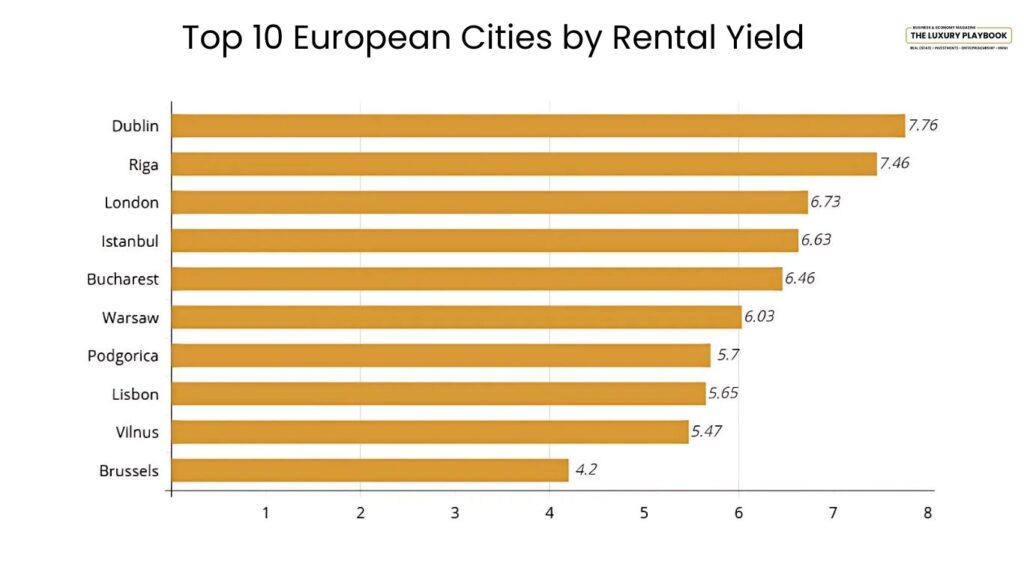
Top 10 European Cities by Rental Yield
- Dublin: 7.33% – High demand from tech professionals, limited housing supply.
- Riga: 7.46% – Affordable property prices and growing rental demand.
- London: 6.73% – Stable demand from expatriates, professionals, and tourists.
- Istanbul: 6.63% – Low property prices, strong tourist and expatriate demand.
- Bucharest: 6.46% – Urbanization and affordable property prices create strong rental returns.
- Warsaw: 6.03% – Growing business hub with strong rental demand.
- Podgorica: 5.7% – Emerging market with rising foreign investment.
- Lisbon: 5.65% – Booming tourism and strong demand for both short- and long-term rentals.
- Vilnius: 5.47% – Tech industry growth and increasing expatriate population.
- Brussels: 4.20% – EU’s capital, consistent demand from diplomats and expatriates.
Worst 10 European Countries by Rental Yield
These markets may still offer value for other reasons, whether capital appreciation, lifestyle, or portfolio diversification. But lower average rental yields driven by high property prices, sluggish rental demand, or difficult economic conditions mean they don’t make the top tier for pure yield-focused investors.
- Monaco: 1.7% – Extremely high property prices but limited rental market demand.
- Switzerland (Zurich): 2.0% – Very high property costs and low rental yields due to the stability of the Swiss franc.
- France (Paris): 2.5% – High property prices, strict rental regulations, and low yields.
- Italy (Rome): 2.6% – Aging housing stock and slow property market.
- Norway (Oslo): 2.7% – High living costs but low rental yields.
- Germany (Berlin): 3.0% – Rent caps and other legal restrictions limit returns.
- Denmark (Copenhagen): 3.2% – High property prices and rental controls.
- Finland (Helsinki): 3.3% – High costs of property ownership with moderate rental demand.
- Netherlands (Amsterdam): 3.4% – Strong tourism but rental price controls reduce yields.
- Austria (Vienna): 3.5% – High property prices but moderate demand due to rent control regulations.
Actionable Insights for Investing in European Rental Real Estate Markets
Looking across the top European cities by rental yield, a clear picture emerges. Several markets stand out as genuinely compelling opportunities for investors focused on maximising returns through some of the best rental real estate markets in Europe. Here’s what the data tells you, and what you should actually do with it.
1. Look for Growth Potential in Emerging Markets
Bucharest, Riga, and Podgorica give you the chance to enter markets where property prices are still accessible but yields are already impressive. Rapid urbanisation and economic growth are doing the heavy lifting in these cities, and they suit both long-term buy-and-hold strategies and short-term rental plays.
- Example: In Bucharest, rental yields of 6.36% are supported by a growing population and an emerging tech sector. Property prices are still accessible, offering potential for both capital appreciation and consistent rental income.
If you’re looking to capitalise on markets where property values still have significant room to grow, these three cities deserve a serious look right now.
2. Leverage Tourism in Key Cities
Lisbon, Istanbul, and London are all powered in part by relentless tourism. That creates a strong foundation for short-term rental platforms like Airbnb, where occupancy rates stay high because the mix of tourists, business travellers, and expatriates never really dries up.
- Example: Lisbon’s tourism-driven economy and a short-term rental-friendly market contribute to its high yields of 5.65%. The average Airbnb listing in central Lisbon generates significantly higher returns compared to long-term rentals.
If short-term rental income is your priority, target cities with strong tourism infrastructure and regulatory environments that don’t make Airbnb-style operations a headache. Do your due diligence on local short-term rental rules before you commit.
3. Capitalise on Business and Expat Demand
Brussels, London, and Warsaw are business hubs that attract a steady stream of expatriates and professionals who prefer renting over buying. These markets offer reliable long-term tenancy, particularly in areas close to financial districts, international institutions, and major employers.
- Example: Brussels benefits from being the de facto capital of the EU, with strong demand for rentals from diplomats, civil servants, and business professionals. Rental yields of 5.54% are driven by high demand from expatriates who require long-term housing.
Look for properties near international organisations, financial districts, and universities. Rental demand in these pockets is deep, consistent, and less sensitive to broader economic cycles than the wider market.
4. Explore Alternative Investment Strategies
In high-cost markets like Dublin and London, the traditional route of buying a full-sized apartment isn’t always the highest-yield play. Studio apartments, student accommodation, and shared housing or co-living spaces often deliver stronger returns while requiring a lower capital outlay to get started. You can learn more about structuring these kinds of plays by looking at how smart investors use LLCs to maximise real estate investment potential.
- Example: In London, investing in a studio apartment near universities or tech hubs can yield strong returns, with average rental prices ranging from £1,500 to £2,500 per month for compact units in prime locations.
Diversify your portfolio by exploring niche property types, including student housing, serviced apartments, and co-living spaces, especially in high-demand urban areas where competition for rental stock is fierce.
5. Pay Attention to Legal and Regulatory Frameworks
The legal environment can make or break a rental investment. Cities like Berlin and Amsterdam have introduced rent controls and placed restrictions on short-term rentals through platforms like Airbnb, which can put a hard ceiling on your returns regardless of how strong underlying demand is.
- Example: Berlin has strict rent control measures in place, which caps rental price increases, limiting potential profits for landlords. While the market may still be attractive for capital appreciation, rental yields are typically lower.
Before you commit capital to any European market, research local rental laws, property tax structures, and regulations around short-term lettings. Understanding the buying versus renting dynamics in your target country is a good starting point before diving into the specifics of rental regulations.
6. Consider the Impact of Economic and Political Stability
Montenegro and Turkey offer some of the most eye-catching yields on this list, but that comes with a corresponding level of risk. Political volatility and economic uncertainty are real factors in both markets. Currency fluctuations are particularly important to model carefully, since a devaluing local currency can erode your euro or dollar returns faster than you’d expect. The Financial Times real estate desk regularly tracks these macroeconomic risks in emerging European property markets and is worth monitoring closely.
- Example: While Istanbul offers impressive rental yields of 6.63%, Turkey’s economic instability and inflation rates pose risks to long-term investments. Investors should take these factors into account when calculating potential returns.
If you prefer to sleep well at night, focus on stable economies like Ireland or Belgium. The yields are still competitive, the tenant pools are deep and reliable, and the political and regulatory environments are predictable. Bloomberg’s European real estate coverage consistently highlights these markets as the safe harbour choices for risk-conscious investors. That stability is worth something, especially when you’re building a portfolio for the long term rather than chasing a single-year return.