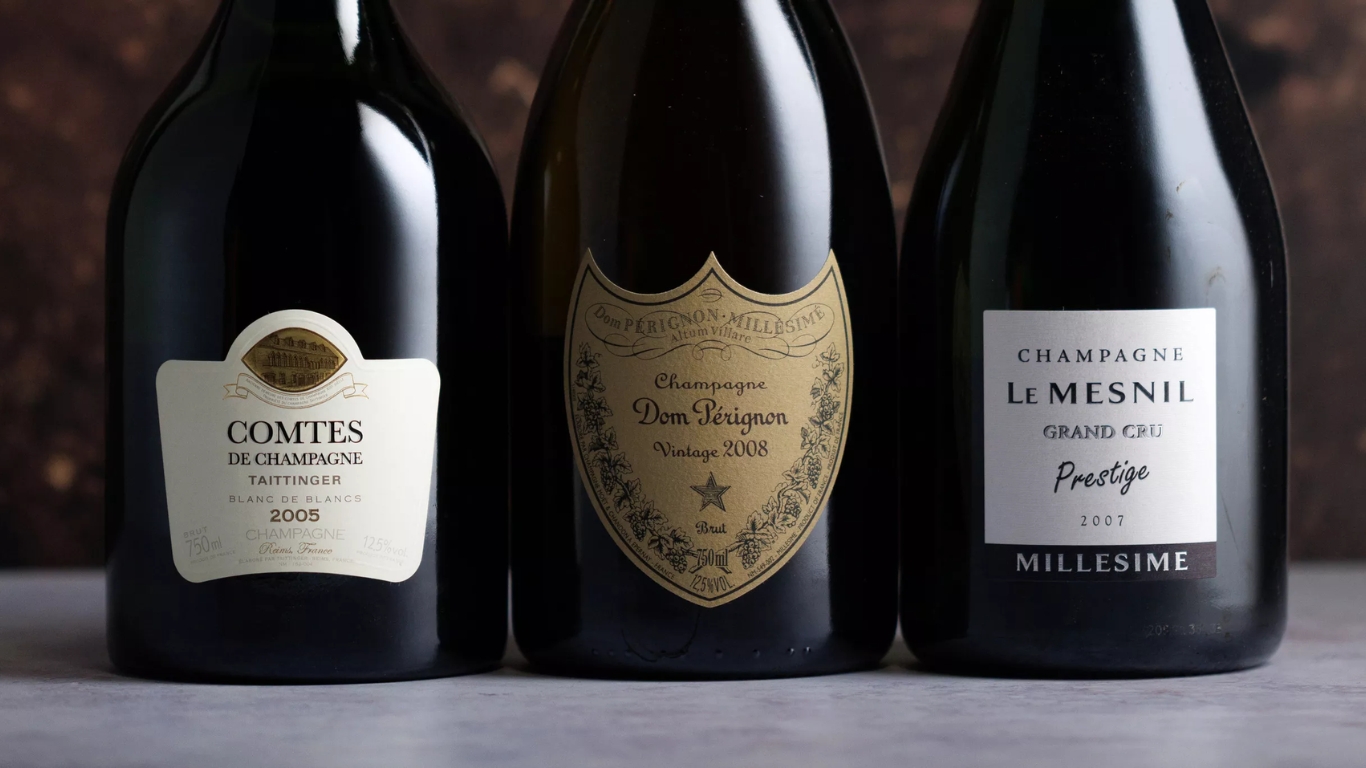

Bordeaux Supérieur is a classification that covers some of the finest wines produced in the Bordeaux region of France.
It sits above standard Bordeaux AOC wines in terms of quality, yet stays remarkably affordable and accessible for both wine collectors and serious investors.
Bordeaux Supérieur wines are held to stricter production requirements than their standard counterparts, including longer aging periods, lower yields, and tighter vineyard management. The result is a wine with superior structure and complexity that punches well above its price point.
From an investment perspective, Bordeaux Supérieur offers a genuinely compelling opportunity, whether you’re a casual enthusiast dipping your toes in or a seasoned collector building a serious portfolio.
These wines carry strong aging potential, often improving over a 5 to 10 year window, which makes them attractive for anyone with a long-term holding mindset.
And as global demand for Bordeaux wines keeps climbing, especially across North America and Asia, Bordeaux Supérieur wines have steadily become more valuable in the secondary market. Supply is finite. Demand is not.
In this article, you’ll get a full picture of Bordeaux Supérieur, covering its history, regions, taste profile, pricing, and what kind of return on investment you can realistically expect as a collector or investor in 2026.
Table of Contents
What Is Bordeaux Supérieur?
Bordeaux Supérieur is an Appellation d’Origine Contrôlée designation that applies to wines produced in the Bordeaux region of France under stricter regulations than those governing standard Bordeaux AOC wines.
That classification isn’t just a label. It signals higher quality standards, meaning you’re getting better structure, more aging potential, and greater complexity in the glass.
Bordeaux Supérieur covers primarily red wines, though a small percentage of whites also carry the designation.
The red wines are typically built around the classic Bordeaux grape varieties you’d expect, including Merlot, Cabernet Sauvignon, Cabernet Franc, Petit Verdot, and Malbec.
And to earn that Supérieur label, producers must follow stricter vineyard management and winemaking rules across the board.
- Lower Yields: Bordeaux Supérieur wines come from vineyards with lower production limits, ensuring more concentrated and higher-quality grapes.
- Longer Aging Requirements: These wines must be aged for at least 12 months before release, compared to standard Bordeaux AOC wines, which have no minimum aging requirement.
- Higher Alcohol Content: Bordeaux Supérieur wines generally have a minimum alcohol content of 10.5-12%, slightly higher than regular Bordeaux wines, enhancing their body and structure.
- Quality Control Measures: Stricter regulations on vineyard density, grape ripeness, and winemaking techniques ensure wines of superior balance, depth, and complexity.
The Bordeaux Supérieur AOC was officially recognized in 1943, creating a tier of wines that, while not classified as Grand Cru or Premier Cru, strike an excellent balance between affordability and aging potential.
Many Bordeaux Supérieur wines rival higher-end Bordeaux labels at a fraction of the cost. For collectors focused on value-driven investing, that gap is where the opportunity lives.
The History of Bordeaux Supérieur
The Bordeaux Supérieur classification was officially recognized in 1943, but its roots stretch back far longer than that.
Bordeaux has been producing world-class wine for centuries, with viticulture in the area dating all the way back to the Roman era.
The region’s reputation for exceptional winemaking led to the development of the broader Bordeaux classification system, designed to distinguish wines based on quality, aging potential, and terroir.
By the early 20th century, many Bordeaux producers were operating at a level above the standard AOC but didn’t fall within the 1855 Grand Cru classification or earn designated classified growth status. They needed somewhere to belong.
French authorities responded by creating the Bordeaux Supérieur AOC, setting it apart through stricter vineyard management rules and tighter aging regulations.
Key Historical Developments
- 1855: The famous Bordeaux Wine Classification was established under Emperor Napoleon III, ranking the region’s best wines, but leaving many quality-driven producers unclassified.
- 1936: The Bordeaux AOC (Appellation d’Origine Contrôlée) was introduced to regulate winemaking practices. However, many high-quality wines did not fit into the established classification.
- 1943: The Bordeaux Supérieur AOC was created to recognize wines that exceeded standard Bordeaux quality without requiring Grand Cru classification.
- Late 20th Century: Advances in winemaking techniques, vineyard management, and global demand helped Bordeaux Supérieur wines gain wider recognition. Many of these wines started outperforming classified growths from lesser vintages.
- 21st Century: Bordeaux Supérieur wines continue to grow in global prestige, offering some of the best value investments in fine wine today.
Built on centuries of winemaking expertise, Bordeaux Supérieur has become a classification synonymous with quality, affordability, and real investment potential.
As demand for Bordeaux wines rises in emerging markets, Bordeaux Supérieur keeps gaining traction as an accessible and increasingly lucrative investment category.
Bordeaux Supérieur Wine Regions & Terroir
The Bordeaux Supérieur AOC designation spans multiple regions within the broader Bordeaux wine-growing area, covering both Left Bank and Right Bank appellations.
Unlike classified growths, which are tied to specific châteaux, Bordeaux Supérieur wines are produced across a range of terroirs, and each one lends its own distinct character to the final bottle.
1. Right Bank – Merlot-Dominant Wines
The Right Bank is home to some of Bordeaux’s most prestigious appellations, including Saint-Émilion and Pomerol.
Most Bordeaux Supérieur wines from the Right Bank lean heavily on Merlot, delivering a fruit-forward profile, softer tannins, and a round, approachable style that appeals to a wide range of palates. Key sub-regions worth knowing include several areas that offer strong value at the Supérieur level.
- Côtes de Bordeaux: Produces structured, well-balanced wines that offer excellent aging potential.
- Fronsac: Known for full-bodied, tannic wines with rich black fruit flavors.
- Blaye and Bourg: These regions provide value-driven Bordeaux Supérieur wines, often comparable to those from neighboring Saint-Émilion.
2. Left Bank – Cabernet Sauvignon-Dominant Wines
The Left Bank, home to well-known appellations like Médoc and Graves, is built around Cabernet Sauvignon.
Bordeaux Supérieur wines from this side of the river tend to show higher tannins, bold structure, and serious aging potential. The key sub-regions here reward patient investors most generously.
- Médoc & Haut-Médoc: Producing structured, mineral-driven wines with high acidity and firm tannins.
- Graves & Pessac-Léognan: Often blending Cabernet Sauvignon with Merlot, these regions create wines with smoky, earthy, and complex profiles.
3. Entre-Deux-Mers – Balanced and Affordable Bordeaux Supérieur Wines
Sitting between the Garonne and Dordogne rivers, Entre-Deux-Mers is a diverse region producing both red and white Bordeaux Supérieur wines.
It’s traditionally known for crisp whites, but its Bordeaux Supérieur reds are gaining real attention for their balanced fruit and tannin structure at competitive price points. Worth watching closely.
Soil Composition & Climate Influence
- Gravelly Soils: Found mainly on the Left Bank, these soils promote excellent drainage, resulting in powerful, tannic wines with longevity.
- Limestone & Clay: More common on the Right Bank, these soils retain moisture and encourage Merlot growth, producing wines with soft texture and lush fruit flavors.
- Maritime Climate: Bordeaux’s proximity to the Atlantic Ocean ensures a mild, temperate climate, allowing for a long growing season and optimal grape ripening.
If you’re selecting Bordeaux Supérieur wines with strong aging potential in mind, understanding terroir isn’t optional. It’s essential.
Right Bank wines, with their Merlot dominance, tend to mature faster and appeal to a broader consumer base, making them well-suited for short to medium-term investment strategies.
Left Bank wines, particularly those with higher Cabernet Sauvignon content, build complexity over time and are better positioned for long-term holding.
As climate change reshapes Bordeaux’s growing conditions, certain higher-altitude and limestone-rich areas are expected to climb in value. That means specific Bordeaux Supérieur wines could become even more attractive investment targets over the next decade.
Bordeaux Supérieur Wine Taste & Smell Characteristics
Bordeaux Supérieur wines are known for their complexity, depth, and refined structure, qualities that clearly set them apart from standard Bordeaux AOC wines.
Longer aging requirements, stricter vineyard regulations, and careful grape selection all combine to produce enhanced aromas, richer flavors, and improved aging potential in every bottle.
Taste Profile of Bordeaux Supérieur
Red Bordeaux Supérieur wines are predominantly Merlot and Cabernet Sauvignon-based, which gives them a bold yet balanced profile that collectors consistently seek out.
Depending on the specific blend, you can expect real variation in structure, tannin weight, and fruit concentration. No two producers are exactly alike.
- Right Bank (Merlot-Dominant Wines)
- Fruit-forward flavors with notes of ripe plum, black cherry, and raspberry
- Soft tannins, making them approachable at a younger age
- Smooth, velvety texture, often with hints of vanilla and mocha from oak aging
- Medium to full body, depending on the producer and vintage
- Fruit-forward flavors with notes of ripe plum, black cherry, and raspberry
- Left Bank (Cabernet Sauvignon-Dominant Wines)
- More tannic and structured, requiring longer aging for full development
- Blackcurrant, cassis, and blackberry flavors
- Earthy and mineral notes, with hints of tobacco, graphite, and leather
- Higher acidity and firmer tannins, ideal for long-term aging
- More tannic and structured, requiring longer aging for full development
- Entre-Deux-Mers (Balanced Wines)
- Lighter and more fruit-driven than Left Bank wines
- Red berry and floral notes, often blended with subtle oak influences
- Medium tannins, making them accessible for early drinking
- Lighter and more fruit-driven than Left Bank wines
Aromas of Bordeaux Supérieur Wines
Bordeaux Supérieur wines go through a minimum of 12 months of aging, which gives them the time to develop the kind of layered aromas that evolve beautifully in the glass over years.
- Primary Aromas: Fresh fruit notes like blackberry, cherry, and red currant dominate young Bordeaux Supérieur wines.
- Secondary Aromas: Barrel aging introduces hints of cedar, vanilla, baking spices, and chocolate.
- Tertiary Aromas (Aged Wines): With extended aging, wines develop notes of leather, dried fruit, tobacco, and truffle, contributing to greater complexity.
For investors, the aging potential of Bordeaux Supérieur wines is one of the most critical factors to understand before buying.
Where standard Bordeaux AOC wines are often best consumed within 3 to 5 years, Bordeaux Supérieur wines can age comfortably for 10 to 15 years, depending on the vintage and producer.
For investment purposes, wines with higher tannins and acidity, typically those from the Left Bank, tend to develop greater complexity over time and deliver stronger returns in the secondary market.
Merlot-based Right Bank wines mature faster by comparison, offering quicker turnaround opportunities for investors who prefer shorter holding periods.
Bordeaux Supérieur Storage
Proper storage is non-negotiable if you want to protect the quality, aging potential, and investment value of your Bordeaux Supérieur wines.
Unlike standard Bordeaux AOC wines that are often consumed within a few years of release, Bordeaux Supérieur wines are built to age for 10 to 15 years, with some exceptional vintages going well beyond that.
To maximize your return on investment, you need to get storage right from day one.
Ideal Storage Conditions
- Temperature: Bordeaux Supérieur wines should be stored at a consistent 12-14°C (53-57°F). Fluctuations in temperature can cause premature aging and negatively impact the wine’s complexity and balance.
- Humidity Levels: A humidity level of 60-70% helps preserve cork integrity, preventing oxidation and spoilage.
- Light Exposure: Wines should be stored in dark environments, as UV rays can degrade the wine’s chemical structure and cause off-flavors.
- Bottle Positioning: Store bottles horizontally to keep the cork moist and airtight, preventing oxidation.
- Vibration-Free Environment: Minimize movement to allow the wine to age undisturbed, preserving tannin structure and preventing sediment disruption.
Cellaring & Investment Holding Periods
- Short-Term Holding (3-5 years): Right Bank Merlot-heavy Bordeaux Supérieur wines are generally more approachable at a younger age, making them ideal for short-term investment cycles.
- Medium-Term Holding (5-10 years): Balanced blends from Entre-Deux-Mers and Blaye develop well within this period, offering solid ROI potential.
- Long-Term Holding (10-15+ years): Left Bank Cabernet Sauvignon-dominant wines, particularly from Médoc and Graves, improve significantly over extended aging, making them more desirable in the secondary market.
Best Storage Options for Investors
For serious investors, professional wine storage facilities offer temperature-controlled environments, insurance coverage, and optimal aging conditions. Some of the top global wine storage providers are worth researching before you commit to a facility.
- Octavian Vaults (UK)
- The Wine Society (France)
- Vinothèque (USA)
Many Bordeaux wine producers also offer en primeur storage options, allowing you to purchase wines directly from the barrel before bottling. This ensures optimal aging conditions from the very start and can maximize your future resale value.
Pay close attention to storage if you’re targeting high returns on Bordeaux Supérieur wines. The numbers speak for themselves.
Well-stored bottles command 20 to 30% higher resale values compared to wines that have been kept in suboptimal conditions. That gap is entirely avoidable with the right setup.
At high-end auctions, provenance matters enormously. The wine’s full storage and ownership history can be the difference between a premium price and a disappointing sale. Professionally stored Bordeaux Supérieur wines consistently fetch stronger results.
Bordeaux Supérieur Pricing
Bordeaux Supérieur wines offer exceptional value when you stack them against Grand Cru Classé wines, which is exactly what makes them such an attractive entry point for investors seeking affordable access with real upside potential.
Prices vary depending on vintage quality, region, producer reputation, and aging potential, so knowing where to look matters.
Current Market Prices for Bordeaux Supérieur Wines (2026)
- Entry-Level Bordeaux Supérieur Wines: Typically priced between $12 – $25 per bottle, these wines are ready-to-drink within 3-5 years and cater primarily to casual drinkers rather than investors.
- Mid-Tier Bordeaux Supérieur Wines: Ranging from $25 – $50 per bottle, these wines often come from high-quality vineyards and renowned producers, offering strong potential for appreciation over 5-10 years.
- Premium Bordeaux Supérieur Wines: Limited-production, age-worthy wines can range from $50 – $150+ per bottle, with some exceptional vintages reaching auction prices of $200-$500 after extended aging.
Price Trends Over the Last Decade
Bordeaux Supérieur wines have seen steady appreciation over the past 10 years, driven by growing demand in emerging markets and the increasing scarcity of affordable fine wines from Bordeaux. The trend line points in one direction.
- 2015 – 2020: Average price growth of 5-7% per year, with stronger appreciation for Right Bank wines due to their earlier drinkability.
- 2021 – 2024: Global demand surged, leading to 8-12% annual price increases, particularly for top vintages and boutique producers.
Auction and Secondary Market Performance
The secondary market tells a clear story. Vintage 2010 Bordeaux Supérieur wines have seen resale values climb by 15 to 20% over the past decade, and that’s before accounting for provenance premiums.
Wines from prestigious producers have performed exceptionally well, with continued demand and limited supply keeping upward pressure on prices.
Well-stored 2009 Bordeaux Supérieur wines have delivered even stronger returns, with some exceeding 25% ROI in select auctions, particularly for bottles with excellent provenance and documented aging history.
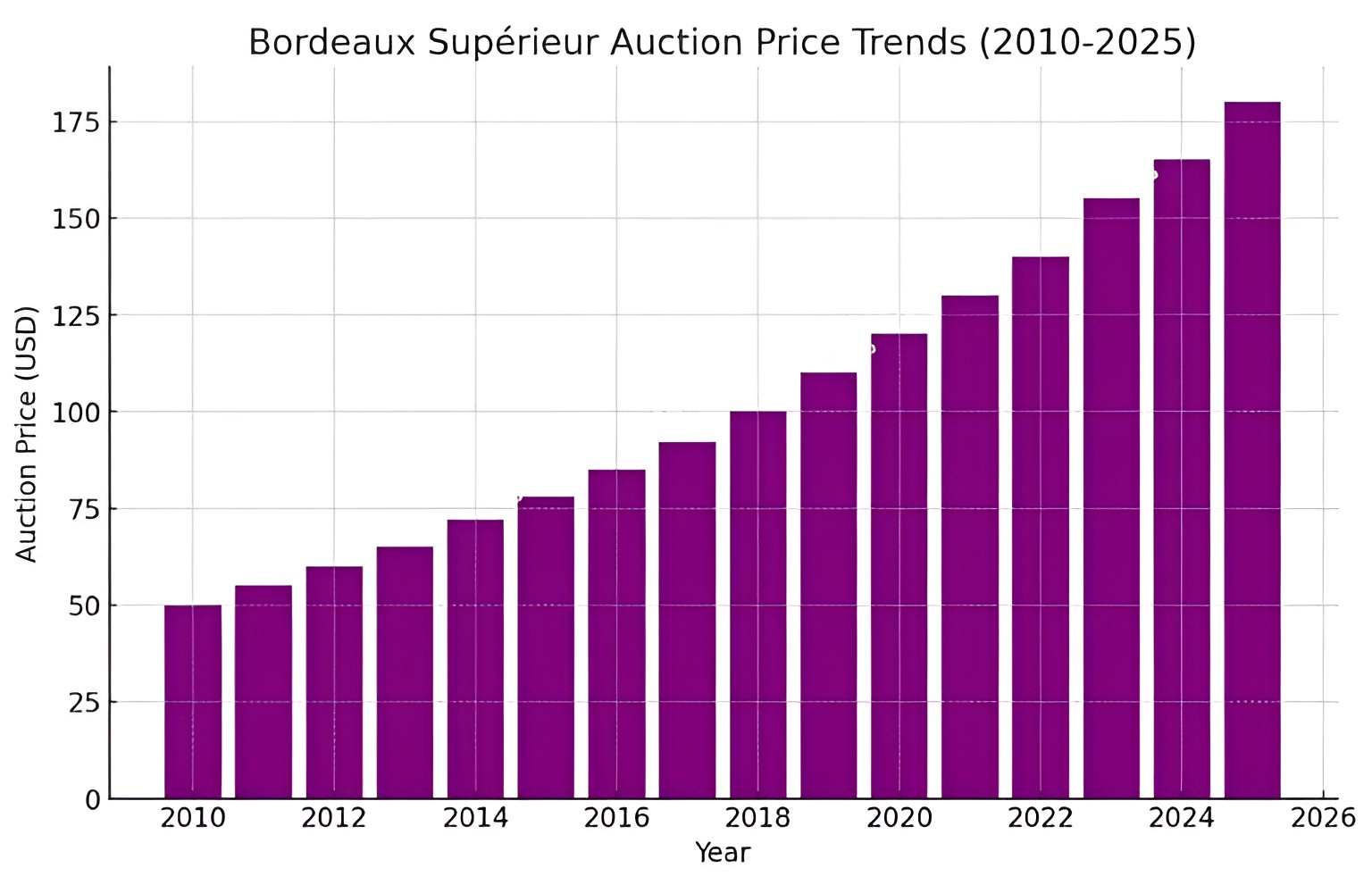
Looking ahead, the 2026 outlook is positive. Analysts tracking the fine wine market are predicting continued price appreciation, especially for top-performing Right Bank Merlot-dominant wines and Left Bank Cabernet Sauvignon-dominant wines built for long-term aging.
From an investment standpoint, Bordeaux Supérieur gives you an affordable entry point that Grand Cru Bordeaux simply can’t match, where prices typically start at $500 and climb to $5,000 per bottle or beyond.
That accessibility makes it a smart option for investors looking to diversify their portfolios without committing serious capital to a single label.
And the growth data backs the thesis. Prices for well-rated vintages from respected producers have shown consistent appreciation year over year, much like other fine wine categories gaining collector attention.
Its secondary market strength adds another layer of appeal. Aged Bordeaux Supérieur wines perform well at wine auctions, online marketplaces, and private sales.
That market liquidity gives you more flexible exit options compared to lesser-known fine wines, which can be notoriously difficult to move when you want out. Bordeaux Supérieur is a category with real, reliable demand.
Bordeaux Supérieur Historical ROI
Bordeaux Supérieur wines have consistently delivered strong investment returns, especially for well-rated vintages and bottles from reputable producers.
They may not carry the same prestige as classified growths, but the steady appreciation and strong resale demand make them a genuinely viable option for both short-term traders and long-term holders.
Historical ROI Trends (2010 to 2026)
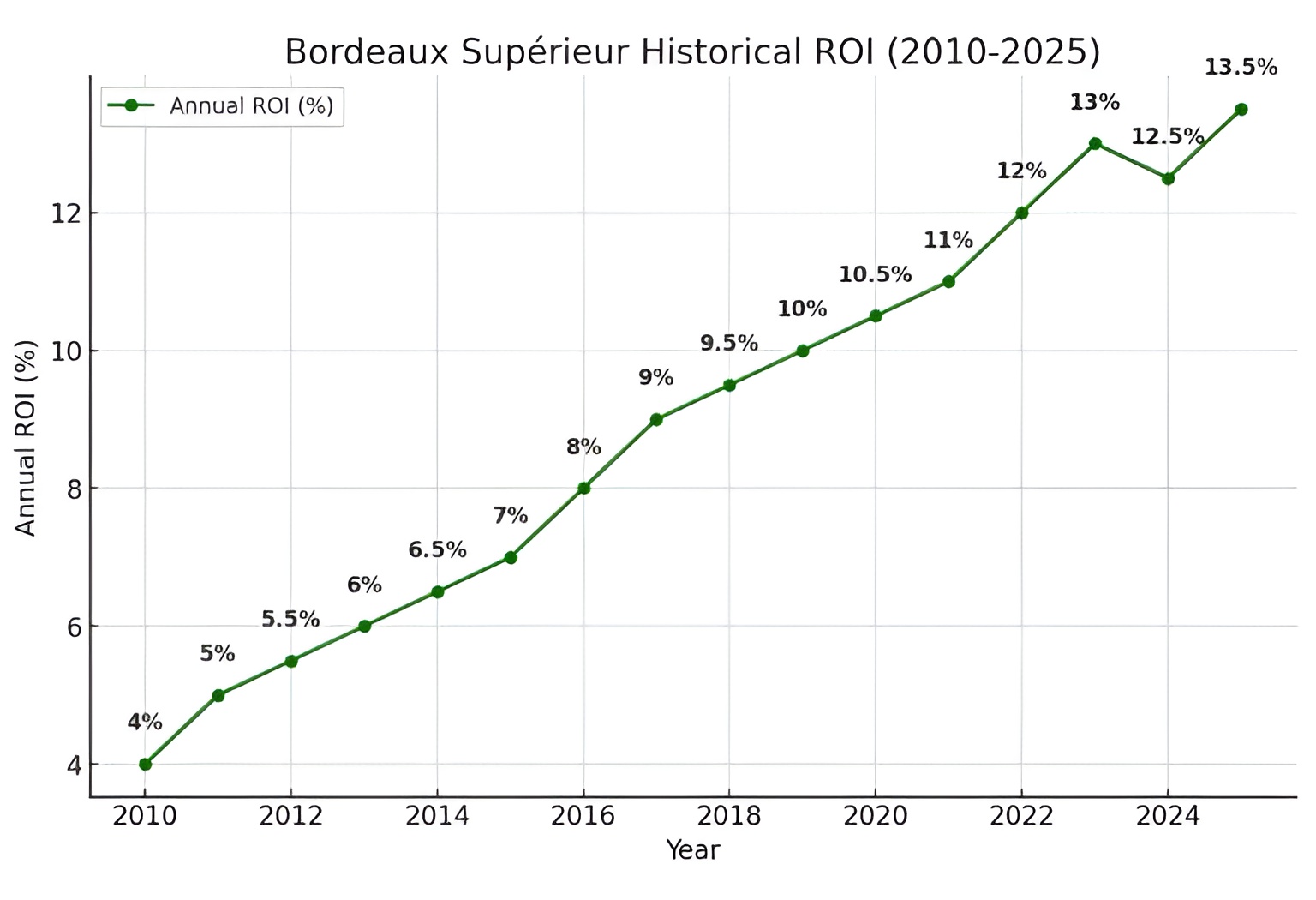
Over the past 15 years, Bordeaux Supérieur wines have followed a clear upward trajectory in value, driven by increased global demand, improved winemaking techniques, and growing interest from emerging markets discovering Bordeaux for the first time.
- 2010-2015: Average annual ROI of 4-6%, with modest but steady price appreciation.
- 2016-2020: ROI increased to 6-9% per year, particularly for top-tier Bordeaux Supérieur wines from exceptional vintages (e.g., 2015, 2018).
- 2021-2024: A surge in fine wine investment led to 8-12% annual ROI, with select wines from highly rated vintages appreciating by 15-20% in secondary markets.
- 2025 Projection: Analysts predict Bordeaux Supérieur wines will continue to grow in value at a rate of 10-15% annually, particularly for limited-production and age-worthy wines.
Comparison to Other Bordeaux Wine Categories
Comparison to Other Bordeaux Wine Categories
Best Performing Bordeaux Supérieur Vintages in Auctions
- 2010 Bordeaux Supérieur Wines: Some of the best-performing Bordeaux Supérieur wines from this vintage have appreciated by over 18% in private sales.
- 2015 & 2018 Bordeaux Supérieur Wines: These highly rated vintages have shown 12-15% annualized returns, making them standout investment options.
- 2020 Bordeaux Supérieur Wines: With a 96-point rating from major wine critics, wines from this vintage are expected to see price appreciation of 10-12% per year over the next decade.
The historical ROI data makes one thing clear. Bordeaux Supérieur consistently delivers better returns than standard Bordeaux AOC wines, making it one of the most compelling entry-level fine wine investments you can make.
Its appreciation outpaces lower-tier Bordeaux wines, giving you more promising upside potential without requiring the capital outlay that premium classifications demand.
Bordeaux Supérieur also shows lower volatility than Grand Cru Bordeaux, which can swing dramatically based on critic scores and market speculation. That’s a feature, not a limitation.
The more stable return profile makes it a reliable choice for investors who want predictable long-term growth rather than exposure to the kind of high-risk price swings that can wipe out gains overnight.
Another key driver behind Bordeaux Supérieur’s investment appeal is the direction of global demand. The category is on the right side of a major trend.
You’re seeing increased traction in North America, China, and a range of emerging markets, where consumers and collectors are waking up to the value proposition and aging potential that Bordeaux Supérieur offers. The expansion of wine trade agreements is also opening new distribution channels that could accelerate this demand further.
That expanding market base means continued resale value and liquidity in the secondary market, reinforcing Bordeaux Supérieur’s place as a reliable, appreciating asset in the fine wine sector.
Best Varieties of Bordeaux Supérieur
Bordeaux Supérieur wines come in a range of styles, each with its own characteristics that appeal to different investor profiles and holding strategies.
Red Bordeaux Supérieur wines dominate the category, but there are also limited white and sweet wines that offer real diversification opportunities for collectors and active traders.
Best Red Bordeaux Supérieur Varieties for Investment
Red Bordeaux Supérieur wines are built on Merlot or Cabernet Sauvignon, with aging potential typically ranging from 5 to 15 years depending on the producer and vintage conditions.
The best investment-worthy bottles tend to come from small, high-quality producers who focus on limited production, rigorous vineyard management, and extended aging. Scarcity and quality together are what drive value.
- Merlot-Dominant Bordeaux Supérieur Wines (Right Bank)
- Soft, fruit-forward wines with flavors of black cherry, plum, and chocolate.
- Best for short-to-medium-term investment (5-10 years).
- Highly sought-after in Asian and U.S. markets, leading to steady price appreciation.
- Examples: Blaye Côtes de Bordeaux, Fronsac Bordeaux Supérieur.
- Soft, fruit-forward wines with flavors of black cherry, plum, and chocolate.
- Cabernet Sauvignon-Dominant Bordeaux Supérieur Wines (Left Bank)
- More structured, tannic wines with flavors of cassis, tobacco, and cedar.
- Longer aging potential (10-15 years), ideal for long-term investment.
- Appreciates well in value due to higher collector demand and increasing scarcity.
- Examples: Médoc, Graves, and Pessac-Léognan Bordeaux Supérieur.
- More structured, tannic wines with flavors of cassis, tobacco, and cedar.
- Bordeaux Supérieur Blends
- Typically combine Merlot, Cabernet Sauvignon, and Cabernet Franc for balance.
- Wines offer versatile aging potential and consistent price appreciation.
- Examples: Côtes de Bourg Bordeaux Supérieur blends.
- Typically combine Merlot, Cabernet Sauvignon, and Cabernet Franc for balance.
Best White Bordeaux Supérieur Varieties for Investment
White Bordeaux Supérieur wines are less common, but they present an interesting niche investment opportunity, especially as demand for premium dry whites and sweet wines from Bordeaux continues to build among collectors.
- Dry Bordeaux Supérieur Blanc
- Made from Sauvignon Blanc, Sémillon, and Muscadelle, these wines are known for crisp acidity and citrus-driven profiles.
- Typically aged for 5-8 years, but certain vintages appreciate 10-12% per year in value.
- Examples: Entre-Deux-Mers Bordeaux Supérieur Blanc wines.
- Made from Sauvignon Blanc, Sémillon, and Muscadelle, these wines are known for crisp acidity and citrus-driven profiles.
- Sweet Bordeaux Supérieur Wines (Similar to Sauternes & Barsac)
- Produced from botrytized (noble rot) grapes, leading to honeyed, rich flavors.
- Highly collectible, particularly limited-edition releases, with ROI exceeding 15% annually for top vintages.
- Examples: Bordeaux Supérieur Moelleux wines (Late-Harvest Whites).
- Produced from botrytized (noble rot) grapes, leading to honeyed, rich flavors.
Best Bordeaux Supérieur Collections in 2026
Best Bordeaux Supérieur Collections in 2025
FAQ
What is the difference between Bordeaux Supérieur and regular Bordeaux AOC wines?
Bordeaux Supérieur wines have stricter production standards than regular Bordeaux AOC wines. They require lower yields, longer aging (minimum 12 months), and higher alcohol content, leading to greater depth, structure, and aging potential.
Bordeaux Supérieur wines are generally considered higher quality and have better investment potential than standard Bordeaux AOC wines.
Are Bordeaux Supérieur wines a good investment in 2025?
Yes, Bordeaux Supérieur wines offer strong investment value, particularly for those seeking affordable entry points into fine wine investment.
With average annual ROI ranging from 8-15%, these wines are growing in demand across Asia, the U.S., and Europe, making them a profitable long-term investment.
Which Bordeaux Supérieur vintages have the highest ROI?
2010 & 2015 Vintages: Showed 15-20% appreciation over the past decade.
2018 & 2020 Vintages: Rated highly by wine critics, expected to increase 10-12% annually.
Rare limited-edition Bordeaux Supérieur wines have exceeded 20% ROI in auctions.
Can Bordeaux Supérieur wines be sold at auctions?
Yes. Well-aged Bordeaux Supérieur wines from prestigious producers and top vintages perform well at wine auctions, secondary markets, and private sales.
Aged bottles with excellent provenance and professional storage command higher resale values.