
The Manchester real estate market in 2026 gives you a stable, high-performing investment environment that puts the city among the UK’s most attractive regional property plays. As the unofficial capital of the North, Manchester brings a diverse economic base, a growing population, and rapid infrastructure development to the table. Those three forces keep demand strong across both the sales and rental sectors, year after year.
As of Q2 2026, the average residential property price in Manchester sits at approximately £241,000, up 5.3% year over year. That growth tells a clear story. Limited housing supply, regeneration-led appreciation in city centre zones, and a strong pipeline of private and public investment in housing, commercial space, and transport are all pushing prices upward together.
The rental market is punching well above the national average. Average rents now exceed £1,300 per month following a 10.2% annual increase, with high occupancy levels across both professional and student segments. Demand is strongest near business districts, universities, and new-build developments, pushing yields well above the national average in several boroughs.
The Manchester housing market in 2026 gives you a resilient opportunity if you are seeking high rental returns, long-term appreciation, and exposure to one of the UK’s most economically dynamic cities.
Table of Contents
Overview of The Manchester Real Estate Market
The Manchester real estate market in 2026 is defined by steady capital growth, rising tenant demand, and a continued shortage of quality housing across key districts. As a core city of the Northern Powerhouse, Manchester’s property market is well-supported by economic diversification, inward migration, and large-scale development projects spanning residential, commercial, and transport sectors.
As of Q2 2026, the average property price in Manchester sits at approximately £241,000, reflecting a 2.3% annual increase that outperforms the national average and sustains a multi-year trend of upward price momentum. Core growth areas include Ancoats, Salford Quays, and parts of South Manchester, where modern housing stock and proximity to amenities keep drawing buyer and tenant interest alike.

Demand is strongest in the city centre and inner-ring suburbs, where regeneration schemes and infrastructure improvements are unlocking new residential capacity. New-build activity is pushing forward, but supply is still falling short of current demand, particularly in the affordable and mid-range price segments.
That imbalance is supporting capital values and pushing rents higher, making Manchester especially attractive to income-focused investors.
First-time buyers, buy-to-let landlords, and institutional players are all active in this market, with foreign capital also targeting long-term lettings and build-to-rent schemes. Mortgage availability is improving after a volatile interest rate cycle, adding further upward pressure to both transaction volumes and entry-level pricing.
Key market characteristics in 2026 worth keeping in mind:
- Average citywide property price: £241,000
- Annual price growth: 2.3% (2024–2025)
- Prime growth zones: Ancoats, Salford Quays, Castlefield, Chorlton
- Buyer mix: Owner-occupiers, UK-based landlords, institutional BTR investors
- New supply: Focused on high-density flats and mid-rise schemes in regeneration areas
- Sales volume trend: Stable, with upward movement in secondary districts
Manchester’s housing market in 2026 is a regional outperformer. You get a compelling mix of affordability, growth, and rental demand that is hard to find elsewhere in the UK. If you are targeting mid-tier capital appreciation and strong income yields, Manchester deserves a serious look in your property portfolio.
Neighborhood Analysis
Manchester’s property market is built on diverse submarkets, each with its own distinct investment profile. From city-centre regeneration hotspots to high-yield commuter zones, the city’s neighborhoods vary widely in pricing, tenant mix, and growth potential. Knowing where to focus makes all the difference.
Ancoats
Ancoats is one of the most desirable residential areas in central Manchester right now. Known for its industrial heritage, converted mills, and upscale new-builds, it draws young professionals and remote workers who want urban living done properly.
Average prices sit around £320,000, or roughly £4,700 per square metre, with consistent rental demand and strong liquidity. Yields are moderate, but capital growth is reliable thanks to limited supply and sustained gentrification that shows no sign of slowing.
Salford Quays
Salford Quays has matured into a self-contained residential and commercial hub anchored by MediaCityUK. It attracts both professionals and students working in tech, media, and creative industries, giving you a broad and stable tenant base.
Properties in Salford Quays range from £260,000 to £300,000, or roughly £4,200 to £4,600 per square metre. Rental yields are strong, averaging 5.5%, especially for modern one and two-bedroom flats in purpose-built schemes.
Northern Quarter
The Northern Quarter is Manchester’s creative district, offering loft-style apartments, nightlife, and independent retail. It appeals to younger renters and city-centre buyers who want walkable convenience and a neighbourhood with genuine character.
Typical prices hover around £310,000, or about £4,800 per square metre, with high rental turnover and competitive yields near 5%. Properties here benefit from cultural cachet and long-term tenant appeal that keeps vacancy low.
Chorlton
Chorlton is a suburban, lifestyle-led neighbourhood in South Manchester that is popular with families and professionals who want greenery and good schools without leaving the city limits behind.
Property prices here sit at approximately £370,000, or around £4,500 per square metre. Appreciation is slower, but vacancy is low and owner-occupier interest is strong. You are looking at yields around 4%, but with long-term value stability that suits certain portfolio strategies well.
Hulme
Hulme is still an underpriced inner-city district in the midst of gradual regeneration. Its proximity to the city centre and university zones is attracting price-sensitive investors who want to get in before values move.
Average prices in Hulme sit around £220,000, or roughly £3,200 per square metre, with gross rental yields ranging from 5.5% to 6.2%. Those are among the best numbers you will find anywhere in central Manchester right now.
Neighborhood Median Prices and Price per Square Metre
Manchester_Neighborhood_Investment_Data_2025.csv
Manchester Rental Market Overview
The Manchester rental market in 2026 is outperforming the national average, supported by a young, mobile population, a growing student base, and a strong employer presence across finance, technology, and media. With limited new rental supply and rising mortgage barriers keeping more people renting for longer, demand keeps intensifying and pushing average rents to record highs across both central and suburban districts.
High occupancy, double-digit rent growth, and a resilient tenant base make Manchester one of the UK’s strongest rental markets for income-oriented investors. The fundamentals here are genuinely difficult to argue with.
Average Monthly Rent by Property Type (2026)
- 1-Bedroom Apartment: £950 – £1,200
- 2-Bedroom Apartment: £1,200 – £1,450
- 3-Bedroom Apartment: £1,450 – £1,800
- Premium City Centre Units: £2,000 – £2,500+
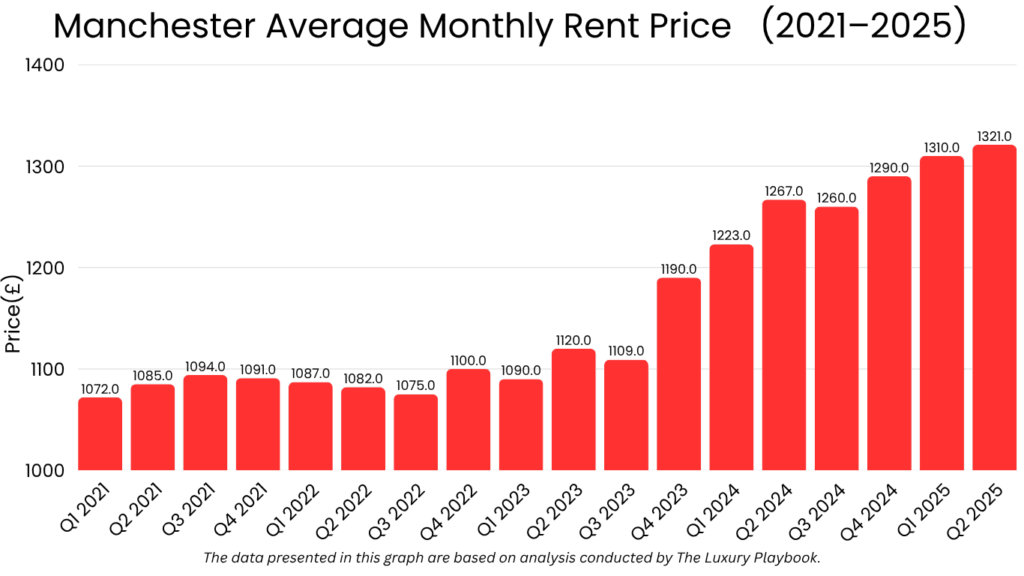
The average rent across Manchester now sits at £1,321 per month, driven by constrained supply and fierce competition among renters. The highest rental growth has been in Salford Quays, Ancoats, and Castlefield, where regeneration and quality amenities attract professionals and investors focused on protecting and growing asset value over time.
University-driven areas like Fallowfield and Ardwick stay highly competitive, delivering reliable turnover and strong seasonal occupancy. South Manchester suburbs like Didsbury and Chorlton cater to long-term tenants and family renters who tend to stay put and pay consistently.
Yield Performance and Tenant Segmentation
Manchester consistently delivers above-average gross rental yields, typically ranging from 4.5% to 6.5%, with outer and up-and-coming districts offering the highest returns. According to Rightmove’s rental yield data, northern cities continue to outperform the national average by a meaningful margin.
- High-Yield Zones: Hulme, Ardwick, Fallowfield (5.7%–6.5%)
- Balanced Performance: Salford Quays, Castlefield, Northern Quarter (4.8%–5.5%)
- Lower-Yield Stability: Didsbury, Chorlton (3.9%–4.2%)
Tenant demand is strongest for modern one and two-bedroom units, preferably furnished and within walking distance of transit or employment hubs. Lease terms average 12 to 24 months, though mid-stay demand is growing in high-amenity developments near MediaCityUK and the Spinningfields business district.
Manchester’s rental market stays legally stable, with no city-wide rent caps currently in place. As a landlord, you need to comply with standard national regulations, including deposit protection, HMO licensing, and EPC minimum standards at an E rating or above.
Energy-efficient upgrades are increasingly being prioritised as landlords look to stay competitive and meet future compliance targets. Getting ahead of those requirements now protects your yield down the line.
Short-term letting is permitted, but local councils are introducing stricter oversight on transient rentals in city-centre buildings, particularly those being used for Airbnb or serviced accommodation models. Worth factoring in if that is part of your strategy.
Manchester’s rental market offers income resilience, structural undersupply, and strong tenant fundamentals. If you are targeting long-term rentals in regeneration corridors or student-dense zones, you are well-positioned to achieve above-market returns in 2026 and beyond. The ONS Index of Private Housing Rental Prices consistently places the North West among the fastest-growing rental regions in England.

Factors Influencing the Manchester Housing Market
The Manchester housing market in 2026 is shaped by a convergence of demographic shifts, economic growth, infrastructure investment, and policy conditions. These combined forces keep reinforcing Manchester’s appeal as one of the UK’s top-performing regional property markets, especially for yield-focused and long-hold investors who want to build wealth steadily over time.
- Strong Economic Fundamentals: Manchester remains the economic engine of the North West, with a diverse base in finance, media, tech, education, and life sciences. With over 1.4 million jobs in Greater Manchester and a growing number of FTSE employers relocating outside London, the city continues to attract skilled professionals—boosting both owner-occupier demand and the rental pool.
- Population Growth and Urban Density: The city’s population is expected to surpass 600,000 by 2026, with wider Greater Manchester approaching 3 million. In-migration from other parts of the UK, along with a substantial student population of over 100,000, has created long-term housing pressure across multiple price points.
- Regeneration and Transport Infrastructure: Flagship regeneration zones such as Victoria North, Mayfield, and St. John’s are adding thousands of homes and reshaping urban living. Investment in Metrolink expansion, HS2 rail connectivity, and green public space is making districts like Ancoats, Eastlands, and Newton Heath more accessible and attractive to renters and buyers alike.
- Limited Supply and Developer Constraints: While Manchester has a visible skyline of cranes, new-build delivery is not keeping pace with demand. Construction delays, cost inflation, and local planning bottlenecks have constrained new housing starts. As a result, resale apartments—particularly in central areas—continue to appreciate, and rental supply remains tight.
- Institutional Investment in Build-to-Rent (BTR): Major institutional players continue to commit capital to Manchester’s BTR market, favouring high-density urban assets with long-term lease profiles. These professionally managed units are reshaping tenant expectations and putting pressure on traditional private landlords to modernise and compete.
- Mortgage Rate Stabilisation: After 18 months of volatility, lending conditions are gradually improving, with mortgage availability and rate normalisation supporting both first-time buyers and leveraged investors. LTVs remain favourable on rental stock with strong EPC ratings, and fixed-rate products are regaining popularity.
Manchester Housing Market Forecast for 2026
The Manchester housing market is forecast to maintain a steady upward trajectory through 2026, with moderate price growth and sustained rental inflation driven by ongoing regeneration, demographic expansion, and constrained supply. The rate of appreciation may ease back from previous peaks, but rental income and long-term value preservation stay strong.
For yield-driven investors and long-hold buyers, Manchester is expected to be one of the UK’s most consistent urban real estate markets through 2026. That consistency is exactly what smart capital looks for.
Property prices in Manchester are projected to grow by 4.0% to 5.5% through 2026. That forecast is backed by continued undersupply, improving mortgage affordability, and strong inward migration. Growth will be most pronounced in emerging districts such as Hulme, Ardwick, Newton Heath, and areas adjacent to Victoria North, where regeneration is accelerating fastest.
Established hotspots like Ancoats, Salford Quays, and Castlefield are expected to grow more modestly, somewhere between 3.0% and 4.5%, due to maturing pricing and saturation of high-end stock. But these zones still offer long-term security and tenant appeal that makes them worth holding.
Citywide, the average price is expected to reach somewhere between £258,000 and £265,000 by Q4 2026, depending on inflation, borrowing costs, and how quickly local supply can respond.
Rents are forecast to increase by 5.0% to 6.5%, led by pressure from new graduate renters, incoming professionals, and the limited release of newly built stock. The highest rental growth will likely land in inner-city districts like Fallowfield, Ardwick, MediaCity, and parts of the Northern Quarter, where rental supply stays low and tenant competition is fierce. Savills’ residential research supports this outlook, pointing to sustained rental pressure across major UK regional cities.
- 2-bedroom flats in Ancoats, Salford Quays, and Castlefield could exceed £1,500/month
- 1-bedroom apartments in regeneration zones are expected to average £1,250–£1,400/month
Gross yields will stay competitive, ranging from 4.5% to 6.5%, with older resale stock outperforming in areas undergoing active redevelopment or benefiting from improved transport links.
New development pipelines will be uneven. Build-to-rent-led projects and institutional blocks will keep reshaping the skyline, but private sector completions will stay below demand, especially in mid-range, owner-occupier-focused housing. That lag in affordable supply keeps pressure on both prices and rents.
Investor sentiment is positive. With improved mortgage terms, steady population growth, and no imminent regulatory shocks on the horizon, Manchester is expected to hold its position as the top UK regional market for diversified portfolios. Foreign capital will keep targeting city-centre buy-to-let and build-to-rent partnerships, while domestic investors seek high-yield properties in regeneration corridors. If you want a deeper understanding of how to evaluate specific assets within a market like this, bottom-up investing principles give you a useful framework for making those calls.
Manchester’s housing market in 2026 is forecast to deliver stable, sustainable growth with reliable rental upside. If you prioritise tenant-ready assets in rising zones, you are looking at consistent returns and solid mid-tier capital appreciation over the medium term.
Is It Worth Buying a Property in Manchester?
Yes, with the right property type and location, Manchester is one of the UK’s most investable regional cities in 2026. Its combination of above-average rental yields, consistent population growth, and ongoing regeneration makes it attractive for income-focused and long-term investors. That said, price growth is becoming more segmented and not every district offers the same upside, so where you buy matters as much as the city itself.
The average gross rental yield across Manchester ranges between 5% and 6.5%, outperforming many UK cities. Neighbourhoods like Hulme, Fallowfield, and Ardwick keep delivering strong cash flow thanks to lower purchase prices and high rental demand. Central locations such as Ancoats, Castlefield, and Salford Quays offer stronger capital preservation but lower yields, making them better suited to capital-stable portfolios. For context on how a comparable UK market stacks up, the shifting dynamics in London luxury real estate show why secondary cities like Manchester are attracting serious attention from investors right now.
That said, there are a few things you should factor into your decision before committing capital:
- Capital growth will be modest in mature zones, as some prime areas near saturation.
- New development competition is growing in the BTR sector, particularly in city-centre towers.
- Energy efficiency and EPC compliance are increasingly vital, with older stock requiring upgrades to remain legally lettable by 2028.
- Student HMO areas (like Fallowfield) are under tighter scrutiny, with local councils considering density controls and registration schemes.
The best-performing opportunities will likely be in value-growth corridors undergoing infrastructure and urban renewal, such as Newton Heath, Miles Platting, and the areas around Victoria North. Entry prices in those zones stay accessible while long-term demand is clearly building. According to Manchester Evening News property coverage, buyer interest in these emerging postcodes has been rising steadily as regeneration projects move forward.
Other Market Forecasts and Overviews
London Real Estate Market Overview and Forecast
Liverpool Real Estate Market Overview and Forecast
Bristol Real Estate Market Overview and Forecast
Derby Real Estate Market Overview and Forecast
FAQ
Is Manchester a good place to invest in property in 2025?
Yes. Manchester offers high rental yields, strong tenant demand, and long-term growth supported by regeneration and economic expansion.
What is the average property price in Manchester in 2025?
Approximately £246,000, with higher prices in central neighborhoods like Ancoats and Castlefield.
Where are the best areas to invest in Manchester?
Hulme, Fallowfield, Ardwick, and Salford Quays offer a strong mix of yield and capital growth potential.
Are rental yields strong in Manchester?
Yes. Yields range between 4.5% and 6.5%, outperforming the national average, especially in value-growth districts.
Can foreigners buy property in Manchester?
Yes. There are no restrictions on foreign property ownership in the UK.
Are rent caps or price controls in place in Manchester?
No. Manchester does not currently enforce rent controls, but landlords must comply with national tenancy laws and local licensing in some areas.
What kind of property performs best for investment in Manchester?
1- and 2-bedroom apartments in regeneration areas or close to transit hubs deliver the best balance of price, yield, and demand.
Is short-term letting legal in Manchester?
Yes, but it’s regulated, and local councils are tightening enforcement, particularly in city-centre developments.
Will Manchester house prices rise in 2026?
Yes. Prices are forecast to increase by 4.0% to 5.5%, with stronger growth in emerging districts and regeneration zones.