

South African wine is having its moment in the spotlight. Critics from Wine Spectator to Jancis Robinson have been praising the country’s “New Wave” producers for creating wines that rival anything coming out of Burgundy or Barolo. The narrative is genuinely compelling: exceptional terroir, innovative winemakers, and prices that seem almost too good to be true for wines of this caliber.
But if you’re a wine investor looking past the critical acclaim, South African wine carries some serious structural baggage. The kind that makes it a risky bet for capital you actually care about.
The real question isn’t whether South Africa makes great wine. It clearly does. The question is whether the market infrastructure, global recognition, and investment ecosystem exist to deliver meaningful returns for collectors putting real money behind the critics’ praise.
Table of Contents
Key Takeaways
Navigate between overview and detailed analysisKey Takeaways
- South Africa’s “New Wave” wines are critically acclaimed, with 95+ scores rising 43% YoY in 2025 and global sommelier recognition increasing.
- Despite excellence, weak distribution, low brand recognition, and limited auction presence keep these wines from being investment-ready.
- Wines retail 40–60% below Burgundy/Barolo, reflecting structural limitations rather than inefficiency.
- Liquidity is limited: small production volumes and negligible secondary market activity restrict investor exits.
- Macro risks like currency volatility, politics, and infrastructure challenges add barriers for institutional capital.
- To become investable, South Africa needs stronger distribution, deeper secondary markets, and institutional adoption.
The Five Ws Analysis
- Who:
- UHNW collectors, wine investors, and global funds evaluating emerging wine regions.
- What:
- South Africa’s acclaimed wines offer exceptional quality but lack the infrastructure for reliable investment performance.
- When:
- Momentum peaked in 2025, with acclaim rising faster than investment readiness.
- Where:
- Key regions include Swartland (Chenin, natural reds), Hemel-en-Aarde (Pinot Noir, Chardonnay), and Stellenbosch (Cabernet blends).
- Why:
- Because while quality rivals Burgundy, limited liquidity, recognition, and macro instability prevent South African wines from being true investment-grade assets.
The Hype Around South Africa’s New Wave Wines
The critical momentum behind South African wine has hit fever pitch in 2026, with international wine publications falling over themselves to crown the next great South African producer.
Tim Atkin’s annual South Africa Report, published in September 2025, awarded 95+ point scores to 127 South African wines, up from 89 wines in 2024, representing a 43% increase in top-tier recognition.
Wine Spectator’s 2026 annual rankings included 23 South African wines scoring 92 or more points, compared to just 11 back in 2020, according to their digital archive. That’s more than double the recognition in under six years.
Regional recognition has become more pronounced too, with Swartland leading the charge for innovative, minimal-intervention winemaking built on old-vine fruit. According to Decanter’s regional survey, Swartland now boasts 15 producers regularly pulling international scores above 93 points, including breakthrough names like Sadie Family and Mullineux whose wines fetch £60 to £120 at retail in London wine shops.
Stellenbosch keeps evolving beyond its Cabernet Sauvignon reputation too, with producers like Klein Constantia and Kanonkop earning serious recognition for elegant Bordeaux-style blends that genuinely compete with classified growth châteaux on quality.
The sommelier community has embraced South African wines with real enthusiasm, generating buzz in restaurants from New York to Tokyo. According to Wine and Spirits Magazine’s 2026 sommelier survey, 67% of sommeliers at top-tier restaurants now carry South African wines on their lists, up from just 34% in 2020.
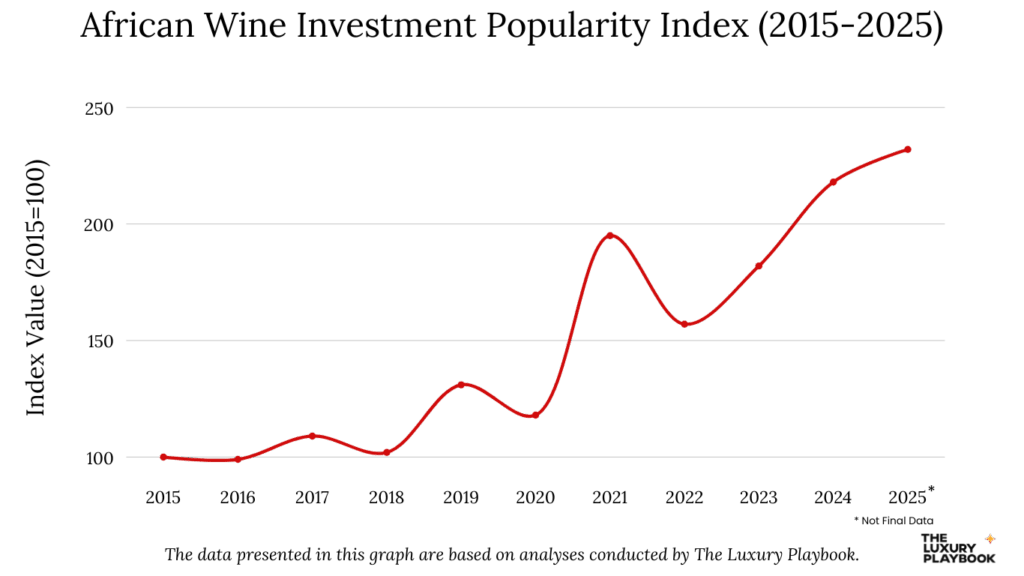
That restaurant presence creates word-of-mouth marketing that money simply can’t buy. Influential wine professionals are championing South African producers to affluent clientele who might, eventually, become serious collectors. But “eventually” is doing a lot of heavy lifting in that sentence. And if you’re thinking about whether estate wines actually outperform as investments, the timeline question matters enormously.

Barriers Holding Back South African Wine Investments
Despite the critical love, South African wine faces real structural barriers that make it tough for investors to generate meaningful returns. Global distribution is still severely limited, with most top South African producers exporting less than 30% of their production, according to Wines of South Africa’s 2026 export data.
That creates an immediate liquidity problem. Wines that can’t be easily bought and sold across major markets struggle to develop the secondary market activity that actually drives investment returns.
Brand recognition gaps compared to established regions add another layer of difficulty. According to Wine Intelligence’s Global Wine Brand Power Index, no South African wine brand ranks in the global top 50 for consumer awareness, while Bordeaux and Champagne dominate recognition metrics almost entirely.
That awareness deficit hits you directly in the pricing power. Even exceptional South African wines struggle to command the premiums that drive investment appreciation in better-established regions.
Currency volatility piles on yet another layer of risk worth taking seriously. The South African rand has depreciated 23% against the dollar over the past five years, according to Reserve Bank of South Africa data through late 2026. That creates real headwinds for international investors even when wine prices appreciate in local currency terms.
Political and economic uncertainties, including ongoing concerns about land reform and infrastructure reliability, create additional risk premiums that sophisticated wine investors have to factor into every allocation decision.
Production scale limitations constrain investment potential further. Most acclaimed South African producers make fewer than 10,000 cases annually, according to industry data compiled by Wine Magazine. Scarcity is something critics love to celebrate, but investors find it genuinely problematic. Limited availability makes it hard to build meaningful positions or achieve portfolio-moving returns even when individual wines perform well.
Price vs Value Challenges for Investors
The pricing dynamics of South African wine present a real paradox. Top South African wines trade at 40 to 60% discounts to qualitatively comparable wines from Burgundy or Barolo, according to Liv-ex market data, which creates an apparent value proposition that’s hard to ignore at first glance. But that pricing reflects market realities rather than temporary inefficiencies. South African wines simply lack the historical track record and collector base needed to support higher valuations, and that’s not something a few great vintages will fix overnight.
Auction market performance tells the real story for investors hunting exit liquidity. South African wines accounted for just 0.3% of total auction lots sold globally, with average lot values of £247 compared to £1,247 for Burgundy and £823 for Bordeaux. And perhaps more telling, many lots failed to meet reserve prices entirely, signaling limited collector demand despite all the critical acclaim. If you want to understand how serious collectors actually use auctions to build and exit positions, this breakdown on wine auction strategy is worth your time.
The domestic market provides some support but insufficient scale for meaningful investment returns. According to South African Wine Industry Statistics 2025, domestic consumption accounts for 67% of total production, but local collectors typically focus on established European regions rather than domestic wines.
That auction reality creates a ceiling on demand that limits price appreciation potential, regardless of how much quality improves or how many glowing reviews get published.
The Risk of Overhyping South Africa’s Potential
The current enthusiasm for South African wine carries some uncomfortable echoes of previous investment bubbles in emerging wine regions that ultimately let investors down badly. The Australian wine boom of the 1990s is the obvious comparison. Critical acclaim and “discovery” narratives drove investment interest that the underlying market simply couldn’t sustain.
According to Wine Business Monthly’s retrospective analysis, Australian wine investments from that era delivered average annual returns of negative 2.3% over the subsequent decade as hype gave way to market reality. That’s not a rounding error. That’s a decade of losses dressed up in glowing tasting notes.
Media narratives around South African wine tend to spotlight quality improvements and critic scores while glossing over the structural market challenges that actually determine investment viability. Wine publications thrive on discovery stories. Their enthusiasm, genuine as it may be, doesn’t automatically translate into the sustained collector demand that investment appreciation requires.
According to an analysis by Wine Investment Analytics, regions that achieve critical acclaim without matching improvements in distribution, brand recognition, and collector base typically see initial price spikes followed by stagnation or outright decline. South Africa is currently sitting squarely in that early spike phase.
The “next big thing” mentality can lead you to overlook the fundamentals that actually drive long-term wine investment success. Historical analysis of wine investment returns shows that sustained appreciation needs more than just quality wine. It requires strong secondary markets, institutional recognition, and demographic tailwinds from a growing collector base. You can see similar dynamics playing out in other alternative asset classes, from collectible art figures to luxury goods, where hype and fundamentals often tell very different stories.
South African wine may eventually develop those supporting factors. But the current evidence suggests the market infrastructure is still years away from the kind of maturity that justifies serious capital allocation.
What Needs to Change Before Investors Commit
For South African wine to become a genuinely viable investment category, several fundamental shifts need to happen well beyond continued quality improvements and critical praise. Distribution network expansion is the most urgent need. Viable wine investments require availability in major global markets including New York, London, Hong Kong, and increasingly mainland China. Right now, South Africa is largely absent from those conversations.
Secondary market development needs sustained collector interest that goes beyond restaurant sommeliers and enthusiastic wine drinkers. You need serious investors willing to pay premium prices for proven performers, and that crowd hasn’t shown up yet in any meaningful numbers.
According to Financial Times wine market reporting, viable wine investment categories require minimum annual auction volumes of around £50 million to provide adequate liquidity. South African wine currently misses that threshold by more than 90%. That’s not a gap you close in a single vintage cycle.
Brand recognition improvements need systematic marketing investment plus time, and there’s no shortcut on the time part. Wine regions typically require 15 to 20 years of consistent quality and marketing to achieve the recognition levels that support investment-grade pricing power, according to brand consulting firm Wine Vision’s analysis.
While South African wine quality has improved dramatically, the brand building process remains in early stages.
Institutional recognition from wine funds, wealth managers, and serious collectors might be the single most critical missing element right now. Until established wine investment advisors start recommending South African allocations to their clients, the region will keep struggling to attract the patient capital required for sustained price appreciation.
Current evidence suggests that institutional adoption is still years away. The quality is there. The infrastructure, the track record, and the money aren’t. And in wine investment, all three matter equally.