Cartier sits in its own register among serious watchmakers. Few brands carry the same combination of design pedigree, genuine watchmaking depth, and cultural recognition that crosses entirely outside the watch-collecting world. The collector conversation in 2026 reads Cartier as essential, in a way it didn't quite a decade ago.
That shift is real and structural. The brand has spent the past five years rebuilding its serious-watchmaking credentials after the long 2000s period when Cartier read primarily as a jewellery maker that also produced watches. Phillips, Christie's and Sotheby's have all responded by giving Cartier increasing page space in their major sales.
The Tank: Cartier's defining reference
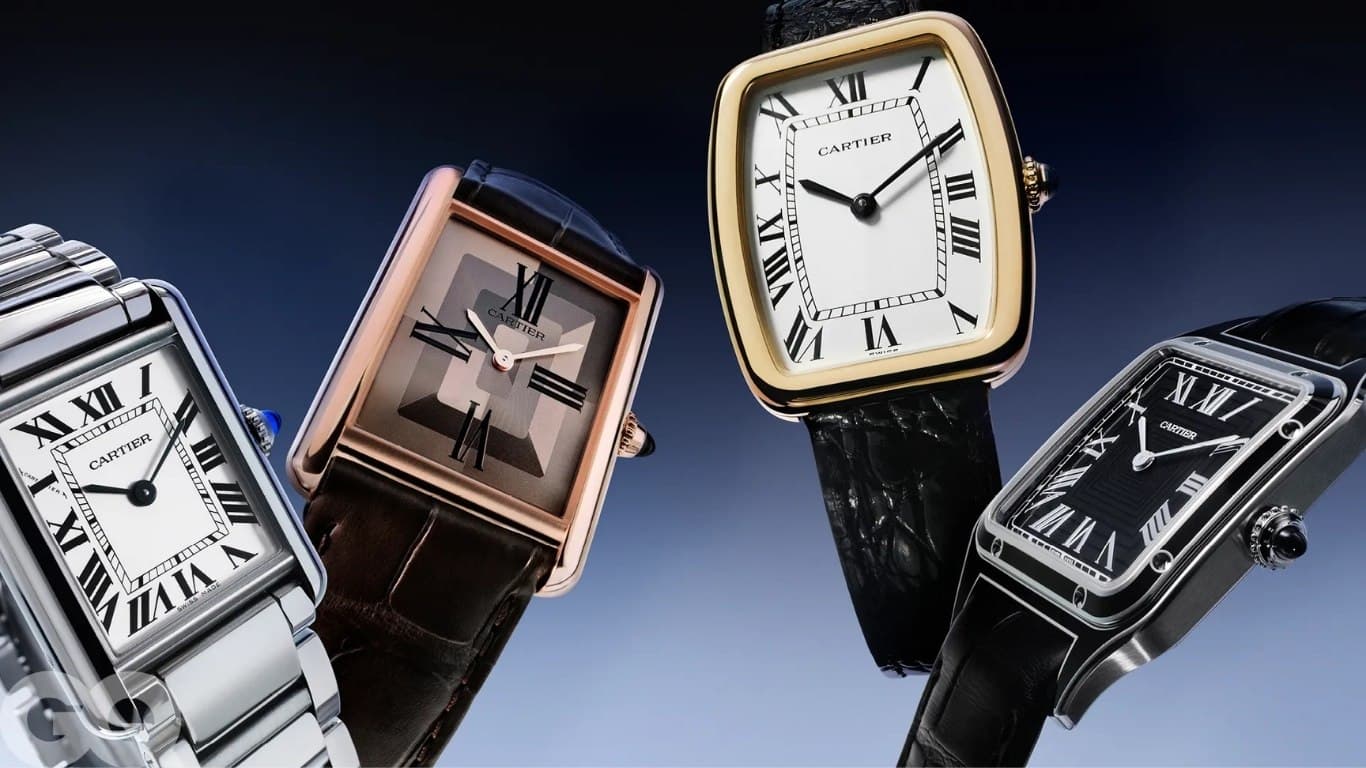
The Tank Louis Cartier is the iteration most collectors cite as the brand's defining watch. Designed in 1917, reportedly inspired by the silhouette of the Renault FT tank from World War I, the geometry has been refined gradually across more than a century without being abandoned. The case proportions, the Roman-numeral dial, the railway-track minute markers, the blued steel hands, the cabochon-crowned winding stem are all elements that have stayed remarkably consistent.
Current production of the Tank Louis Cartier runs around 12,000 to 15,000 euros depending on configuration. Vintage pieces, particularly the 1960s and 1970s manual-wind references with the original Cartier Paris signature, trade meaningfully higher. The Tank Cintrée, the curved-case reference that anchors vintage Cartier collecting, has moved substantially at auction across the past five years.
The broader Tank family extends across registers. The Tank Américaine, the Tank Française, the Tank Asymétrique, and the more accessible quartz Tank Must all carry the underlying design language in different proportions and movements. Each lives in its own corner of the catalogue without diluting the line.
The Santos and the wider catalogue
The Santos predates the Tank by thirteen years. Louis Cartier designed it in 1904 for the Brazilian aviator Alberto Santos-Dumont, making it the first wristwatch designed specifically for actual aviation use. The current Santos de Cartier across the small, medium and large case configurations retails between roughly 7,000 and 11,000 euros in steel, higher in two-tone and gold.
The QuickSwitch bracelet system on the current generation is one of the more thoughtful contemporary Cartier engineering details. The Pasha line, originally designed in 1985, was relaunched in 2020 in a substantially refined form. It has been one of the brand's stronger contemporary collector additions.
The Crash, the warped-case reference originally designed in 1967, has become one of the most-discussed Cartier references in modern collecting. New production examples and vintage originals both trade at meaningful premiums. The provenance story (allegedly inspired by a watch damaged in a car accident) sits alongside Salvador Dalí's melting clocks as a candidate explanation, depending on who you ask.
The vintage Cartier market in 2026
Vintage Cartier has become one of the more interesting niches in modern watch collecting. The 1960s and 1970s pieces from Cartier Paris, Cartier London, and the early Must de Cartier era command serious collector attention. Auction results across the past five years have moved many of these references substantially, and Phillips's dedicated specialist Cartier sales have done much of the work consolidating the category.
The vintage market discipline is reference-specific and condition-sensitive in the manner of vintage Swiss watchmaking generally. Original case (no aggressive polishing of the geometric edges that define the design), original dial (no service replacement), credible service history, and full set documentation where available all carry weight.
The Phillips Geneva and Christie's Hong Kong sales handle the upper end; the credible specialist dealers (A Collected Man's Cartier section, the established London and Paris specialists) handle the broader vintage market.
The contemporary watchmaking case
The case Cartier has been building over the past five years is that the brand is a serious modern watchmaker, not just a jewellery house with a watch operation. The in-house calibres (1904 MC, 9603 MC) in the upper end of the catalogue, the Privé collection, and the increased visibility of the Geneva atelier all speak to this case. The Privé collection in particular has been the brand's signal that contemporary Cartier means something different than the broader marketing-led catalogue.
Small production numbers, technically interesting movements, and design execution that respects the brand's geometric heritage are what the Privé pieces are about. The Tonneau, the Crash CPCP, and the various complicated Tank references that the Privé operation has produced are where the most considered contemporary Cartier collecting actually happens. Hodinkee, Apartamento and the broader design-led trade publications have all picked up the shift.
What collectors look for in modern Cartier
For modern Cartier, the references that come up most consistently in serious collector conversation are the Tank Louis Cartier in the larger 33mm and 38mm sizes, the Santos de Cartier in steel, the Crash limited and standard production references, the various Privé pieces, and the contemporary Pasha. For vintage, the Tank Cintrée, the Crash original references, the Maxi Oval, and the various Cartier London and Cartier Paris pieces from the 1960s and 1970s anchor serious vintage collecting.
The longer story collectors are watching is whether Cartier maintains the contemporary watchmaking discipline that has, across the past five years, rebuilt the brand's serious-watchmaking credibility. The Privé collection has been the strongest evidence of that discipline; the broader catalogue has been steadily refined around the Tank, Santos and Pasha cores.
So far, on the evidence of how Phillips, Christie's and the major specialist dealers are giving Cartier increasing serious attention, the discipline looks structural rather than momentary.
We last reviewed this analysis in May 2026.
Frequently Asked Questions
- Do Cartier watches hold their value?
- Yes, Cartier watches generally hold their value well over time. Their iconic designs, premium materials, and strong brand reputation contribute to solid resale value. Factors like model rarity, demand, and condition also play a key role. Vintage and limited-edition Cartiers, in particular, can even appreciate in value, making them a smart choice for long-term investment.<br /><br />
- Why should I buy a Cartier watch?
- A Cartier watch is more than just a timepiece—it's a symbol of timeless luxury, crafted with precision and elegance since 1847. Owning one means wearing a piece of history, favored by royalty and tastemakers alike. Plus, Cartier watches are known for holding their value, and in some cases, appreciating over time. It's a stylish investment that combines prestige with lasting quality.

Stefanos Moschopoulos
Stefanos Moschopoulos founded The Luxury Playbook in Athens and has spent the better part of a decade following the auction calendar, the en primeur releases, and the watchmakers, gallerists, and shipyards the magazine covers. He writes the field guides and listicles that anchor the Connoisseur section — pieces built on Phillips and Christie's results, Liv-ex movements, and conversations with collectors he has met across Geneva, Bordeaux, Basel, and Monaco. His own collecting habits sit closer to watches and wine than art, and it shows in the level of detail in the magazine's coverage of those categories. Under his direction, The Luxury Playbook now publishes long-form field guides, market-defining year-end listicles, and the Voices interview series with the founders behind the houses and the brands.