The Tissot Gentleman punches above its price because it lands a combination of technical specifications and design discipline that no other accessible-tier Swiss watch at its price point reliably matches. The 40mm steel case, the modified ETA caliber with the 80-hour Powermatic 80 power reserve, the silicon balance spring (uncommon at this tier), and the design language that respects classical Swiss dress-watch conventions all read as a coherent package at the $725 to $850 retail range.
- The Tissot Gentleman Powermatic 80 Silicium punches well above its price point, with silicon balance spring engineering and dial finishing that competes with much pricier alternatives.
- The Powermatic 80 calibre delivers eighty hours of power reserve and chronometer-grade accuracy at price points no other Swiss brand reliably matches.
- Bracelet integration and dial design on the Gentleman remain among the strongest in the accessible-Swiss tier, with details that reward close inspection.
- We see the Gentleman as the most reasonable single Tissot purchase, with everyday wearability and serious watchmaking aligned at a price point that respects new collectors.
- Service infrastructure and parts availability favour Tissot meaningfully, with Swatch Group support sustaining decades of ownership at sensible cost.
- The Gentleman's case proportions and dial colour catalogue give the reference broad wrist appeal, with versatility that supports both dress and casual wear.
- Who is this for?
- New collectors building a first shelf, gift buyers, and established collectors exploring accessible Swiss watchmaking for daily-wear options.
- What is happening?
- A grounded case for the Tissot Gentleman Powermatic 80 Silicium, covering the calibre engineering, the finishing standards, and the accessible-luxury value proposition.
- When did this emerge?
- The current case reflects 2026 manufacturer programmes, with Powermatic 80 Silicium rollouts continuing to reshape the accessible-Swiss landscape.
- Where is this happening?
- Authorised Tissot dealers globally stock the Gentleman, with pre-owned options widely available through Chrono24 and dedicated specialists.
- Why does it matter?
- The Gentleman delivers serious mechanical watchmaking at accessible price points, which makes the reference the strongest single option for collectors building entry-tier depth.
Few accessible-tier Swiss watches combine these credentials with execution that doesn't read as dated three years post-purchase. The Gentleman remains one of the most considered accessible watches at its price point, and it earns its place at the entry tier of credible Swiss mechanical collecting on grounds the broader category mostly doesn't reach.
Why the Tissot Gentleman punches above its price
Three things converge. The modified Powermatic 80 caliber delivers an 80-hour power reserve, which is substantially better than the 38 to 42 hours most accessible Swiss mechanicals offer. A buyer who rotates through multiple watches doesn't need to reset the Gentleman every weekend, and that practical detail compounds across years of ownership.
The silicon balance spring is the technical headline at this tier. Silicon is antimagnetic and resistant to temperature variation in ways traditional metal balance springs aren't. The inclusion at this price point is the kind of trickle-down technical detail that Swatch Group's industrial scale enables. Most accessible Swiss watches at the price band use traditional Nivarox metal hairsprings; the Gentleman's silicon spring is a meaningful upgrade.
The design discipline carries the third pillar. The Gentleman's case-and-dial geometry reads as classical without being derivative; the proportions hold up well across years rather than reading as dated. The 40mm case sits well across most wrists, and the 11mm case thickness reads slimmer than most accessible-tier mechanical references manage.
The Gentleman in detail
The current Gentleman Powermatic 80 references span steel, two-tone, and various dial configurations including the standard silver, blue, black, and the various sunburst variants. The Powermatic 80 caliber, a modified ETA C07.111 with the extended power reserve, provides the 80 hours of running time on a full wind that the line is built around.
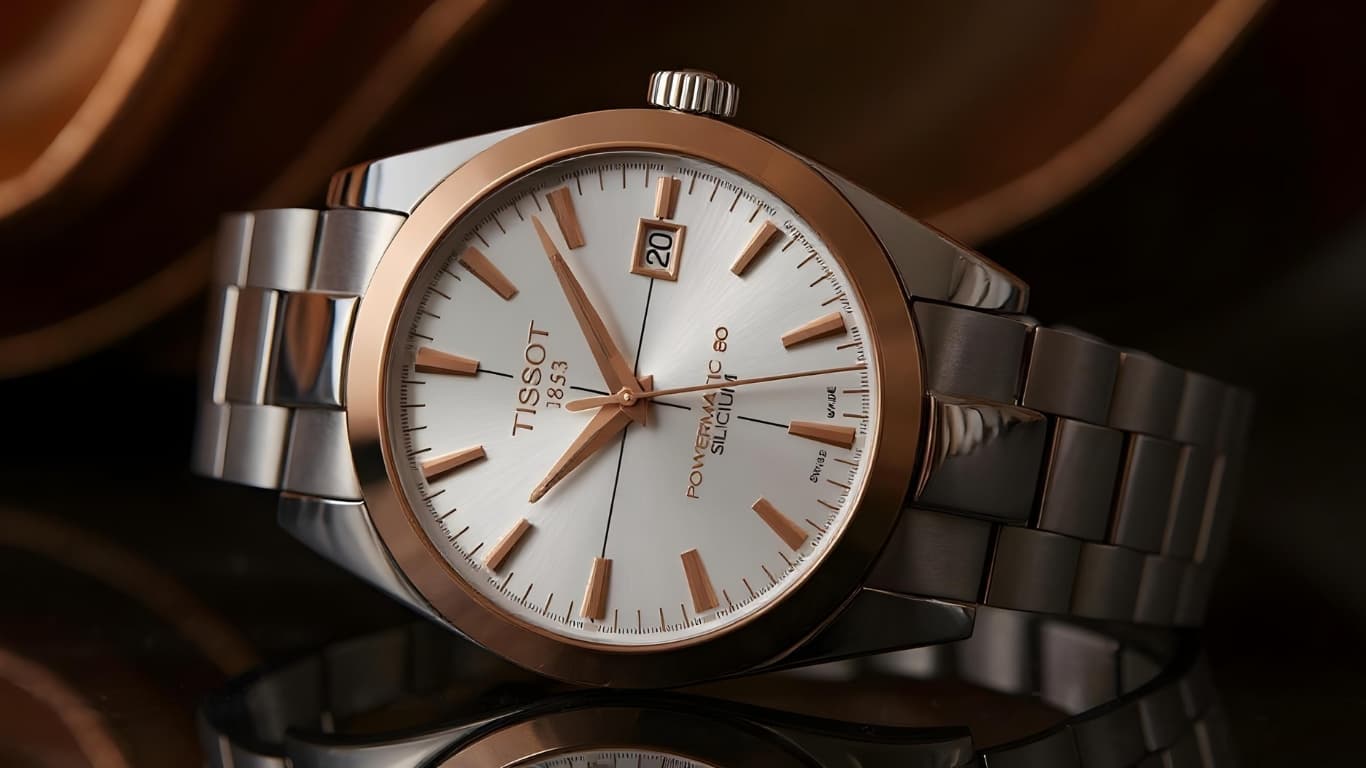
The bracelet construction is the brand's strongest accessible-tier work. The bracelet end-links integrate cleanly with the case; the clasp is the hidden-deployant style that sits flush against the wrist. The construction quality at the bracelet level reads closer to the upper accessible tier than to the entry, which is part of why the Gentleman trades meaningfully better than its retail position suggests.
The dial geometry, with the applied baton or stick indices, the dauphine hands, and the cleanly proportioned date window at three, is the most considered contemporary expression of classical Swiss dress-watch design language at the accessible price point. The execution doesn't reach for stylistic gimmicks, which matters at a price band where the broader category mostly does.
The silicon spring and what it changes
The silicon balance spring matters more than buyers at this price point usually appreciate. Traditional metal Nivarox hairsprings are sensitive to magnetic fields. Daily exposure to phones, tablets, laptops, and the broader electromagnetic environment of contemporary life slowly compromises timekeeping accuracy on traditional mechanical watches in ways that require periodic service intervention.
Silicon is genuinely antimagnetic. The hairspring isn't affected by the typical magnetic exposures contemporary watches encounter, and the timekeeping consistency holds up substantially better across years of ownership. The detail trickles down from Swatch Group's upper-tier industrial production (where Omega's Co-Axial calibres have used silicon for years) into the accessible Tissot line, and it changes the practical ownership case meaningfully.
The 80-hour power reserve in practice
The extended power reserve is one of the more useful contemporary improvements to entry-tier Swiss mechanical execution. The standard ETA 2824 family, which anchored the broader accessible-tier Swiss category for decades, runs around 38 to 42 hours on a full wind. The Powermatic 80 caliber's 80-hour reserve means the watch sits ready to wear after a weekend off the wrist without resetting.
The detail matters most for collectors with multiple watches in rotation. The Gentleman handles a Monday-to-Friday rotation off the wrist (Saturday morning to Monday morning) without needing to be wound, which is a practical comfort the standard accessible-tier mechanical category doesn't really offer.
What collectors look for in a Tissot Gentleman
For modern Gentleman, the references that come up most consistently in serious accessible-tier collector conversation are the steel reference with the silver, blue, or black dial in the 40mm case, the two-tone references for collectors drawn to the dressier register, and the various special editions. Box-and-papers documentation matters less at this price point than at upper tiers but still affects modest resale value.
The Tissot authorised dealer network handles the Gentleman as part of the broader Powermatic 80 line. The brand's service network is reliable and well-understood; service intervals run on the standard mechanical-watch cadence, and the Powermatic 80 caliber is well-supported by the Tissot service infrastructure.
The Gentleman's place in a serious collection isn't as a cornerstone reference; at this price point, no single watch is. It earns its place as the credible accessible-tier mechanical that demonstrates Swiss watchmaking discipline at the price band. Collectors who eventually move into Tudor and Omega tiers above often retain a Gentleman in the rotation; the watch wears well in registers a more aggressive sport reference doesn't suit.
Where the Gentleman fits in a serious rotation
The Gentleman is the right watch for the dress-shirt register most working professional collectors actually wear regularly. It fits under a cuff cleanly, it reads classical without trying too hard, and it doesn't ask for the kind of attention an upper-tier reference would draw. That role matters in a serious collection, and the Gentleman fills it more reliably than most accessible-tier alternatives.
The cross-shopping context: against the Hamilton Jazzmaster, the Mido Multifort, the Longines Master Collection (at a meaningfully higher price point), and the various accessible-tier Frederique Constant references, the Gentleman holds its position cleanly. The 80-hour reserve and the silicon balance spring give it technical credentials the immediate accessible-tier alternatives don't reliably match.
What this means for collectors
The Gentleman is one of the few accessible-tier Swiss references where the technical specifications, the design execution, and the price point all align coherently. The brand's marketing-led upper-tier references tend to underperform in serious collector conversation; the Gentleman, anchored by genuine technical and design discipline at its actual price, earns the consideration it gets.
We'd argue the Gentleman is the most under-appreciated accessible-tier Swiss reference in contemporary production. Read clearly, the watch executes a specific brief unusually well, and the buyers who acquire one with eyes open about what it is tend to wear it more heavily than they expected. That practical case is what the line continues to be built around, and it is the case that holds up most reliably across years of ownership.
We last reviewed this analysis in May 2026.

Frequently Asked Questions
- Does the Tissot Gentleman hold its value over time?
- Yes, the Tissot Gentleman retains value better than most watches in its price category. Core models typically hold 85–90% of their retail price within the first 12–24 months, especially when sold with original box and papers.<br><br>
- Is the Tissot Gentleman considered a luxury watch?
- It sits in the accessible Swiss segment. It is not a luxury status piece in the way Rolex or Omega is, but it offers authentic Swiss manufacturing and strong technical value for the money.<br>
- How does the Tissot Gentleman compare to entry-level Rolex or Omega models?
- The Tissot Gentleman offers exceptional value for money, but it does not appreciate like Rolex or Omega. However, for under $1,000, it offers better finishing, movement, and value retention than most similarly priced quartz or fashion watches.<br><br>
- Which version has the best value retention in 2026?
- Powermatic 80 references with distinctive dials tend to perform best. Ice Blue and well liked Open Heart configurations usually attract more interest than standard colors.

Stefanos Moschopoulos
Stefanos Moschopoulos founded The Luxury Playbook in Athens and has spent the better part of a decade following the auction calendar, the en primeur releases, and the watchmakers, gallerists, and shipyards the magazine covers. He writes the field guides and listicles that anchor the Connoisseur section — pieces built on Phillips and Christie's results, Liv-ex movements, and conversations with collectors he has met across Geneva, Bordeaux, Basel, and Monaco. His own collecting habits sit closer to watches and wine than art, and it shows in the level of detail in the magazine's coverage of those categories. Under his direction, The Luxury Playbook now publishes long-form field guides, market-defining year-end listicles, and the Voices interview series with the founders behind the houses and the brands.