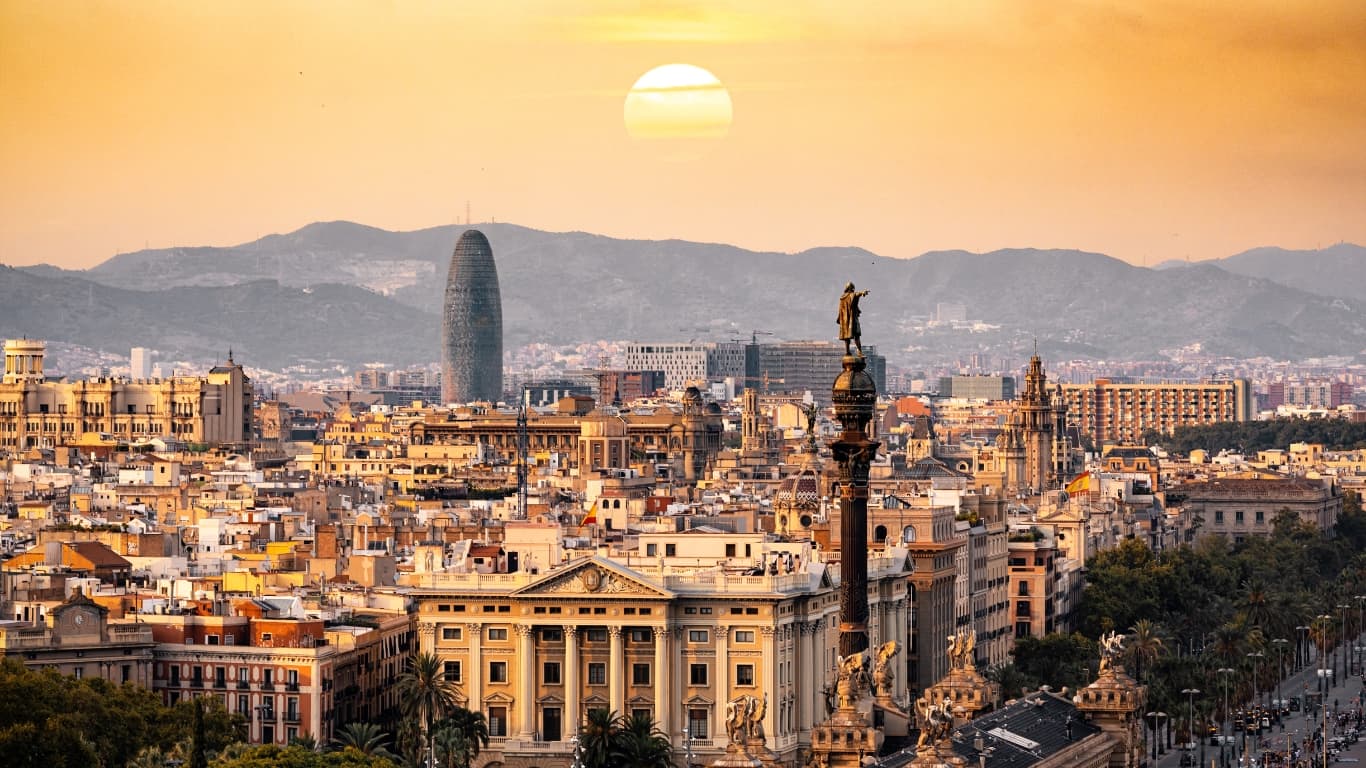
The Barcelona property market in 2026 is one of the most internally varied prime conversations in Europe. The city's Eixample modernista grid still anchors the prime tier, but Sarrià-Sant Gervasi, Diagonal Mar and the Poblenou tech corridor have each carved out their own buyer demographics. Average residential pricing across the city now sits near EUR 4,380 per square metre, with prime central addresses well above EUR 7,000 per square metre.
Knight Frank's Wealth Report and Prime Index place Barcelona among the southern European cities that international buyers consult first when relocating from Paris, Geneva or London. Engel & Völkers Barcelona, Lucas Fox and JLL Iberia all support that picture.
We track Barcelona as the most architecturally distinctive prime market in Spain. The Cerdà nineteenth-century chamfered-block plan, the Gaudí canon and the contemporary Diagonal Mar developments together give the city an architectural depth that few European capitals can match at comparable pricing.
- Barcelona property continues to attract sustained international interest, with Pedralbes, Eixample and Sarria-Sant Gervasi anchoring the upper end of the local prime segment.
- We see INE and Idealista data confirming continued residential appreciation through 2025 and 2026, although Catalan regulatory pressures have moderated the trajectory versus Madrid.
- Knight Frank Spain and Savills Spain reports continue to place Barcelona at the prime tier of European secondary capitals, with deep international buyer interest.
- Catalan rental price controls and short-term licensing restrictions have meaningfully affected yield calculations for buy-to-let investors in central Barcelona.
- The Beckham Law remains accessible for qualifying international professionals, with Barcelona attracting steady relocation flows from the technology and creative sectors.
- For most considered Spanish buyers we view Barcelona as offering distinctive cultural and lifestyle appeal, with the regulatory landscape requiring explicit consideration before commitment.
- Who is this for?
- International and Spanish buyers evaluating Barcelona property acquisition, alongside the advisers, brokers and family office staff framing those decisions.
- What is happening?
- A market read of Barcelona property in 2026, covering Pedralbes, Eixample, Sarria-Sant Gervasi, Catalan rental controls and the Beckham Law dynamic.
- When did this emerge?
- The article reflects 2026 market conditions through INE, Idealista, Knight Frank Spain and Savills Spain data alongside our observations.
- Where is this happening?
- The piece focuses on Barcelona, including Pedralbes, Eixample and Sarria-Sant Gervasi.
- Why does it matter?
- Barcelona combines genuine appeal with distinctive regulatory complexity, which is why understanding the framework matters before any acquisition conversation.
The Barcelona market today
Three structural forces define the picture in 2026. New-build supply is scarce, with strict heritage protections, complex permitting and high construction costs keeping the development pipeline thin (new construction is under 20 percent of total listings).
The Catalan rent-control framework caps long-term rental price increases in designated high-demand zones. Most central Barcelona is included, which has reshaped how residential properties are held.
The Spanish Golden Visa property pathway ended in April 2025. The Barcelona prime market has continued to attract international buyers despite the end of the residency-by-investment route.
- Citywide average around EUR 4,380 per square metre
- Prime central zones EUR 6,500 to EUR 7,500 per square metre
- Affordable corridors EUR 2,700 to EUR 3,200 per square metre
- New construction under 20 percent of total listings
Neighbourhoods defining Barcelona in 2026
Eixample
Eixample is the city's flagship prime district. The Cerdà chamfered blocks, the Quadrat d'Or stretch with its Gaudí, Domènech i Montaner and Puig i Cadafalch buildings, and the proximity to Passeig de Gràcia together produce one of the most architecturally consistent prime residential offers in southern Europe. Average prices run EUR 6,800 to EUR 7,500 per square metre, with restored apartments on Passeig de Gràcia and Rambla de Catalunya routinely above EUR 9,000.
Sarrià-Sant Gervasi
The upper-class residential district above the Diagonal (Putxet, Bonanova, Pedralbes) combines green space, international schools and detached or semi-detached residences. Prices average EUR 6,200 to EUR 7,000 per square metre, with detached houses and penthouses regularly exceeding EUR 1.5 million.
Gràcia
Gràcia retains the village quality that has made it Barcelona's most distinctive bohemian-residential district. Average pricing runs EUR 5,200 to EUR 6,200 per square metre, with the strongest activity on the upper-Gràcia streets and around Plaça del Sol.
Sant Martí (Diagonal Mar and Poblenou)
The 22@ Poblenou tech corridor and the Diagonal Mar contemporary towers produce the city's most modern residential face. Jean Nouvel's Torre Glòries, the Diagonal Mar towers and the Roger Stirk Harbour-led waterfront masterplans anchor the contemporary tier. Prices typically run EUR 5,500 to EUR 6,500 per square metre, with seafront luxury units above EUR 8,000.
Nou Barris
Nou Barris in the city's northeast remains the most accessible district. Prices stay between EUR 2,700 and EUR 3,200 per square metre, with two- and three-bedroom apartments delivering the strongest tenant turnover.
The Barcelona rental landscape
The rental market is structurally undersupplied and increasingly segmented by regulation. The Catalan rent-control framework caps annual increases on long-term leases in designated high-demand zones, and most central Barcelona is included.
One-bedroom apartments rent between EUR 950 and EUR 1,300 per month, two-bedrooms between EUR 1,300 and EUR 1,900, three-bedrooms between EUR 1,800 and EUR 2,600. Luxury units in Eixample and Diagonal Mar exceed EUR 3,500.
The short-term tourist rental regime is among the tightest in Europe. License freezes are in place across central districts, with active municipal enforcement against unlicensed listings. Bloomberg and the FT have covered the regulatory shift in detail.
The architectural and cultural register
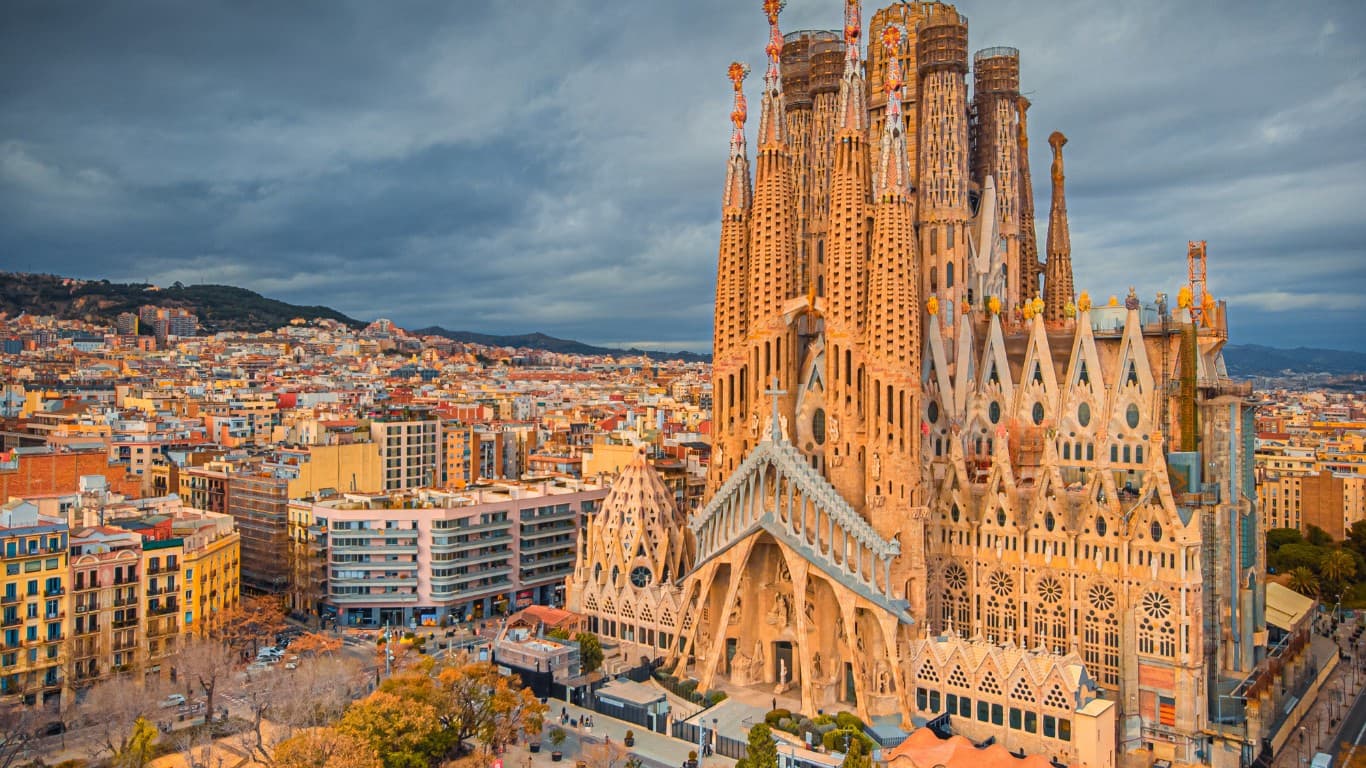
The Eixample chamfered blocks (Ildefons Cerdà's nineteenth-century plan) have been studied by urbanists for 150 years. The Gaudí buildings (Casa Batlló, La Pedrera, the still-completing Sagrada Família) sit on the same boulevards.
The 1992 Olympics rebuilt the Mediterranean waterfront. Frank Gehry's 1992 fish at the foot of Port Olímpic set the tone for the contemporary additions in Diagonal Mar that followed. The MACBA (Richard Meier), the CCCB and the contemporary commissions around 22@ Poblenou anchor the cultural register.
Mansion Global, Christie's International Real Estate and Engel & Völkers Barcelona all describe a market where the architectural register matters more to the buyer than headline pricing. Lucas Fox has reported off-market activity above EUR 5 million across Sarrià-Sant Gervasi and Eixample.
How Barcelona compares with European prime markets
Barcelona prime at EUR 7,500 per square metre sits below Madrid prime (now above EUR 8,500 per square metre at the central tier) and well below Mayfair (around GBP 30,000 to GBP 40,000 per square metre). Savills's World Cities Prime tracker puts Monaco near EUR 55,000 per square metre, far above Barcelona at every tier.
Dubai Marina prime trades near AED 22,000 per square metre (around EUR 5,500), broadly in line with Barcelona's mid-prime band. The comparison readers find more useful is Barcelona against Lisbon (EUR 6,500 to EUR 8,000 per square metre) and Athens (EUR 5,500 to EUR 7,500 per square metre).
The Greek Golden Visa programme (EUR 250,000 in qualifying regions, EUR 800,000 in central Athens, Thessaloniki, Mykonos and Santorini from August 2024) sits in a different category. Barcelona is now an architectural-heritage play, no longer a residency-by-investment pathway.
What we expect through year-end 2026
Property prices are projected to rise 2. 5 to 4. 0 percent through 2026.
Core areas (Eixample, Sarrià-Sant Gervasi, Gràcia) are expected to grow steadily, with restored, energy-efficient stock pushing the upper end of the band.
Peripheral districts (Nou Barris, Sant Andreu, Horta-Guinardó) are projected to track 4. 0 to 5. 5 percent as buyers priced out of the centre move outward.
Rental prices are projected to grow 2. 0 to 3. 5 percent, moderated by the rent-control framework but supported by tight supply.
The Catalan rent-control framework has stabilised tenant occupancy and pushed the rental segment toward longer, professionally managed leases.
What this means for buyers
Barcelona rewards the buyer drawn to Mediterranean urbanism, the architectural coherence of Cerdà's modernista grid and one of the deepest cultural calendars in southern Europe. The neighbourhoods responding most distinctly to the design-led international shift (Eixample's restored modernista stock, the Diagonal Mar contemporary towers, the upper Sarrià-Sant Gervasi residences) are quietly outperforming the citywide averages.
The end of the Golden Visa removes the residency-pathway sweetener but leaves the architectural and lifestyle cases intact. The rent-control framework changes the economics of buy-to-let strategies, but it also reinforces the long-term-occupancy stability that primary-residence buyers value.
We last reviewed this analysis in May 2026.
Frequently asked
What is the average residential price in Barcelona in 2026?
The citywide average sits near EUR 4,380 per square metre. Prime central districts exceed EUR 7,000.
Can international buyers purchase property in Barcelona?
Yes. There are no restrictions on Spanish property ownership for non-residents. The Golden Visa property-based residency pathway ended in April 2025, but ownership itself remains open.
Which neighbourhoods are seeing the most buyer attention?
Eixample, Sarrià-Sant Gervasi, Gràcia and the Sant Martí (Diagonal Mar / Poblenou) corridor draw the most consistent demand from buyers tracking architectural depth and proximity to the cultural and technology corridors.
Are short-term rentals permitted?
Only with a valid municipal license, and the central districts are largely under license-freeze conditions. Most landlords now operate long-term leases.
Are rent caps in effect?
Yes. The Catalan housing law caps annual rent increases on long-term leases in designated high-demand zones. Most central Barcelona is included.


Savvas Agathangelou
Savvas Agathangelou co-founded The Luxury Playbook and has spent years reporting from the prime postcodes the magazine covers — Mayfair, Knightsbridge, the Athens Riviera, Dubai's Palm crescents, and the southern Mediterranean coastlines where the world's wealthy keep coming back. His background is in international hospitality, and that frame shapes how he writes about property: the developer's choices, the architect's signature, the agency's bench of named brokers, the building's service standard once the buyer moves in. He files developer spotlights, agency profiles, and the seasonal "Properties That Defined" listicles, and he hosts the magazine's founder-and-leadership interviews on the Voices side.