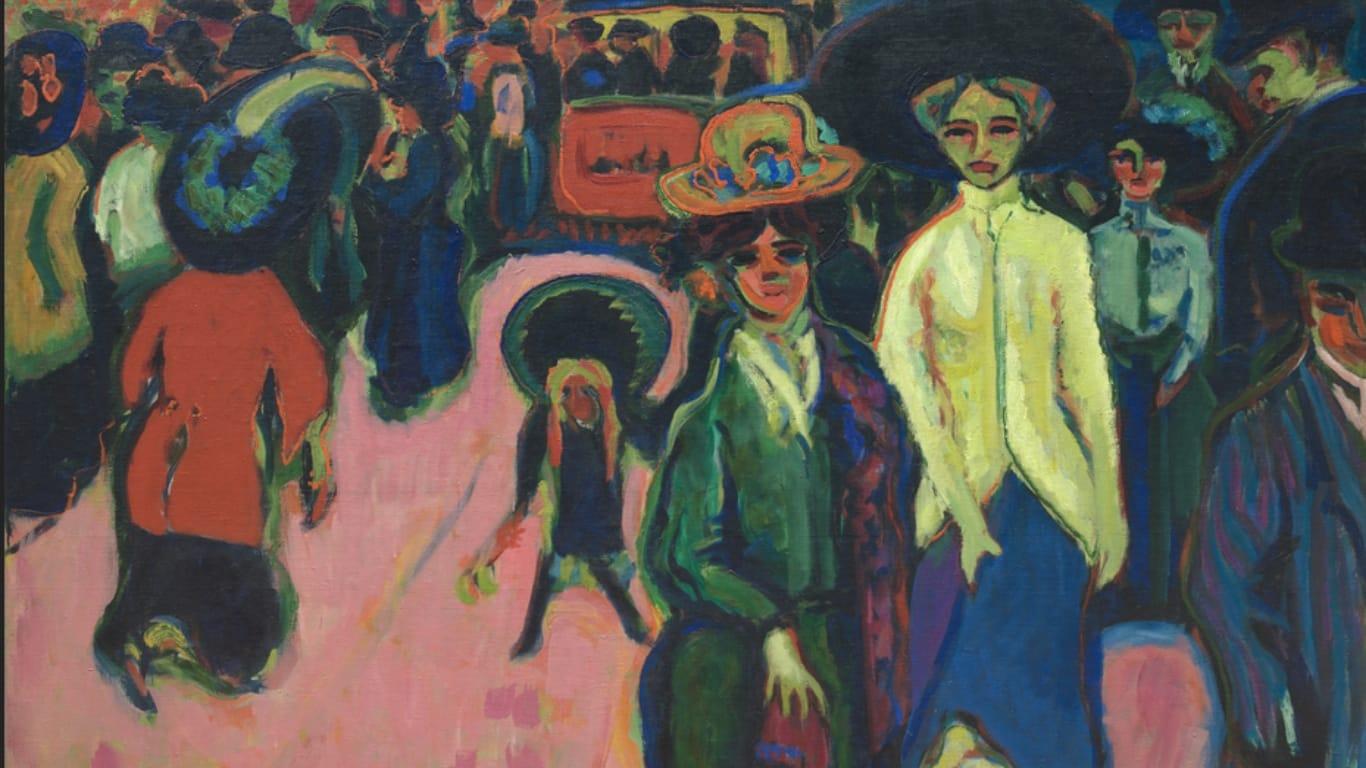
Expressionism is one of the most consequential European movements of the twentieth century and one of the most consistently undervalued at auction relative to its institutional standing. The movement runs from roughly 1905 through the late 1930s, anchored in two German groups (Die Brücke in Dresden, founded 1905; Der Blaue Reiter in Munich, founded 1911) and extending through the Weimar Republic period into Neue Sachlichkeit and the broader figurative tradition that ran in parallel.
The market for Expressionism is thinner at the top than its institutional position would suggest, and that gap is part of what makes the segment interesting in 2026. For collectors approaching the category, the work itself sits across some of the deepest institutional collections in Europe, but the salesroom has historically priced it at meaningful discounts to comparable Cubist, Surrealist, or French modern material.
- Expressionism emerged in Germany in the early twentieth century and became one of the defining movements of European modernism alongside Cubism and Fauvism.
- Die Brucke, founded in Dresden in 1905, anchored the first wave around Ernst Ludwig Kirchner, Erich Heckel and Karl Schmidt-Rottluff.
- Der Blaue Reiter, founded in Munich in 1911 around Wassily Kandinsky, Franz Marc and August Macke, represented the second major Expressionist group.
- Austrian Expressionism, anchored by Egon Schiele and Oskar Kokoschka, sits alongside the German movement and forms part of the same broader collecting market.
- Top-tier Expressionist work appears regularly in major Impressionist and Modern sales and continues to draw serious institutional and private demand.
- For modern collectors, Expressionism is a coherent early-twentieth-century chapter whose canonical work rewards focused engagement with German and Austrian art history.
- Who is this for?
- Modern art collectors, family offices and advisors building positions in early-twentieth-century European painting, alongside curators of the German and Austrian Expressionist canon.
- What is happening?
- A collector field guide to Expressionism, covering Die Brucke, Der Blaue Reiter, Austrian Expressionism, canonical artists and the realistic auction supply environment.
- When did this emerge?
- Most active around the May and November Impressionist and Modern sales at Christie’s and Sotheby’s, with particular weight given to major German and Austrian Expressionist loan exhibitions.
- Where is this happening?
- Centred on the German and Austrian markets historically, with auction activity concentrated in London, New York and Berlin and institutional holdings at the Neue Nationalgalerie and the Leopold Museum.
- Why does it matter?
- Expressionism is a coherent early-modernist chapter, and a clear field guide helps collectors engage with the movement’s distinct national traditions, scholarship and market structure with proper discipline.
The shape of the Expressionist canon
Die Brücke anchors the first phase. The core cohort: Ernst Ludwig Kirchner (the dominant figure), Erich Heckel, Karl Schmidt-Rottluff, Emil Nolde, Max Pechstein, and Otto Mueller. The group worked in Dresden from 1905, moved to Berlin around 1910-1911, and dissolved in 1913.
Their painting (heavy palette, distorted figures, expressive brushwork) and their work in printmaking (woodcuts especially) define the foundational Brücke output.
Der Blaue Reiter, founded in Munich in 1911 by Wassily Kandinsky and Franz Marc, ran a different conceptual line. Kandinsky moved toward abstraction; Marc's animal paintings and his correspondence with Kandinsky shaped the group's theoretical position. August Macke and Gabriele Münter were core members; Paul Klee was loosely affiliated.
The Weimar period extends Expressionist concerns into the Neue Sachlichkeit (New Objectivity) tradition. Max Beckmann is the towering figure of this phase, with George Grosz, Otto Dix, Christian Schad, and Rudolf Schlichter producing major work through the 1920s and into the 1930s before the Nazi rise to power dispersed or destroyed much of the production environment.
How the Expressionist market actually trades
Expressionist works appear at the Impressionist and Modern evening sales at Christie's, Sotheby's, and Phillips. The German specialist houses (Ketterer Kunst in Munich and Berlin, Lempertz in Cologne, Grisebach in Berlin) also handle significant Expressionist material at their own evening sales, with the strongest works moving between the German specialist auction calendar and the major-house international sales.
Kirchner is the most active Expressionist auction market. His strongest Brücke and early Berlin period works (1910-1914) have made into the high seven and low eight figures consistently over the past two decades. "Berliner Straßenszene" (1913) made $38.1 million at Christie's New York in November 2006; subsequent strong Kirchner lots have priced in similar territory.
Beckmann commands the strongest Weimar-period market. His major triptychs are largely in museum collections, but the strong figurative works from the 1920s have priced into the high seven and eight figures at major-house evening sale. The Beckmann market is among the deeper single-artist segments inside the broader German modern conversation.
Nolde, Heckel, Schmidt-Rottluff, and Pechstein at the top tier price in the high six and low seven figures for strong canvases. The Blaue Reiter cohort (Kandinsky, Marc, Macke, Münter, Klee) has been more cycle-sensitive, with the strongest Kandinsky and Marc works pricing into the high seven and eight figures.
The institutional record that supports the market
The institutional position of Expressionism in Germany is exceptional. The Brücke Museum in Berlin holds the deepest dedicated Brücke collection. The Lenbachhaus in Munich holds the foundational Blaue Reiter material.
The Kunstpalast in Düsseldorf, the Folkwang in Essen, the Sprengel in Hannover, the Hamburger Kunsthalle, and the Berlinische Galerie all hold significant Expressionist collections.
Internationally, the Pompidou, MoMA, Tate, the Met, the National Gallery in Washington, and the Stedelijk all hold canonical Expressionist material. The Albertina in Vienna holds extensive Expressionist works on paper. The Neue Galerie in New York, founded by Ronald Lauder, is the single most consequential American institution for the segment.
Major retrospectives have continued through the past two decades. The Kirchner retrospectives at the Brücke Museum and the Royal Academy. The Beckmann retrospectives at MoMA (2003), the Pompidou, and the Städel.
The Nolde retrospectives in Berlin and Frankfurt. The continued Kandinsky and Marc programmes at the Lenbachhaus and the Pompidou.
The collectors building serious Expressionist depth
The serious Expressionist collector base is anchored in Germany, Switzerland, and the broader German-speaking diaspora. American collectors are present but have historically been less dominant in the segment than in Cubist or Surrealist markets. Ronald Lauder's Neue Galerie has been a defining institutional collector through the past three decades.
The named senior collector tier has built unusually deep tightly held secondary market positions in the segment. Many of the leading German Expressionist collections were assembled in the postwar period through the 1980s, when prices were modest and the institutional record was already deep. These collections have remained largely intact, with limited rotation back to the market.
That tightness on the supply side is part of what supports prices at the top, and it is why the German specialist auction houses (Ketterer, Grisebach, Lempertz) often handle the most consequential Expressionist sales of the year. The German collector base prefers to transact with houses that share its specialist depth.
Provenance, restitution, and the documentation framework
Expressionism carries unusually heavy provenance research requirements. The Nazi Entartete Kunst ("Degenerate Art") campaign of 1937 confiscated thousands of Expressionist works from German museums and private collections. The subsequent dispersal of those works through the 1937-1945 period created a provenance pattern that requires careful research for any pre-war Expressionist lot.
The standard restitution research framework applies: the Art Loss Register, the Commission for Looted Art in Europe, the German Lost Art Foundation database (Deutsches Zentrum Kulturgutverluste), and the relevant national restitution archives. The major-house specialists and the German specialist houses all maintain dedicated restitution research capacity.
The Beckmann market has been particularly affected by restitution work. Several major Beckmann pieces have moved through restitution processes over the past two decades, and the provenance documentation for any pre-war Beckmann is part of standard due diligence.
What distinguishes serious Expressionist collecting
The serious Expressionist collector engages with the catalogue raisonné scholarship and the German-language academic literature. The Kirchner catalogue raisonné (managed by the Kirchner Foundation in Davos) is the foundational reference. The Beckmann catalogue raisonné, the Nolde Stiftung Seebüll archive, and the various Blaue Reiter resources provide additional depth.
Condition and conservation matter. Many Expressionist works used experimental pigment combinations that have not aged uniformly. Some Brücke period paintings have particular fragility issues.
The major-house conservation departments and the German museum conservation networks handle most of the meaningful work.
The works-on-paper and prints markets are particularly active in Expressionism. Brücke and Blaue Reiter artists produced extensive woodcut, lithograph, and etching work; the print market offers serious entry below the painting tier and is one of the more accessible parts of the broader German modern urban experience conversation.
What this means for collectors
Expressionism is a deep institutional category with a tightly held secondary market. The German specialist auction houses and the major-house Impressionist and Modern departments cover the segment. The institutional record is exceptional.
The collector base is committed and stable.
For collectors approaching the category, the practical starting points are works on paper and prints, plus the broader secondary-tier names (Heckel, Schmidt-Rottluff, Pechstein, Mueller) before committing to top-tier Kirchner or Beckmann painting. Engagement with the German specialist dealers and the senior auction-house specialists is the standard discipline.
What we'll watch next
The Beckmann market is among the strongest single-artist segments in the broader European modern category, and we expect continued evening-sale activity at the top tier. The Kirchner market is similarly active in the German specialist circuit.
We are also watching the continued institutional buildup in the Gulf and East Asia. The Louvre Abu Dhabi and the broader regional institutional programmes have shown selective interest in German Expressionism, and that demand could shift supply patterns over the next decade. For broader context, our coverage of blue-chip collections places Expressionism inside the broader market conversation.
We last reviewed this analysis in May 2026.