
Bear markets don’t have to wreck your portfolio. Once you understand how they work and what separates them from bull markets, you can start finding real ways to turn falling prices into profit.
- Bear markets concentrate years of investing lessons into a few quarters and reward the small minority who arrive with a written plan.
- Defensive sectors such as consumer staples, healthcare and utilities historically hold value better when growth disappoints, although they rarely escape entirely.
- Quality factor exposure, lower leverage and stronger balance sheets are often the cleanest way to participate while limiting downside.
- Cash and short-duration bonds preserve optionality. Having both lets us add to long-term positions when valuations finally reset.
- Selectively shorting via inverse ETFs or put options can hedge a portfolio, but sizing and time decay need to be respected.
- The investors who do best in bear markets usually act on rules written in calmer times rather than improvised during the drawdown itself.
- Who is this for?
- Long-term investors and active allocators who want a thoughtful playbook for protecting capital and adding selectively when equity markets turn lower.
- What is happening?
- An editorial overview of strategies for investing through a bear market, covering defensive sectors, quality factor exposure, cash management and hedging.
- When did this emerge?
- Most relevant during prolonged equity drawdowns and the late stages of a bull market when investors should already be stress-testing their assumptions.
- Where is this happening?
- Applicable across major equity markets, with deepest defensive and hedging toolkits available on US exchanges and through global sector ETFs.
- Why does it matter?
- Bear markets create more permanent damage when investors abandon plans they never wrote down. A clear framework keeps long-term compounding intact.
What is a bear market?
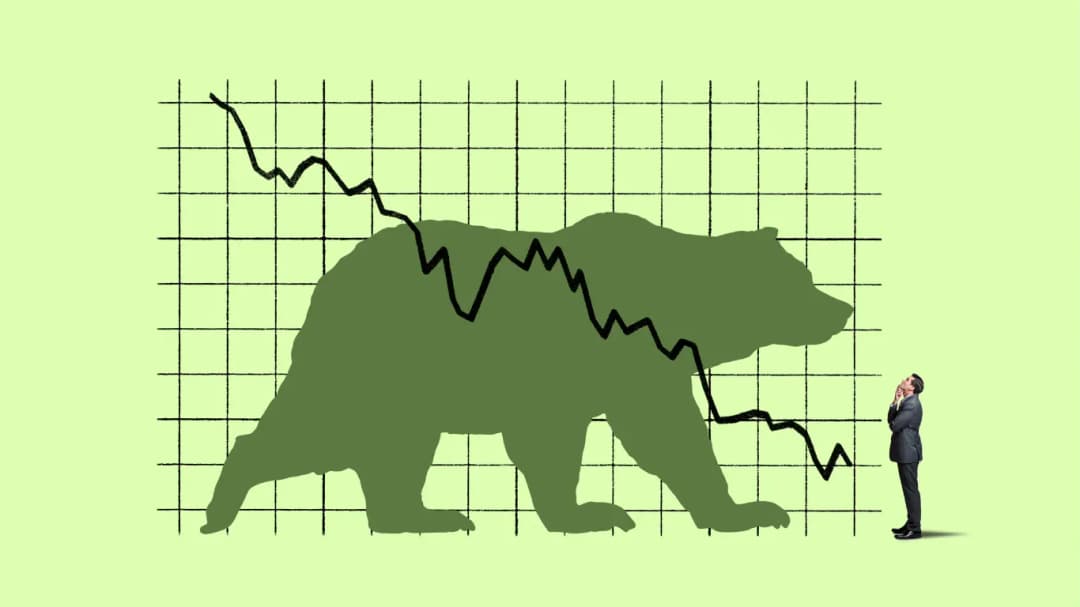
A bear market is what happens when securities prices, think stocks, bonds, or commodities, fall sharply and keep falling over a sustained period. Pessimism takes hold. Investors expect more losses, so they stop buying, and that hesitation feeds the downward spiral.
The longer it runs, the more damage it does to unprepared portfolios.
Understanding the difference between a bear market and a bull market
Before you can profit from a bear market, you need to know exactly what you’re dealing with. In a bull market, prices climb steadily, optimism is everywhere, and buying activity picks up across the board. Confidence builds on itself, and the general direction is up.
A bear market flips all of that. Sentiment turns negative, selling pressure mounts, and prices slide lower as investors rush for the exit. The strategies that made money in a bull market can destroy you in a bear market, so knowing which environment you’re in isn’t optional.
It’s everything. Panic selling is one of the most costly mistakes investors make when sentiment shifts.
What’s the difference between a bear market and a market correction?
A market correction is shorter, sharper, and less severe than a full bear market. Corrections typically kick in after a strong run-up in prices, pulling things back to more rational levels. They can feel alarming in the moment, but they don’t always signal something worse is coming.
Still, they can absolutely be the opening act of a bear market, so you should never ignore them.
Knowing the difference matters enormously when you’re deciding how to respond. A correction might call for patience and selective buying. A genuine bear market often demands a completely different playbook, one built around protection, repositioning, and finding ways to profit from the decline itself.
Strategies investors and traders use when prices are falling
Take a short-selling position
Short-selling is one of the most direct ways to profit when prices are dropping. The mechanics are straightforward: you borrow shares, sell them at the current price, and aim to buy them back later at a lower price. The difference is your profit.
But short-selling demands precision. Timing and analysis matter more here than almost anywhere else in active market trading.
The best short-selling candidates in a bear market tend to be companies highly exposed to economic cycles, think heavy debt loads, shrinking revenues, or sectors that contract when consumer spending tightens. Cyclical industries often fit this profile well. Identifying these ahead of the broader market is where the real edge sits.
That said, short-selling carries serious risk. Your downside is theoretically unlimited because a stock can keep rising against your position. Before you enter a short, you need a clear thesis, solid research, and a defined exit point to cut losses if the trade goes wrong.
Going in without that discipline is how accounts get wiped out.
Dollar-cost averaging
Dollar-cost averaging is a quieter strategy, but a powerful one. You invest a fixed amount at regular intervals regardless of what the market is doing. When prices are low, that fixed amount buys you more shares.
When prices are high, it buys fewer. Over time, your average cost per share comes down.
This approach works best for investors playing a longer game. Short-term volatility becomes almost irrelevant because you’re not trying to time the market perfectly. You’re building a position steadily, and when the market eventually recovers, you benefit from having accumulated shares at depressed prices.
Using benchmarks to track your performance alongside this strategy can give you a much clearer picture of how you’re actually doing.
To make dollar-cost averaging work, set your investment amount, automate the transfers, and stick to the schedule. The biggest threat to this strategy isn’t the market. It’s your own emotions pushing you to stop investing when things look bleak.
Automation removes that temptation.
Trade the VIX
The Volatility Index, widely known as the VIX, measures how much volatility the market expects in the near future. In a bear market, the VIX spikes as fear and uncertainty take hold. Traders who understand this can either trade the VIX directly or use it as a real-time gauge to sharpen their decision-making across other positions.
Trading the VIX is not for beginners. Its movements can be sharp and punishing if you’re on the wrong side. But for experienced traders, rising VIX levels can signal exactly the kind of environment where certain strategies start to pay off.
Know the instrument before you touch it.
Trade Indices and ETFs
When individual stocks are getting crushed, indices and exchange-traded funds give you a way to position against the broader market decline rather than betting everything on a single company. An index tracks a basket of stocks, and an ETF mirrors the performance of an underlying index, sector, or commodity.
Trading indices or ETFs in a bear market lets you spread your risk across the broader trend. If you believe the whole market is heading lower, shorting an index or buying an inverse ETF can be a cleaner, more efficient expression of that view than picking individual stocks. The Financial Times regularly covers how institutional investors use ETF structures during periods of sustained market stress.
Portfolio Diversification
Diversification is your first line of defence when markets turn. By spreading capital across different asset classes, industries, and geographies, you reduce the chance that one bad call takes down your whole portfolio. No single position can hurt you as badly when your exposure is spread intelligently.
In a bear market, some asset classes will fall less than others, and a few will actually rise. A well-diversified portfolio captures some of that resilience while cushioning the blows from underperforming positions. The key is doing the research to understand how your assets actually correlate with each other, not just assuming that holding ten different stocks counts as real diversification.
Trade ‘safe-haven’ assets
When markets sell off hard, money flows into assets that feel stable and predictable. These safe-haven assets tend to hold their value or even appreciate when everything else is sliding, making them a natural place to look during a bear market.
Gold is the classic example. Bloomberg data has consistently shown gold outperforming risk assets during major market downturns. Government bonds from stable economies, the Swiss franc, and the Japanese yen also tend to attract capital in times of stress. Allocating part of your portfolio to these assets before conditions deteriorate can protect and even grow your wealth when others are losing ground. How UHNW investors position during geopolitical stress offers a useful real-world lens on this kind of thinking.
Choose high-yielding dividend shares
When capital gains are hard to come by, income becomes the priority. High-yielding dividend shares pay you regularly regardless of short-term price movements, giving you a cash return even while markets are struggling. That income stream can meaningfully offset paper losses during a prolonged downturn.
Companies that maintain consistent dividends through tough cycles tend to be mature, financially sound businesses with stable cash flows. Utilities, healthcare, and consumer staples are sectors worth looking at. Picking the right dividend stocks takes analysis, but the reward is a portfolio that keeps generating returns even when prices are falling.
Trade options
Options trading gives you another toolkit for navigating a bear market. With options, you have the right but not the obligation to buy or sell an asset at a set price within a specific window. That flexibility is exactly what you need when markets are volatile and directional moves can be dramatic.
Bear market options strategies can include buying put options to profit from falling prices, selling call options on stocks you expect to stay flat or decline, or using more complex structures like spreads and straddles to manage risk while capturing volatility. Each approach carries its own risk profile. Reuters financial coverage is a solid resource for following how professional traders are positioning with options during market stress. Master the basics before you layer on the complexity.

Stocks that have historically performed well in bear markets
Not every stock suffers equally when markets turn south. Some companies are built for exactly this kind of environment, their revenues stay relatively stable, demand for their products holds up, and investors treat them as safe harbours when the broader market is in freefall.
Utility companies, consumer staples businesses, healthcare providers, and essential service companies have historically shown far more resilience than cyclical sectors during bear markets. These are businesses people keep paying regardless of economic conditions. Identifying these names early and building a position before the downturn deepens is a strategy seasoned investors return to again and again.
Strategies for finding opportunities in a bear market
The strategies above give you a solid foundation, but profiting in a bear market also rewards a proactive mindset. Screening for oversold stocks with strong fundamentals, monitoring sector rotation, watching institutional money flows, and keeping a watchlist of quality companies you’d buy at the right price are all ways to stay ahead. The investors who come out ahead in bear markets are usually the ones who did the preparation before the panic set in.
- Conducting thorough research and analysis to identify undervalued stocks or sectors that may recover once the market stabilizes.
- Monitoring market trends and news to capitalize on short-term fluctuations or market anomalies.
- Keeping a watchful eye on companies with strong fundamentals and a track record of weathering economic downturns.
- Staying disciplined and avoiding emotional decision-making during periods of market volatility.
Combine these approaches with patience and real discipline and you put yourself in a position to not just survive a bear market, but to come out the other side meaningfully ahead. Markets recover. The question is whether you’ve positioned yourself to benefit when they do.
FAQ
What Not to Do in a Bear Market?
In a bear market, it’s crucial to avoid panic selling, a common mistake driven by anxiety and the desire to cut losses. Such impulsive actions often result in selling at the market bottom, locking in losses and missing future gains.
Attempting to time the market is another pitfall, as consistently predicting market highs and lows proves challenging. Instead, focusing on long-term goals and adhering to a well-defined investment strategy is advised. Additionally, neglecting diversification can be detrimental; spreading investments across different sectors and asset classes helps mitigate risks and seize opportunities presented by varying market performances.
We last reviewed this analysis in May 2026.


Alex Tzoulis
Alex Tzoulis is Co-Owner and Markets Analyst at The Luxury Playbook, specializing in equities, crypto, forex, and global financial markets. His work focuses on analyzing macroeconomic trends, geopolitical developments, and monetary policy, translating them into actionable insights across both traditional and digital asset classes. He leads the platform's financial market coverage, providing structured analysis across stock market investing, trading strategies, and cryptocurrency markets. His expertise strengthens the publication's authority in financial markets and capital allocation, bridging traditional finance with emerging digital investment ecosystems.