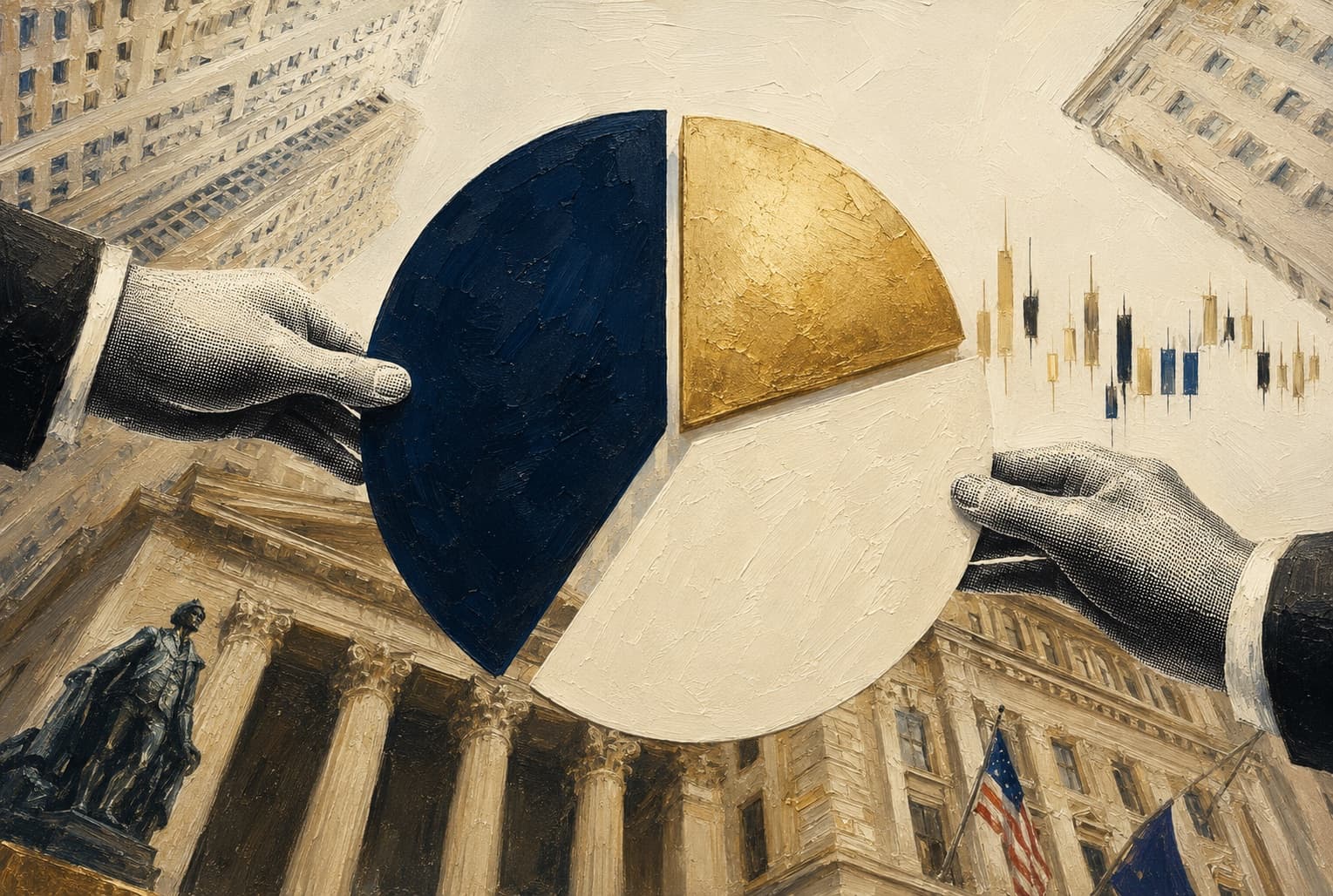
Right now, with sector volatility running hot, optimism still fragile, and an aging bull market testing everyone’s patience, the debate between index funds and mutual funds has never been more strategic. Your allocation decisions today carry real consequences for years ahead.
Passive investment vehicles like index funds now control over 54% of total U.S. equity fund assets, a structural shift in how serious portfolios get built. But despite the surge in passive strategies, actively managed mutual funds still oversee trillions in assets, especially among investors chasing alpha in inefficient or speculative markets.
This divergence is not just about ideology. It is about allocation logic, and getting that logic right matters more than most investors realize.
Take a 35-year-old building a long-horizon Roth IRA. They will likely prefer the ultra-low-cost exposure of a Vanguard Total Stock Market Index Fund (VTSAX). But a high-income professional targeting short-term alpha in emerging tech might choose the Fidelity Blue Chip Growth Fund (FBGRX), even with a higher expense ratio, because of its active exposure to specific innovation trends.
Two different investors, two completely different tools.
Rate-sensitive sectors like real estate and utilities are facing headwinds while tech rebounds in anticipation of Federal Reserve easing. That means your fund selection needs to reflect macroeconomic alignment, not just a backward glance at past performance.
Index funds offer predictability and fee compression. But mutual funds can adapt more dynamically in a fragmented market cycle where stock dispersion sits at a 10-year high. Knowing which tool fits your moment is the real edge.
The index-versus-active debate sits inside a well-documented dataset. S&P Global's SPIVA scorecards quantify how often active managers beat their benchmark net of fees, and the answer is rarely flattering for active strategies over multi-year horizons.
The fund providers themselves anchor the institutional view. Vanguard's long-running research on expense ratios and Morningstar's independent ratings make the cost picture concrete, while BlackRock's iShares index data shows how passively-managed assets have scaled.
Index Funds vs Mutual Funds Summary
| Criteria | Index Funds | Mutual Funds |
|---|---|---|
| Investment Strategy | Passive management | Active management |
| Decision-Making | Rule-based, systematic, with minimal human intervention. | Manager-driven, based on market forecasts, analysis, and active stock picking. |
| Return Expectations | Market-matching returns; tracks indices like S&P 500 or Nasdaq-100. | Potential for outperformance (alpha) but often underperforms net of fees. |
| Performance Consistency | High consistency across long-term horizons; low variability. | Inconsistent performance, heavily reliant on manager skill and market conditions. |
| Volatility | Generally lower due to broad diversification and lack of active trading. | Higher due to active trading, concentrated bets, or sector overweighting. |
| Risk Exposure | Exposed to market (systematic) risk only. | Exposed to both market risk and manager-specific risks (timing, strategy). |
| Turnover Ratio | Low turnover: 2%–10% annually. | High turnover: often exceeds 50%, leading to greater transaction costs and tax events. |
| Tax Efficiency | Highly tax-efficient due to low capital gains distributions. | Less tax-efficient due to frequent trading and capital gains distributions. |
| Management Fees | Low (typically 0.02%–0.20% expense ratios). | Higher (typically 0.60%–1.50% or more in management fees). |
| Benchmark Dependency | Tracks index performance exactly (e.g., S&P 500, MSCI World). | Often benchmarked against indices, but results vary widely. |
| Long-Term Suitability | Ideal for retirement portfolios, long-term investors, and passive strategies. | Suitable for short-term tactical plays, market timing strategies, or niche sector investments. |
| Outperformance Likelihood | Rarely outperforms the market; aims for average market return. | Potential to outperform, but statistically underperforms in ~80, 90% of cases over 10 years. |
| Investor Profile | Cost-sensitive, risk-averse, long-term focused. | Higher risk tolerance, confident in active management or sector-specific plays. |
What is an Index Fund?
An index fund is a passively managed investment vehicle designed to replicate the performance of a specific financial market index. Instead of trying to beat the market, it aims to mirror the market’s returns, typically with minimal management costs and low portfolio turnover. You get broad exposure without paying for a team of analysts trying to outsmart everyone else.
The most common examples include funds tracking the following benchmarks.
- S&P 500 Index Funds (e.g., Vanguard 500 Index Fund – VFIAX)
- Total Market Index Funds (e.g., Schwab Total Stock Market Index – SWTSX)
- International Index Funds (e.g., Fidelity International Index – FSPSX)
In 2026, index funds have attracted record inflows, especially from retail investors and 401(k) plans. Net inflows into U.S. index funds exceeded $1.2 trillion in 2024, largely pulling capital away from actively managed mutual funds. That trend has only accelerated heading into 2026, and the data from Morningstar’s fund flow research backs it up.
Key Characteristics of Index Funds
- Passive Management: No active stock picking. The fund automatically adjusts to match the underlying index’s composition.
- Low Expense Ratios: Most index funds have fees between 0.02% to 0.10%, significantly lower than the 0.60% to 1.50% range of many mutual funds.
- Tax Efficiency: Due to low turnover, capital gains distributions are rare, providing an edge in taxable brokerage accounts.
- Market Correlation: Index funds closely track the broader market’s highs and lows, making them ideal for those seeking long-term average returns.
Popular Indexes Tracked
| Index Tracked | Description | Average Annual Return (10-Year) |
|---|---|---|
| S&P 500 | 500 largest U.S. companies | ~10.2% |
| Nasdaq-100 | Top 100 non-financial tech-heavy stocks | ~13.6% |
| Russell 2000 | Small-cap U.S. equities | ~8.4% |
| MSCI EAFE | Developed international markets | ~7.1% |
| CRSP U.S. Total Market | Entire U.S. investable equity market | ~10.1% |
If you are investing in 2026, you are navigating elevated interest rates, persistent geopolitical risks, and moderate inflation. In that context, index funds offer a low-cost, predictable backbone for your portfolio, especially if you are running a buy-and-hold strategy, a core-satellite approach, or dollar-cost averaging into retirement accounts.
- Dollar-Cost Averaging
- Buy-and-Hold Retirement Strategies
- ETF Wrappers for Portfolio Core Positions
The explosive growth of index-based ETFs, like the iShares Core S&P 500 (IVV), gives you liquidity and intraday trading flexibility that traditional mutual funds simply cannot match. That makes index investing more accessible and more efficient than ever before.

What is a Mutual Fund?
A mutual fund pools capital from multiple investors to purchase a diversified portfolio of stocks, bonds, or other securities. You are essentially buying into a professionally managed collection of assets alongside thousands of other investors.
Unlike index funds, mutual funds are typically actively managed. Fund managers make deliberate calls on which securities to buy and sell, with the goal of outperforming a benchmark index. That sounds appealing, but the track record is more complicated than the pitch suggests.
As of 2026, mutual funds still manage over $21 trillion in global assets, even as the shift toward passive investing accelerates. Their appeal lies in professional oversight, customized investment strategies, and access to specialized sectors or asset classes that passive indexes simply do not cover well.
Key Characteristics of Mutual Funds
- Active Management: A fund manager or team uses research, forecasts, and judgment to make portfolio decisions.
- Higher Expense Ratios: Management fees can range between 0.60% and 2.00%, significantly higher than those of passive funds.
- Turnover & Tax Implications: Frequent trading generates higher turnover ratios and potentially greater capital gains distributions, important considerations for taxable accounts.
- Minimum Investment Requirements: Often require minimum investments ranging from $1,000 to $10,000, depending on the fund and provider.
Fund Types
| Fund Category | Description | Typical Strategy |
|---|---|---|
| Actively Managed Equity | Seeks to outperform a stock index | Stock picking, sector rotation |
| Target-Date Funds | Designed for retirement based on age | Shifts allocation over time |
| Sector-Specific Funds | Focus on industries like tech or healthcare | Concentrated, high-risk/high-reward |
| Balanced Funds | Mix of stocks and bonds | Moderate growth & income |
| Bond Funds | Invest in fixed-income securities | Focus on yield & capital preservation |
While index funds dominate inflows, mutual funds still attract investors who want specific things from their portfolio.
- Active risk management during market volatility
- Exposure to niche asset classes (e.g., emerging markets debt, frontier equities)
- High-conviction strategies that deviate from benchmarks
If you are in a higher tax bracket, a tax-managed mutual fund can actually work in your favor. And if you are approaching or already in retirement, income-generating funds with consistent dividend distributions may better match your cash flow needs than a pure index approach.
Mutual funds stay relevant for investors who prioritize custom strategy execution, professional oversight, and the real possibility of above-market returns. Just know that those benefits come with higher costs, and you need to decide whether the trade-off makes sense for your situation.
Index Funds vs. Mutual Funds: Management
One of the most defining differences between index funds and mutual funds comes down to how they are managed. Passive versus active management affects everything from fund performance to cost, tax efficiency, and long-term suitability for your investor profile.
Index Funds
Index funds are passively managed. They are built to replicate the performance of a benchmark index, whether that is the S&P 500, the Nasdaq-100, or the MSCI Emerging Markets Index, rather than beat it. No stock-picking, no market-timing, no active bets.
- Management Style: No active decision-making on stock selection. Holdings mirror the index composition.
- Tracking Error: Typically below 0.05%, indicating minimal deviation from the index.
- Personnel Involvement: Requires limited oversight, contributing to lower management costs.
- Performance Outlook: Tends to match the market average with fewer surprises.
That makes index funds ideal if you are a long-term investor seeking steady, market-linked growth with minimal intervention on your part.
Mutual Funds
Mutual funds take the opposite approach. They are built on the goal of outperforming the market through active portfolio construction and strategic asset allocation. You are paying for a manager’s conviction, and sometimes that pays off handsomely.
- Management Style: Involves daily research, stock analysis, and market forecasting.
- Turnover Ratio: Often above 50%, indicating frequent buying and selling of securities.
- Personnel Involvement: Highly dependent on the expertise and consistency of the fund manager.
- Performance Outlook: Offers potential for alpha, but success varies dramatically across funds.
But here is the honest picture. According to 2024 data from Morningstar, only 24% of U.S. active mutual funds outperformed their benchmarks over a 10-year period. Once you strip out the higher fees, that number gets even harder to justify for most investors.
| Criteria | Index Funds | Mutual Funds |
|---|---|---|
| Management Style | Passive | Active |
| Goal | Track benchmark | Beat benchmark |
| Manager Involvement | Minimal | High |
| Turnover Ratio | < 5% | 50–100%+ |
| Fee Structure | Low (avg. 0.05–0.20%) | High (avg. 0.60–2.00%) |
| Long-Term Consistency | High | Variable |
| Tax Efficiency | High | Lower due to capital gains distributions |
Management style shapes cost, predictability, and long-term results. Index funds deliver simplicity and cost efficiency. Mutual funds offer the chance at outperformance, but at a price.
For most investors, especially in retirement accounts or taxable brokerage accounts, the passive model has proven more reliable over time. If you want to understand how leverage tools like a portfolio line of credit can complement either strategy, that is worth exploring as your portfolio grows.

Index Funds vs. Mutual Funds: Costs
Costs are not a footnote in your investment strategy. They are central to your long-term outcome. When you are weighing index funds against mutual funds, the difference in fees can quietly cost you tens of thousands, sometimes hundreds of thousands, in foregone returns over decades.
The expense ratio is the annual operating cost of a fund expressed as a percentage of assets under management. It covers management fees, administrative costs, and other operating expenses. It gets deducted automatically, so you rarely feel it in the moment, but it compounds against you every single year.
- Index Funds: Due to passive management, expense ratios often fall between 0.03% to 0.20%.
- Mutual Funds: Actively managed strategies can carry expense ratios ranging from 0.60% to 2.00%, depending on the fund’s complexity, size, and brand.
Here is a number that should get your attention. On a $100,000 investment held for 20 years at a 7% annual return, a 1.50% fee typical of some mutual funds would cost you over $75,000 in lost returns compared to an index fund charging just 0.10%. That is not a small rounding error. That is a meaningful chunk of your future wealth.
Mutual funds may also charge sales loads, which are fees you pay when buying or selling shares. Front-end loads can run as high as 5.75% on some funds, which means you are starting in a hole before the market even moves.
- Front-End Load: Typically 3%–5% of your investment, deducted immediately.
- Back-End Load (Deferred Sales Charge): Applies when selling, often decreasing the longer you hold the fund.
- 12b-1 Fees: Annual marketing or distribution fees, often 0.25% to 1.00%.
By contrast, most index funds are no-load and commission-free, especially when you purchase through low-cost providers like Vanguard, Fidelity, or Charles Schwab. You keep more of what you earn from day one.
Higher turnover ratios in mutual funds also create more frequent taxable events. According to Morningstar, active funds average a turnover rate of 63%, compared to just 7% for index funds. That gap has real tax consequences for you.
Here is why that turnover gap matters for your after-tax returns.
- Frequent trading generates capital gains distributions, which are taxable in brokerage accounts.
- Index funds, with low turnover, offer greater tax efficiency, especially in non-retirement portfolios.
| Cost Component | Index Funds | Mutual Funds |
|---|---|---|
| Expense Ratio | 0.03% – 0.20% | 0.60% – 2.00% |
| Front-End Load | None | 3% – 5% (if applicable) |
| Back-End Load | None | 1% – 5% (varies by fund) |
| 12b-1 Marketing Fees | Rare (< 0.10%) | Common (0.25% – 1.00%) |
| Turnover Ratio | < 10% | 50% – 100%+ |
| Tax Efficiency | High | Low to Medium |
The cost advantage is not incidental. Low-cost index funds consistently outperform the majority of high-fee mutual funds over long horizons, particularly once you factor in taxes and inflation. That is not an opinion.
It is what the long-run data keeps showing, as Bloomberg’s fund performance coverage has documented repeatedly.
Which Is Better For Investors?
For choosing between index funds and mutual funds in 2026, the better option for most investors is fairly clear. Index funds offer a stronger balance of performance, cost efficiency, and simplicity. That said, mutual funds can still play a useful role in specific strategies, and writing them off entirely would be shortsighted.
Index funds are passively managed, tracking a specific market index like the S&P 500 or the Nasdaq-100. Because no active decision-making is involved, they come with extremely low fees, typically between 0.03% and 0.15%. You pay less and get reliable market exposure.
It is a straightforward value exchange.
Over time, that fee advantage compounds into meaningfully better net returns. This is not theoretical. The math plays out the same way decade after decade.
From 2013 to 2023, index funds tracking the S&P 500 delivered average annual returns of about 10.3%, while the average actively managed mutual fund returned closer to 8.2% after fees. That 2% gap might sound modest, but stretched across 20 years, it reshapes your entire portfolio outcome.
A 2% difference in annual returns can translate to a 20 to 30% difference in total portfolio value over two decades. That is real money, the kind of money that funds a second property, a vintage collection, or a decade of meaningful retirement income. For context on how alternative assets fit into a broader wealth strategy, asking the right questions before investing in a startup follows a similar discipline of fee awareness and return expectations.
Tax efficiency is another genuine strength of index funds. Because they trade infrequently, they generate fewer taxable events and let your gains compound without constant friction from the IRS. For taxable brokerage accounts specifically, where long-term capital gains treatment is preferable, index funds are often the smarter structural choice.
You can see how the Financial Times covers tax-efficient investing for a deeper read on this angle.
But mutual funds are not obsolete. Not by a long shot.
They stay useful for investors who want access to specialized sectors, tactical allocations, or genuinely active strategies with conviction behind them. A mutual fund focused on emerging market small-cap stocks, for example, may offer insights and flexibility that a passive index simply cannot replicate. Some mutual funds do outperform in volatile markets, especially when the manager running them has a strong and verifiable track record.
Still, the long-term data tells a consistent story. Most mutual funds underperform their benchmark indices once fees and taxes are factored in. Your job as an investor is to know when the exception might apply to you, and to be honest with yourself when it does not.
- For long-term growth, low costs, and broad diversification, index funds are generally the better investment in 2025.
- For niche strategies or active management in less efficient markets, mutual funds can offer additional value.
FAQ
Are index funds safer than mutual funds?
Yes, generally. Index funds track broad market indices and avoid stock-picking risk. Their passive strategy and diversification typically make them less volatile than actively managed mutual funds, especially those focusing on specific sectors or small-cap stocks.
Do mutual funds or index funds have higher fees?
Mutual funds usually have higher fees. Actively managed mutual funds often charge 1% to 2% annually, while index funds charge as little as 0.03%. Over time, these costs can significantly reduce your investment returns.
Which performs better: index funds or mutual funds?
Historically, index funds outperform most mutual funds over the long term due to lower costs and consistent exposure to market gains. For example, over the past 10 years, over 80% of active managers underperformed the S&P 500.
Can I hold both index funds and mutual funds in one portfolio?
Yes. Many investors use index funds as a low-cost core holding and complement them with actively managed mutual funds for targeted strategies or sector exposure.
Are index funds good for retirement?
Absolutely. Their low cost, simplicity, and consistent long-term returns make them ideal for retirement portfolios. Funds tracking the S&P 500 or total U.S. market are especially popular in 401(k) and IRA accounts.
Are mutual funds better for short-term investing?
Not necessarily. Both index and mutual funds are generally better suited for long-term goals. For short-term needs, money market funds or short-duration bond ETFs might be more appropriate.
Can mutual funds outperform index funds in some years?
Yes, some mutual funds do outperform in certain years, especially during volatile or bear markets. However, sustained outperformance is rare, and identifying consistent winners in advance is difficult.
We last reviewed this analysis in May 2026.


Alex Tzoulis
Alex Tzoulis is Co-Owner and Markets Analyst at The Luxury Playbook, specializing in equities, crypto, forex, and global financial markets. His work focuses on analyzing macroeconomic trends, geopolitical developments, and monetary policy, translating them into actionable insights across both traditional and digital asset classes. He leads the platform's financial market coverage, providing structured analysis across stock market investing, trading strategies, and cryptocurrency markets. His expertise strengthens the publication's authority in financial markets and capital allocation, bridging traditional finance with emerging digital investment ecosystems.