The Bern property market in 2026 remains the most institutionally driven of Switzerland's prime markets. Bern is the de facto political capital, home to the Swiss federal government, the Swiss National Bank and a UNESCO World Heritage-listed medieval Old Town. Average residential pricing now reads near CHF 11,800 per square metre, with prime stock in the historic core and the prestigious Aare-loop neighbourhoods commanding meaningful premiums.
Knight Frank's Wealth Report and Prime Index keep Bern inside Switzerland's top tier alongside Zurich, Geneva, Basel and Lausanne. We track the city as the cleanest expression of Switzerland's defensive prime market profile.
Savills's World Cities Prime work and Engel & Völkers Bern both describe a structurally low-volatility market driven by federal-government, Swiss National Bank and broader institutional employment. Mansion Global and FT Property have used the UNESCO Old Town as the journalistic entry point into the city's prime conversation.
- Bern offers the most institutionally stable Swiss residential market, with the federal government employer base and constrained supply supporting steady price firmness.
- We see the historic centre, Kirchenfeld and Elfenau anchoring the upper end of the local prime segment, with strong demand from federal employees and corporate relocations.
- Wuest Partner data shows Bern residential appreciation tracking just below Zurich and Basel, with the gap reflecting the more local employer base and slower demographic shifts.
- Lex Koller restrictions shape participation across the Swiss market, with Bern procedures defining qualifying foreign buyer access in line with the broader framework.
- Yields on Bern rental stock remain attractive relative to Zurich and Geneva, with the more stable tenant mix supporting consistent net cash flow.
- For most considered Swiss buyers we view Bern as offering the steadier residential profile within the German-speaking Swiss complex.
- Who is this for?
- Swiss residents and qualifying international buyers evaluating Bern property, alongside the advisers, brokers and family office staff framing those decisions.
- What is happening?
- A market read of Bern property in 2026, covering the historic centre, Kirchenfeld, Elfenau, federal employer dynamics and the rental yield landscape.
- When did this emerge?
- The article reflects 2026 market conditions through Wuest Partner, BFS and SNB data alongside our own observations.
- Where is this happening?
- The piece focuses on Bern, including the historic centre, Kirchenfeld and Elfenau.
- Why does it matter?
- Bern offers the most institutionally anchored Swiss residential market, which is why understanding the federal base dynamics matters before any acquisition.
The Bern property market today
Switzerland's Lex Koller framework restricts non-resident foreign purchases. Bern applies the standard cantonal regime, with the UNESCO Old Town adding heritage-protection layers to any structural change inside the inscribed perimeter.
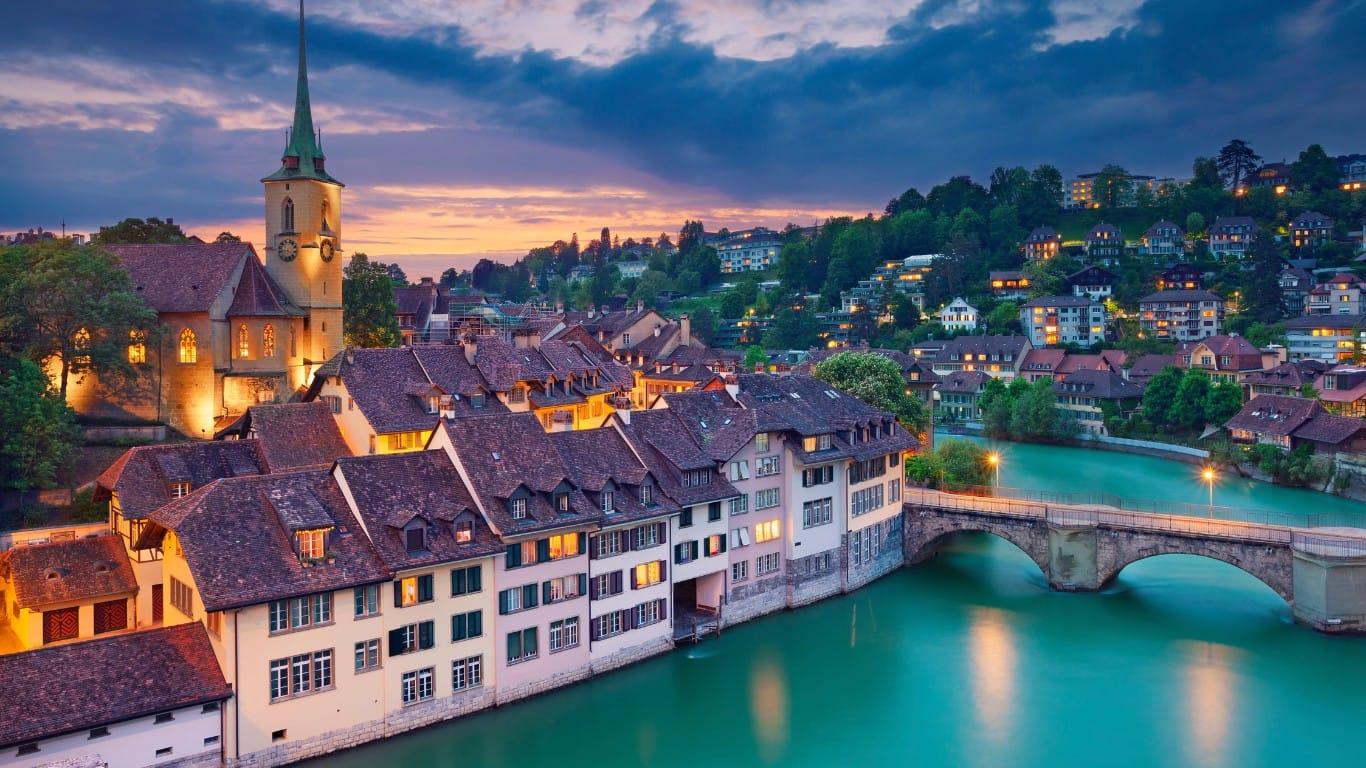
Inventory at the prime tier is structurally constrained. Six kilometres of arcaded sandstone streets, the Zytglogge clock tower, the Cathedral Münster and the strict heritage protections together keep new supply rationed inside the historic core.
- Average pricing around CHF 11,800 per square metre
- UNESCO Old Town and Aare-frontage stock above the city average
- Lex Koller restrictions on non-resident foreign ownership
- Federal-government and Swiss National Bank demand drives activity
Neighbourhoods defining Bern in 2026
The Old Town inside the Aare loop is the UNESCO inscribed core. Restored arcaded sandstone buildings draw the deepest premiums and the longest hold times.
Kirchenfeld is the established prime residential district across the Aare from the Old Town. Embassy-grade detached houses and mature plot sizes anchor the family-buyer demographic.
Elfenau, the park-adjacent prestige neighbourhood, draws the deepest senior-civil-service and institutional buyer interest.
Bümpliz and Bethlehem draw the most accessible buyer demand on the western periphery, with steadily improving transit connectivity.
The institutional and architectural register
The Swiss federal Bundeshaus, the Swiss National Bank headquarters, the federal supreme court (in Lausanne) and the broader federal-government employer base anchor the city's institutional gravity. The Paul Klee legacy is concentrated at Renzo Piano's Zentrum Paul Klee on the eastern edge of the city.
Christie's International Real Estate, Sotheby's International Realty and the senior Swiss brokerage networks all describe a market where the architectural and institutional register matters more than headline pricing growth. The UNESCO inscription is the durable asset.
Bloomberg's culture coverage and the FT have both used the Bundeshaus and the Zentrum Paul Klee as the entry points into the broader Bern residential conversation. The cultural infrastructure is mature, even if quieter than Zurich's or Basel's.
Bern against Zurich and Geneva
The three German- and French-speaking Swiss prime markets reward different buyers. Zurich is the corporate-banking capital, Geneva is the international-institutional capital, Bern is the federal-political capital.
Zurich prime sits above CHF 19,000 per square metre, Geneva trophy stock above CHF 28,000 per square metre, Bern at CHF 11,800 with prime above that line. Bern offers the most accessible entry into the Swiss top tier for buyers who value federal-institutional gravity over corporate or international-institutional positioning.
The Lex Koller framework applies equally across all three. Federal-government employees with Swiss residency and senior civil servants transact in similar volumes, but the political-stability profile is uniquely Bern-specific.
How Bern compares with Mayfair, Monaco and Dubai Marina
Bern trades at roughly a fifth of the Monaco trophy line, which Savills's World Cities Prime tracker puts near EUR 55,000 per square metre. Mayfair prime sits around GBP 30,000 to GBP 40,000 per square metre, well above Bern.
Dubai Marina prime trades near AED 22,000 per square metre (around CHF 5,400), below Bern. The comparison readers find more useful is Bern against Berlin: Berlin Mitte prime sits around EUR 9,000 to EUR 11,000 per square metre, putting Bern at a comparable line with a different employer base entirely.
The Greek Golden Visa programme (EUR 250,000 in qualifying regions, EUR 800,000 in central Athens, Thessaloniki, Mykonos and Santorini from August 2024) and the Cyprus PR pathway sit in different categories. Bern is a domestic-anchored, federal-institution-driven asset, not a residency play.
What we expect through year-end 2026
Pricing is projected to climb 1 to 3 percent through the back half of 2026. The UNESCO Old Town and Aare-frontage stock are expected to outperform the city average on structural scarcity rather than active demand surges.
The federal employer base is structurally stable. Federal-government, Swiss National Bank and the broader institutional cluster continue to anchor demand across cycles in a way few European political capitals can match.
Knight Frank's Prime Index tracker and Savills's World Cities Prime quarterly both support the defensive trajectory. The Swiss franc remains a structural currency hedge for buyers who value that profile.
What this means for buyers
Bern rewards the buyer who values structural stability, the UNESCO Old Town heritage register and a federal-institutional employer base. The defensive market profile is the durable asset.
For EU-resident and federal-employee buyers, the Old Town, Kirchenfeld and Elfenau read as some of the most defensible mid-tier Swiss prime stock we cover. For non-EU buyers, Lex Koller closes most direct purchase routes, and the realistic pathway runs through Swiss residence or institutional sponsorship.
We last reviewed this analysis in May 2026.
Frequently asked
How is the Bern property market evolving in 2026?
Pricing is projected to climb 1 to 3 percent through the year, supported by federal-government employment and the UNESCO Old Town heritage register. The defensive market profile remains the characteristic feature.
Which areas are seeing the most buyer attention?
The UNESCO Old Town, Kirchenfeld and Elfenau draw the most consistent prime demand. Bümpliz and Bethlehem anchor the more accessible western corridor.
Can foreign nationals buy property in Bern?
Partially. Lex Koller restrictions apply to non-resident foreign nationals. EU residents and Swiss-resident professionals face fewer restrictions.
What distinguishes Bern within Swiss markets?
The combination of federal-government employment, the Swiss National Bank headquarters, the UNESCO World Heritage Old Town and the structurally low-volatility character of the de facto Swiss political capital.
How does the UNESCO Old Town designation shape the market?
The inscription protects one of Europe's most preserved late-medieval cityscapes. It adds heritage-protection layers to structural change inside the inscribed perimeter, which keeps supply rationed and reinforces the architectural integrity of the historic core.
Related reading on The Luxury Playbook: Swiss real estate.