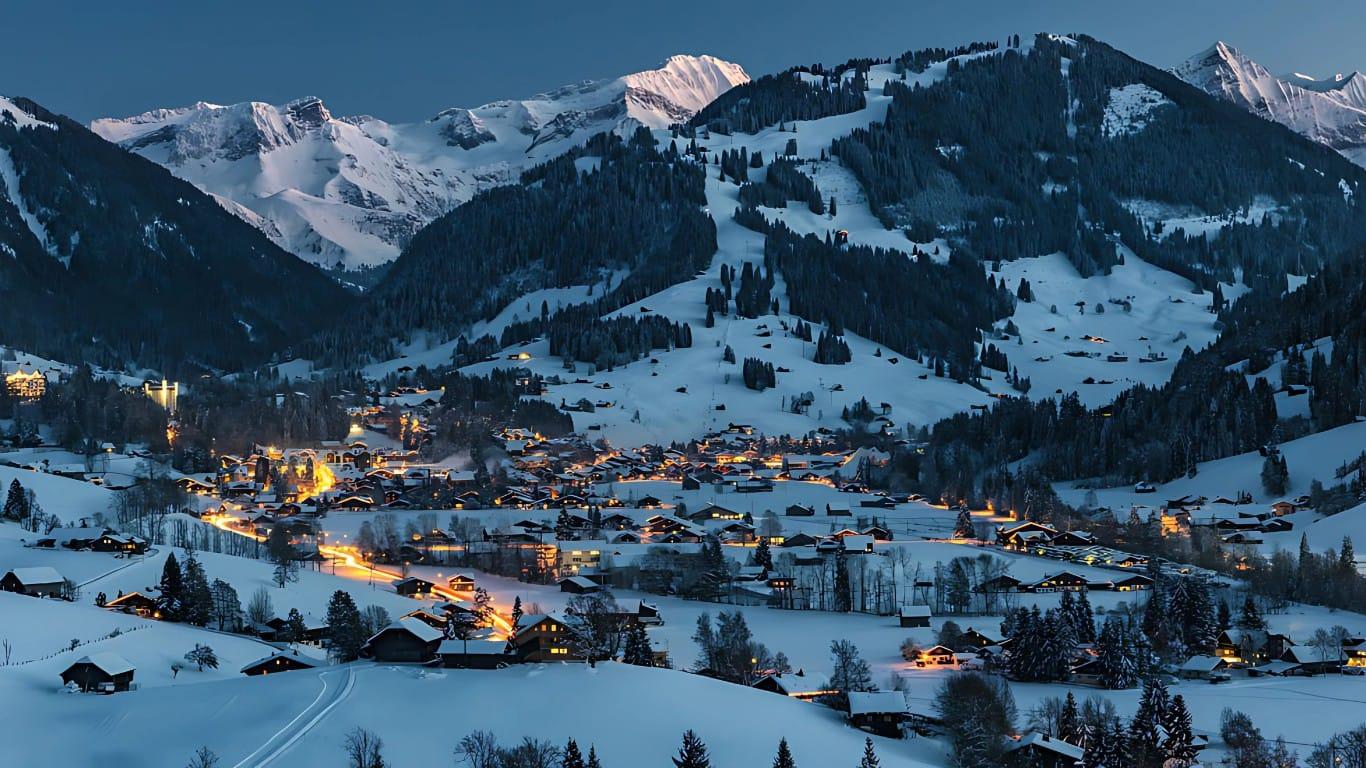
The Gstaad property market in 2026 sits at the very top of the European alpine hierarchy alongside St. Moritz and Courchevel. The Bernese Oberland village has drawn old European families, Gulf royals, American tech founders and a steadily growing presence of Asian principal-family wealth for more than a century. Prime chalet pricing now exceeds CHF 40,000 per square metre, with trophy stock in the most protected neighbourhoods commanding pricing above CHF 60,000 per square metre.
Knight Frank's Wealth Report and Prime Index keep Gstaad among the most consequential alpine ultra-prime markets globally. Savills's World Cities Prime tracker, the Engel & Völkers Gstaad office and Christie's International Real Estate all describe a buyer composition that has been remarkably consistent across cycles.
We track Gstaad as the most architecturally protected alpine prime market in Europe. Strict cantonal zoning preserves the traditional Bernese Oberland chalet vernacular in ways no other major ski resort can match.
- Gstaad remains the most exclusive Swiss alpine residential market, with chalets in the Oberbort arc and Promenade-adjacent locations setting the upper end of the European mountain segment.
- We see prime Gstaad chalets trading at among the highest prices per square metre in the European Alps, with constrained supply and Lex Koller restrictions reinforcing the scarcity dynamic.
- Knight Frank Alpine reports and UBS Real Estate data consistently place Gstaad at the trophy tier of the European alpine market, alongside Verbier and Zermatt at the upper end.
- Foreign buyer access under Lex Koller is sharply constrained in Bern canton, with permit quotas defining qualifying acquisition opportunities for non-residents.
- The exclusive social and cultural calendar, including the Gstaad Palace ecosystem, continues to support the demand from ultra-high-net-worth households seeking discretion.
- For most considered Swiss buyers we view Gstaad as the trophy alpine asset within the European complex, with appreciation tied to genuine scarcity rather than broader cycles.
- Who is this for?
- Ultra-high-net-worth international and Swiss buyers evaluating Gstaad property, alongside the advisers, brokers and family office staff framing those acquisitions under Lex Koller.
- What is happening?
- A market read of Gstaad property in 2026, covering the Oberbort arc, Promenade locations, Lex Koller constraints and the trophy alpine positioning.
- When did this emerge?
- The article reflects 2026 market conditions through Knight Frank Alpine, Wuest Partner, BFS and UBS Real Estate data alongside our observations.
- Where is this happening?
- The piece focuses on Gstaad in Bern canton, including the Oberbort arc and Promenade-adjacent locations.
- Why does it matter?
- Gstaad pricing reflects genuine scarcity at the European alpine level, which is why understanding the Lex Koller constraints matters before any acquisition discussion.
The Gstaad property market today
Switzerland's Lex Koller framework severely restricts foreign property ownership in alpine resort areas. The Gstaad / Saanen quotas are unusually tight, and most prime transactions involve Swiss-resident or specifically authorised purchasers.
Inventory at the prime tier is structurally constrained. The chalet-vernacular zoning, the protected meadow framework and the height-limited contemporary projects together keep new supply rationed.
- Prime chalet pricing above CHF 40,000 per square metre
- Trophy properties above CHF 60,000 per square metre
- Lex Koller plus resort-specific quotas restrict foreign buyers
- Detached chalets with mountain views and ski-in access command the deepest premiums
Neighbourhoods defining Gstaad in 2026
Schönried and Saanenmöser hold the highest-altitude prime chalet positions, with ski-in access and the deepest privacy.
The Gstaad village core concentrates around the Promenade, the Gstaad Palace and the Park Gstaad hospitality cluster. Heritage chalets here command the most consistent ultra-prime demand.
Saanen, the principal commune, draws the broadest buyer composition. Mature plot sizes and the Saanen-MOB rail anchor the family-buyer demographic.
Rougemont, the French-speaking adjacent commune, offers the most distinctive cross-cantonal positions. Heritage stock and slightly more accessible quotas have drawn growing French-speaking buyer interest.
The architectural and cultural register
The chalet vernacular is strictly protected by cantonal zoning. Exposed beam construction, carved facades, traditional roof pitches and locally sourced timber are non-negotiable in new construction. The result is one of the most architecturally coherent ultra-prime markets in Europe.
The hospitality cluster anchors the cultural character. The Gstaad Palace (since 1913), the Park Gstaad, the Alpina Gstaad and the broader hotel set together support the year-round social calendar.
The Sommets Musicaux de Gstaad, the Hublot Polo Gold Cup, the Swatch Beach Volleyball Major and the year-round ski programme give the village an unusually deep cultural register for an alpine resort. Christie's International Real Estate and Sotheby's International Realty both describe a market where the social calendar drives a meaningful share of prime trades.
Gstaad against St. Moritz and Courchevel
The three European alpine ultra-prime markets reward different buyers. Gstaad is consistently European-old-money anchored, with a Gulf and emerging Asian principal-family layer.
St. Moritz is more cosmopolitan and tech-money inflected, with prime chalet pricing exceeding CHF 45,000 per square metre and Suvretta or Champfèr trophy stock above CHF 70,000 per square metre. Courchevel 1850 prime sits closer to EUR 35,000 to EUR 45,000 per square metre.
All three sit firmly inside Knight Frank's Prime Index alpine tracker. All three operate under tight foreign-buyer restrictions, with Lex Koller protecting the Swiss positions and French residency frameworks shaping Courchevel.
How Gstaad compares with Monaco, Mayfair and Dubai Marina
Gstaad trophy stock trades around the Monaco trophy line, where Savills's World Cities Prime tracker puts pricing near EUR 55,000 per square metre. Mayfair prime sits around GBP 30,000 to GBP 40,000 per square metre, below Gstaad at the trophy tier.
Dubai Marina prime trades near AED 22,000 per square metre (around CHF 5,400), well below Gstaad. The comparison readers find more useful is Gstaad against Aspen, where prime chalet pricing now reads close to Gstaad on a per-square-metre basis at the trophy line.
The Cyprus PR and Greek Golden Visa programmes (EUR 250,000 in qualifying regions, EUR 800,000 in central Athens, Thessaloniki, Mykonos and Santorini from August 2024) sit in different categories. Gstaad is a heritage-anchored, multi-generational asset, not a residency play.
What we expect through year-end 2026
Prime pricing is projected to climb 2 to 5 percent in the trophy segments through the back half of 2026. The structural scarcity of legally compliant chalet stock supports the trajectory.
The buyer composition remains the durable asset. Old European families, Gulf royals, American tech founders and the emerging Asian principal-family layer continue to anchor the market across cycles.
Knight Frank's Prime Index tracker and Christie's International Real Estate both support the forecast. The Swiss franc remains a structural currency hedge for buyers who value that profile.
What this means for buyers
Gstaad rewards the buyer who treats alpine real estate as a multi-generational anchor. The chalet-vernacular zoning, the hospitality cluster and the social calendar are the durable assets.
For Swiss-resident and specifically authorised buyers, the Saanenmöser, Schönried and Saanen positions read as some of the most defensible alpine prime stock in Europe. For non-EU and non-authorised buyers, the Lex Koller quotas close most direct purchase routes, and the realistic pathway runs through long-stay residence, employer-sponsored permits or qualifying institutional structures.
We last reviewed this analysis in May 2026.
Frequently asked
How is the Gstaad property market evolving in 2026?
Prime pricing is projected to climb 2 to 5 percent in trophy segments through the year, supported by structural scarcity and the consistent international ultra-prime buyer composition.
What's most in demand in Gstaad?
Detached chalets with mountain views, ski-in access and high-spec finishes command the strongest premiums. Heritage chalets near the Gstaad village core anchor the deepest ultra-prime demand.
Can foreign nationals buy property in Gstaad?
Severely restricted under Lex Koller and resort-specific quotas. Most prime transactions involve Swiss-resident or specifically authorised purchasers.
What distinguishes Gstaad among alpine destinations?
The combination of consistent international ultra-prime buyer composition, structurally protected chalet vernacular, and a hospitality and cultural calendar that has shaped the village's character for more than a century (Gstaad Palace, Park Gstaad, Alpina Gstaad).
How does Gstaad compare with international prime markets?
Gstaad trades around the Monaco trophy line at the top tier, broadly in line with Aspen on a per-square-metre basis, and well above Mayfair and Dubai Marina. It is heritage-anchored rather than residency-driven, and rewards multi-generational holding.