
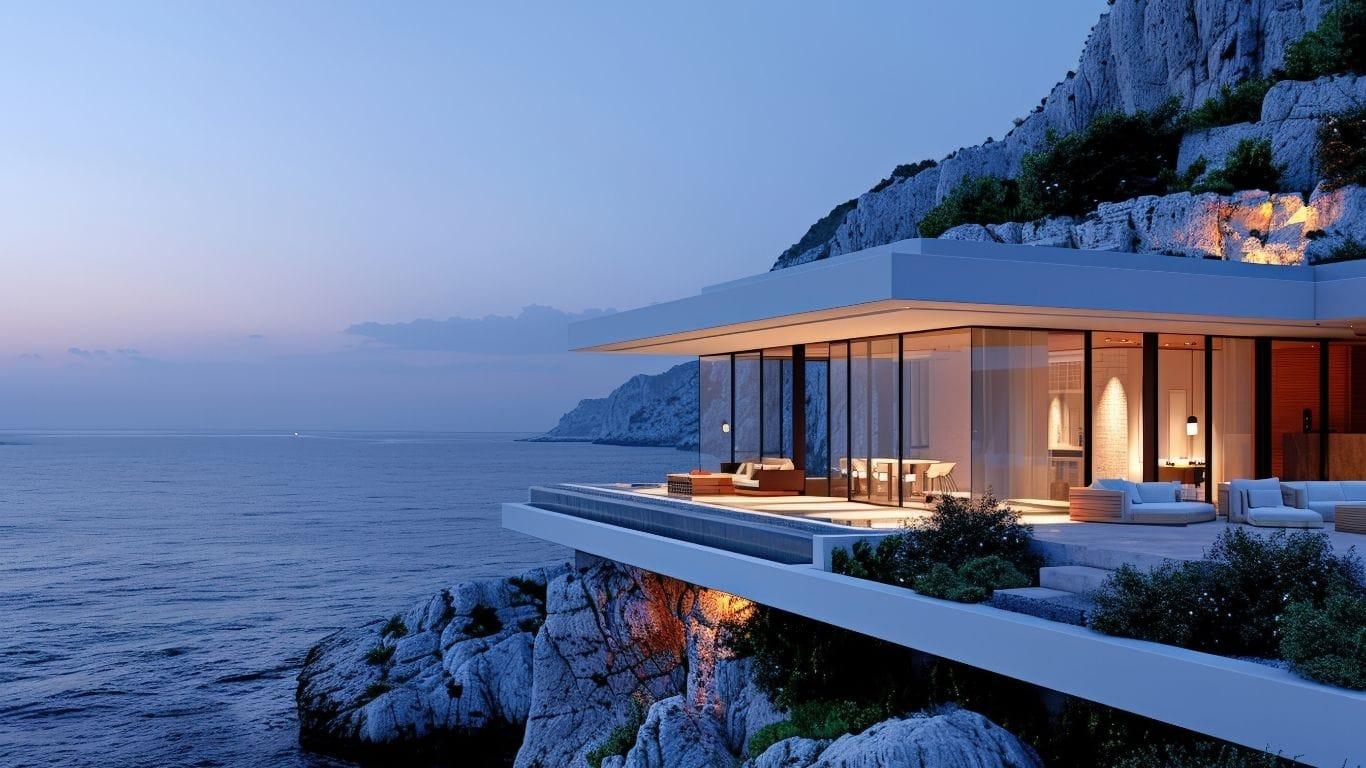
The waterfront property conversation in 2026 has matured.
The Sotheby's International Realty Luxury Outlook and Knight Frank's Wealth Report both register the same pattern: the most consistently sought-after waterfront residences are no longer defined by raw view alone but by an interlocking set of architectural, climate-resilience and design qualities that the design-literate buyer set has been steadily reweighting toward.
Mansion Global's coastal-property archive has tracked this drift carefully, from the Cap d'Antibes restorations to the Hamptons new-build commissions, from the Lake Como villa market to the Sydney Harbour prime addresses, the segment that matters now combines architectural pedigree with serious environmental thinking.
What follows is an editorial read on the markets that actually matter for serious waterfront buyers in 2026, and why the design conversation around waterfront living has shifted as decisively as it has.
- Waterfront prime stock continues to outperform inland luxury in several key markets, although the gap is narrowing as climate-risk pricing begins to bite.
- We see Miami, Palm Beach, the Hamptons and parts of the Côte d'Azur leading the global waterfront premium conversation in 2026.
- Insurance pricing has become a meaningful underwriting variable for waterfront homes, with several US carriers withdrawing from exposed coastal markets entirely.
- Mediterranean waterfront remains structurally supply-constrained, which is part of why the French and Italian Riviera continue to anchor European prime pricing.
- Buyers are paying more attention to sea-level projections and storm-surge modelling, with several family offices commissioning their own climate analysis pre-purchase.
- For long-hold positions we view the best waterfront assets as still attractive, but the underwriting discipline now required is materially higher than even five years ago.
- Who is this for?
- Prime buyers considering waterfront acquisitions, family offices weighing climate exposure within their property allocations and advisers serving cross-border coastal buyers.
- What is happening?
- A market read of the waterfront luxury segment for 2026, covering the leading markets, insurance and climate considerations, and key buyer behaviour patterns.
- When did this emerge?
- The article reflects market conditions and pricing dynamics as observed through late 2025 and into 2026, including the most recent climate-risk underwriting shifts.
- Where is this happening?
- The piece covers Miami, Palm Beach, the Hamptons, Monaco, the Côte d'Azur, the Italian and Sardinian coasts, and the leading Caribbean and Mediterranean island markets.
- Why does it matter?
- Waterfront acquisitions now require climate and insurance diligence that was optional a decade ago, which is why understanding the current market geography matters.
The architectural and design shift
The waterfront segment gets tracked separately by the major brokerage research desks. Knight Frank's waterfront-property work and Savills' world-cities research both surface the price differential between equivalent inland and waterfront properties.
The brokerage transaction record adds confirmation. Sotheby's International Realty and Christie's International Real Estate publish listing data that shows the premium has held up consistently across the Mediterranean, the U.S. Northeast, the Caribbean and select Asian markets.
The studios most active in waterfront residential commissions today, John Pawson, Studio KO, Vincent Van Duysen, Annabelle Selldorf, Studio MK27, Charles de Lisle, Joseph Dirand, Renzo Piano Building Workshop, have all built portfolios that take the climate question seriously.
Elevated foundations, flood-resistant materials, climate-resilient detailing, and renewable-energy integration are no longer engineering afterthoughts but design priorities. The Hamptons new-build commissions of recent years routinely sit on substantially elevated foundations.
The Caribbean villa restorations being led by studios such as Studio MK27 and SAOTA factor in hurricane-resilience as a baseline.
Sustainability has moved from optional to expected. The buyers actively in the market have made energy efficiency, responsibly sourced materials, and water-conservation infrastructure baseline criteria. Properties that fail to meet these standards have begun to discount accordingly.
The Cap d'Antibes and Cap Ferrat restorations of the past five years have integrated solar systems, rainwater harvesting and high-efficiency mechanical specifications without compromising the period architectural envelope.
The technology layer has matured similarly. Smart-home systems are baseline. The most sophisticated commissions, from Monaco's high-rise prime to the Florida Gulf Coast, include private-marina automation, smart docking and high-bandwidth marine connectivity.
Architectural Digest's coverage has tracked these features as part of the standard luxury-waterfront specification rather than as differentiators.
Wellness and outdoor living
For deeper context, the breakdown in where waterfront fits inside the broader luxury-property taxonomy is worth reading alongside this analysis.
Wellness amenities are now an expected layer of waterfront design. The Maldives villa market, the Cap d'Antibes private estates, the Bali resort-residential developments, and the Dubai waterfront prime towers all incorporate substantive wellness infrastructure, yoga decks, meditation gardens, treatment suites, breathwork facilities, integrated outdoor-fitness areas.
The waterfront context, the ability to swim, paddle, walk a coastal path before breakfast, gives the wellness conversation a coherence that urban properties cannot match.
The markets that matter
Cap d'Antibes and the Côte d'Azur
The Cap d'Antibes prime segment, the 1920s villas commissioned during the Riviera's first heyday, the post-war restorations, the contemporary design-led commissions, anchors the European waterfront conversation. The Hôtel du Cap-Eden-Roc remains the cultural reference point. Knight Frank's Côte d'Azur tracking and Engel & Völkers's Riviera coverage both place Cap d'Antibes, Cap Ferrat and the Saint-Jean-Cap-Ferrat / Beaulieu corridor at the deepest tier of European prime waterfront.
Cap Ferret on the Atlantic side has been gaining serious design-led buyer interest from the same cohort.
Lake Como
The Lake Como villa market, Bellagio, Tremezzo, Cernobbio, Menaggio, operates on a register of historic villa stock, mountain backdrop and proximity to Milan that no other lake market in the world can match. Villa d'Este, the Mandarin Oriental Lago di Como, and the smaller hotel-residence properties anchor the cultural infrastructure. The villa market is exceptionally constrained, most genuine waterfront villas have been in family ownership for generations.
Monaco
Monaco operates as a singular waterfront market. The principality's high-rise prime, Le Sporting, the Tour Odéon, the One Monte-Carlo development, combines the most expensive per-square-meter pricing in the world with the legal and tax framework that has anchored its buyer pool for nearly a century. Knight Frank's Prime International Residential Index tracks Monaco at the very top of the global rankings consistently.
The Hamptons
The Hamptons compound segment, East Hampton's Lily Pond Lane, Southampton's Meadow Lane, the Bridgehampton estates, the Sagaponack oceanfront, anchors the American waterfront prime conversation. M. Stern Architects, Bates Masi, Selldorf Architects and others.
Lasata, the East Hampton estate Tom Ford acquired in 2024, is a representative example of the provenance-led trade defining the upper end.
Miami and the Florida Gulf Coast
The Miami waterfront, Indian Creek Island, Star Island, Sunset Islands, Key Biscayne, Coconut Grove, anchors the U.S. East Coast contemporary segment. The architectural register has shifted dramatically over the past decade toward studios such as SAOTA, Studio MK27, Oppenheim Architecture, Zaha Hadid Architects (the One Thousand Museum tower), and Renzo Piano (the Eighty Seven Park development). The Florida Gulf Coast, Naples, Sanibel, Captiva, operates as a quieter but equally serious market.
Sydney Harbour
Sydney's harbour-front prime segment, Point Piper, Vaucluse, Mosman, the Northern Beaches, combines architectural depth (the harbour-front modernist commissions, the Federation-era waterfront houses), the Opera House and Harbour Bridge as visual anchors, and a buyer pool drawn from across the Asia-Pacific region. Christie's International Real Estate's Sydney coverage has documented record-breaking trades in the segment.
Dubai
Dubai's waterfront prime, Palm Jumeirah, the Burj Al Arab waterfront, Bluewaters, Jumeirah Beach Residence, operates on the contemporary architectural model. The market has matured substantially from the speculative period and now anchors a genuine ultra-high-net-worth buyer pool, particularly from South Asia, the Gulf and the Russian-speaking world.
Vancouver, Auckland, Honolulu
The Pacific Rim waterfront segment, Vancouver's Coal Harbour and West Vancouver, Auckland's Herne Bay and Westmere, Honolulu's Kahala and Diamond Head, anchors the lower-volume but architecturally distinctive Pacific waterfront conversation. Each market has its own cultural register and architectural inheritance.
Lisbon and the Portuguese coast
The Lisbon waterfront, the Estoril and Cascais coast, and the Comporta beachfront further south have emerged as one of the most actively traded European waterfront markets. Studio KO, Vincent Van Duysen and others have led significant Comporta commissions. The Portuguese Golden Visa programme, while currently under political review, supported the international buyer thesis.
Climate-resilience as a defining 2026 priority
Climate exposure is now priced into waterfront valuations as a serious discount factor for properties without resilient design. Bloomberg-tracked coastal insurance pricing has risen materially across the Florida market, parts of the Caribbean and selected Mediterranean markets. The buyers actively in the market are increasingly willing to pay a clear premium for properties with elevated foundations, hurricane-resistant materials, modern flood resilience and serious renewable-energy integration.
Properties without these characteristics are seeing softer demand, particularly in the new-build segment.
What the design-led waterfront buyer is concentrating on now
The cohesive picture of the 2026 waterfront-property segment: architectural pedigree from the right studios; climate-resilient design treated as a baseline rather than an upgrade; renewable energy integration; mature wellness infrastructure; provenance-led acquisitions in the historic markets (Cap d'Antibes, Lake Como, the Hamptons); and contemporary architectural commissions in the newer markets (Miami, Dubai, Comporta).
The buyers anchoring the segment treat waterfront residence as a long-term cultural asset whose value compounds across decades. The architects, designers and senior brokers they work with are the through-line that makes the segment cohere.
Frequently asked
What defines a serious waterfront property in 2026?
Architectural pedigree, location specificity, climate-resilient design, and integration of contemporary wellness and technology infrastructure.
Which markets matter most for international waterfront buyers?
Cap d'Antibes / Côte d'Azur, Lake Como, Monaco, the Hamptons, Miami / Florida Gulf Coast, Sydney Harbour, Dubai (Palm Jumeirah and Bluewaters), Vancouver, Auckland, Honolulu, and the Lisbon / Comporta corridor.
Which architects are most active in waterfront residential commissions?
John Pawson, Studio KO, Vincent Van Duysen, Annabelle Selldorf, Studio MK27, SAOTA, Charles de Lisle, Joseph Dirand, Renzo Piano Building Workshop, Oppenheim Architecture, Robert A.M. Stern Architects.
How does climate resilience affect waterfront pricing?
Properties with elevated foundations, hurricane-resilient design, modern flood resilience and serious renewable-energy integration are commanding premia; properties without these features are increasingly discounted.
Related reading on The Luxury Playbook: Trophy Properties: Why Billionaires Love Them.
We last reviewed this analysis in May 2026.