
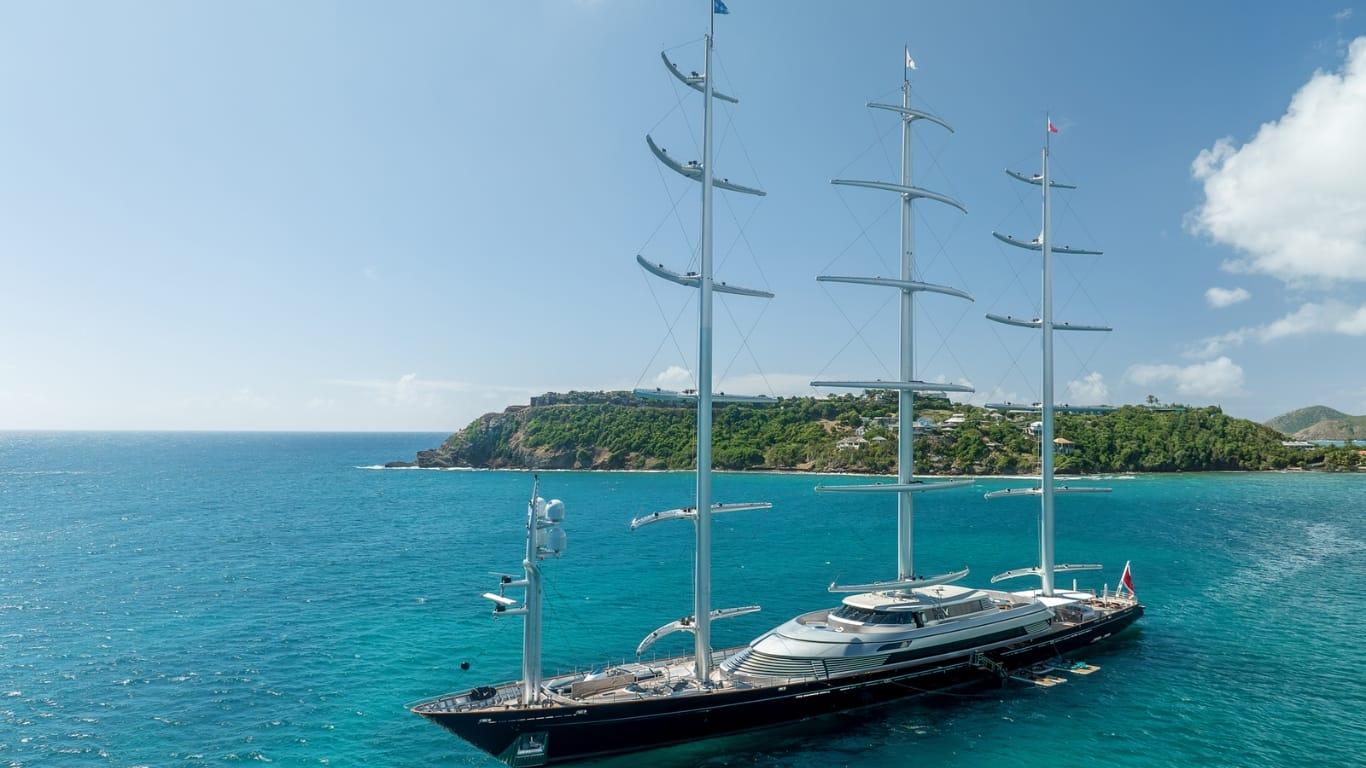
The Maltese Falcon is, by any honest reckoning, the only large-scale at-sea proof of a 1960s engineering thought experiment. Wilhelm Prölss sketched the DynaRig as a fuel-saving merchant-marine concept when oil was cheap and wind power was a curiosity, and for forty years the drawings sat in a Hamburg filing cabinet. Then a Silicon Valley venture capitalist with a taste for difficult projects asked an Italian shipyard and a Dutch naval architect what it would take to build the thing at sea-going scale. The answer was an 88-metre carbon-masted square-rigger that arrived in 2006 and rewrote what a very large sailing yacht could plausibly do.
Nearly two decades on, the rig has been built at this scale exactly one more time. Boat International has put the Falcon on its cover more than once, and the boat has taken Showboats Design Awards and World Superyacht Awards in numbers few hulls match. The shorthand on her performance is the one you hear in every dockside conversation: more than 25,000 square feet of square sail set or struck from the bridge by a single operator, deployment time around six minutes, recorded sailing speeds north of nineteen knots. The build cost, reportedly close to US$130 million in 2006 currency, was the price of finding out whether Prölss had been right. He had been.
Key Takeaways & The 5Ws
- The Maltese Falcon is an 88-metre three-mast Perini Navi build delivered in 2006 for Tom Perkins; she remains the only large-scale at-sea proof of Wilhelm Prölss's 1960s DynaRig concept.
- The rig uses three free-standing rotating carbon-fibre masts carrying square sails on fixed yards, with the 25,000-plus square feet of sail area deployable from the bridge by a single operator in roughly six minutes.
- Naval architecture is by Dykstra Naval Architects; interior by Ken Freivokh; carbon-mast engineering developed with Insensys (later TPI Composites) and Magma Structures.
- The Falcon has been recorded sailing in excess of nineteen to twenty knots and is among the fastest very-large sailing yachts ever built; her design has won numerous Showboats and World Superyacht Awards.
- The DynaRig has been built at this scale only once more: the 106-metre Black Pearl, launched by Oceanco in 2018. Twenty years after the Falcon, the rig still has no third large hull at sea.
- Who is this for?
- Sailing-yacht owners and charter principals weighing the next generation of large rigs, design-curious readers, and the engineering crowd that has been quietly following the DynaRig since the original Prölss papers.
- What is it?
- The editorial story of the Maltese Falcon and the DynaRig as a built engineering proof: how a 1960s concept became an 88-metre Perini Navi hull, and why it still defines the upper bound of what a very large sailing yacht can do.
- When does it matter most?
- Now, as the next generation of large sailing yachts is being scoped and the second DynaRig hull, Black Pearl, has matured into a known quantity at sea rather than a speculative follow-on.
- Where does it apply?
- The Perini Navi alumni shipyards, the Dykstra Naval Architects project book, and the European sailing-superyacht market where square-rig efficiency is on the table.
- Why consider it?
- Because the rig changes what a very large sailing yacht can actually do at sea, and because the design language the Falcon established has not, in our reading, been surpassed.
Prölss And The 1960s Thought Experiment
Wilhelm Prölss was a German engineer at the University of Hamburg working a problem that, in the mid-1960s, looked like a curiosity. Merchant ships burned cheap bunker fuel; wind was free but operationally awkward, because traditional square rig demanded crew aloft and a long sail-handling drill that no commercial operator wanted to staff. His answer was the DynaRig: free-standing rotating masts carrying square sails on fixed yards, with the sails stowed inside the mast itself and deployed by an internal mechanism. No yardmen, no climbing. The whole rig presented as a single articulated wing to the breeze.
It was an elegant solution to a problem nobody quite had. The oil shocks of the 1970s briefly revived interest in wind-assisted merchant shipping, but no operator built the rig. The materials were not ready: free-standing masts of the required height needed carbon-fibre composite that the era could not produce at scale, and the control systems implied integration that no working hull had received. By the 1990s the concept was a footnote in naval architecture coursework. What changed was Silicon Valley. Tom Perkins, the Kleiner Perkins venture capitalist and serial yacht commissioner, found his way to the Prölss drawings through Dykstra Naval Architects. The question changed from whether the DynaRig could work to who would build it.
Perkins, Perini, And The 2006 Build
The answer was Perini Navi, the Viareggio shipyard that had spent two decades teaching itself how to build very large sailing yachts. Perini took the hull. Dykstra took the naval architecture and the rig engineering brief. Ken Freivokh took the interior, working with Perkins on a deck plan that had to absorb three rotating mast bases without any of the conventional standing rigging that ordinarily organises a sailing yacht's deck. The carbon-mast work went to Insensys, the UK composites firm that later became part of TPI Composites, with Germany's Magma Structures contributing to the rig engineering. Doyle Sails built the square sails to a brief with no recent precedent.
What emerged at launch in 2006 was an 88-metre three-mast hull carrying a sail plan that read like a clipper ship on first glance and like nothing that had ever sailed on second. The build cost was reportedly close to US$130 million in 2006 currency, roughly what a comparable motor yacht of that LOA would have cost, with the difference that no comparable sailing yacht existed at all. Perkins sailed her, then sold her around 2009 to Elena Ambrosiadou. Perini Navi itself went through later restructuring and now sits within The Italian Sea Group. The Falcon has moved through subsequent ownership and remains an active charter and private vessel.
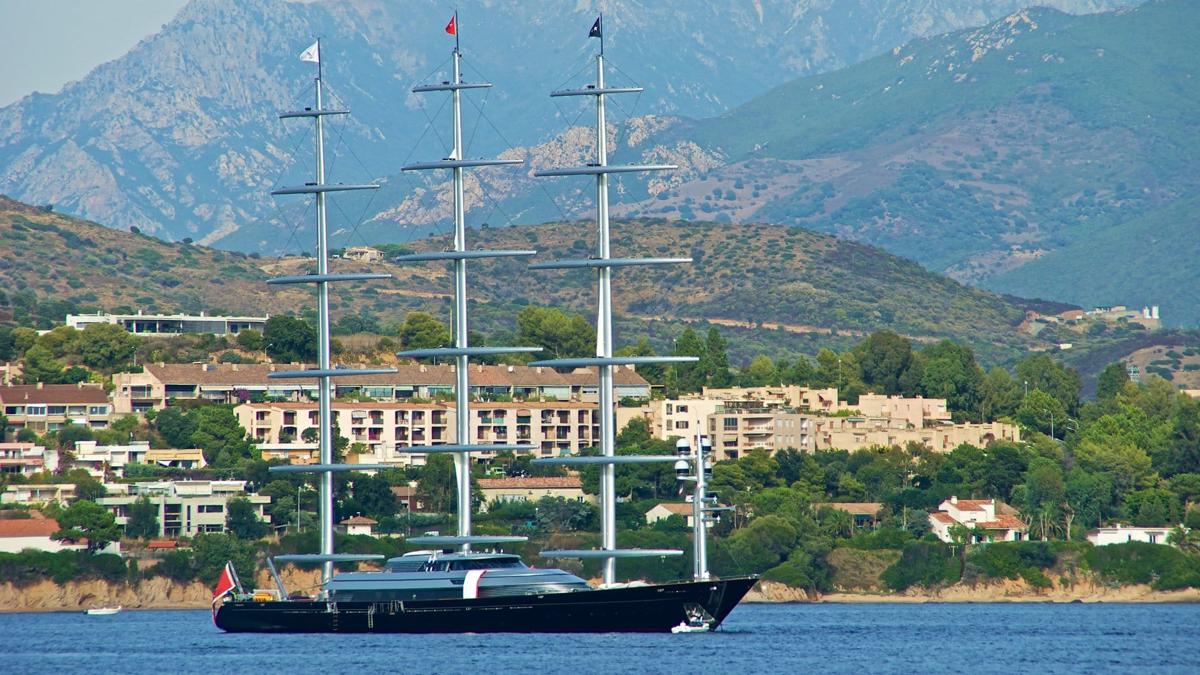
Photo: Voilier (under sail) by JeanbaptisteM via Wikimedia Commons (CC BY 2.0)
How The DynaRig Actually Works
The rig's elegance is that it presents to the breeze as a single articulated wing. Each of the three masts rotates independently, which means each can be trimmed to the apparent wind angle at its own height. The sails are square, set on fixed yards, and unfurl outward from the mast along the yard like a roller blind extending sideways. When fully deployed, the three masts present a wall of square canvas roughly 200 feet tall; when furled, the sails disappear inside the spar and the rig presents only the masts themselves.
The control system is the part that makes the difference. Conventional square rig requires a yard crew and a sail-handling drill that no modern yacht carries. The DynaRig replaces all of that with hydraulic deployment mechanisms inside each mast and a bridge console that reads sail set, mast rotation, and load on each spar. The single-operator capability is not marketing copy; it is a hard engineering achievement. The Falcon's bridge can set or strike the entire 25,000 square feet of sail in around six minutes without anyone leaving the wheelhouse.
Performance has matched the geometry. The Falcon has been recorded sailing in excess of nineteen to twenty knots in honest breeze, which places her among the fastest very-large sailing yachts ever built. Her efficiency upwind is better than the silhouette suggests, because the rotating masts let the sails work at angles a fixed square rig could never reach. The dockside conversation about whether a square-rigger could be a fast sailing yacht ended, in our reading, the first season she sailed.
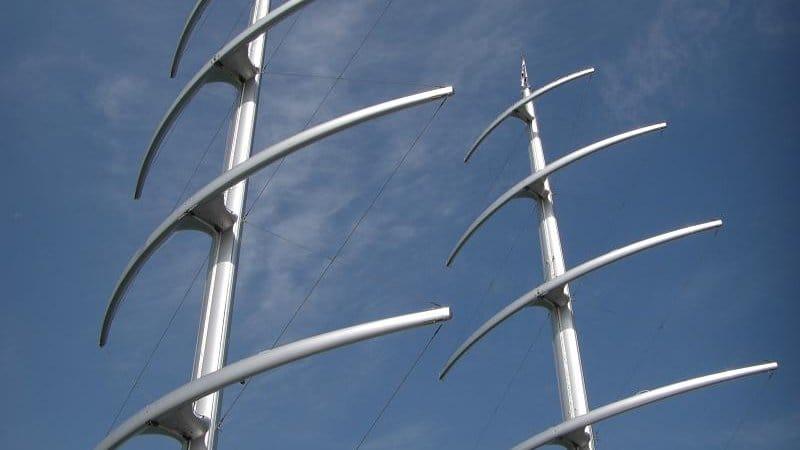
Photo: DynaRig close-up by krisfrye via Wikimedia Commons (CC BY-SA 2.0)
Black Pearl And The Second Generation
The Falcon's commercial follow-on took twelve years to arrive. Black Pearl, launched by Oceanco in the Netherlands in 2018, is a 106-metre three-mast DynaRig hull with a brief that explicitly built on the Falcon's proof. The Pearl refined the rig: composite mast technology had moved on, the control systems had another decade of yacht-industry maturity, and the hull form was designed from the outset around the DynaRig rather than retrofitted to accept it. The result is a yacht that sails harder than the Falcon and carries the rig at larger scale without giving anything away on handling.
After Black Pearl, the queue stopped. Dykstra has published technical notes on further DynaRig applications, and several owners have looked seriously at the rig for next-generation hulls. Almost none have committed. The reasons are conservatism rather than engineering: the rig is bespoke, the supplier chain is narrow, and a principal building a 100-metre-plus sailing yacht has every incentive to specify a rig other yards know how to build and other crews know how to sail. The next decade of large sailing-yacht commissions is the period in which a third DynaRig hull becomes likely. If it arrives, it will almost certainly come out of a Dutch yard with Dykstra on the naval architecture, because that is where the institutional knowledge lives.
Why The Maltese Falcon Still Matters In 2026
Twenty years after launch, the Falcon's design awards record reads like a parody of completeness: Showboats Design Awards, World Superyacht Awards, repeated Boat International covers, the kind of magazine schedule boats simply do not maintain for two decades. She still draws attention in every harbour she enters, and not as nostalgia. She draws attention because the silhouette is correct: the rig looks like what a very large sailing yacht ought to look like in 2026 rather than 2006.
The wider yachting market is moving in a direction the Falcon anticipated: larger sail plans, smaller operating crews, integrated control systems, and a willingness to specify carbon-composite rigging at scales that were exotic when she launched. For broader market context, see our note on the future of the superyacht market through 2032, and for the Dutch shipyard story that produced her successor, see why every billionaire wants a yacht built in the Netherlands. Our editorial read is that the Maltese Falcon is the yacht against which all future large sailing commissions will be implicitly measured, whether they specify a DynaRig or not. She established what the rig could do at sea, she set the design vocabulary, and she did it twenty years before the market was ready to absorb the lesson. The market is catching up. The Falcon is still the reference.

.jpg)
.jpg)