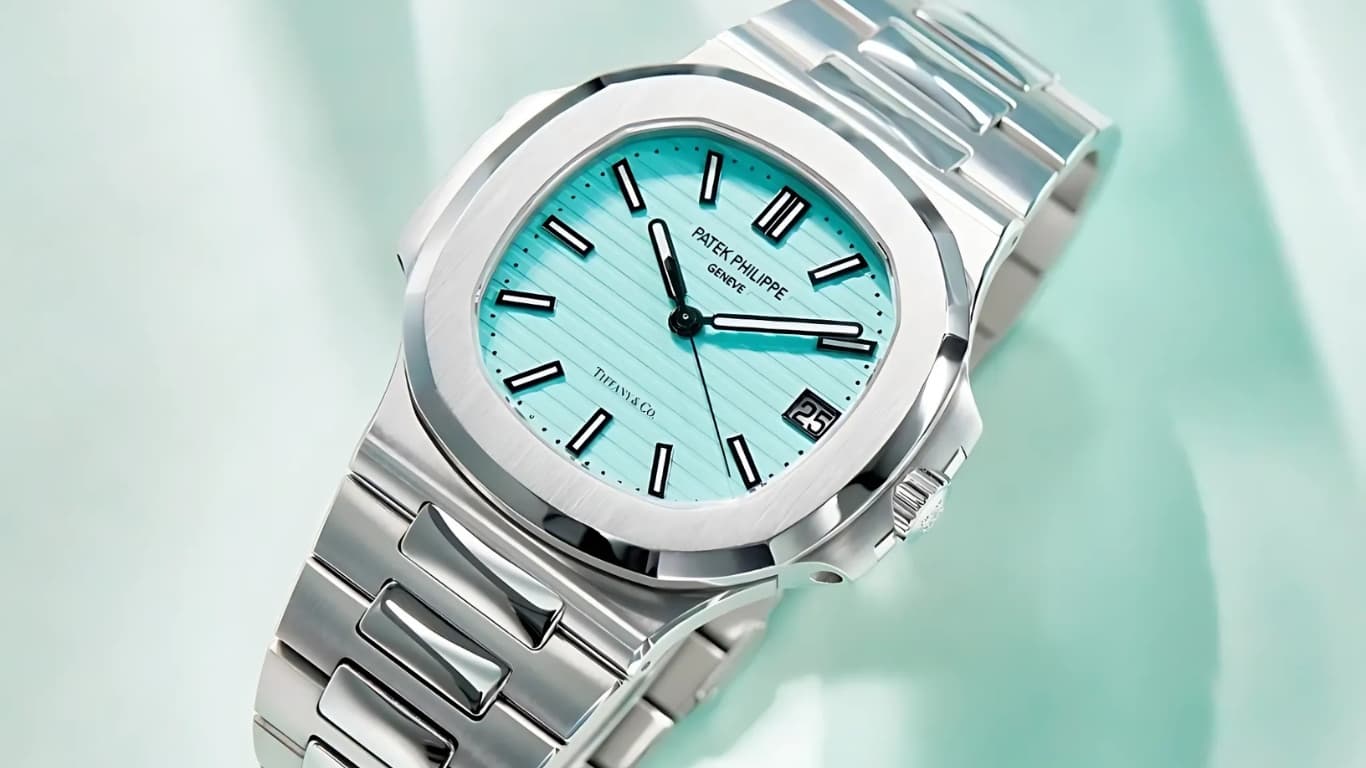
When Patek Philippe unveiled the Nautilus 5711/1A-018 in Tiffany Blue back in December 2021, the watch world went through what felt like a genuine turning point.
The first piece sold for $6.5 million at Phillips New York, nearly 124 times its $52,635 retail price, sending shockwaves through collector circles and investment forums overnight. Celebrity sightings piled on fast, with Jay-Z wearing his in December 2021 and LeBron James spotted at Le Mans in June 2023, amplifying what was already becoming a full-blown speculative frenzy.
For watch investors, the Tiffany Nautilus seemed to validate the thesis that modern steel sport watches had arrived as legitimate alternative assets worth serious capital allocation. But the story behind that thesis is a lot more complicated than the headlines suggested.
What actually emerged was something more troubling: a cautionary tale about how scarcity, celebrity endorsement, and auction theater can create unsustainable valuations that mislead an entire generation of collectors about what constitutes sound watch investment.
Table of Contents
Key Takeaways
Navigate between overview and detailed analysisKey Takeaways
- The Tiffany Blue Nautilus release in 2021 symbolized the height of modern watch speculation, driven more by hype than fundamentals.
- Its astronomical auction debut at $6.5M was less a sustainable valuation and more a product of artificial scarcity and publicity.
- Celebrity appearances by Jay-Z and LeBron James amplified demand, fueling a frenzy across blue-dial watches and sport models.
- Resale performance since then shows volatility and declining values, exposing the risks of chasing hype-driven assets.
- The Tiffany Nautilus remains culturally iconic, but it should be viewed as a market anomaly rather than a blueprint for reliable watch investing.
The Five Ws Analysis
- Who:
- Patek Philippe and Tiffany & Co., with only 170 collectors worldwide able to access the watch at retail.
- What:
- A special-edition Nautilus 5711/1A-018 in Tiffany Blue, launched to commemorate 170 years of partnership between the brands.
- When:
- Released in December 2021, coinciding with the discontinuation of the Nautilus 5711 line.
- Where:
- Sold exclusively through Tiffany boutiques in New York, Beverly Hills, and San Francisco, later resold at global auction houses.
- Why:
- Created as a celebratory “farewell” model, it became a speculative symbol of how scarcity, celebrity, and marketing can distort luxury watch valuations.
The Historic Collaboration Between Patek Philippe and Tiffany and Co.
The partnership between Patek Philippe and Tiffany and Co. stretches all the way back to 1851, when Tiffany began selling Patek timepieces, with a formal agreement following in 1854. That 170-year relationship gave Patek the historical foundation it needed when releasing the 5711/1A-018 as a commemorative piece in 2021.
Production was deliberately microscopic, just 170 pieces worldwide, distributed exclusively through Tiffany boutiques in New York, Beverly Hills, and San Francisco. Each watch carried dual signatures on the dial and case engravings reading “170th Anniversary Tiffany and Co. Patek Philippe 1851 to 2021,” creating the kind of documentation that supposedly justifies extraordinary valuations.
The timing was no accident. Patek announced the 5711’s discontinuation in 2021, positioning the Tiffany edition as both a farewell to an iconic reference and a celebration of a historic partnership. Two powerful narratives, delivered simultaneously.
As Thierry Stern, President of Patek Philippe, described it: “The Tiffany Blue Nautilus is our victory lap for the 5711, celebrating 170 years of partnership with Tiffany & Co.”

Auction Records That Shocked the Watch Market
The charity auction in December 2021 set a benchmark that would warp market perceptions for years. The $6.503 million result at Phillips New York became the headline that launched thousands of speculative purchases. The fact that proceeds benefited The Nature Conservancy added a thin layer of philanthropy to what was, at its core, market manipulation through artificial scarcity.
Subsequent sales exposed the volatility hiding beneath those headline numbers. An April 2023 example achieved HKD 20.4 million (roughly $2.6 million) at Sotheby’s, which sounds impressive until you realize that was a 60% decline from the initial charity sale. Private sales in 2026 are estimated at €3 to €4 million, suggesting continued erosion from peak valuations.
Within the Nautilus lineage, the Tiffany edition ranks among the five most expensive results, surpassing prior modern steel benchmarks like the Reference 1518 in steel at $3.6 million in 2019. But those comparisons hide a critical distinction. Vintage Patek references that command high prices typically earn them over decades of proven collectability. The Tiffany Nautilus reached those same heights within months, powered almost entirely by manufactured hype.
Why the Tiffany Nautilus Became an Instant Investor Benchmark
The formula that created the Tiffany phenomenon combined several elements that, in hindsight, should have raised caution flags rather than investment enthusiasm. The limitation to 170 units created artificial scarcity. The co-signed dial and farewell narrative gave luxury marketing the storytelling framework it needed. And the high-profile charity auction planted a price anchor with almost no relationship to intrinsic value.
Celebrity endorsements then accelerated what might have otherwise been a gradual price discovery process. When Jay-Z wore the watch publicly and LeBron James appeared with it at Le Mans, they handed the market exactly the social proof it needed to convince ordinary collectors this was a serious investment rather than speculative gambling.
The cultural hype spread well beyond the Tiffany Nautilus itself. Prices for Rolex Oyster Perpetual turquoise dials and other vaguely similar sport watches spiked to multiples of retail during 2021 and 2022, showing just how far irrational exuberance can travel through an entire market segment based on nothing more than superficial color similarities. If you want to understand how that kind of bubble forms and spreads, the pattern is more familiar than most collectors would like to admit.
One of Hodinkee’s watch editors captured the prevailing sentiment: “This watch is not just a timepiece; it’s a cultural phenomenon. The Tiffany Blue dial elevates the Nautilus into a new world of desirability.”
That breathless commentary, repeated across watch media and social platforms, helped transform what should have been recognized as a temporary market distortion into an accepted investment thesis. And once that thesis took hold, it was very hard to dislodge.

Did the Tiffany Blue Nautilus Create a New Era of Watch Investing?
The Tiffany Nautilus successfully blurred the line between passionate collecting and financial speculation, but not in ways that benefit most watch enthusiasts. Buyers who entered the market during 2021 and 2022 convinced themselves they were making sophisticated alternative asset allocations. In reality, they were participating in a greater fool scheme that depended entirely on finding subsequent buyers willing to pay even higher prices.
The watch did generate sustained demand for blue-chip Patek sport models, with Tiffany-signed pieces now treated as investment-grade collectibles by those who need to justify their purchases. Standard 5711 models surged from roughly $30,000 retail pre-discontinuation to $100,000 to $150,000 in secondary markets, enriching those who already owned the watches while creating painful losses for late entrants.
Current resale data for the Tiffany edition tells a sobering story. WatchCharts shows prices in late 2026 hovering around €1.04 million, while private sales reportedly range between €3 million and €4 million. That wide spread points to a thin, inefficient market where valuations depend heavily on the specific circumstances of each transaction rather than any underlying fundamental value.
The broader market flashes similar warning signs. By Q2 2026, pre-owned watch prices had declined just 0.3%, with stabilization led by Rolex and Patek. That stability sounds reassuring until you remember it follows dramatic declines from 2022 and 2023 peaks, meaning many investors are still underwater on purchases made during the Tiffany-driven frenzy.
The Ripple Effect on Patek Philippe and the Wider Market
Within Patek’s lineup, the Tiffany episode supercharged Nautilus visibility and values, pushing pricing into territory that has almost nothing to do with these watches as actual timekeeping instruments. The transition to the 5811/1G following the 5711’s discontinuation maintained the artificial scarcity that keeps prices inflated rather than allowing any natural market correction.
The spillover proved particularly damaging for collectors of other brands. Rolex’s turquoise-dial Oyster Perpetuals, especially the discontinued 41mm versions, commanded enormous premiums based solely on superficial color similarity to the Tiffany Nautilus. You can trace exactly how Rolex’s material decisions feed into secondary market premiums if you follow the money carefully enough.
In 2025, these watches still trade above retail despite having no meaningful connection to the Patek collaboration beyond sharing a color palette.
Investment interest then spread to Audemars Piguet and Richard Mille, reinforcing luxury sports watches as an “asset class” despite the fact that they lack the liquidity, price transparency, and regulatory protections that characterize actual investable asset classes. That categorization error has led countless collectors to allocate serious capital to watches using investment frameworks that simply do not account for the unique risks and costs of physical luxury goods.
The Tiffany Nautilus now functions as a market signal, with experts pointing to its performance as a read on high-end watch demand overall. Relying on a single, artificially scarce reference as a market barometer says a great deal about how immature watch investing still is compared to established alternative asset categories.
The investment returns look striking on paper. The Tiffany Blue 5711 resale range of €1.04 million to €3 or €4 million translates to a massive return on its retail price, and Nautilus references overall have shown annualized returns of 12% to 30% on average, driven by rarity and desirability. Financial Times coverage of the alternative assets space has noted how these numbers attract capital that might otherwise flow into more conventional investments.
But those figures hide several uncomfortable realities. The vast majority of collectors cannot access these watches at retail. Secondary market liquidity is limited. Transaction costs are high. And past performance during an period of monetary expansion tells you very little about what comes next.
The fundamental problem with the Tiffany Nautilus as an investment case study is that it mistakes a unique convergence of circumstances, a 170-year anniversary, a 170-piece production run, celebrity endorsement, a charity auction, and the discontinuation of the reference, for a repeatable investment strategy. None of those ingredients can be replicated on demand.
For every collector who bought at retail and sold at peak, dozens paid inflated secondary market prices on the belief that “Patek always appreciates.” What they missed is that investment-grade vintage Patek references earned their status over decades, not months. Bloomberg’s reporting on collectible asset bubbles has made this point repeatedly, and the Tiffany Nautilus story fits that pattern almost perfectly. If you found yourself caught up in that excitement, you are far from alone. But knowing how it happened is the first step to making sharper decisions next time.

Stefanos Moschopoulos
Stefanos Moschopoulos is the Founder and Head of Editorial at The Luxury Playbook, specializing in fine assets and alternative investments. His work focuses on analyzing luxury asset classes such as art, watches, collectibles, and yachting as structured investment vehicles, aligning them with broader wealth-building strategies. He leads the editorial direction of the publication, ensuring all content around alternative assets is data-driven, macro-aware, and investment-focused. His expertise lies in translating niche luxury markets into clear frameworks for portfolio diversification, long-term capital preservation, and asymmetric returns within non-traditional asset classes.