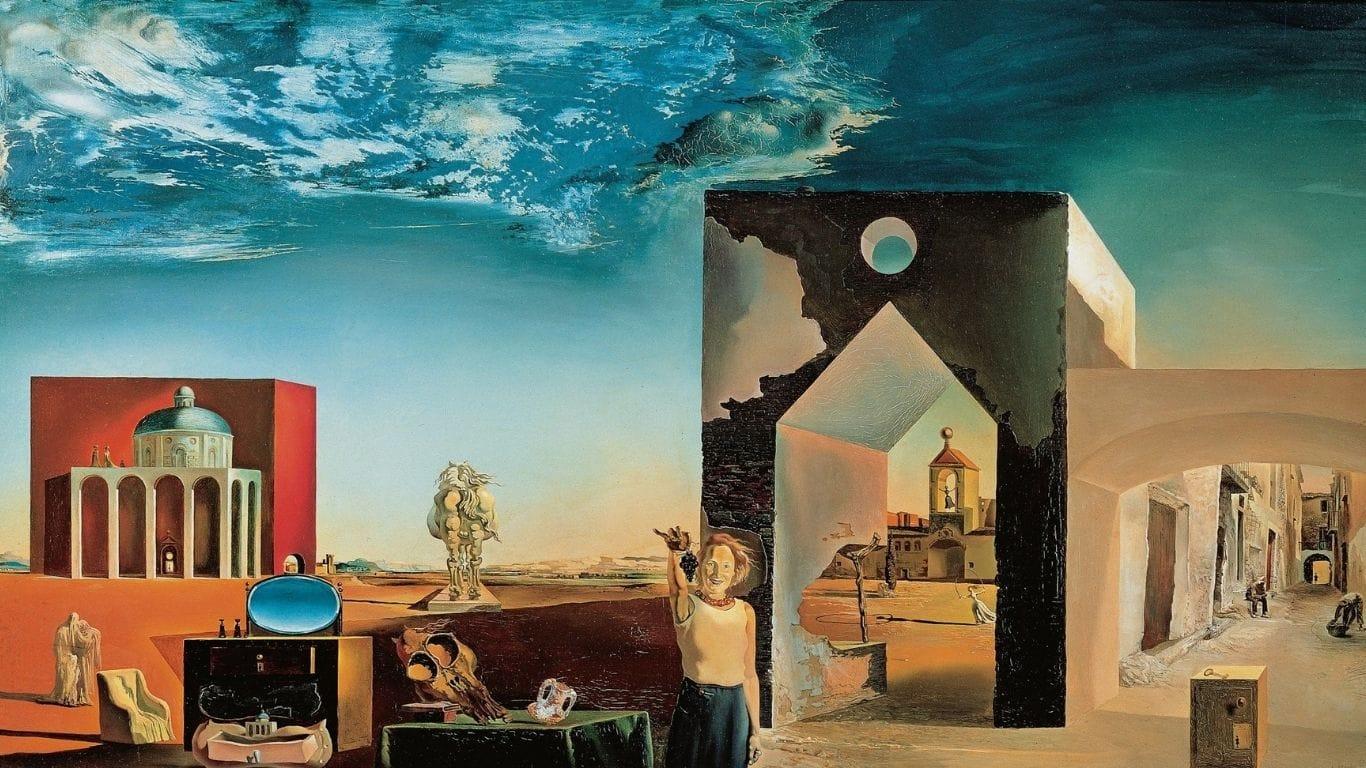
Salvador Dalí (1904-1989) sits in a category of his own in the modern market: a household name whose serious work is far smaller than his public profile suggests. The collectors who do business in Dalí at auction know that the catalogue divides cleanly between a small spine of museum-grade canvases and a much wider field of decorative, late, and authentication-fraught works.
The benchmark transactions are anchored at the museum end of that catalogue. Sotheby's, Christie's, and the Fundació Gala-Salvador Dalí have spent four decades sorting the corpus, and the painting-by-painting market we cover today is the result of that work.
- Salvador Dali, working between 1904 and 1989, sits in a category of his own where the serious work is far smaller than his public profile suggests.
- The 1929 to 1936 surrealist core produced the Dali paintings the market values above all others, with most canonical examples held institutionally rather than traded publicly.
- The Persistence of Memory at MoMA, The Great Masturbator at the Reina Sofia and Soft Construction with Boiled Beans at the Philadelphia Museum of Art anchor the corpus.
- Sotheby’s London sold Portrait de Paul Eluard from 1929 for thirteen point five million pounds in February 2011, a benchmark for the cohort.
- The classical period after 1940, including The Sacrament of the Last Supper at the National Gallery of Art, has rerated upward across the past two decades.
- Dali has the worst authentication landscape of any major twentieth-century artist, with the Comite Dali and the Fundacio Gala-Salvador Dali anchoring the active framework.
- Who is this for?
- Modern art collectors, advisors and observers of the Dali market who want a clear read on which paintings actually define the artist’s auction tier and which sit outside it.
- What is happening?
- An editorial overview of the Salvador Dali paintings that defined his market, covering the surrealist core, the classical period, the authentication landscape and the dealer infrastructure.
- When did this emerge?
- Most relevant around the May and November Impressionist and Modern sales at Christie’s and Sotheby’s and during major Dali loan exhibitions across European and American institutions.
- Where is this happening?
- Centred on the New York and London salesrooms at Christie’s and Sotheby’s, with institutional holdings at MoMA, the Reina Sofia, the Philadelphia Museum of Art and the Dali Museum in St Petersburg.
- Why does it matter?
- Understanding which Dali paintings actually carry the market protects collectors from the wider authentication landscape and supports disciplined engagement with one of modernism’s most uneven secondary segments.
The 1929-1936 surrealist core
The decade from 1929 to 1936 produced the Dalí paintings the market values above all others. These are the works of his first surrealist phase: small, hallucinatory, technically meticulous, and made when the artist was central to André Breton's surrealist circle in Paris.
"The Persistence of Memory" (1931, MoMA), "The Great Masturbator" (1929, Reina Sofía), "The Lugubrious Game" (1929, private collection), and "Soft Construction with Boiled Beans" (1936, Philadelphia Museum of Art) anchor the corpus. The works are rarely traded because most are institutionally held.
When examples from the period do surface, they transact at the top of the Dalí market. Sotheby's London sold "Portrait de Paul Éluard" (1929) at £13.5M in February 2011, which remains a benchmark for the cohort.
The classical period reversal
Dalí's break with surrealism after 1940 produced his second commercially important phase. The classical period, sometimes called "Dalínian classicism," includes "The Sacrament of the Last Supper" (1955, National Gallery of Art), "Christ of Saint John of the Cross" (1951, Kelvingrove Glasgow), and "The Discovery of America by Christopher Columbus" (1959, Dalí Museum St Petersburg).
Critical reception of the period has rerated upward across the past two decades. The Tate Modern's 2007 Dalí retrospective and the 2012 Pompidou show both placed the post-1940 work in a more serious frame, which has supported the secondary market.
For broader coverage of the modern segment Dalí sits within, our modern art collectors field guide sets out the dealers, fairs, and houses where the cohort transacts.
The authentication problem
No major 20th-century artist has a worse authentication landscape than Dalí. The artist signed blank sheets of paper through the 1970s and 1980s in volumes that flooded the print and works-on-paper market with material of contested authenticity.
The Comité Dalí, the Fundació Gala-Salvador Dalí, and individual scholars maintain the active authentication structure for paintings. The catalogue raisonné project, ongoing since the 1990s, is the working reference for what is genuinely autograph.
Collectors entering the segment should buy only paintings with unbroken provenance, ideally through Christie's, Sotheby's, or one of the established Dalí dealers, Marlborough, Stair Sainty, and the Fundació-affiliated specialists. Anything with thin or recent provenance demands forensic attention.
Watches, fashion, and the wider catalogue
Dalí licensed his image and signature to a remarkable range of products through the 1960s and 1970s. The melting watch became a worldwide visual signature in part because Dalí actively cultivated the commercial extension of the motif.
The commercial work has its own market, and a sophisticated one. The Aliyah and Biblia Sacra suites, the gold and bronze sculptural editions issued through the Dalí Museum St Petersburg, and the textile and ceramic editions all transact at established price points. None of it crosses into the seven-figure painting territory, but the segment has its own depth.
Our blue-chip artists defining 2026 coverage situates Dalí within the modern blue-chip cohort that still sets evening-sale floors.
What gets confused with a Dalí
The most common misattribution is studio work or work by Dalí's circle. The artist was central to a small group of Catalan, French, and Spanish followers, and the visual idiom transferred easily. The Fundació Gala-Salvador Dalí is the authority that separates autograph from studio.
The late works, signed during the artist's institutional decline in the 1980s, are the area of greatest contested attribution. The signature is genuine; whether the artist actually executed the work, and to what degree, is the question.
For collectors interested in the broader contemporary roster that draws on Dalí's surrealist legacy, our artists defining the market in 2026 coverage tracks the names currently extending the tradition.
What this means for collectors
Dalí is a market for patient buyers. The serious 1929-1936 surrealist works almost never surface, the classical period is rerating in a controlled way, and the print and works-on-paper segment is treacherous without forensic provenance work.
The collectors we know who hold Dalí at the serious tier hold one canvas, sometimes two. They bought it with provenance they could defend in front of any authentication body, and they hold it as the anchor of a broader surrealist position.
We last reviewed this analysis in May 2026.
Frequently Asked Questions
What is the most valuable Salvador Dalí painting at auction?
"Portrait de Paul Éluard" (1929) sold at Sotheby's London for £13.5M in February 2011 and remains a benchmark for the early surrealist period. Most of Dalí's strongest 1929-1936 works are in museum collections, including MoMA's "The Persistence of Memory" and the Philadelphia Museum of Art's "Soft Construction with Boiled Beans."
Why is Dalí authentication so difficult?
The artist signed blank sheets of paper through the 1970s and 1980s in volumes that flooded the print and works-on-paper market with material of contested authenticity. The Comité Dalí and the Fundació Gala-Salvador Dalí maintain the active authentication structure, and the catalogue raisonné project has been ongoing since the 1990s. Provenance from Christie's, Sotheby's, or an established Dalí dealer is essential.
Are Dalí prints a good entry point for collectors?
Only with forensic provenance. The print and works-on-paper segment is the area of greatest contested attribution because of the blank-signature practice of the 1970s and 1980s. Collectors interested in entry-level Dalí should focus on works with unbroken provenance through established dealers or major auction houses, and the editioned sculptural works issued through the Dalí Museum St Petersburg are a cleaner segment.
Which Dalí period is the strongest collecting target?
The 1929-1936 surrealist core if scarcity is no obstacle, the classical period from 1940 onward for collectors willing to engage with the rerating curve, and the early 1940s works on paper as the most accessible entry to serious Dalí. The post-1980 material remains contested and is generally avoided by experienced collectors.