
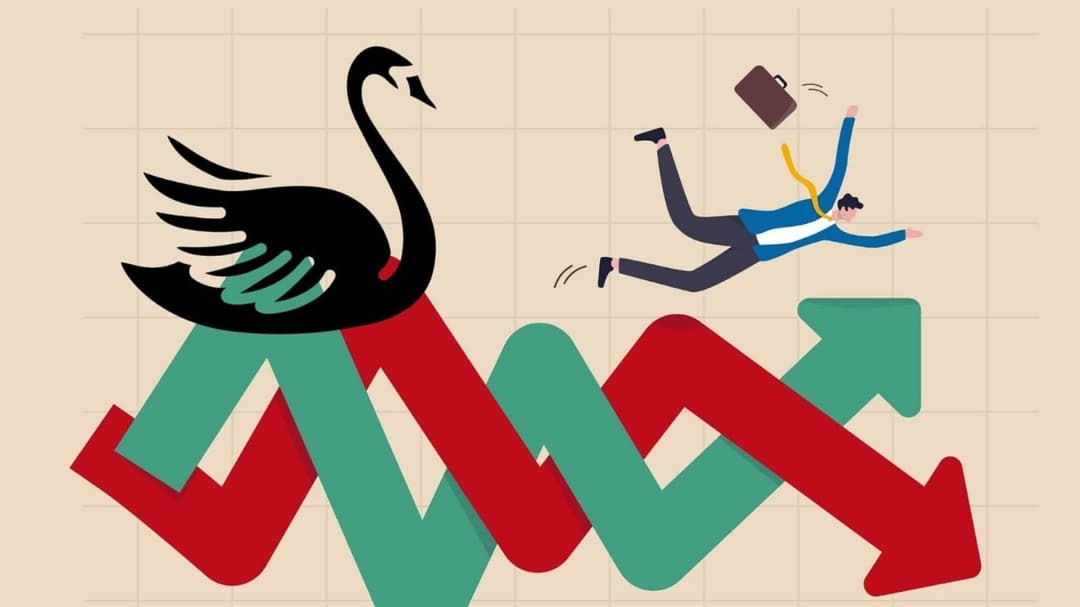
A Black-Swan Event in the stock market is an unexpected, rare phenomenon that unleashes exceptional volatility and often triggers a sharp market downturn. These events sit far outside normal forecasting range, making them nearly impossible to predict in advance. What defines them is a brutal combination of scarcity, devastating consequences, and that frustrating human habit of looking back afterward and thinking the whole thing was obvious.
- A black-swan event is an unpredictable occurrence with severe consequences that lies outside normal expectations, popularised by Nassim Nicholas Taleb in his 2007 book.
- Historical examples include the 1987 crash, the 1997 Asian financial crisis, the 2008 collapse and the 2020 COVID-driven market dislocation across multiple weeks.
- Black-swan events typically cluster with other tail risks because fragile systems break in multiple places once stress passes a critical threshold during crises.
- Common features include sudden liquidity evaporation, correlation breakdowns and the failure of historical risk models that assumed normal probability distributions.
- Antifragile portfolio construction, championed by Taleb, includes deliberate tail-risk hedges that benefit from extreme moves rather than simply absorbing them.
- A disciplined investor accepts that black swans cannot be predicted but designs portfolios with enough liquidity and diversification to survive and exploit them.
- Who is this for?
- Long-term investors and risk-aware allocators who want to understand black-swan events, build portfolios that can survive them and recognise the warning signs that precede major market dislocations.
- What is happening?
- An editorial overview of black-swan events in the stock market, covering Taleb’s framework, historical examples and the portfolio design principles that help investors withstand extreme tail risks.
- When did this emerge?
- Always relevant for risk management, with particular focus during periods of complacency when investor confidence and low volatility tend to obscure underlying systemic fragility.
- Where is this happening?
- Universal across global equity, credit and currency markets, with the most studied black-swan events historically concentrated in US, European and Asian financial crises.
- Why does it matter?
- Black-swan events cause disproportionate damage to unprepared investors, and the discipline to construct portfolios that can survive them is what separates long-term wealth builders from forced sellers.
Understanding Black-Swan Events
Black-swan risk is a constant in modern market data. Federal Reserve Economic Data hosts the long-run volatility and drawdown series that frame what counts as a true tail event, and the Federal Reserve's financial-stability reports walk through the structural exposures regulators are watching today.
The institutional research desks formalise the framing. BlackRock and JP Morgan both publish recurring work on tail-risk hedging and scenario design, which makes the abstract idea of a black swan concrete enough to size against.
Few concepts have gripped the world of finance quite like Black-Swan events. They don’t happen often, but when they do, the fallout is deep and the ripple effects can reshape entire markets. If you’re serious about protecting your wealth, understanding these events isn’t optional.
The Origin of the Term
The phrase “Black-Swan Event” traces back to an old Latin expression used to describe something impossibly rare, rooted in the long-held belief that black swans simply didn’t exist. That assumption collapsed when explorers found them in Australia. Nassim Nicholas Taleb borrowed this idea and applied it to finance, using it to describe events that seem unthinkable right up until the moment they happen and then proceed to change everything.
Black-Swan events, as Nassim Nicholas Taleb defined them, share three distinct characteristics worth knowing cold.
- Rarity: They are highly improbable within the bounds of ordinary expectations.
- Severe Impact: Their occurrence leads to substantial upheaval, as seen in the 2008 Financial Crisis and the COVID-19 pandemic.
- Retrospective Predictability: Although unpredictable initially, people tend to rationalize them in hindsight.
Positive vs. Negative Black-Swan Events
Not every Black-Swan event is a catastrophe. Take the Dotcom Bubble burst in 2001. Yes, it wiped out enormous wealth, but it also cleared the path for the tech and communication revolution that followed.
The difference between a positive and negative Black-Swan comes down to long-term effects and how fundamentally it rewires systems and beliefs.
That’s exactly why having a solid risk management strategy matters so much. You want to blunt the damage while staying positioned to catch any upside that emerges from the chaos.
Why Black-Swan Events Are Hard to Predict
For deeper context, the breakdown in how to manage risk in the stock market when tail events hit is worth reading alongside this analysis.
Black-Swan events are extreme outliers with an outsized punch, which is precisely what makes them so difficult to see coming. Events like the 2008 financial crisis and the COVID-19 pandemic exposed just how fragile our forecasting models really are when reality decides to go off-script.
Limitations of Standard Forecasting Tools
Traditional forecasting tools, especially those built on statistical models like the normal distribution, were never designed to handle Black-Swan events. These models assume the future will look a lot like the past, leaning heavily on historical data. But Black-Swan events are by nature unprecedented.
They fall completely outside the range of what those models can even imagine.
The 2008 financial crisis is the clearest example of this failure. Before the collapse, standard risk models including Value at Risk and other normal-distribution metrics were flagging low probabilities of any extreme market downturn. These tools assumed markets would keep behaving the way they always had.
They had no framework for the cascading failures building inside the housing market and the broader financial system. That’s the fundamental flaw in using historical data to predict the truly unprecedented.
The COVID-19 pandemic drove the same lesson home. Most economic models simply could not account for a full global economic shutdown and the devastating pressure it would place on supply chains, employment, and financial markets. Relying solely on historical data and existing models left the world badly exposed.
The Complexity and Incompleteness of Models
Even more sophisticated models, like those grounded in Pareto efficiency or advanced economic theory, hit a wall when Black-Swan events arrive. They can handle a wide range of scenarios, but they’re built on assumptions that simply don’t hold when the truly extreme and unforeseen shows up.
Think about asset allocation models before 2008. Spreading investments across multiple asset classes was supposed to manage risk effectively. But the global interconnectedness of markets meant the crisis hit nearly every asset class at once, making those carefully built models almost irrelevant overnight.
Even the most sophisticated tools have blind spots when events fall outside all expected parameters.
Hindsight Bias and the Illusion of Predictability
After a Black-Swan event hits, people almost always fall into the trap of thinking it was predictable all along. That’s hindsight bias at work. You start to believe the warning signs were obvious, even when they weren’t visible at the time.
This creates a false sense that such events can be anticipated, which undermines any honest understanding of just how random and unpredictable they truly are.
After 9/11, analysts pointed to signals that looked, in retrospect, like clear warnings. But before the event, those signals were buried in noise, lacking the context that would have made them legible. The same thing happened with the internet boom of the 1990s.
Today it seems obvious that it would disrupt nearly every industry it touched. At the time, almost nobody foresaw the pace or the scale of that transformation.

Factors Leading to a Black Swan Event
Black-Swan events are rare and deeply unpredictable, yet their consequences ripple through global systems for years. Nassim Nicholas Taleb, who brought the concept into mainstream thinking, points to several cognitive biases and systemic failures that consistently leave us blind to what’s coming.
1. Confirmation Bias
Confirmation bias is one of the biggest reasons Black-Swan events catch people off guard. Your brain naturally gravitates toward information that confirms what you already believe, and it quietly filters out anything that challenges that view. In the lead-up to the 2008 financial crisis, many experts focused exclusively on data supporting the idea that housing prices would rise indefinitely.
The warning signs of systemic risk were right there, but they didn’t fit the prevailing story, so they were ignored. That selective attention is exactly how confirmation bias sets you up for a blindside.
2. Narrative Fallacy
Humans are hardwired to tell stories. When faced with complex, chaotic events, you naturally reach for a simple, coherent narrative to make sense of it all. The problem is that simplification distorts reality.
After the dot-com bubble burst in 2000, the dominant narratives blamed individual corporate failures rather than the broader systemic forces, like speculative investment behavior at scale, that actually drove the collapse. Those tidy stories felt satisfying but they prevented a genuine understanding of what went wrong.
3. Neglect of Black Swan Possibilities
Most people and institutions operate as though Black-Swan events are so rare they’re not worth planning for. That mindset is expensive. Before the COVID-19 pandemic, pandemic preparedness plans existed in many countries, but they were underfunded, incomplete, and largely shelved because a global pandemic felt too remote to take seriously.
That collective neglect meant the world was caught almost entirely flat-footed when it finally arrived.
4. Hidden Evidence and Misinterpretation
When you analyze past crises, you tend to focus on the obvious, visible causes while missing the deeper, less visible forces at work. Before the 2008 collapse, analysts zeroed in on rising interest rates as a risk factor. What they missed were the systemic flaws in financial regulation and the hidden leverage quietly building inside the banking system.
Focusing on incomplete evidence doesn’t just give you the wrong answer. It gives you dangerous confidence in the wrong answer.

Preparing for Black-Swan Events
You can’t predict a Black-Swan event. But you can absolutely prepare for one. Building a resilient portfolio that can absorb serious market disruptions takes a mix of smart diversification, disciplined risk management, and the right financial instruments working together.
The goal isn’t just survival. It’s staying positioned to recover fast and, in some cases, come out ahead.
Diversification as a Strategy
Diversification is the foundation of any serious Black-Swan defense. When you spread your investments across different asset classes, industries, and geographies, you reduce your exposure to any single point of failure. If one market segment takes a hit, the rest of your portfolio isn’t dragged down with it.
You can explore how dividend stocks across sectors can add another layer of resilience to a well-diversified strategy.
During the 2008 financial crisis, portfolios concentrated in U.S. financial stocks were devastated. Those with exposure to international equities, bonds, and commodities fared considerably better. Ray Dalio of Bridgewater Associates built his entire “all-weather” portfolio philosophy around this idea, blending equities, bonds, and inflation-hedged securities in a way that holds up across wildly different economic conditions.
Risk Management Techniques
Diversification alone won’t save you. You also need active risk management tools in place. Stop-loss orders can help contain losses under normal conditions, but during extreme volatility, like the period when the S&P 500 dropped 38.49% during the 2008 crisis, they lose effectiveness fast because of market slippage.
That’s the gap between the price you expected and the price you actually got.
Options and derivatives offer a more robust layer of protection. Put options give you the right to sell a security at a set price, acting as insurance against sharp declines. During the March 2020 market crash triggered by COVID-19, investors holding put options on major indices were able to offset significant losses while others watched portfolios collapse. Choosing the right hedge fund with a mandate to use these instruments can be another smart move for investors who want this kind of coverage without managing it themselves.
Volatility Derivatives
Volatility derivatives like VIX options and futures are built specifically for moments of market panic. The VIX, widely known as the “fear index,” tracks the market’s expected volatility over the next 30 days. When markets are calm it sits low, but during a crisis it spikes hard.
During the COVID-19 pandemic, the VIX hit levels not seen since 2008, creating exactly the kind of environment where volatility derivatives pay off.
Investing in VIX derivatives is a core part of building what Taleb calls an antifragile portfolio, one that doesn’t just survive stress but actually benefits from it. During the March 2020 crash, while traditional equity investors took heavy losses, those holding VIX options or futures locked in substantial gains that offset the damage elsewhere. It’s one of the most powerful ways to turn market panic into an opportunity rather than a threat.
We last reviewed this analysis in May 2026.


Alex Tzoulis
Alex Tzoulis is Co-Owner and Markets Analyst at The Luxury Playbook, specializing in equities, crypto, forex, and global financial markets. His work focuses on analyzing macroeconomic trends, geopolitical developments, and monetary policy, translating them into actionable insights across both traditional and digital asset classes. He leads the platform's financial market coverage, providing structured analysis across stock market investing, trading strategies, and cryptocurrency markets. His expertise strengthens the publication's authority in financial markets and capital allocation, bridging traditional finance with emerging digital investment ecosystems.